
Celecoxib, a common anti-inflammatory pain drug, reduced depression-like behavior and lowered brain inflammation in rats kept under weeks of daily restraint stress, according to a 2026 animal study.1
Research Highlights
- Better behavior under stress: compared with stressed, untreated rats, celecoxib-treated rats moved more in an open arena (p = 0.007), explored a new maze arm more (p < 0.001) and swam longer in a forced swim test (p < 0.001).1
- Lower brain inflammation: celecoxib lowered 3 inflammatory signals in the hippocampus — TNF-α, IL-1β and IL-6 (all p < 0.001).1
- Lower stress hormone: hippocampal corticosterone was also lower in treated rats (p < 0.001), and stained brain tissue showed less neuron damage.1
- Similar to fluoxetine: the SSRI fluoxetine (Prozac), tested as a comparison, improved the same measures; the 2 drugs were not compared head to head.1
- Small rat study: 40 male rats, 1 celecoxib dose, given during the stress rather than after it. Human add-on trials of celecoxib for depression have been much less convincing.2,3
How Restraint Stress Creates Depression-Like Behavior in Rats
Celecoxib (Celebrex) is a nonsteroidal anti-inflammatory drug that selectively blocks COX-2, an enzyme that makes prostaglandins — chemical messengers that drive inflammation, pain and fever. Doctors mainly prescribe it for arthritis pain.1
Interest in celecoxib for depression comes from the inflammatory hypothesis of depression: the idea that immune signals called cytokines, such as TNF-α, IL-1β and IL-6, can change mood and brain function. Many people with depression have higher levels of these cytokines.1
Chronic restraint stress is a standard way to produce depression-like behavior in rodents. Each day, a rat is placed in a narrow ventilated tube that limits its movement for several hours.
Over weeks, restrained rats tend to explore less, give up sooner in stressful tests and lose some interest in sugar water, a rodent stand-in for anhedonia (reduced pleasure).
How Ling et al. Tested Celecoxib in Stressed Rats
Yian Ling et al., at Anhui Medical University and Hefei Fourth People’s Hospital in China, randomly assigned 40 male Sprague-Dawley rats to 4 groups of 10:1
- Control: no stress, no drug
- Stress only: 4 hours a day in a restraint tube (7 cm wide, 16 cm long) across 6 weeks
- Stress + celecoxib: 20 mg/kg a day by mouth for the last 2 weeks of stress
- Stress + fluoxetine: 10 mg/kg a day by mouth for the same 2 weeks, as a known antidepressant comparison
Restraint continued every day while the drugs were given. The researchers stated plainly that this design tests a drug given during ongoing stress, not reversal of an established depression-like state.1
Behavior was measured with 4 tests:
- Open field test: how far a rat moves in a large open box, and how much it ventures into the exposed center.
- Forced swim test: how long a rat keeps actively swimming in a water tank before floating still, often read as a measure of giving up.
- Y-maze: how much a rat explores a newly opened arm, a measure of exploration and spatial memory rather than depression itself.
- Sucrose preference test: how much sugar water a rat drinks when plain water is also available.
After testing, the researchers measured cytokines and corticosterone in the hippocampus, a brain region involved in memory and mood that is especially sensitive to stress. They also examined brain and adrenal tissue under the microscope.1
Celecoxib Improved Movement, Exploration and Swimming in Stressed Rats
Restraint stress clearly changed behavior. Compared with unstressed controls, stressed rats traveled less in the open field and barely moved through its center (both p < 0.001), explored the new maze arm less (p = 0.005) and swam for less time (p < 0.001).1
Celecoxib-treated rats did better than stressed, untreated rats on every behavior measure with a reported test:1
- Open field center distance: p = 0.033
- Total distance moved: p = 0.007
- Exploring the new maze arm: p < 0.001
- Swimming time: p < 0.001
Sugar-water preference dropped in stressed rats and recovered with celecoxib, but the paper gave no test statistic for that result.1
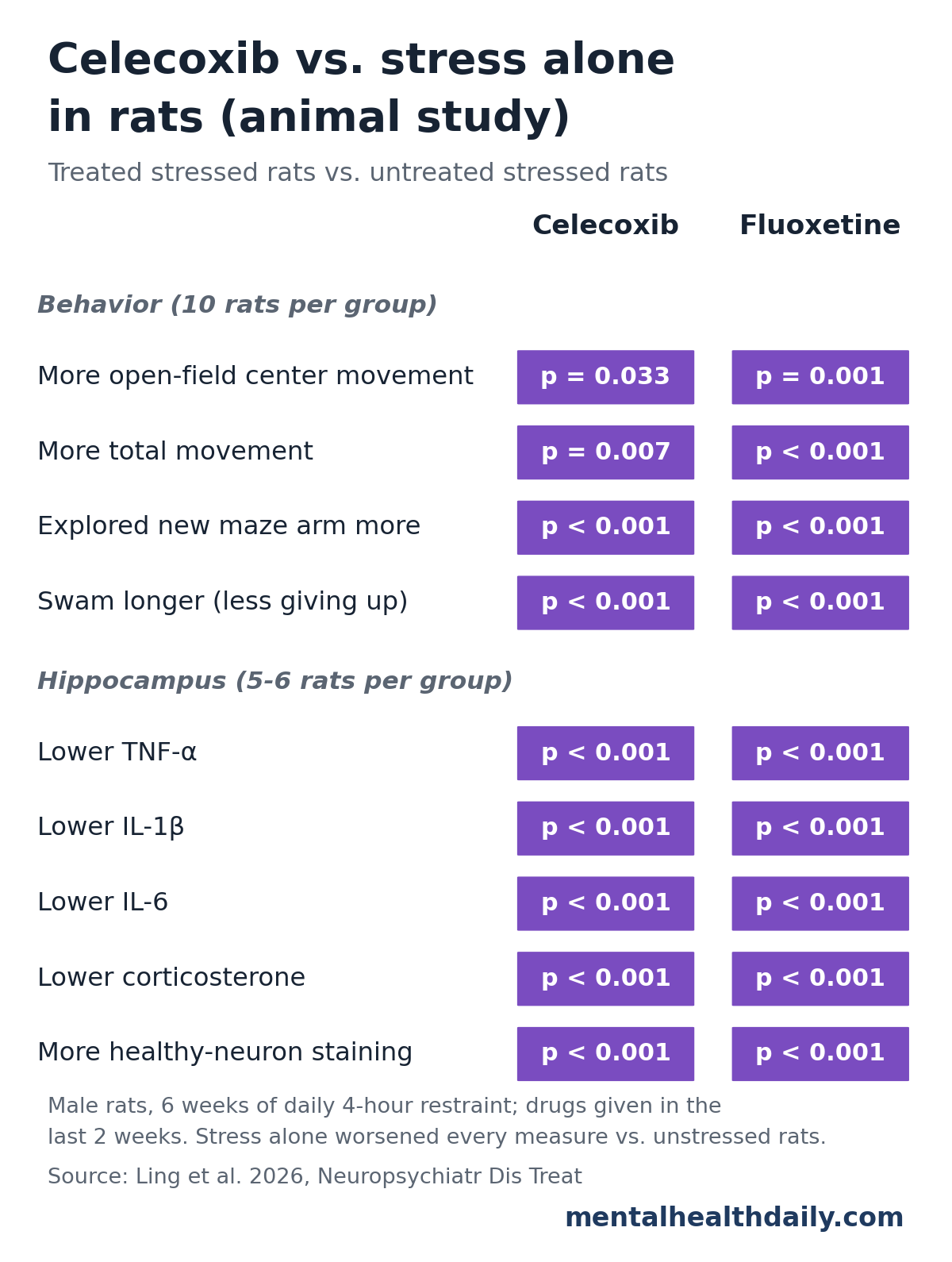
Partial recovery in the open field: in the published bar chart, celecoxib-treated rats still moved less through the center than unstressed rats, and fluoxetine had the smaller p-values on both open-field measures. The study did not test the 2 drugs against each other.1
Celecoxib Lowered Hippocampal Inflammation and Corticosterone
In hippocampal tissue from 6 rats per group, restraint stress raised all 3 measured cytokines, and celecoxib brought each one down compared with stress alone (all p < 0.001):1
- TNF-α (tumor necrosis factor-alpha), a major driver of inflammation
- IL-1β (interleukin-1 beta), which triggers fever and sickness behavior
- IL-6 (interleukin-6), one of the cytokines most often elevated in people with depression
Corticosterone, the main rodent stress hormone (similar to human cortisol), was also lower in the hippocampus of celecoxib-treated rats (p < 0.001). Adrenal glands from treated rats looked less damaged under the microscope.1
Microglia: staining for IBA-1, a marker of microglia (the brain’s immune cells), was lower with celecoxib. The researchers noted that IBA-1 alone cannot show whether microglia were more numerous or more active.1
Neuron damage: stressed rats had shrunken, sparse neurons in the dentate gyrus of the hippocampus and fewer Nissl bodies, a stain that marks healthy protein-making machinery in neurons.
Celecoxib increased the Nissl body count (p < 0.001 in 5 rats per group), and electron microscopy in 3 rats per group showed less damage to neurons and mitochondria.1
Fluoxetine produced similar changes on every one of these tissue measures.1
Human Trials of Celecoxib for Depression Are Less Clear
Celecoxib has already been tested in people, mostly as an add-on to standard antidepressants. A 2026 meta-analysis of 7 randomized placebo-controlled trials with 365 patients found a moderate average benefit, but rated the certainty of that evidence as very low because the trials were small and several had a high risk of bias.2
The same meta-analysis concluded that celecoxib add-on treatment is not recommended for major depression because its benefit is so uncertain. MHD covered it in Celecoxib for Depression: 7 Trials, Add-On Benefit Unclear.2
A 2021 trial involving 119 mostly treatment-resistant patients, found no benefit of adding celecoxib to vortioxetine, even in patients with higher baseline inflammation.3
Other animal work has been encouraging. In a 2024 mouse study, Dinur et al. found that low doses of celecoxib combined with cannabidiol (CBD) produced antidepressant- and anxiety-reducing effects in several stress and inflammation models, at doses that did little on their own.4
One possible reason for the gap: stressed rodents share a strong, uniform inflammatory response, while only some people with depression have raised inflammatory markers. Ling et al. described anti-inflammatory treatment as most promising for patients with that inflammatory profile.1
Limitations of This Celecoxib Rat Study
This is an early-stage animal experiment. It shows that celecoxib changed stress-related behavior and brain markers in male rats; it cannot show that celecoxib treats depression in people.
- Male rats only: no females were studied.
- Small groups: 10 rats per group for behavior, 5-6 for tissue measures, and 3 for electron microscopy.
- Prevention, not reversal: celecoxib was given during ongoing stress, so the study tests protection while stress continues rather than recovery afterward.
- One dose, 2 weeks: no dose-response data and no long-term treatment.
- Mechanism not tested: COX-2 activity and prostaglandins were not measured, and the researchers stated that the results do not establish an anti-inflammatory or stress-hormone mechanism.
- Hippocampus only: no blood markers and no other brain regions such as the prefrontal cortex.
- Mostly descriptive tissue images: the H&E staining, IBA-1 staining and electron microscopy were presented as representative pictures, without a standardized damage score.
- Thin statistical reporting: results are given mainly as p-values, without group means in the text, and the sugar-water result has no reported test. Behavior scoring was not described as blinded.
Safety in people: long-term celecoxib carries known cardiovascular and other risks, which the researchers noted must be weighed against any possible mood benefit. Celecoxib is not an approved depression treatment.1
References
- Ling Y, Li J, Liu W, Gao Y, Nie L, Zhu C, Xia Q. Celecoxib ameliorates chronic restraint stress-induced depression-like behavior in Sprague-Dawley rats. Neuropsychiatric Disease and Treatment. 2026;22:616612. doi:10.2147/NDT.S616612
- Srisurapanont M, et al. Celecoxib adjunct to antidepressants for major depressive disorder: systematic review and meta-analysis. Brain, Behavior, & Immunity – Health. 2026;55:101277. doi:10.1016/j.bbih.2026.101277
- Baune BT, et al. No evidence for clinical efficacy of adjunctive celecoxib with vortioxetine in the treatment of depression: a 6-week double-blind placebo controlled randomized trial. European Neuropsychopharmacology. 2021;53:34–46. doi:10.1016/j.euroneuro.2021.07.092
- Dinur E, Goldenberg H, Robinson E, Naggan L, Kozela E, Yirmiya R. A novel anti-inflammatory formulation comprising celecoxib and cannabidiol exerts antidepressant and anxiolytic effects. Cannabis and Cannabinoid Research. 2024;9(2):561–580. doi:10.1089/can.2022.0225