
Among people with bipolar disorder in Finland, recent prescriptions for 6 medicine groups — including tricyclic antidepressants, opioids, sedatives and antipsychotics — were linked to higher odds of dying from a poisoning. Lithium and other mood stabilizers were not.1
Research Highlights
- National registry data: 777 people with bipolar disorder who died of poisoning between 1996 and 2018 were compared with 3,108 living people with bipolar disorder matched by age and sex.1
- 6 medicine groups linked to higher odds: after adjustment, recent use of tricyclic antidepressants, gabapentinoids, opioids, Z-drugs, benzodiazepines or antipsychotics was linked to about 2 to 3 times the odds of fatal poisoning.1
- Mood stabilizers were not: lithium, valproate, lamotrigine and carbamazepine showed no significant link in the main analysis.1
- More than half were suicides: 56.5% were recorded as suicidal and 38.4% as accidental.1
- Severity likely plays a part: people who died had far more substance use disorders and past suicide attempts, and the researchers say the links may partly reflect more severe illness.1
If you are struggling or thinking about suicide, help is available right now. In the US, call or text 988 to reach the 988 Suicide & Crisis Lifeline. Elsewhere, contact your local emergency number or crisis service.
How the Finnish Study Compared People Who Died of Poisoning With Matched Controls
Bipolar disorder is a mood disorder with episodes of mania or hypomania and depression. People with the condition live about 13 years less than average, and suicide and accidental poisonings account for a share of that gap.1
Janina Salmelainen et al. at the University of Eastern Finland drew on several linked national registers. The base group was 60,045 people diagnosed with bipolar disorder at ages 15 to 65.1
- Cases: 777 people (1.3% of the cohort) whose main cause of death was poisoning by medicines or illicit substances. In Finland, the cause of nearly all such deaths is set by a forensic autopsy.
- Controls: 4 living people with bipolar disorder for each case, matched by sex and age; 55.3% of both groups were male.
- Exposure: whether pharmacy dispensing records showed a medicine in use during the 2 weeks before death (or the same date for controls).
- Adjustment: work status, inpatient diagnosis, other medicines, and conditions such as substance use disorders, past suicide attempts, anxiety, personality disorders, epilepsy and ADHD.
This design is a nested case–control study: everyone came from the same cohort, so cases and controls shared the same diagnosis and registers. Results are given as adjusted odds ratios (aOR), where 1.0 means no difference and 2.0 means about twice the odds of fatal poisoning among people with recent use.
The people who died were in a harder place overall. Compared with controls, they more often had a substance use disorder (67.1% vs. 27.1%) or a past suicide attempt (44.3% vs. 12.8%), and far fewer were employed (9.8% vs. 32.5%).1
6 Medicine Groups Linked to Higher Odds of Fatal Poisoning in Bipolar Disorder
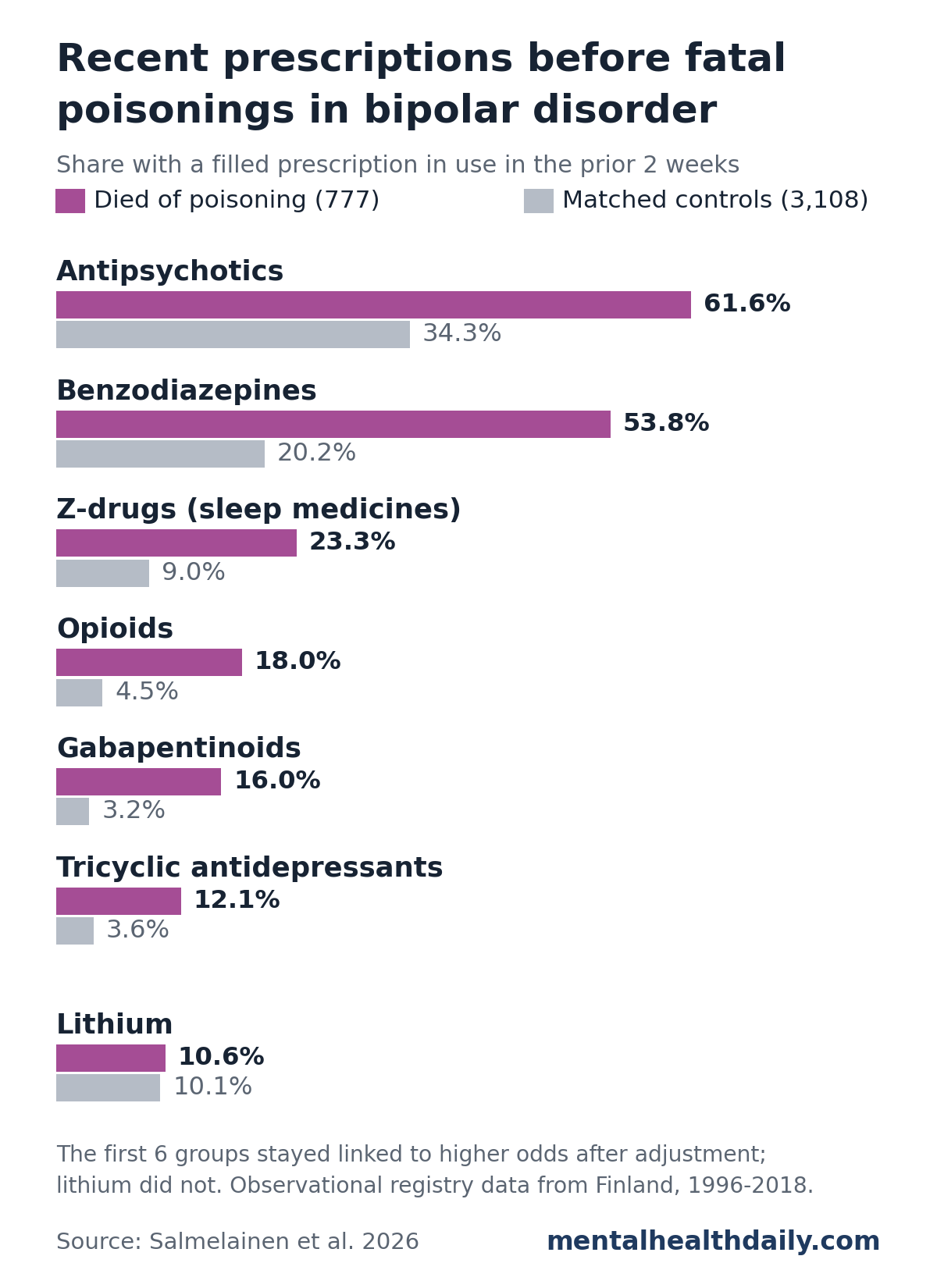
Every one of the 6 groups was more common among people who died. After full adjustment, these links remained:1
- Tricyclic antidepressants (an older class of antidepressants): aOR 3.07 (95% CI 2.09–4.50)
- Gabapentinoids (a class used for nerve pain, seizures and anxiety): aOR 3.05 (2.08–4.47)
- Opioids (prescription painkillers): aOR 2.65 (1.88–3.75)
- Z-drugs (non-benzodiazepine sleep medicines): aOR 2.19 (1.66–2.88)
- Benzodiazepines (sedatives used for anxiety and sleep): aOR 2.13 (1.71–2.64)
- Antipsychotics (a mainstay of bipolar treatment): aOR 1.94 (1.56–2.40), with similar results for first- and second-generation drugs
Antidepressants differed by type. Tricyclics had the strongest link of any group, while SSRIs (selective serotonin reuptake inhibitors, the most common modern antidepressants) were not significantly linked (aOR 1.19, 0.94–1.51). Tricyclics have higher toxicity in overdose than SSRIs.1
Other common medicines dropped out after adjustment. Paracetamol (acetaminophen), NSAID pain relievers and beta blockers were more common among those who died, but not once health conditions and other medicines were accounted for. ADHD medicines showed no link.1
Lithium and Other Mood Stabilizers Were Not Linked to Higher Odds
Lithium use was nearly identical in both groups (10.6% of those who died vs. 10.1% of controls; aOR 1.07, 0.77–1.48). Valproate, lamotrigine and carbamazepine also showed no significant link in the main analysis.1
Two exceptions turned up when deaths were split by intent:1
- Carbamazepine was linked to higher odds of suicidal poisoning (aOR 2.20, 1.13–4.30).
- Mood stabilizers overall (aOR 0.67) and valproate (aOR 0.56) were linked to lower odds of accidental poisoning.
Lithium is often described as protective against suicide in bipolar disorder. A Swedish register study of 51,535 patients found suicide-related events were 14% lower during lithium treatment than during untreated periods, with no change during valproate treatment.3
The Finnish researchers say lithium prescribing “should be encouraged and facilitated,” especially for people with suicidal thoughts or other risk factors.1
Stopping treatment may carry its own risk. In a timing analysis, past use of most of these medicines without current use was also linked to fatal poisoning, most strongly for valproate. The researchers suggest people who stop mood stabilizer treatment may face higher risk, though residual confounding could also explain it.1
Prescribing Safety Steps for People With Bipolar Disorder
The researchers concluded that the benefits of these medicines should be weighed carefully against overdose risk, especially for people with suicidal thoughts, medicine misuse or a substance use disorder.1 Prevention strategies they name include:
- Choosing medicines with safety in mind: weighing how toxic a medicine is in overdose when choosing between treatment options.
- Smaller supplies: limiting the quantity dispensed at one time and the length of treatment.
- Watching combinations: the researchers note that opioids, sedatives and gabapentinoids carry more risk together than alone. In this study, combined use of all 3 was linked to the highest odds (aOR 4.82), though the difference from other combinations was not statistically significant.
- Asking about alcohol and other substances: screening for other substances that slow the nervous system.
- Patient awareness: helping patients recognize the symptoms of poisoning.
For patients and families: do not stop or change any medicine because of this study. Sudden changes can trigger relapse, and the study could not show that any medicine caused these deaths. Bring concerns about safe storage, supply size or medicine combinations to the prescriber.
Earlier work on the same Finnish cohort found that 13.1% of people with bipolar disorder had at least one poisoning that led to a hospital stay or death. Poisoning deaths there were most strongly linked to substance use disorder and a history of suicide attempt.2
These are the same groups the Finnish researchers flag for extra care with prescribing.
Limitations of This Finnish Registry Study
This is observational data, so it shows which medicines were more common before poisoning deaths, not that the medicines caused them.1
- Confounding by severity: people with more severe or harder-to-treat illness may be more likely to receive some of these medicines in the first place. The registers had no data on symptom severity, prescribing reason or bipolar subtype.
- Filled, not taken: pharmacy records show what was dispensed, not what someone was taking or had saved from older prescriptions.
- Missing substances: alcohol, over-the-counter medicines and illicit drugs were not captured, and two-thirds of those who died had a substance use disorder.
- No toxicology link: the data do not show which medicine, if any, was involved in each death.
- One country, older data: Finland from 1996 to 2018; prescribing today and in other countries can look different.
Even so, nationwide registers with almost complete autopsy coverage give an unusually full picture of medicine use before these deaths.
References
- Salmelainen J, Tiihonen M, Taipale H, Lieslehto J, Tanskanen A, Tiihonen J, Hamina A. Medicine use preceding fatal poisonings among individuals with bipolar disorder. Basic & Clinical Pharmacology & Toxicology. 2026;139:e70305. doi:10.1111/bcpt.70305
- Niskanen M, Kärkkäinen O, Taipale H, Lieslehto J, Tiihonen J, Hamina A. Bipolar disorder and poisoning due to medicines or illegal substances. Acta Psychiatrica Scandinavica. 2025;152(4):299–307. doi:10.1111/acps.70017
- Song J, Sjölander A, Joas E, et al. Suicidal behavior during lithium and valproate treatment: a within-individual 8-year prospective study of 50,000 patients with bipolar disorder. American Journal of Psychiatry. 2017;174(8):795–802. doi:10.1176/appi.ajp.2017.16050542