
A 2026 case report describes one man in his 30s with autism, childhood temporal lobe epilepsy and treatment-resistant schizophrenia whose delusions are built around fictional media characters. Clozapine has eased his psychosis but has not restored his insight.1
Research Highlights
- Delusions drawn from autistic interests: he attributes his own experiences and his illness to specific fictional characters and describes spiritual battles shaped by the media he follows.1
- In hospital since 2007: his psychosis began in adolescence, and he has needed continuous inpatient psychiatric care since 2007.1
- Partial response to clozapine: on 350 mg a day, plus valproate and aripiprazole, agitation eased and engagement improved, but the delusions continued and insight stayed severely impaired.1
- Most adult seizures looked nonepileptic: a 2009 EEG showed no epileptic activity, a 2011 MRI found normal temporal lobes, and doctors judged most later episodes to be nonepileptic.1
- The overlap itself is well documented: about 12% of autistic people have epilepsy, and psychosis affects about 7% of people with temporal lobe epilepsy.23
How Often Autism, Epilepsy and Psychosis Occur Together
The 3 conditions in this case overlap more often than chance alone would predict. Large reviews have put numbers on each pairing:
- Epilepsy in autism: a 2019 systematic review of 74 studies covering 283,549 patients found a median epilepsy prevalence of 12.1% in autistic people. About 9% of people with epilepsy were autistic.2
- Psychosis in epilepsy: a 2014 meta-analysis of 58 studies estimated that 5.6% of people with epilepsy have a psychotic illness. Their odds of psychosis were 7.8 times those of people without epilepsy. The figure was 7% in temporal lobe epilepsy, where seizures start in the part of the brain that handles memory, emotion and language.3
- Psychosis in autism: a 2019 review of 14 studies with 1,708 autistic participants estimated that 9.5% also had a non-affective psychosis such as schizophrenia. Rates were higher among inpatients (20.6%) than outpatients (9.1%).4
All 3 in one person is still unusual. Turkson et al. describe it as a rare and difficult combination to manage, partly because it is hard to tell which condition is driving a given symptom.1
One Man’s Course From Childhood Epilepsy to Long-Term Hospital Care
The patient was diagnosed with temporal lobe epilepsy as a child. In adolescence he showed signs of autism, and psychiatric symptoms appeared: paranoid delusions, voices and visions centered on his media fixations, and seizure-like episodes set off by stress.1
His psychosis became treatment-resistant schizophrenia (TRS), meaning symptoms persisted after adequate trials of several antipsychotics. He has lived on inpatient psychiatric wards since 2007.1
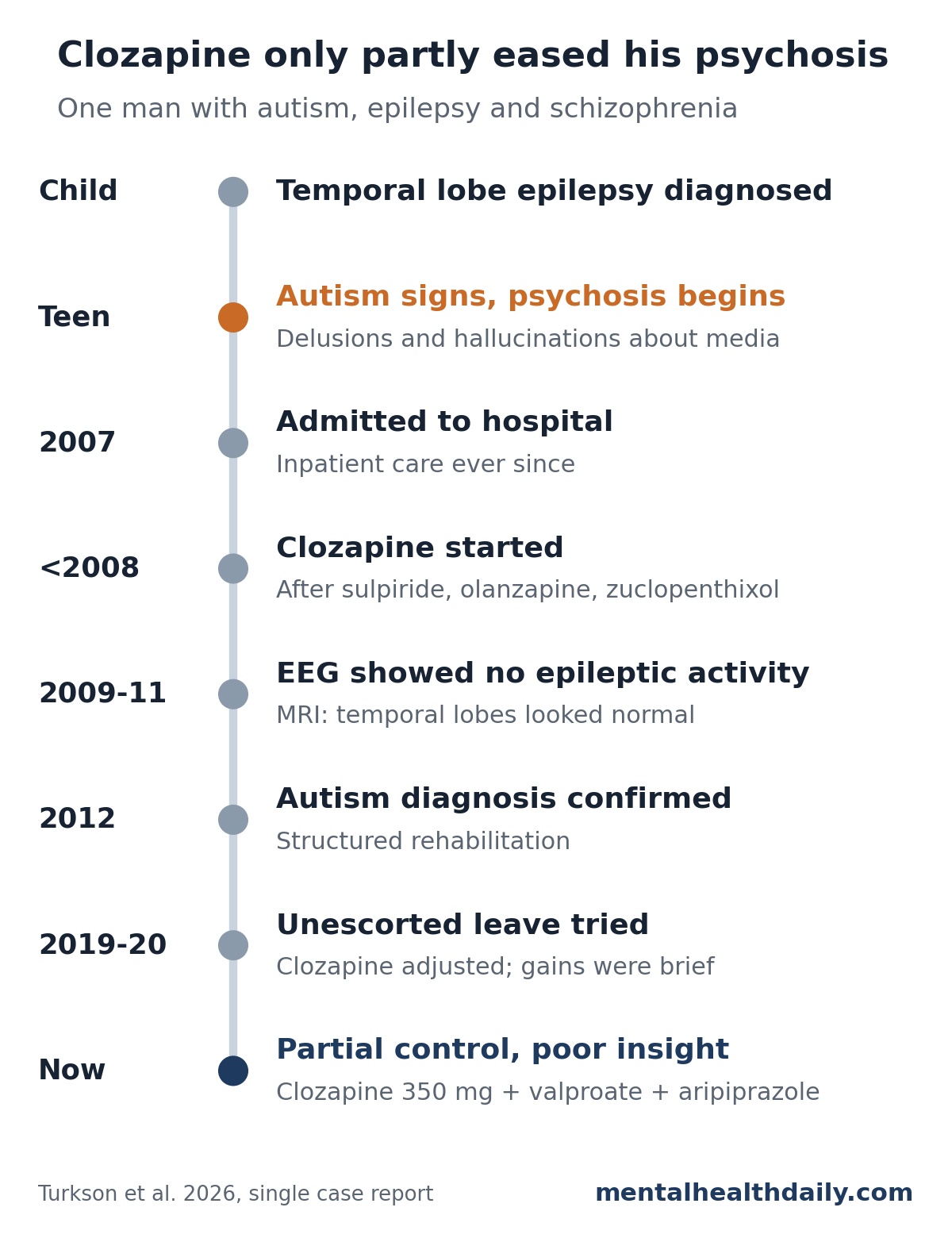
- 2007: first hospital admission on an initial antipsychotic regimen. Psychotic symptoms persisted.
- 2012: autism diagnosis confirmed, followed by structured rehabilitation.
- 2015–2017: ongoing psychosis with aggression that came and went. Medication changes brought stretches of stability.
- 2019–2020: staff tried unescorted leave and adjusted his clozapine dose. His engagement improved for a while.
- Now: reality testing is still severely impaired, and care is managed by a multidisciplinary team.
Psychological testing showed weak verbal comprehension and working memory, with perceptual (visual) reasoning relatively spared. He has occasionally injured himself during psychotic episodes.1
Delusions Built Around Fictional Media Characters
The most distinctive feature of the case is how his autistic interests and his psychosis merged. He blames specific fictional media characters for his illness, links his personal experiences to them, and describes taking part in spiritual battles shaped by the media he follows.1
Turkson et al. read this as cognitive rigidity (difficulty shifting from one way of thinking to another) and intense special interests being absorbed into persecutory and self-referential delusions.1
Insight remains poor: he can name his diagnoses and say what they mean, but he does not show a clear grasp of how or why they affect him. His fixed beliefs have held despite years of medication and rehabilitation.1
Diagnostic overshadowing is a related risk. It happens when clinicians attribute a new symptom to an existing diagnosis, for example reading psychotic beliefs as autistic special interests, or the reverse. The researchers warn that this can delay accurate diagnosis and treatment.1
Were His Seizures Epileptic?
The report lists childhood-onset temporal lobe epilepsy, but the adult workup mostly pointed elsewhere. The diagnostic code it gives is for dissociative neurological symptom disorder with nonepileptic seizures (NES), which are episodes that look like seizures but are not caused by abnormal electrical bursts in the brain. They are often linked to psychological stress.1
- EEG (September 2009): mild, nonspecific slowing and no epileptic activity. Head and arm jerks during the recording had no matching EEG change. No video EEG was documented.
- MRI (2011): mildly enlarged ventricles (the brain’s fluid-filled spaces), with no abnormality in either temporal lobe.
- Episodes (2011): awareness was preserved, there was no confusion afterward, and there were clear psychological triggers, all consistent with NES.
- Later episode (2025): one event involved reduced responsiveness and an injury, but the overall pattern still pointed to NES in adulthood.
After a neurological review, his antiepileptic medicines were stopped because the EEG showed no epileptic activity and most events looked nonepileptic. Even so, his current medication list still includes sodium valproate (an anticonvulsant also used to steady mood) for mood stabilization and epilepsy, and the report’s abstract credits valproate with effectively managing his epilepsy.1
Clozapine and Add-On Medicines Gave Only Partial Control
Clozapine is the standard antipsychotic for treatment-resistant schizophrenia and needs regular blood monitoring. He began taking it before 2008, after trials of sulpiride, olanzapine and zuclopenthixol. Doctors later added amisulpride, aripiprazole and haloperidol at different times to boost its effect.1
His current daily regimen, given under supervision on the ward, includes:1
- Clozapine 350 mg once daily: the main antipsychotic.
- Sodium valproate 1,400 mg once daily (modified release): for mood stabilization and epilepsy.
- Aripiprazole 10 mg once daily: an add-on antipsychotic.
- Sertraline 100 mg once daily: for anxiety and depression.
- Clonazepam 1 mg 3 times daily: for anxiety and seizure prevention.
- Hyoscine hydrobromide 300 mcg twice daily: for excess drooling, a common clozapine side effect.
He also takes lactulose for constipation and vitamin D. The team reported that the regimen was generally well tolerated, with no side effects serious enough to stop a drug or make a major dose change.1
What “partial stabilization” meant: less severe agitation and better engagement with ward routines, without any end to the delusions or return of insight. The care team’s goals were better insight, less aggression and a move to a supported community setting. Only the second was partly met.1
Community moves have failed: each attempt to move him out of hospital ran into worsening symptoms and difficult behavior when his surroundings changed.1
He also receives occupational therapy, psychological therapy and structured rehabilitation. The researchers suggest that talking therapies adapted for autism, such as cognitive behavioral therapy built around a person’s specific interests with clearer, less ambiguous language, may be worth exploring. This case does not test that idea.1
Limits of This Single Case Report
One patient cannot show how common this presentation is or which treatments helped him. The report also has specific gaps:1
- Missing early records: some history was lost when NHS services moved from paper to electronic records in the mid-2000s, so early diagnostic criteria and medication trials are incomplete.
- No formal autism assessment on file: standard tools such as the ADOS or ADI-R were not documented. The diagnosis rests on developmental history and clinical features.
- No symptom rating scales: there were no PANSS or similar scores, so “partial control” is a clinical judgment.
- No drug levels reported: clozapine and valproate blood levels were monitored, but the exact values were not available.
- Uncertain epilepsy picture: EEG and MRI findings and the stopped antiepileptics sit uneasily with the epilepsy label and the continued valproate.
The patient lacked the capacity to consent, and no legal representative was available. The researchers removed identifying details and state that publication followed institutional and journal ethics rules.1
Why the Researchers Call for Autism-Informed Psychiatric Care
Turkson et al. call for integrated, autism-informed psychiatric care and multidisciplinary plans built around the individual patient. Their case shows how autistic interests can become woven into delusional thinking, producing a presentation that does not fit standard diagnostic boundaries.1
Families who notice new, fixed and unusual beliefs in an autistic relative can raise them with the care team, since either condition can mask the other. Any medication change should go through the prescribing clinician.
If you or someone you know is in crisis or thinking about self-harm, call or text 988 in the US (Suicide & Crisis Lifeline), call Samaritans on 116 123 in the UK, or contact local emergency services.
References
- Turkson M, Taiwo M, Polden M, Greening J. Autism spectrum disorder, temporal lobe epilepsy, and treatment-resistant schizophrenia with media-themed delusions and impaired insight: a case report. Case Reports in Psychiatry. 2026;2026:2386844. doi:10.1155/crps/2386844
- Lukmanji S, Manji SA, Kadhim S, Sauro KM, Wirrell EC, Kwon CS, Jetté N. The co-occurrence of epilepsy and autism: a systematic review. Epilepsy & Behavior. 2019;98:238–248. doi:10.1016/j.yebeh.2019.07.037
- Clancy MJ, Clarke MC, Connor DJ, Cannon M, Cotter DR. The prevalence of psychosis in epilepsy; a systematic review and meta-analysis. BMC Psychiatry. 2014;14:75. doi:10.1186/1471-244X-14-75
- De Giorgi R, De Crescenzo F, D’Alò GL, et al. Prevalence of non-affective psychoses in individuals with autism spectrum disorders: a systematic review. Journal of Clinical Medicine. 2019;8(9):1304. doi:10.3390/jcm8091304