
A 2026 case report from Japan describes 1 woman in her 50s with treatment-resistant schizophrenia whose doctors found multiple sclerosis (MS) on brain scans 31 years after her psychosis began.
After MS treatment she had no further relapses, but her delusions continued, and clozapine helped only partly.1
Research Highlights
- MS found late: white-matter lesions on MRI and immune markers in her spinal fluid led to an MS diagnosis about 31 years after her psychosis began.1
- Psychosis that resisted treatment: haloperidol, zotepine, injectable paliperidone and olanzapine all failed to control her delusions and hallucinations.1
- No MS relapses, but delusions stayed: after ofatumumab, she had no further MS relapses during follow-up, but her persecutory delusions persisted.1
- Clozapine gave partial help: her mood swings improved, while the delusions continued.1
- Linked, not proven: the researchers describe the MS–schizophrenia connection in this case as associative rather than causal.1
Why Multiple Sclerosis Can Look Like Schizophrenia
Multiple sclerosis is an autoimmune disease in which the immune system attacks myelin, the fatty insulation around nerve fibers in the brain and spinal cord. The damaged patches, called lesions, show up as bright spots on MRI, often in the brain’s white matter (the wiring that connects brain regions).1
MS is best known for physical symptoms such as weakness, numbness, vision problems and trouble walking. It can also cause depression, fatigue and memory and thinking problems.1
Psychosis is less common. Miura et al. cite estimates that 2% to 3% of people with MS develop psychotic symptoms such as persecutory delusions or hearing their name called.1 A 2015 systematic review of 118 studies put the figure at 4.3% in population-based studies, with a wide margin of uncertainty (0% to 10.3%).2
Similar age of onset: MS most often starts around age 30, and schizophrenia usually begins between the late teens and the 30s. When psychiatric symptoms come first and the neurological signs are faint, telling the 2 conditions apart can be hard.1
One Woman’s 31-Year Course From Psychosis to an MS Diagnosis
The patient had done well at school and entered a university in a city. Shortly after enrolling, she began to feel she was being watched and developed persecutory delusions (fixed false beliefs that others mean her harm). She left university.1
3 years later, a local clinic diagnosed atypical psychosis, but she stopped follow-up without medication. For about 13 years she went untreated, with symptoms that eased but left her socially withdrawn and unable to keep a job.1
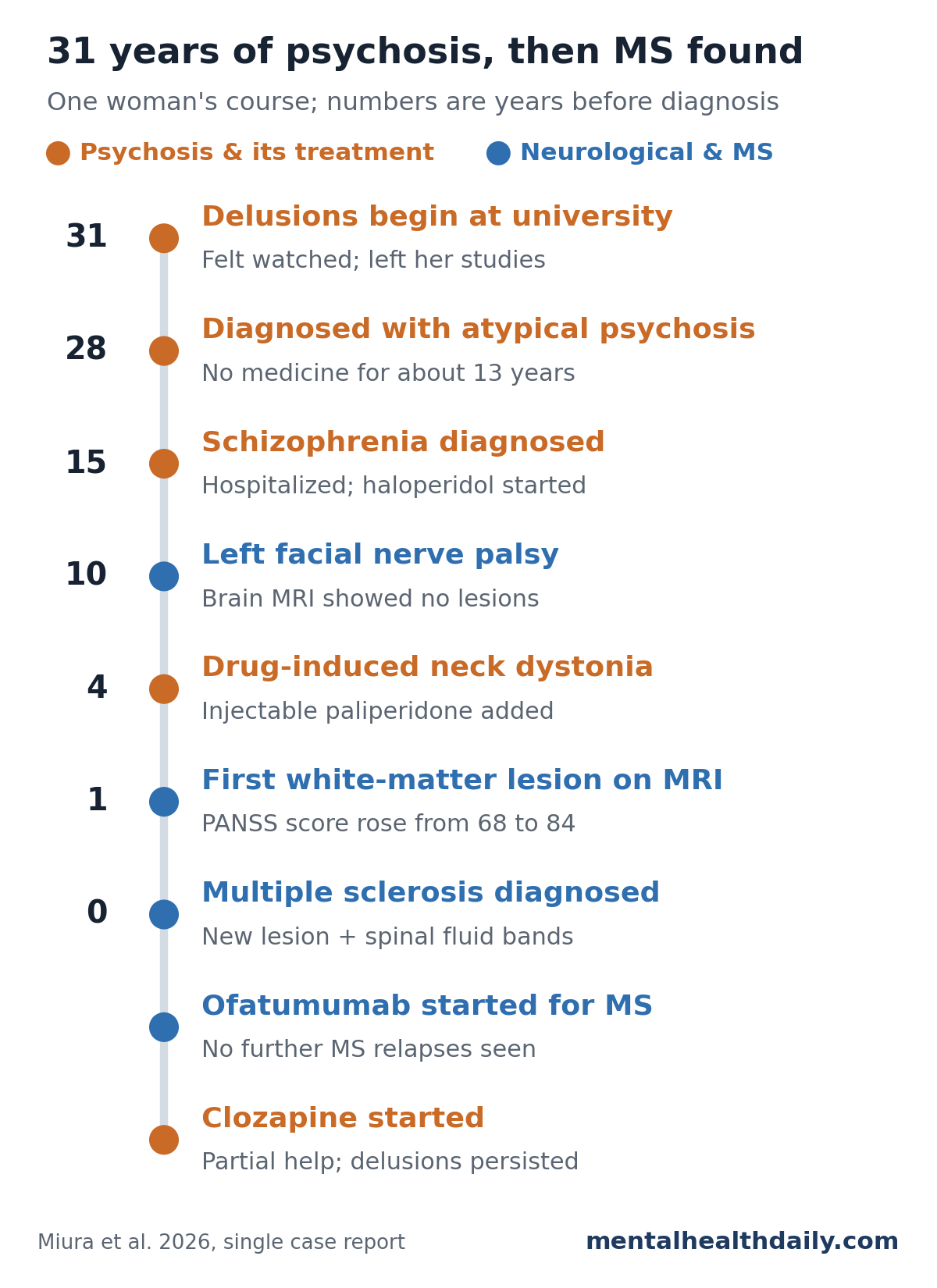
15 years before the MS diagnosis, she was hospitalized with hallucinations and delusions and diagnosed with schizophrenia. Haloperidol, an older antipsychotic, helped at first, then lost its effect.1
A first neurological warning sign: 10 years before the MS diagnosis, the left side of her face became weak (a peripheral facial nerve palsy). A brain MRI at the time showed no lesions, and the palsy cleared with steroids. Her psychiatric condition grew more unstable afterward, with repeated hospital stays.1
4 Antipsychotics Failed Before Clozapine
Treatment-resistant schizophrenia (TRS) means symptoms persist despite adequate trials of antipsychotic medicine. International consensus criteria require at least 2 different antipsychotics, each at an adequate dose and for long enough, with adherence checked.3
Her doctors checked that she was actually taking each medicine, using supervised dosing in hospital, injection records and reports from her family:1
- Haloperidol, up to 6.25 mg a day: early benefit that did not last.
- Zotepine, up to 450 mg a day: only partial benefit, even when given under supervision.
- Paliperidone long-acting injection, up to 150 mg every 4 weeks: added as her refusal to take medicine grew worse. She had voiced delusions of being poisoned.
- Olanzapine, up to 7.5 mg a day: no significant improvement during supervised inpatient care.
Mood stabilizers (lithium, then valproic acid) were also tried for agitation and mood swings, without lasting benefit. 4 years before the MS diagnosis, she developed involuntary tongue and neck movements that a neurologist diagnosed as drug-induced dystonia.1
Symptoms got worse in the final year: her score on the Positive and Negative Syndrome Scale (PANSS), a standard 30-item rating of psychosis severity, rose from 68 in May to 84 in August of that year. Positive symptoms such as delusions climbed from 14 to 20.1
How MRI and Spinal Fluid Tests Revealed MS
In the year before her MS diagnosis, an MRI showed a lesion in the white matter next to the brain’s right fluid-filled chamber (the lateral ventricle). Doctors kept watch.1
About 10 months later, a follow-up scan before planned electroconvulsive therapy (ECT) found a new lesion nearby. ECT was put on hold, and she was transferred to Tohoku University Hospital for a full workup with neurologists.1
Oligoclonal bands sealed the diagnosis. These are bands of antibodies found in the cerebrospinal fluid (the fluid around the brain and spinal cord) but not in the blood, a sign that the immune system is active inside the central nervous system. Together with the MRI lesions, they confirmed MS.1
A few months later, the right side of her face became weak, and MRI showed a new active lesion in the brainstem. After this second facial palsy, her forgetfulness became more noticeable.1
What MS Treatment and Clozapine Changed
Steroids were stopped early: high-dose intravenous steroids, a standard treatment for MS flare-ups, were stopped on day 2. While taking them she became severely agitated, had hallucinations and attempted self-harm, with no improvement in her psychosis.1
Ofatumumab, an antibody drug that depletes the B cells involved in MS inflammation, was then started to prevent relapses. During follow-up she had no further MS relapses or new neurological problems. Her persecutory delusions and emotional ups and downs continued.1
Clozapine, the standard medicine for treatment-resistant schizophrenia, was also started because earlier antipsychotics had failed or caused side effects. It improved her emotional instability, but her delusions persisted.1
Cognitive testing: on the Brief Assessment of Cognition in Schizophrenia (BACS), her scores for attention and processing speed and for executive function (planning and mental flexibility) were significantly lower than the average for people with schizophrenia her age. Both are areas that MS often affects.1
Could MS Have Fueled Her Treatment Resistance?
Miura et al. suggest that MS damage may have added to her existing schizophrenia, deepening her cognitive problems and making her psychosis harder to treat. Their reasons:1
- Timing: her psychiatric relapses and hospital stays grew more frequent after her first facial palsy and again once lesions appeared on MRI.
- Cognitive pattern: her attention and executive deficits were unusually severe for schizophrenia and match the pattern often seen in MS.
- Shared biology: earlier research has linked schizophrenia to inflammation, autoantibodies and problems with myelin-producing cells. A genetic study of more than 20,000 people found risk regions shared by MS and schizophrenia.
The team also points to its own postmortem brain studies. In brain tissue from 25 people with schizophrenia, 3 had unusually high activity of the gene for aquaporin-4, a water-channel protein targeted by the immune system in a related disease, neuromyelitis optica. Genes that differed between those 3 and the rest were enriched in an MS-related pathway. The researchers present these data as a starting point for new hypotheses, drawn from people other than this patient.1
They also stress that MS-related psychosis is not necessarily the same as schizophrenia in its symptoms, course or treatment response. The 2 remain separate diagnoses.1
What One Case Can and Cannot Show
A single case can show that MS and long-standing treatment-resistant psychosis can occur in the same person and that MS may go unrecognized for years. It cannot show that MS caused her psychosis or her treatment resistance, how often this happens, or whether MS treatment helps psychiatric symptoms.1
- Unknown MS start date: no brain scan was done when her psychosis began, and an MRI 10 years before the diagnosis was clear.
- Few formal ratings: PANSS scores were recorded only twice, both before the MS diagnosis. The response to ofatumumab and clozapine was described in words, not scores.
- Schematic symptom curves: the report’s symptom timeline is a clinician’s retrospective sketch, not measured data.
- Nonspecific cognitive deficits: attention and executive problems are common in schizophrenia itself, so they cannot point to MS on their own.
- Long antipsychotic exposure: decades of illness, repeated relapses and years of medication may also have contributed to treatment resistance.
Checking for Medical Causes When Psychosis Resists Treatment
Miura et al. conclude that doctors should consider MS in people with treatment-resistant schizophrenia, especially when marked attention and executive problems come with unusual clinical or neurological features.1
Red flags they name include unusual neurological signs (in her case, facial palsy), unexpected MRI or spinal fluid findings, and psychiatric symptoms that change in step with MS activity or MS treatment. Cognitive decline alone is not enough to suspect MS.1
Psychiatry has been paying closer attention to immune causes of psychosis. A 2020 international consensus on autoimmune psychosis, in which immune attacks on the brain produce psychotic symptoms, set out a cautious approach for recognizing possible, probable and definite cases and the tests needed to investigate them.4
Patients and families can raise new neurological symptoms in someone with long-standing psychosis, such as facial weakness, vision changes, numbness or trouble walking, with the care team. Any change in medication should go through the treating clinicians.
If you or someone you know is in crisis or thinking about self-harm, call or text 988 in the US (Suicide & Crisis Lifeline), call Samaritans on 116 123 in the UK, or contact local emergency services.
References
- Miura S, Nagaoka A, Hino M, Shishido R, Hatano M, Hosogai Y, Miyahara K, Oba Y, Kaneko K, Kunii Y, Tomita H. Possible contribution of multiple sclerosis pathology to treatment-resistant schizophrenia: a case study. Neuropsychopharmacology Reports. 2026;46:e70158. doi:10.1002/npr2.70158
- Marrie RA, Reingold S, Cohen J, et al. The incidence and prevalence of psychiatric disorders in multiple sclerosis: a systematic review. Multiple Sclerosis Journal. 2015;21(3):305–317. doi:10.1177/1352458514564487
- Howes OD, McCutcheon R, Agid O, et al. Treatment-resistant schizophrenia: Treatment Response and Resistance in Psychosis (TRRIP) Working Group consensus guidelines on diagnosis and terminology. American Journal of Psychiatry. 2017;174(3):216–229. doi:10.1176/appi.ajp.2016.16050503
- Pollak TA, Lennox BR, Müller S, et al. Autoimmune psychosis: an international consensus on an approach to the diagnosis and management of psychosis of suspected autoimmune origin. Lancet Psychiatry. 2020;7(1):93–108. doi:10.1016/S2215-0366(19)30290-1