
At a large pediatric neurology practice in Orlando, Florida, more than 1 in 3 autistic patients who had genetic testing came back with an abnormal result.
Patients with a history of seizures, and female patients, were more likely to have one.1
Research Highlights
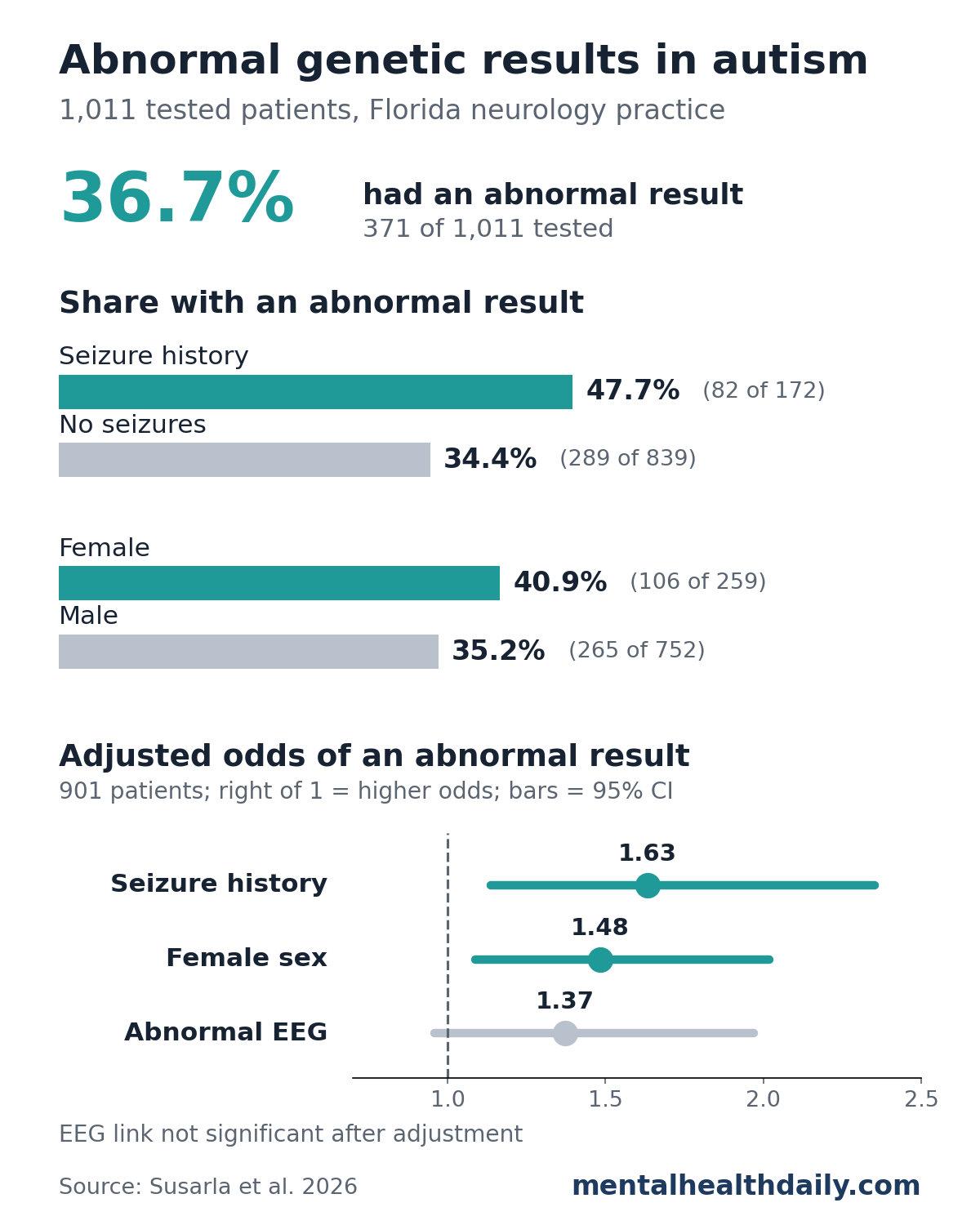
- 36.7% abnormal: 371 of 1,011 tested patients had an abnormal genetic finding in their records (95% CI 33.7–39.8%).1
- Seizures linked to abnormal results: a seizure history went with about 1.6 times the odds of an abnormal finding after adjustment (aOR 1.63).1
- Female patients too: after adjustment, female patients had about 1.5 times the odds of male patients (aOR 1.48).1
- Brain scans and EEGs added little: abnormal EEG and MRI results were not independently linked to abnormal genetic findings once other factors were counted.1
- A wide spread of findings: gene variants, missing or extra stretches of DNA, Fragile X–related changes and named syndromes all turned up.1
A Florida Neurology Practice Reviewed 1,884 Autism Charts
Viswabhaskar Susarla et al. reviewed the records of 1,884 patients with an autism spectrum disorder (ASD) diagnosis seen at Kids Neuro Care, a multidisciplinary neurology practice in Orlando, working with the University of Central Florida College of Medicine. Results appeared in September 2026 in the peer-reviewed journal Neurology International.1
- Patients: average age about 10.6, about 3 in 4 male, and 18% with a recorded seizure history. The practice is pediatric, but 170 patients were 18 or older at their evaluation.
- Tested: 1,011 patients (53.7%) had a documented genetic result; 873 had none.
- Other workup: many also had an EEG (a recording of the brain’s electrical activity, used to look for seizure-related patterns) or a brain MRI scan.
Genetic testing is a standard part of an autism evaluation. US genetics and pediatrics groups, including the American Academy of Pediatrics, recommend it to look for an underlying cause.1
What Counted as an Abnormal Genetic Result
The records reflected a mix of test types. The main genetic tests used in autism are:
- Chromosomal microarray: scans the genome for copy-number variants, stretches of DNA that are missing (deletions) or repeated (duplications).
- Fragile X testing: checks one gene on the X chromosome, FMR1, for an expanded repeat that is a well-known inherited cause of intellectual disability and autism features.
- Gene panels or exome sequencing: read many genes letter by letter to find small spelling changes, called sequence variants.
The researchers could not reliably tell which test each patient had, so they did not report how often each test type found something. They counted any result the chart recorded as abnormal, without reclassifying it under current genetics standards.1
That makes “abnormal” a broader label than “genetic cause found.” Fragile X notes, for example, included affected patients but also carrier, premutation and borderline “grey-zone” results.
Gene Variants and Missing or Extra DNA Were the Most Common Findings
Of 368 abnormal results with a written description, the main types were (a patient could have more than 1):1
- Gene or sequence variant: 127 (34.5%)
- Deletion: 77 (20.9%)
- Duplication: 77 (20.9%)
- Runs of homozygosity: 61 (16.6%). These are long stretches where both copies of a chromosome match, which can raise the chance of a recessive condition.
Among all 371 abnormal results, 65 (17.5%) named a specific syndrome or condition, and 27 (7.3%) carried a Fragile X–related note.1
Names that came up more than once included a 16p12 deletion (7 patients), 15q deletions or copy-number changes (5), extra or missing sex chromosomes (4), Charcot–Marie–Tooth disease (4), and 3 patients each with Sotos syndrome, neurofibromatosis type 1, 22q11 deletion (DiGeorge) syndrome and a 16p13.11 copy-number change.
Seizures and Female Sex Were Linked to Abnormal Genetic Results
Seizures: 22.1% of patients with an abnormal result had a seizure history, compared with 14.1% of those with a normal result. Put another way, 82 of 172 tested patients with seizures (47.7%) had an abnormal finding, compared with 289 of 839 without seizures (34.4%).1
Sex: 106 of 259 tested female patients (40.9%) had an abnormal result, compared with 265 of 752 male patients (35.2%). That gap was not significant on its own, but it became significant once age, seizures and EEG results were taken into account.1
In the main adjusted model, which included 901 patients with both genetic and EEG results:1
- Seizure history: adjusted odds ratio (aOR) 1.63 (95% CI 1.14–2.35)
- Female vs male: aOR 1.48 (95% CI 1.09–2.02)
- Abnormal EEG: aOR 1.37 (95% CI 0.96–1.97), not significant
- Age: no link
Both seizure history and female sex stayed significant in a smaller check that also added MRI results (422 patients). An abnormal MRI was not independently linked (aOR 1.24).1
An odds ratio compares the odds of an outcome between 2 groups; 1.6 means the odds were about 60% higher in the group with the feature.
Why Seizures and Genetic Findings Often Go Together
Many single-gene and chromosomal conditions that cause autism also cause epilepsy, so a link between seizures and abnormal results makes sense, the researchers note.1 A 2025 study of 523 children with autism at a US center found epilepsy in 35.4% of those whose test results explained their autism, compared with 16.4% of those without a genetic explanation.2
That 2025 study could compare tests directly: exome sequencing found a cause in 23.0% of children tested, compared with 8.3% for chromosomal microarray.2 The Florida records could not support that kind of comparison.
Some neurodevelopmental genetics clinics have also reported higher genetic yield in girls, the Florida team notes. Their records lacked data on intellectual disability, unusual physical features and developmental regression, so the female-sex link could reflect more complex cases rather than sex itself.1
Patients With Seizures Were Less Likely to Be Tested
Across all 1,884 patients, genetic testing clustered with other neurology workups. Patients who had an EEG had about 2.4 times the odds of genetic testing, and those who had an MRI about 2.2 times.1
Patients with a seizure history were less likely to have a recorded genetic test (aOR 0.68), even though seizures went with more abnormal results among those tested. The records could not explain why; outside testing, seizure-focused visits, insurance and family choice are all possible.1
Limitations of This Autism Genetic Testing Review
Evidence strength: this is a single-practice chart review. It can describe what was found and which features went together, but it cannot show cause, timing, or how well any one test works.
- Not a population rate: only about half of patients were tested, and not at random, so 36.7% does not describe all autistic people.
- Not a diagnostic yield: results were taken as recorded, test types were mixed, and some abnormal findings (such as Fragile X carrier status) may not explain autism.
- Specialty setting: patients seen by a neurology practice likely have more complex neurological features than those in community or primary care.
- Weak prediction: the models separated abnormal from normal results only slightly better than chance (AUC 0.59–0.61).
- No test dates: the order of seizures, EEG, MRI and genetic testing is unknown.
What This Means for Families Considering Genetic Testing
The researchers say their results support broad, guideline-based genetic testing in autism, not limiting it to children with seizures or to girls. Seizures and sex are modest signals, and the models were too weak to decide who should be tested.1
An abnormal result is a starting point for a conversation with a genetics professional, who can explain whether a finding is likely to explain a child’s autism, is uncertain, or is unrelated.
References
- Susarla V, George M, Rathinam A, Bhatti D. Genetic testing abnormalities in children with autism spectrum disorder: prevalence, patterns, and clinical associations. Neurology International. 2026;18(9):172. doi:10.3390/neurolint18090172
- Lob K, Sawka DM, Gaitanis JN, Liu JS, Nie DA. Genetic diagnostic yield in autism spectrum disorder (ASD) and epilepsy phenotypes in children with genetically defined ASD. Journal of Autism and Developmental Disorders. 2025;55:4324–4336. doi:10.1007/s10803-024-06512-1