
Adults who saw mental illness as a spectrum everyone sits on felt more sympathy toward people with schizophrenia, depression, or alcohol dependence, but they recommended treatment less often for schizophrenia and depression, according to a 2011 survey of 3,642 adults in Germany.1
Research Highlights
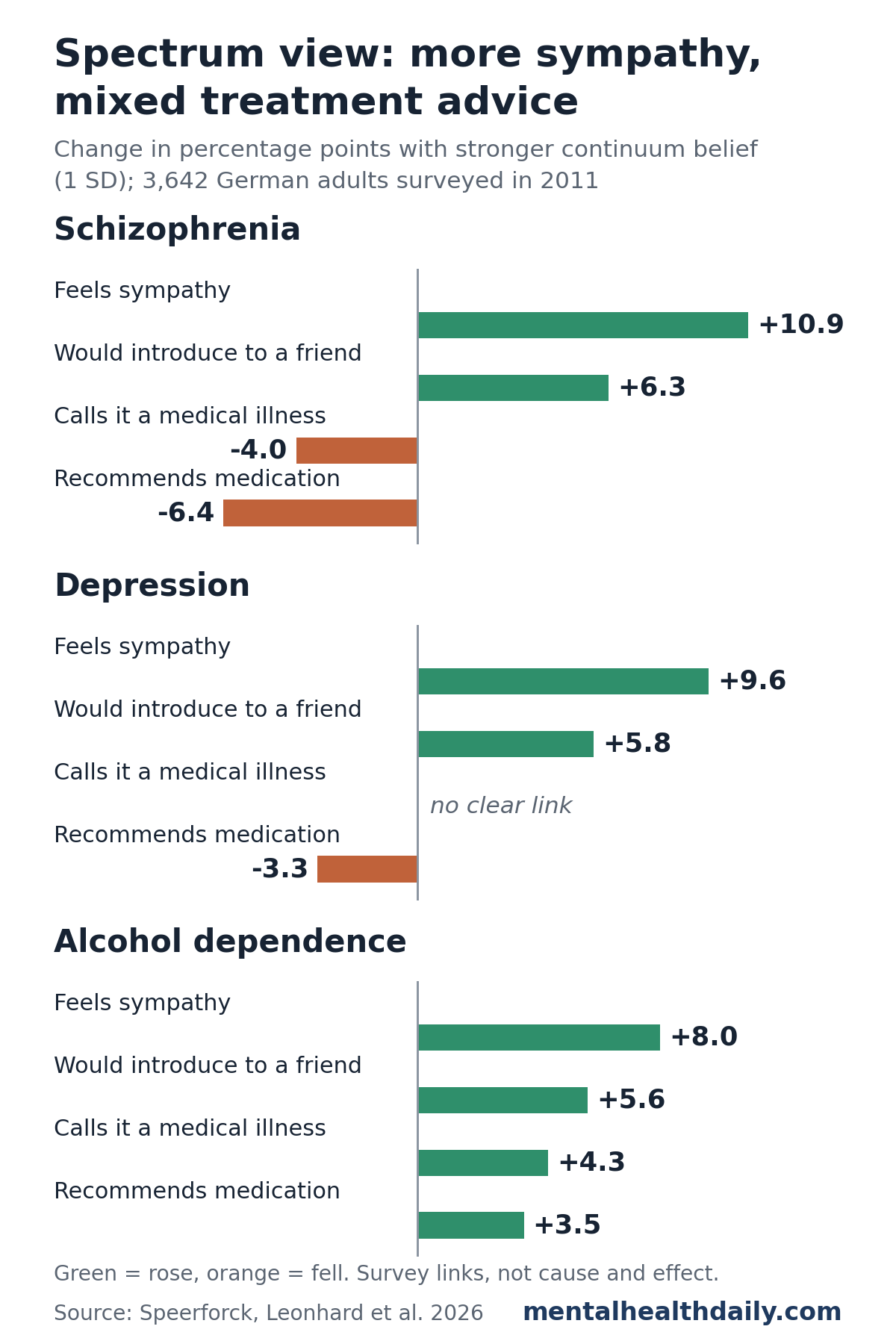
- More sympathy for all 3 conditions: with stronger spectrum beliefs, the chance of feeling sympathy rose 10.9 percentage points for schizophrenia, 9.6 for depression, and 8.0 for alcohol dependence.1
- Less social distance: willingness to introduce the person to a friend rose 5.6 to 6.3 points across the 3 conditions.1
- Fewer treatment recommendations for schizophrenia: recommending medication fell 6.4 points and recommending a psychiatrist fell 5.4 points; calling the symptoms a medical illness fell 4 points.1
- Alcohol dependence went the other way: recognizing it as a medical illness rose 4.3 points and recommending medication rose 3.5 points.1
- Old data, modest models: the interviews took place in 2011, and the models explained only 2.3% to 5.8% of the variation in answers.1
What Continuum Beliefs About Mental Illness Are
Continuum beliefs are the view that mental health and mental illness sit on one spectrum, with everyone somewhere along it, rather than in two separate categories of “well” and “ill.” Anti-stigma campaigns sometimes promote this idea because it stresses how much people with mental illness have in common with everyone else.
A 2021 systematic review of 33 studies found that continuum beliefs are consistently linked to lower stigma, although interventions designed to boost them had mixed effects on stigmatizing attitudes.2
A worry has followed the idea: if symptoms look like an ordinary part of life, people may be less likely to see them as an illness that needs treatment.
How the German Vignette Survey Worked
In a study published in Frontiers in Psychiatry in September 2026, Speerforck, Leonhard, et al. re-analyzed a German population survey carried out in 2 waves in 2011.1
Interviewers met respondents face to face and gave each person one short vignette (a description of a fictional person) matching the diagnostic criteria for schizophrenia, major depression, or alcohol dependence. The vignette did not name the condition.
- Sample: 3,642 adults living in private households in Germany, chosen by random sampling; 64.0% of those approached took part
- Continuum belief: agreement with one statement, “Basically, we are all sometimes like this person. It’s just a question of how pronounced this state is”
- Outcomes: whether the person had a medical illness; whether to see a psychiatrist, try psychotherapy, or take medication; stereotypes such as dangerous or lacking willpower; emotional reactions; and willingness to introduce the person to a friend
Results are reported as the change in the predicted share of people giving each answer when continuum belief rises by 1 standard deviation (a typical step up from average agreement), adjusted for age, gender, and education. A change of +10 means about 10 more people out of 100 gave that answer.
Stronger Spectrum Beliefs Went With More Sympathy and Less Social Distance
Across all 3 vignettes, people with stronger continuum beliefs were more likely to feel sympathy and more willing to introduce the person to a friend, a common measure of how much social distance people want.1 Some negative stereotypes also eased:
- Schizophrenia: seeing the person as “alien” fell 10.6 points and as unpredictable fell 6.7 points; feeling uncomfortable fell 6 points
- Depression: seeing the person as alien fell 2.9 points; feeling uncomfortable fell 2.5 points
- Alcohol dependence: seeing the person as unpredictable fell 3.2 points; feeling uncomfortable fell 4.7 points and feeling annoyed fell 3.0 points
Continuum beliefs were not linked to seeing a person with schizophrenia as dangerous or to feeling afraid of them.
Weaker Treatment Advice for Schizophrenia and Depression
For schizophrenia, people with stronger continuum beliefs were less likely to call the symptoms a medical illness (−4 points) and less likely to recommend medication (−6.4) or a psychiatrist (−5.4).1 For depression, recommendations for psychotherapy (−3.2) and medication (−3.3) dipped slightly, with no significant change in calling it an illness.
Two negative reactions also rose slightly:
- “Lack of willpower”: up 5.1 points for schizophrenia and 3.5 points for depression
- Anger: up 2.5 points for schizophrenia, from a low starting level
The researchers suggest that when people stop seeing behavior as part of an illness, they may hold the person more personally responsible. Blaming willpower may also be a way to keep some distance, by explaining why they themselves would not develop the illness.1
Size of the trade-off: recognition of schizophrenia as an illness and recommendations to see a psychiatrist were already high in this sample, at roughly 8 in 10 people. Against that base, the researchers judged the 4 to 6 point drops as relatively small compared with the gains in sympathy and social acceptance.1
Alcohol Dependence: More Recognition and More Medication Advice
Alcohol dependence reversed the pattern. Only 52% of respondents saw the person in the alcohol vignette as having a mental illness, and stronger continuum beliefs raised that recognition by 4.3 points and medication recommendations by 3.5 points.1
The researchers’ explanation: many people think of drinking as either “normal” or “alcoholic.” Seeing drinking problems on a spectrum may help people notice that someone’s drinking has become a health problem. The “lack of willpower” stereotype, the most common one for alcohol dependence, did not change.
Limitations of This Continuum Beliefs Survey
The study is cross-sectional (one snapshot in time), so it shows which attitudes travel together, not whether changing someone’s beliefs would change their reactions. Other limits:
- 15-year-old data: interviews took place in 2011. In later German surveys, agreement with continuum beliefs rose for depression (43% to 46%) and fell for schizophrenia (26% to 20%) between 2011 and 2020.3
- Low explanatory power: the models explained only 2.3% to 5.8% of the variation in answers, so many other factors shape these attitudes.
- One question: continuum belief was measured with a single statement.
- Hypothetical answers: respondents reacted to a fictional, unlabeled person in a face-to-face interview, which can push answers toward what sounds socially acceptable. What they recommended is not what they or the person would actually do.
- One country: results come from Germany and may differ elsewhere.
What This Means for Anti-Stigma Messages About Schizophrenia
Experimental work shows a similar tension. In one study, a message promoting continuum beliefs about schizophrenia increased fear, possibly because the person felt “too close for comfort.”4
The researchers suggest that campaigns using the spectrum message could add clear information about diagnosis and treatment options, so that more acceptance does not come with less help-seeking.1 Whether that works still needs testing in intervention studies.
References
- Speerforck S, Leonhard A, Angermeyer MC, Schomerus G. Differentiating the potential of continuum beliefs to reduce the public stigma of schizophrenia, depression, and alcohol dependence: associations with illness recognition and treatment recommendations. Frontiers in Psychiatry. 2026;17:1869356. doi:10.3389/fpsyt.2026.1869356
- Peter L-J, Schindler S, Sander C, et al. Continuum beliefs and mental illness stigma: a systematic review and meta-analysis of correlation and intervention studies. Psychological Medicine. 2021;51(5):716–726. doi:10.1017/S0033291721000854
- Schomerus G, Schindler S, Baumann E, Angermeyer MC. Changes in continuum beliefs for depression and schizophrenia in the general population 2011–2020: a widening gap. Social Psychiatry and Psychiatric Epidemiology. 2023;58:17–23. doi:10.1007/s00127-022-02272-4
- Thibodeau R, Peterson KM. On continuum beliefs and psychiatric stigma: similarity to a person with schizophrenia can feel too close for comfort. Psychiatry Research. 2018;270:731–737. doi:10.1016/j.psychres.2018.10.070