
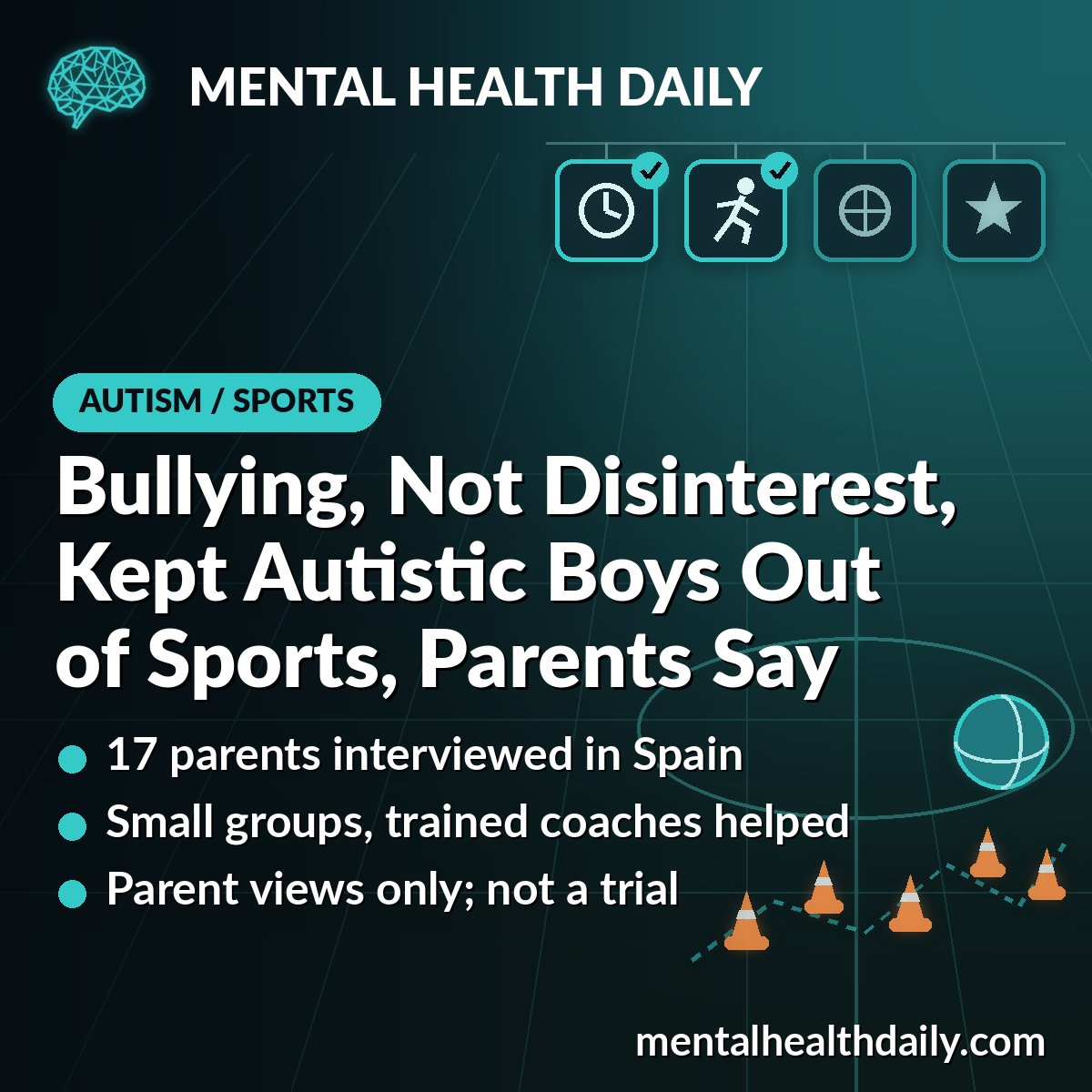
Parents of autistic boys in Spain said their sons had not lost interest in sports. Instead, the boys had pulled away after being bullied, left out and repeatedly failing in regular sports settings, according to a 2026 interview study of 17 parents.1
After their sons finished a 12-week sports program built for autistic children, many parents said the boys were calmer, more willing to exercise, and in some cases ready to join community sports such as karate and soccer.
Research Highlights
- Avoidance came from bad experiences, parents said: the 17 parents (11 mothers, 6 fathers) of boys aged 8 to 12 described their sons’ earlier refusal to play sports as a reaction to bullying, exclusion and failure, not a general dislike of exercise.1
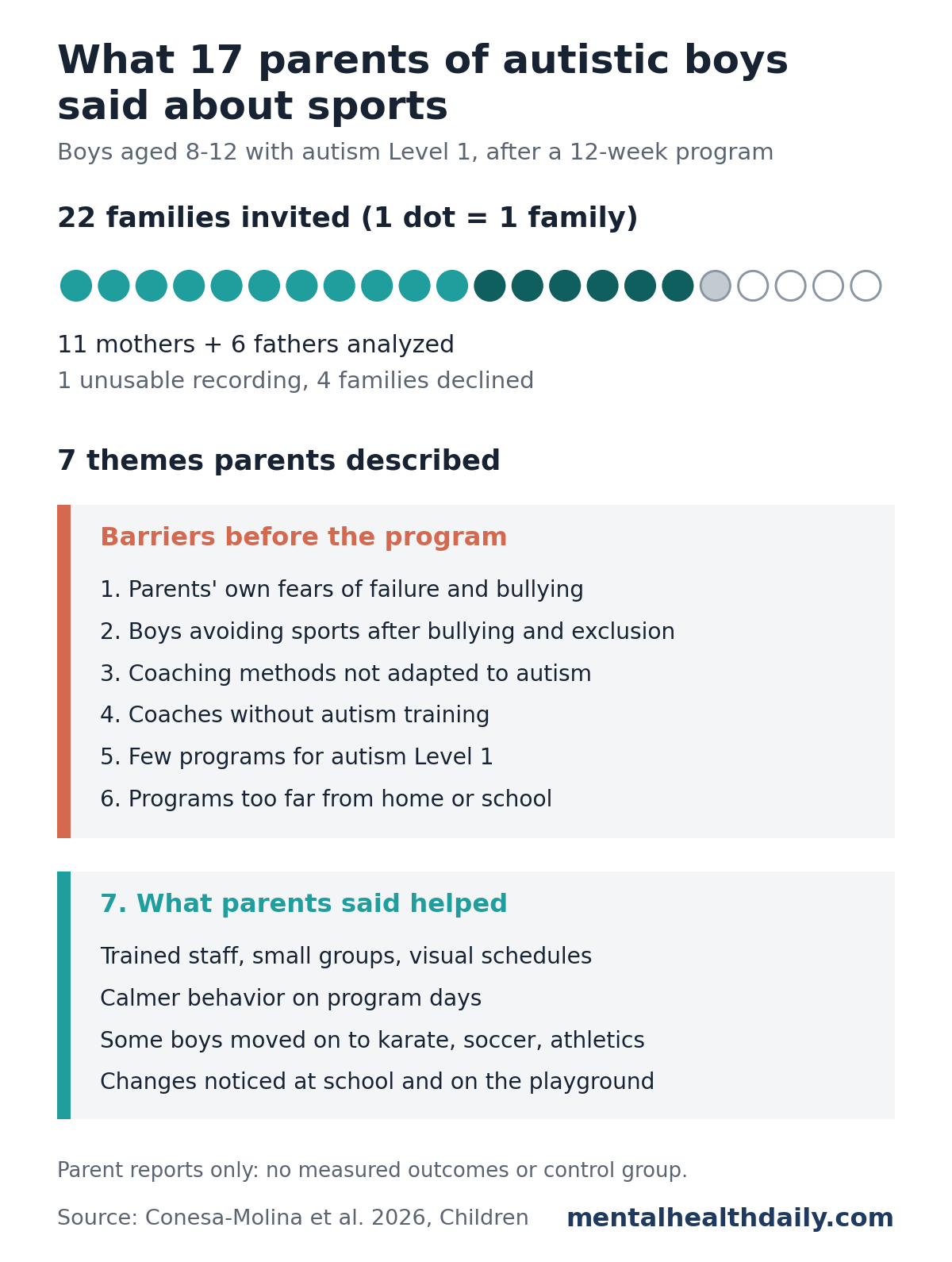
- 6 barriers and 1 theme on what helped: researchers identified 7 themes in the interviews: 6 described barriers, from parents’ own fears to untrained coaches and programs too far from home; the seventh covered program features and changes parents credited.1
- What parents credited: trained staff, groups of up to 8 boys with 2 instructors, visual schedules and predictable routines.1
- An “invisible population”: parents said boys with autism Level 1 fit neither mainstream sports nor programs designed for children with greater support needs.1
- Parent views only: no outcome was measured with a standard test, there was no comparison group, and only families who completed the program were interviewed.1
Who Was Interviewed About Autism and Sports?
Researchers at the Catholic University of Valencia ran a multicomponent physical activity program for boys aged 8 to 12 with autism spectrum disorder (ASD) Level 1.1
Level 1 is the DSM-5 category for autistic people who “require support” but usually have language and thinking skills in the typical range. These children often attend mainstream schools, so their social difficulties can be easy to overlook.
The program ran 3 times between October 2023 and May 2025. Each edition lasted 12 weeks, with 60-minute sessions twice a week. Key features included:
- Small groups: up to 8 boys per group with 2 trained instructors, plus 2 typically developing peers per group
- Predictable sessions: the same order every time, starting with a visual schedule, based on the TEACCH approach to autism education
- Mixed activities: fitness, strength, balance and motor skills, plus games that combine movement with thinking tasks
- A calm finish: a story-based muscle relaxation cool-down
In June 2025, an outside researcher with no link to the program interviewed parents over video call. Interviews lasted 45 to 90 minutes.1
All 22 families whose sons finished the program were invited. Of those, 18 agreed, and 1 recording was unusable, leaving 17 parents in the analysis.
The research team read the transcripts and grouped what parents said into recurring themes, a method called reflexive thematic analysis.
Why Did Autistic Boys Avoid Sports Before the Program?
The central finding was a distinction parents drew themselves. Their sons looked uninterested in physical activity, but parents said the boys were really avoiding the social setting of sports.1
Parents described bullying as a main reason their sons quit. One father said his son “complained they laughed at him, had to quit after 2 months.”
Others described a string of failed attempts. A rugby try-out ended because “the instructions weren’t understood, teamwork mechanics weren’t grasped.”
Over time, parents said, these experiences spread into a general dislike of anything sports-related.
Researchers note that parents’ explanation does not rule out other factors. Motor coordination difficulties, sensory sensitivities and communication demands could also play a part.1
The parents’ accounts fit what larger studies show about bullying. A 2016 meta-analysis of 17 studies estimated that 44% of school-aged youth with ASD had been bullied at school, a higher risk than typically developing peers face.2
What Barriers Did Parents Describe in Regular Sports?
Beyond bullying, parents described 5 other barriers:1
- Their own fears. Many worried before enrolling that their son would fail, be mocked or be misunderstood by coaches. Some never signed up for a team sport because of these worries.
- Teaching methods that did not fit. Long verbal instructions, unspoken rules, large groups and little routine made sessions confusing and stressful.
- Coaches without autism training. Parents said untrained coaches treated meltdowns as misbehavior, or let a child walk away instead of bringing him back in.
- Few suitable programs. One mother called these boys “a very invisible population,” too affected for mainstream sports but not a fit for programs aimed at severe disability.
- Distance. Even when a suitable program existed, a long commute on top of therapy appointments often ruled it out.
What Did Parents Say Changed After the Program?
The seventh theme covered what parents said helped and the changes they noticed in their sons. These are parent observations; the study did not measure behavior, fitness or mood with standard tests.1
Calmer behavior. Several parents said their sons seemed calmer on program days. One mother said aggressive episodes became less frequent, and another described her son leaving a session “regulated, calm, happy” after a hard day at school.
New sports. Some boys went on to karate, athletics or soccer after the program ended. One mother said her son now competes in a regular group, not a special-needs group.
Changes at school. One mother said her son went from not playing at all at recess to playing tag with classmates. Another parent said a teacher noticed better ball skills.
Family effects. Parents also mentioned better sleep, more spontaneous speech, and an informal support group that formed among the mothers.
Parents most often credited the instructor’s autism expertise. They valued staff who stayed calm, re-explained when something did not work, and brought children back into the activity instead of letting them leave.
Not every family was positive. One mother said her son, who generally disliked sports, found attending a burden, and the outdoor venue was hard to manage in winter.1
The changes parents described are broadly consistent with trial evidence. A 2018 meta-analysis of 29 studies with 1,009 young people with ASD found that physical activity programs had a moderate overall benefit (effect size g = 0.62), including on motor skills and social functioning.3
Why the Program’s Effects Are Still Unproven
This study shows how a small group of parents explain their sons’ experiences. It cannot show that the program caused the changes they describe. Specific limits:1
- Only families who finished were asked: only parents of boys who completed the program were eligible, so families who dropped out or had worse experiences were not heard.
- No measurements: all outcomes are parent reports, without standard tests, teacher ratings or a comparison group.
- Researcher involvement: the first author ran the program and did the first round of coding. The team used an outside interviewer and a second coder to limit bias.
- Long recall gap: some parents were interviewed about 18 months after their son’s program ended, so memories may have faded or shifted, and parents may have wanted to give positive answers.
- Boys only, one city: no girls took part in the program, and all families lived in Valencia, Spain. The boys themselves were not interviewed.
What Could Help Autistic Kids Stay in Sports?
Researchers suggest a few practical steps based on what parents said:1
- Train coaches in autism, including how to read behavior as a sign of difficulty and how to give short, clear instructions.
- Use small groups with predictable routines, a format the authors think mainstream clubs could adopt.
- Talk with parents before a program starts to address their fears about bullying and failure.
- Offer programs closer to home, for example at schools and local clubs.
For parents of a child who refuses sports, the main message from these interviews is that refusal may reflect past experiences rather than a fixed dislike. Controlled studies with measured outcomes are still needed to show which program features make the difference.
References
- Conesa-Molina M, Grau MD, Pablos A, Elvira L. Parental perspectives on sports participation in boys with autism spectrum disorder Level 1 following a multicomponent physical activity program: a qualitative study. Children. 2026;13(9):1206. doi:10.3390/children13091206
- Maïano C, Normand CL, Salvas MC, Moullec G, Aimé A. Prevalence of school bullying among youth with autism spectrum disorders: a systematic review and meta-analysis. Autism Research. 2016;9(6):601-615. doi:10.1002/aur.1568
- Healy S, Nacario A, Braithwaite RE, Hopper C. The effect of physical activity interventions on youth with autism spectrum disorder: a meta-analysis. Autism Research. 2018;11(6):818-833. doi:10.1002/aur.1955