
Children with autism had trouble picking out repeated sound patterns but learned repeated picture patterns about as well as other children, a 2026 study of 61 Chinese children ages 7 to 10 found.1
On the sound task, the autism group scored close to guessing, and only 12 of 30 autistic children scored above 50%.
Research Highlights
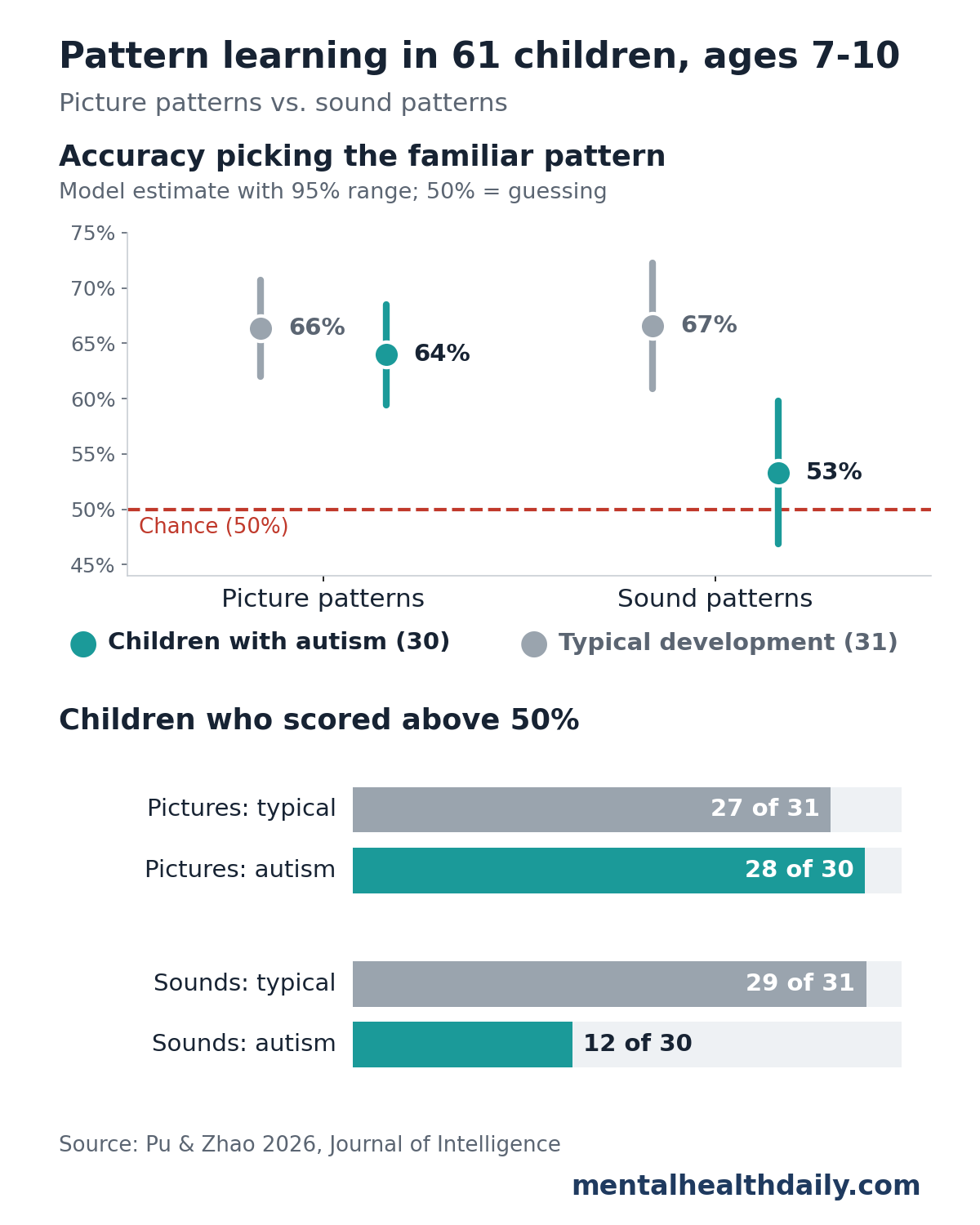
- Sound patterns, near chance: children with autism picked the familiar syllable sequence 53% of the time, not significantly better than the 50% expected from guessing.1
- Picture patterns, close to peers: the same children scored 64% on a matching picture task, compared with 66% for typically developing children, a difference that was not significant.1
- Individual scores: 12 of 30 autistic children scored above 50% on the sound task, versus 28 of 30 on the picture task. Among typically developing children, 29 of 31 and 27 of 31 did.1
- Slower answers on both tasks: autistic children took longer to respond to picture patterns (1,614 vs. 982 milliseconds on average) and to sound patterns (803 vs. 705 milliseconds).1
- Small, early study: 61 children, a 27-question test per task, and only children with mild to moderate autism and an IQ of 70 or higher.1
What Is Statistical Learning, and Why Study It in Autism?
Statistical learning is the brain’s habit of noticing which things tend to follow which, without trying. It works on sounds, sights and touch.
It plays a major role in early language. In fluent speech there are no pauses between words, so babies have to work out where one word ends and the next begins.
A classic 1996 study showed that 8-month-old infants could do this after only 2 minutes of listening to a made-up language, using nothing but how often one syllable followed another.2
Autism is a developmental condition marked by differences in social communication and by restricted, repetitive behaviors and interests. Many autistic children also have delayed or unusual language development.
That raises a natural question: do autistic children pick up these hidden patterns differently, and does it depend on whether the patterns are heard or seen?
Earlier research has not settled it. A 2016 meta-analysis of 13 studies found no overall difference in statistical learning between autistic and non-autistic people (g = −0.13, not significant).3
Most studies tested only one sense at a time, though, which makes it hard to tell whether hearing and vision differ.
How the Picture and Sound Pattern Tasks Worked
Yunhuan Pu and Wei Zhao of Shaanxi Normal University in Xi’an, China, tested 2 groups of Mandarin-speaking children in grades 1 to 3 at mainstream schools:1
- Autism group: 30 children (24 boys, 6 girls) with a clinical autism diagnosis and mild to moderate symptoms, an IQ of 70 or higher, no other diagnoses such as ADHD, and no psychiatric medication
- Typically developing group: 31 children (20 boys, 11 girls)
The groups were matched on age (about 8 years), nonverbal IQ and vocabulary.
Every child did both tasks, in a counterbalanced order. Each task had 2 parts.
- Listening or watching (about 3 minutes): children saw 9 cartoon alien pictures or heard 9 nonsense syllables. The items always came in the same 3 sets of 3, such as “pa-ti-he,” each repeated 24 times.
- Test (27 questions): children heard or saw 2 sequences and pressed a key to choose the one that felt more familiar. One was a real set from the first part; the other mixed the same items in a new order.
Children who had picked up the patterns should choose the real set more than half the time. A child who learned nothing would land near 50%, the same as guessing.
Autistic Children Scored Near Chance on Sound Patterns
On the sound task, the predicted accuracy for children with autism was 53.3% (95% confidence interval 46.9% to 59.8%). That was not significantly above chance (p = 0.156).1
Typically developing children scored 66.6% on the same task, clearly above chance.
The gap between groups on the sound task was significant. Typically developing children had 1.74 times the odds of choosing the right sequence (p = 0.003).
Individual results matched the group averages:
- Children with autism: 12 of 30 (40%) scored above 50% on sounds; many sat near or below 50%
- Typically developing children: 29 of 31 (94%) scored above 50% on sounds
Picture Pattern Learning Was Similar in Both Groups
On the picture task, children with autism scored 64.0%, well above chance (p < 0.001).1
Typically developing children scored 66.4%. The difference between groups was not significant (p = 0.468).
That is not proof the 2 groups learn visual patterns equally well. A study of 61 children can miss a small difference.
But the contrast inside the autism group was clear. Autistic children did significantly better on pictures than on sounds (p = 0.002), while typically developing children showed no difference between the 2 tasks (66% vs. 67%).
Statistically, this showed up as a significant interaction between group and task type (p = 0.023), meaning the autism gap depended on which sense was tested. A simpler check using each child’s average score gave the same result (p = 0.020).
Why Might Sound Patterns Be Harder for Autistic Children?
Response times: children with autism took longer to respond on both tasks, even after accounting for age, IQ and vocabulary.1
- Picture task: 1,614 milliseconds for children with autism vs. 982 for typically developing children, about 64% longer
- Sound task: 803 vs. 705 milliseconds, about 14% longer
On pictures, the extra time came with near-normal accuracy. On sounds, it did not help.
Researchers suggested 3 possible reasons for the sound difficulty, none of which this study tested directly:
- Hearing speech units: autistic children may have more trouble picking out individual speech sounds from a stream, a pattern seen in earlier brain-response studies.
- Short-term memory for sounds: holding a sequence of syllables in mind long enough to compare it with another may be harder.
- Filtering repeated input: heavy repetition of sounds may feel overwhelming and get in the way of automatic pattern learning.
For pictures, researchers pointed to the attention to detail often seen in autism. Focusing on individual shapes may slow responses but still support learning which image comes next.
A different result on sound patterns: a 2012 US study tested 17 school-aged children with autism and a history of language delay on a longer, continuous made-up language. They learned the syllable patterns as well as 24 typically developing children.4
That task used a long, unbroken stream of speech, while the Chinese study used short sets of 3 syllables separated by pauses and a brief listening phase. Differences like these may explain part of the disagreement.
Broader evidence: the 2016 meta-analysis found statistical learning intact in autism across many task types.3 The Chinese study suggests the answer may depend on the sense being tested, at least on short tasks.
Limitations of This Autism Pattern Learning Study
- Small sample: 30 children with autism and 31 without, from one region of China.
- Short test: each task had only 27 questions. Score consistency was lowest exactly where the main result came from (split-half reliability 0.50 for autistic children on the sound task, vs. 0.65 to 0.76 elsewhere).
- Different stimuli, not just different senses: the picture task used cartoon aliens and the sound task used nonsense syllables. The sound difficulty could reflect speech specifically rather than hearing in general.
- One task format: patterns came in short sets with pauses between them. Results may differ with continuous streams or other kinds of pattern-learning tasks.
- Narrow group: only children with mild to moderate autism, an IQ of 70 or higher and good vocabulary. Results may not apply to autistic children with intellectual disability or limited speech.
- Attention not tracked: researchers did not measure whether children were paying attention during the listening phase.
- No link to real language: the study did not test whether sound-pattern scores relate to children’s everyday language or communication.
- Abstract vs. results: the abstract reports the sound-task group difference as p < 0.001; the results section gives p = 0.003. Both are significant.
Bottom line: in this small study, autistic children ages 7 to 10 learned picture patterns about as well as their peers but scored near chance on sound patterns.
That fits the idea that hearing-based pattern learning may be a specific weak spot for some autistic children. It is a single experiment with a short test, so it does not support using the task for diagnosis or choosing therapies.
Researchers proposed testing whether visual supports such as pictures or color coding make spoken patterns easier to learn. That idea has not yet been tested.
References
- Pu Y, Zhao W. Auditory statistical learning deficits in children with autism spectrum disorder: a comparison of visual and auditory segmentation paradigms. Journal of Intelligence. 2026;14:195. doi:10.3390/jintelligence14090195
- Saffran JR, Aslin RN, Newport EL. Statistical learning by 8-month-old infants. Science. 1996;274(5294):1926–1928. doi:10.1126/science.274.5294.1926
- Obeid R, Brooks PJ, Powers KL, Gillespie-Lynch K, Lum JAG. Statistical learning in specific language impairment and autism spectrum disorder: a meta-analysis. Frontiers in Psychology. 2016;7:1245. doi:10.3389/fpsyg.2016.01245
- Mayo J, Eigsti IM. Brief report: a comparison of statistical learning in school-aged children with high functioning autism and typically developing peers. Journal of Autism and Developmental Disorders. 2012;42(11):2476–2485. doi:10.1007/s10803-012-1493-0