
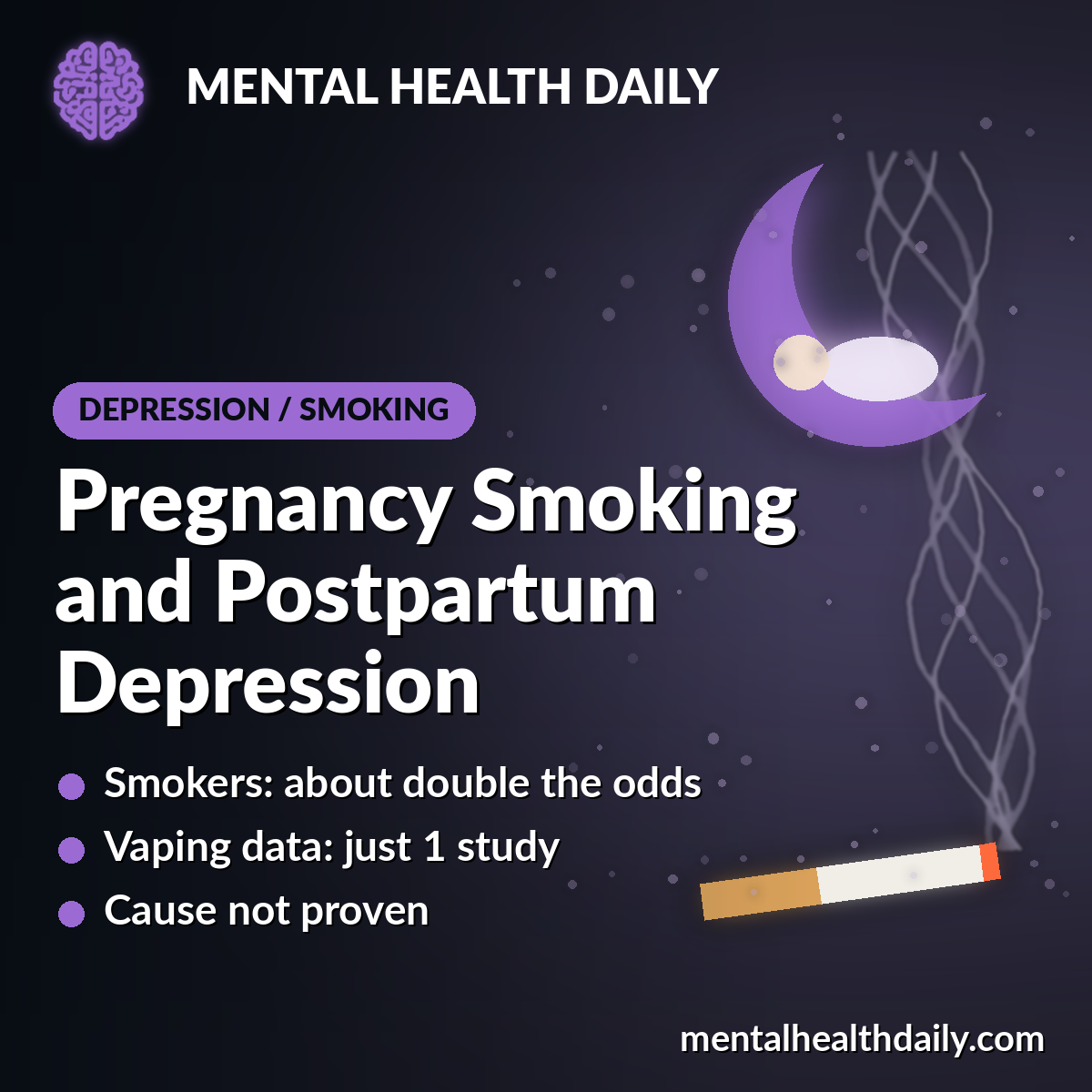
Women who smoked cigarettes during pregnancy had about twice the odds of postpartum depression as women who did not, according to a 2026 meta-analysis of 26 studies covering more than 640,000 participants.1 Secondhand smoke and vaping showed no clear link, but only 4 studies tested them, and none of this evidence shows that smoking itself causes the depression.
Research Highlights
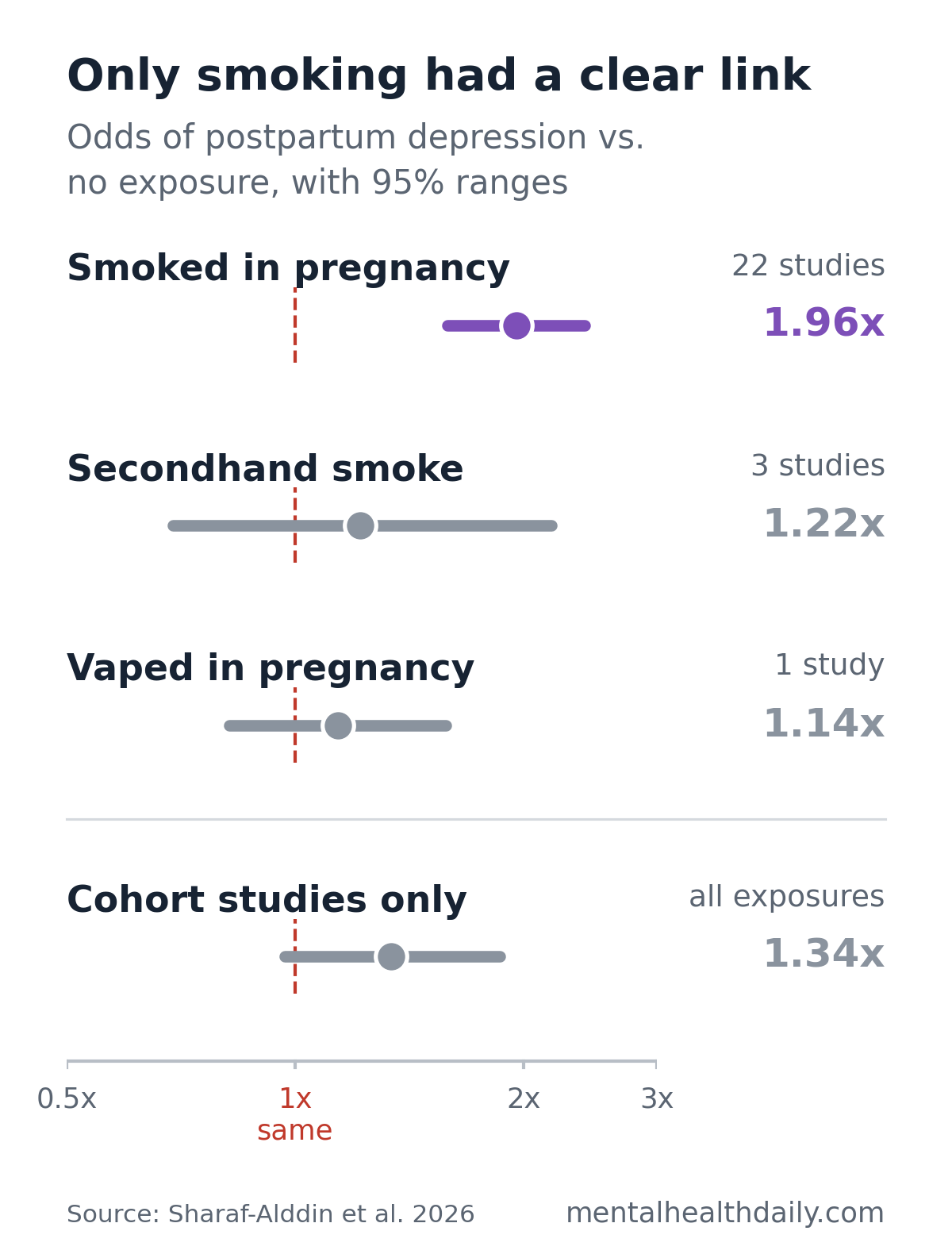
- Smokers had roughly double the odds: Across 22 studies, women who smoked in pregnancy had a pooled odds ratio of 1.96 (95% CI 1.59 to 2.41) for screening positive for postpartum depression.1
- Secondhand smoke and vaping are unsettled, not cleared: Secondhand smoke (odds ratio 1.22, 3 studies) and e-cigarettes (1.14, 1 study of 58,950 US mothers) did not reach significance.1
- Cohort studies found a smaller pooled link than surveys: Across all prenatal nicotine exposure types, cohort studies pooled to 1.34 (95% CI 0.97 to 1.86), a range that includes no difference, vs. 1.92 for cross-sectional and case-control studies across the same exposure types.1
- Screening questionnaires inflate prevalence: About 17% of new mothers screened positive on questionnaires vs. 11% in the 2 studies that used diagnostic interviews.1
- Quitting is promising but unproven for this outcome: In a Japanese cohort of 80,872 women, those who quit after becoming pregnant still had 1.24 times the odds of never-smokers, and no trial has tested whether quitting prevents postpartum depression.8
Postpartum depression is a depressive episode in the months after childbirth. In the included studies, rates ranged from about 1 in 10 to more than 1 in 4 mothers, depending largely on region and how depression was measured.1
Smoking and depression travel together in almost every population studied. The question for pregnancy is whether nicotine adds its own risk, or whether smoking mostly marks women who were already more likely to become depressed.
Smoking in Pregnancy Was Tied to About Twice the Odds of Postpartum Depression
Sharaf-Alddin et al. gathered every study from 2000 to September 2024 that measured nicotine exposure during pregnancy and depression within a year after birth:1
- Studies: 29 reviewed; 26 pooled, yielding 33 separate estimates
- Participants: 642,959 across the pooled estimates
- Designs: Of the 29 reviewed studies, 19 were cross-sectional surveys, 7 were cohort studies, and 3 were case-control studies
- Where: 14 US studies (8 using the national PRAMS pregnancy survey), 7 from Asia, 5 from Europe, 2 from South America, 1 from Africa
- Exposures: cigarettes (plus 1 hookah study), secondhand smoke, and e-cigarettes, all self-reported
Results are reported as odds ratios. An odds ratio of 1 means no difference between exposed and unexposed women; 2 means roughly double the odds. At the depression rates seen here, an odds ratio of 2 corresponds to a somewhat smaller increase in actual risk.
For active smoking, the pooled odds ratio was 1.96 (95% CI 1.59 to 2.41). About 25% of smokers screened positive for postpartum depression, compared with 13% of non-smokers.1
That size of association has held up across independent reviews:
- Chen et al. 2019: 13 studies and nearly 1.5 million women produced a pooled odds ratio of 2.33 (95% CI 1.93 to 2.81).2
- Abedin et al. 2026: a separate meta-analysis of 38 studies found smokers about twice as likely to develop postpartum depression, with current and pregnancy smoking more strongly linked than past smoking.3
- Knysak et al. 2025: a narrative review of 10 recent studies concluded the risk was highest among heavy smokers.4
A 2025 PRAMS analysis of 218,128 US mothers, published after the meta-analysis search closed, added a severity gradient. After adjustment, tobacco use was tied to 1.33 times the odds of mild symptoms, rising to 2.35 times the odds of severe symptoms.5
Secondhand Smoke and Vaping: 4 Studies Cannot Settle It
Secondhand smoke pooled to an odds ratio of 1.22 (95% CI 0.69 to 2.18). Only 3 studies fed that estimate, from North Carolina, Saudi Arabia, and China, and they pointed in different directions.1 Postpartum depression rates were nearly identical in exposed and unexposed women: 10% vs. 9%.
An earlier review reached a different answer. Suzuki et al. pooled 2 studies of 4,103 nonsmoking pregnant women and found 1.77 times the odds of depressive symptoms with secondhand smoke exposure.6 With so few studies on either side, neither result is stable.
Exposure measurement is part of the problem. Every secondhand-smoke study relied on self-report, such as whether anyone smoked in the home, rather than a biological marker like cotinine. Loose measurement tends to blur real differences toward zero.1
Vaping rests on a single study. Choi et al. analyzed 58,950 PRAMS respondents from 2016 to 2019. E-cigarette use in late pregnancy had an unadjusted odds ratio of 1.14, falling to 1.03 after accounting for cigarette use, income, abuse, and other factors.1, 7
Vaping at any point in the prior 2 years did carry 1.63 times the unadjusted odds, but no adjusted analysis was significant.7 The authors concluded that e-cigarette use may be a useful warning sign for postpartum depression rather than an independent cause.
For a pregnant woman who switched from cigarettes to vaping, this means there is no evidence yet that vaping raises postpartum depression risk. Whether vaping is safe for postpartum mood remains largely untested.
Why the 1.96 Figure Does Not Prove Smoking Causes Postpartum Depression
An odds ratio near 2 is a real signal. Several features of this evidence, though, make it a weak guide to what nicotine itself does.
Most studies were snapshots. Cross-sectional surveys ask about smoking and mood at the same time, often months after birth. They made up 19 of the 29 studies.
The cohort studies, which record prenatal nicotine exposure and then follow women forward, pooled across all exposure types to an odds ratio of 1.34 (95% CI 0.97 to 1.86; p = 0.071). The cross-sectional and case-control studies pooled across those exposure types to 1.92.1
The cohorts were mostly small, so they may simply lack power. Because these design subgroups pooled all exposure types, the smaller cohort estimate does not isolate a smoking-specific effect.
Several large studies entered the pool unadjusted. In the forest plot, the values for several of the biggest studies match their crude odds ratios, not the ones corrected for other risk factors:1
- A Seoul study of 80,116 women: 7.34 crude vs. 2.02 adjusted
- The Japan Environment and Children's Study (JECS), 80,872 women: 1.64 crude vs. 1.38 adjusted8
- A North Carolina secondhand-smoke study of 6,884 women: 1.90 crude vs. 1.49 adjusted
Adjustment shrank the association in each case. So the pooled 1.96 is better read as how strongly smoking flags postpartum depression than as nicotine's independent effect. In JECS, after adjustment, smoking during pregnancy carried about 1.4 times the odds.8
Prior depression was not ruled out. Depression before or during pregnancy is among the strongest predictors of postpartum depression, and depressed women are more likely to smoke and less likely to quit. The included studies varied in whether they accounted for mental health history, and the meta-analysis did not separate those that did.1
One included study shows how much this can matter. In US health records covering 10,598 women, nicotine dependence was tied to 1.92 times the odds of postpartum depression. After matching women on mental and behavioral disorders, socioeconomic hazards, and pregnancy complications, the direction reversed to 0.61.1
Reverse causation is plausible. Nicotine brings short-term relief from stress and low mood, so women who are already struggling may keep smoking as self-medication. The authors also noted that withdrawal after quitting can itself cause irritability, low mood, and poor sleep.1
There are forces pushing the other way. Pregnant women often underreport smoking, and some "non-smokers" in these studies had quit only when they learned they were pregnant. Both errors dilute the contrast between groups, which could make the true association larger than measured.1
Biological pathways are plausible too. Nicotine alters serotonin and dopamine signaling and activates the body's stress-hormone system, both implicated in depression.1 None of these mechanisms was tested in the included studies.
Screening Questionnaires vs. Diagnosis: 17% vs. 11%
Across the 16 studies that reported raw rates, 15% of mothers had postpartum depression. Most studies used a questionnaire rather than a clinical interview.1
- EPDS: the Edinburgh Postnatal Depression Scale, a 10-item questionnaire, was used in 16 studies, with cutoffs ranging from 9 to 13 points.
- PRAMS: 8 US studies used 2 survey questions about feeling down and losing interest since the baby was born.
- Diagnostic tools: clinical diagnoses, interviews, or medical-record codes were far less common.
Screening tools are built to catch possible cases, so they overcount. Studies using them found 17% prevalence, compared with 11% in the 2 studies using diagnostic tools.1 Most of the odds ratios in this literature therefore compare rates of positive screens, not confirmed depression.
The studies also disagreed sharply with one another. A statistic called I² estimates how much of the spread between studies reflects real differences rather than chance. It was 99.8% for prevalence and 95.5% for the overall odds ratio, both very high.1
The authors tested whether region, design, study quality, or measurement tool explained the spread, and none did. Tests for publication bias, the tendency for positive findings to reach print more often, found no clear sign of it (Egger test p = 0.343). Removing any single study did not change the result meaningfully.1
Does Quitting Smoking During Pregnancy Lower Postpartum Depression Risk?
No randomized trial has tested whether helping pregnant women quit reduces postpartum depression. The available evidence is observational and only partly reassuring:
- JECS, Japan: compared with never-smokers, women who quit after becoming pregnant had 1.24 times the odds, and those who kept smoking had 1.38. Women who had quit within 5 years before birth had 1.10.8
- PRAMS, US: among 29,654 women who smoked before pregnancy, those who kept smoking through pregnancy and after birth had 1.48 times the odds of those who quit and stayed quit. Quitting and then relapsing after birth carried 1.28.9
- Outside pregnancy: a BMJ meta-analysis of 26 observational studies found that depression scores fell more in people who quit than in continuing smokers: a standardized difference of −0.25 (95% CI −0.37 to −0.12), a small but consistent improvement.10
Read together, these studies suggest that quitting does not worsen mood over the long run and may help. They cannot show that quitting prevents postpartum depression. Women able to quit may differ from those who cannot in stress, support, and prior mental health.
The JECS gradient cuts both ways. Quitters sat between never-smokers and continuing smokers, consistent with a modest benefit of stopping. But their risk stayed above never-smokers, consistent with background vulnerability that quitting does not erase.8
Using Smoking Status to Guide Postpartum Depression Screening
The most defensible use of this evidence is as a risk flag. One included PRAMS analysis described smoking status as a "tacit screen" for postpartum depression in primary care.1
- For clinicians: a patient who smoked or vaped during pregnancy warrants a deliberate EPDS or similar screen after birth, and ideally a look at depression history during pregnancy.
- For quitting: cessation support is worth offering for its established benefits to mother and baby. Mood during a quit attempt deserves attention, since withdrawal can mimic or amplify depression.
- For women who smoked: smoking does not guarantee postpartum depression. Most smokers in these studies did not screen positive, and roughly 1 in 4 did.
- For households: the secondhand-smoke data are too thin to judge mood effects either way.
What Pregnant Smokers and Families Ask
Does vaping during pregnancy cause postpartum depression?
There is no evidence that it does, but only 1 study has looked. In 58,950 US mothers, vaping in late pregnancy was not tied to postpartum depression after adjustment (odds ratio 1.03).7
Is smoking during pregnancy the reason smokers get more postpartum depression?
Possibly in part, but it is unproven. The link shrank after adjustment in the largest studies that reported both numbers, and pre-existing depression could explain much of it.1
If I quit smoking while pregnant, will my postpartum depression risk go down?
Women who quit had lower odds than those who kept smoking in both Japanese and US data, though still higher than never-smokers in Japan.8, 9 No trial has confirmed that quitting prevents postpartum depression.
Does secondhand smoke during pregnancy raise postpartum depression risk?
The evidence conflicts. The newest pooled estimate was not significant (1.22 across 3 studies), while an earlier 2-study review found 1.77.1, 6
Why do postpartum depression rates vary so much between studies?
Mainly measurement. Questionnaire screens with lower cutoffs catch more women than diagnostic interviews, and timing ranged from 48 hours to 12 months after birth.1
References
- Prenatal exposure to nicotine and postpartum depression: a systematic review and meta-analysis. Sharaf-Alddin R, et al. Arch Womens Ment Health. 2026;29:102. doi:10.1007/s00737-026-01739-6
- Prenatal smoking and postpartum depression: a meta-analysis. Chen HL, et al. J Psychosom Obstet Gynaecol. 2019;40(2):97-105. doi:10.1080/0167482X.2017.1415881
- Unravelling the biological nexus of smoking and postpartum depression: a meta-analysis and functional genomics approach. Abedin F, et al. Arch Womens Ment Health. 2026;29:113. doi:10.1007/s00737-026-01753-8
- The impact of prenatal smoking on postpartum depression: a systematic review. Knysak K, et al. Arch Womens Ment Health. 2025;28:741-750. doi:10.1007/s00737-025-01560-7
- Tobacco smoking and postpartum depression symptoms in the Pregnancy Risk Assessment and Monitoring System (PRAMS) study. Beckodro CK, et al. J Affect Disord. 2025;383:222-227. doi:10.1016/j.jad.2025.04.147
- Association of secondhand smoke and depressive symptoms in nonsmoking pregnant women: a systematic review and meta-analysis. Suzuki D, et al. J Affect Disord. 2019;245:918-927. doi:10.1016/j.jad.2018.11.048
- Association of e-cigarette use and postpartum depression: Pregnancy Risk Assessment Monitoring System 2016-2019. Choi BM, et al. J Womens Health. 2024;33(1):45-51. doi:10.1089/jwh.2023.0061
- Prenatal tobacco smoking is associated with postpartum depression in Japanese pregnant women: the Japan Environment and Children's Study. Cui M, et al. J Affect Disord. 2020;264:76-81. doi:10.1016/j.jad.2019.11.145
- The relationship between postpartum depression and perinatal cigarette smoking: an analysis of PRAMS data. Salimi S, et al. J Subst Abuse Treat. 2015;56:34-38. doi:10.1016/j.jsat.2015.03.004
- Change in mental health after smoking cessation: systematic review and meta-analysis. Taylor G, et al. BMJ. 2014;348:g1151. doi:10.1136/bmj.g1151