
At 30 mg, 2C-B felt about as strong as a clinical 125 mg dose of MDMA and wore off just as quickly, in a 2026 Swiss crossover trial of 24 healthy adults.1 It raised blood pressure less than MDMA or a 25 mg dose of psilocybin, and unlike psilocybin, it did not push up ratings of anxiety or "bad drug effects."
Research Highlights
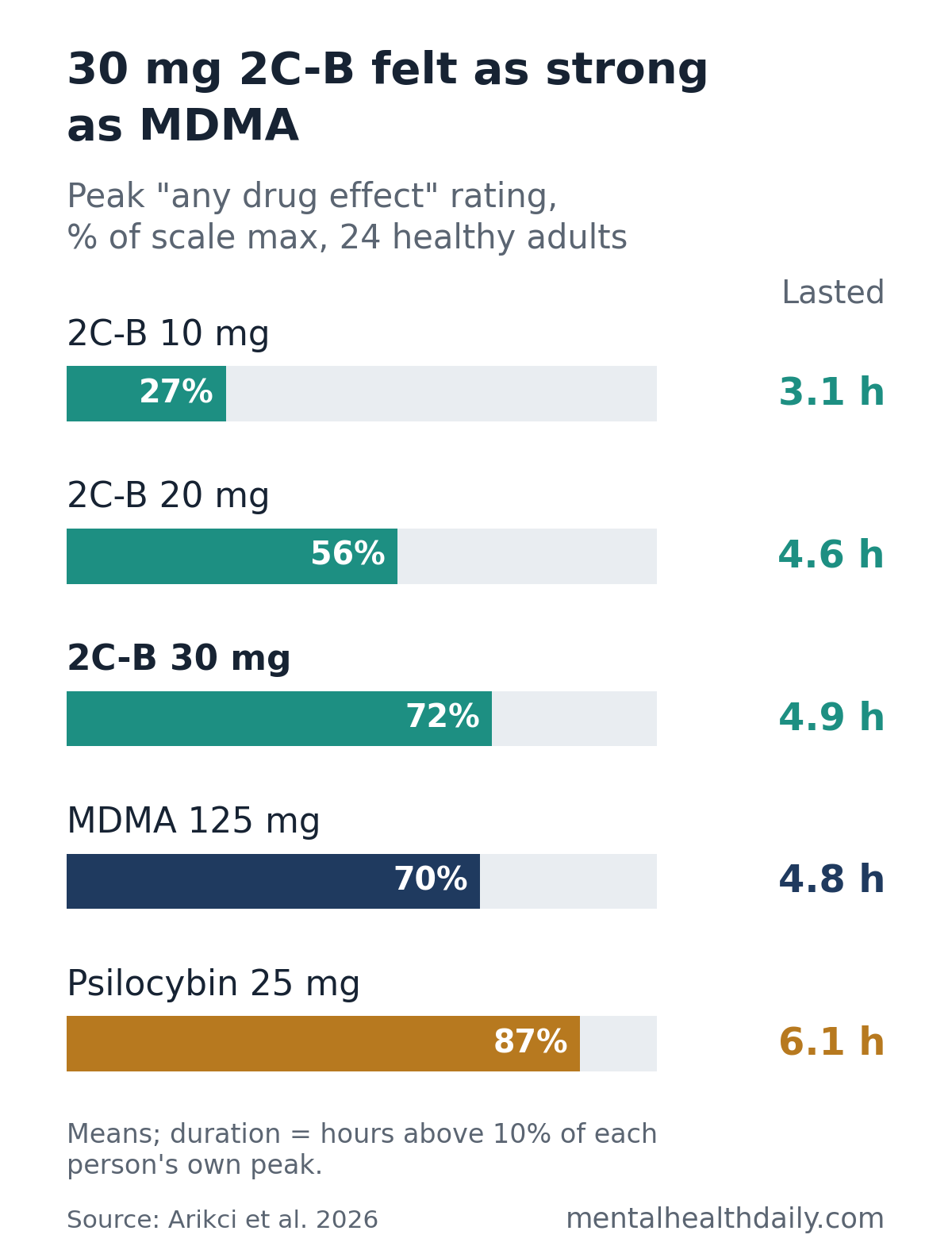
- 30 mg matched MDMA's intensity: Peak "any drug effect" ratings averaged 72% of the scale maximum with 2C-B 30 mg, 70% with MDMA 125 mg, and 87% with psilocybin 25 mg.1
- Shorter than psilocybin: Effects lasted 4.9 hours on average with 30 mg 2C-B, 4.8 with MDMA, and 6.1 with psilocybin. 2C-B's blood half-life was only 1.3 hours.1
- Fewer bad-trip signals: Only psilocybin raised "bad drug effect" and "anxiety" ratings above placebo, and 1 volunteer quit the study after a difficult psilocybin session.1
- Easier on blood pressure: Even at 30 mg, 2C-B raised blood pressure significantly less than MDMA or psilocybin. MDMA produced the biggest overall cardiovascular load.1
- No therapy data yet: These were single doses in 24 screened, healthy volunteers, with 0 patients and no treatment outcomes.
Those results describe single doses in healthy volunteers; no one has yet tested 2C-B as a treatment for any psychiatric condition.
MDMA and psilocybin are the 2 reference drugs of modern psychedelic medicine. MDMA is an entactogen, a drug that mainly produces warmth, openness, and closeness to others. Psilocybin is a classic psychedelic, which mainly alters perception, thinking, and sense of self.
2C-B sits between them on paper. First made by chemist Alexander Shulgin in 1974, it acts mainly on the serotonin 5-HT2A receptor, the same target psilocybin uses, and it also weakly blocks the serotonin transporter that MDMA hits hard.1
Recreational users have long described it as MDMA-like at low doses and more psychedelic at higher ones. This trial was the first to put that description to a controlled test against both prototypes at once.
30 mg 2C-B Matched MDMA's Strength, Not Psilocybin's
Arikci et al., working in Matthias Liechti's clinical pharmacology group at University Hospital Basel, gave each volunteer all 6 conditions in random order, at least 10 days apart:1
- Participants: 24 healthy adults, 12 women and 12 men, average age 36
- Conditions: placebo; 2C-B at 10, 20, and 30 mg; MDMA 125 mg; psilocybin 25 mg, all taken by mouth
- Blinding: neither volunteers nor staff knew which drug was given each day
- Measurements: ratings, vital signs, and blood samples for 9 hours after each dose
The main intensity measure was a visual analog scale: volunteers marked on a line how strongly they felt "any drug effect," from nothing to the maximum possible. 2C-B rose steadily with dose. At 10 mg it was barely noticeable, averaging 27% of the scale maximum. At 20 mg it reached 56%, and at 30 mg, 72%.1
That top dose landed right beside MDMA at 70%. Psilocybin was stronger, at 87%, and the gap between psilocybin and 30 mg 2C-B was statistically significant.
Strength is not the same as pleasantness. Ratings of "good drug effect" and feeling "high" were similar for 30 mg 2C-B, MDMA, and psilocybin. The 3 drugs differed less in how good they felt than in how intense and how unsettling they were.1
What 2C-B Felt Like: Part MDMA, Part Psilocybin
On the social items, 2C-B at 20 and 30 mg behaved like MDMA. Both raised ratings of trust, openness, closeness to others, and wanting to be with other people. So did psilocybin. The 10 mg dose did nothing measurable on these items.1
One result cut the other way: 30 mg 2C-B and psilocybin, but not MDMA, also raised ratings of "want to be alone." That fits a drug with a psychedelic, inward-turning side as well as a social one.
On perception, 2C-B sat in the middle. At 30 mg it changed vision, produced more synesthesia (sounds triggering visual experiences), and loosened the sense of self more than MDMA did, but less than psilocybin.1
The researchers also used the 5D-ASC, a standard questionnaire filled out at the end of the day that scores how far consciousness departed from normal. Overall, 30 mg 2C-B changed consciousness about as much as MDMA and less than psilocybin. Its pattern differed from MDMA's, though: MDMA produced almost purely positive states such as bliss and insight, while 2C-B added clear perceptual changes.1
Empathy rose without an oxytocin surge
On the Multifaceted Empathy Test, which asks people how much they feel for people shown in photos, both 30 mg 2C-B and MDMA increased emotional empathy toward positive images. Psilocybin did the opposite on the thinking side: it made people worse at identifying the emotions in the photos, and worse at recognizing fear on faces.1
Only MDMA raised blood levels of oxytocin, a hormone tied to bonding, and its marker neurophysin I. 2C-B and psilocybin did not.1 The same lab saw the same split in 2020: MDMA 125 mg raised oxytocin while LSD did not.5 Whatever warmth 2C-B produces, it does not appear to run through a large oxytocin release.
That empathy result does not fully match earlier work. A 2023 Dutch trial of 20 mg 2C-B found no empathy increase on the same test, and a 2015 Spanish study of 20 recreational users found 2C-B made happy faces harder to recognize.2, 4 Dose, timing, and study design differed across all 3.
Only Psilocybin Raised Anxiety and "Bad Drug Effect" Ratings
The clearest difference between the drugs was distress. Only psilocybin increased ratings of "bad drug effect" and "anxiety" compared with placebo. The researchers described those increases as weak, but 30 mg 2C-B and MDMA produced none that separated from placebo.1
The end-of-day questionnaires agreed. Psilocybin produced more distressing effects than both 30 mg 2C-B and MDMA, and it was the only drug to raise the anxiety subscale.1
The Dutch trial found the same direction at lower doses. Comparing 20 mg 2C-B with 15 mg psilocybin in 22 people with prior psychedelic experience, Mallaroni et al. found that dysphoria and anxious ego dissolution were greatest under psilocybin, and they labeled 2C-B a psychedelic of "moderate experiential depth."2
This is a dose comparison, not proof that 2C-B is inherently gentler. Psilocybin 25 mg is a full therapeutic dose, and 30 mg 2C-B was still weaker overall. The Basel authors speculated that 40 mg of 2C-B might produce psilocybin-like intensity, distress included.1 They did not test it.
On the broader side-effect checklist, every condition except 10 mg 2C-B raised total complaints above placebo. There were no severe adverse events. 2 enrolled volunteers withdrew, 1 of them after a challenging psilocybin session in the first study day.1
MDMA Worked the Heart Hardest; 2C-B Raised Blood Pressure Least
2C-B raised blood pressure with each dose step, but only slightly. Even at 30 mg, the increase was significantly smaller than with MDMA or psilocybin, which raised blood pressure by similar amounts.1
Heart rate followed a different pattern:
- 2C-B 10 and 20 mg: no increase over placebo
- 2C-B 30 mg: a significant increase, similar to psilocybin
- MDMA: a larger increase than either
Combining the 2 into the rate pressure product, a rough index of how hard the heart is working, MDMA came out highest, followed by psilocybin and 2C-B. None of the drugs changed the QT interval on the heart tracing, a marker of rhythm risk.1
Body temperature was the exception to the "MDMA is hardest on the body" pattern. Psilocybin and 2C-B at 20 and 30 mg raised temperature above placebo; MDMA did not in this study.1
2C-B is not cardiovascularly inert. In a 2018 Spanish observational study, 16 experienced users who took 10 to 20 mg at home showed peak rises of 19 mmHg in systolic pressure and 13 beats per minute in heart rate.3 That study had no placebo, so part of the rise may reflect setting and expectation.
1.3-Hour Half-Life Explains 2C-B's Shorter Session
Blood levels of 2C-B rose in step with dose, peaking about 2 hours after each dose. Its elimination half-life, the time for blood levels to fall by half, was 1.3 hours at every dose.1
- 2C-B: half-life 1.3 hours; effects lasted 4.9 hours at 30 mg
- Psilocin (psilocybin's active form): half-life 2.0 hours; effects lasted 6.1 hours
- MDMA: half-life 9.4 hours; effects lasted only 4.8 hours
For 2C-B and psilocybin, the felt effects tracked blood levels closely. MDMA was the outlier: its effects faded long before the drug left the body.1
The authors suggested that a roughly 5-hour session instead of 6 could be a practical advantage of 2C-B over psilocybin in a clinic. That is an argument about staffing and cost, not about benefit to patients.
Blinding Held Better for 2C-B Than for MDMA
After each session, volunteers guessed what they had taken. Right after the session, they identified 2C-B and psilocybin correctly only about 50% of the time, but spotted MDMA 79% of the time and placebo 67%.1
By the end of the study, when people could compare all their sessions, only 38% correctly identified 30 mg 2C-B, and another 38% mistook it for psilocybin. MDMA and psilocybin were never mistaken for each other.1
Future 2C-B trials could benefit. When most people can tell they received the active drug, as happened with MDMA here, expectation can inflate the difference from placebo. A drug that is harder to identify is easier to test fairly.
Is 2C-B a Plausible Therapy Candidate?
Plausible, not promising yet. The acute profile checks several boxes that matter for a clinic:
- MDMA-like social effects and emotional empathy at 30 mg
- less measured distress than a standard psilocybin dose
- a smaller blood pressure rise than either comparator
- a session about 1 hour shorter than psilocybin's
What it lacks is any evidence of benefit. MDMA reached its current position through patient trials. In a 2021 phase 3 trial in 90 people with severe PTSD, 3 MDMA sessions combined with therapy reduced symptoms far more than therapy with placebo, an effect size of 0.91.6
2C-B has no comparable randomized patient data. The only therapeutic experience the Basel authors cited was a 2015 report on underground psychotherapy in Zurich.1
Pleasant, manageable acute effects in healthy volunteers are a reason to run patient trials, not a substitute for them. Senior author Liechti also consults for 2 psychedelic-drug developers, Definium Therapeutics and Resilient Pharmaceuticals.1
Street 2C-B, "Tusi," and "Pink Cocaine" Are Different Products
The lab results apply to pure, weighed doses of 2C-B. Street products sold under related names often contain something else entirely.
Tusi, also sold as "pink cocaine," reportedly began in Colombia as a pink-dyed 2C-B product. Today it is usually a pink powder of ketamine and MDMA, yet in a Spanish survey 41.8% of respondents believed it contained 2C-B. A 2025 review summarized drug-checking data:7
- Spain: of 470 samples sold as tusi from 2020 to 2024, 93.2% contained ketamine, 92.1% contained MDMA, and 3.6% contained 2C-B
- United States: of about 960 pink powder samples tested by DEA laboratories by 2024, 4 contained any 2C-B
Mislabeling within the 2C family is its own hazard. In a 2017 Swiss case report, a 19-year-old who took a substance sold as 2C-B arrived at an emergency department with severe hallucinations, agitation, and a racing heart. Testing found 2C-P, a more potent relative, with an estimated half-life of 19 hours, compared with 2C-B's 1.3.8, 1
None of the Basel findings on blood pressure, distress, or duration carry over to a snorted ketamine–MDMA mixture or to a misidentified 2C drug.
Limits of the Basel 2C-B Trial
- Healthy volunteers only: 24 screened adults who had contacted the group wanting to join a psychedelic study. People with depression, PTSD, or heart disease may respond differently.
- Single doses: each drug was given once, in a calm hospital setting, with no therapy and no follow-up of lasting effects.
- 1 dose per comparator: MDMA and psilocybin were each tested at one dose, and 2C-B stopped at 30 mg.
- Imperfect blinding: 79% identified MDMA by study end, so expectation may have colored some ratings.
- Numbers in the supplement: the main paper reports most mood, blood pressure, and heart rate results as directions and p-values; the peak values are in online supplementary tables.
Questions About 2C-B vs. MDMA and Psilocybin
Is 2C-B more like MDMA or more like psilocybin?
Both, depending on the measure. At 30 mg it matched MDMA in overall strength, duration, social effects, and emotional empathy, but its perceptual effects and its "want to be alone" ratings looked more like psilocybin. By the end of the study, volunteers mistook it for psilocybin as often as they identified it correctly.1
Is 2C-B less likely than psilocybin to cause a bad trip?
Unknown. The trials did not estimate how often bad trips occurred. At the doses tested, 25 mg psilocybin produced higher anxiety and "bad drug effect" ratings than 30 mg 2C-B, and a 2023 trial found the same direction at lower doses.1, 2 But 30 mg 2C-B was also weaker overall, and higher 2C-B doses were not tested.
Is 2C-B safer for the heart than MDMA?
In this lab setting, 2C-B raised blood pressure less than MDMA and produced a lower overall cardiovascular load. That comparison covers pure single doses in healthy adults, not mixed street products, repeated doses, or people with heart conditions.1
Is tusi the same thing as 2C-B?
Usually not. Most samples sold as tusi contain ketamine and MDMA, and only a small share contain any 2C-B.7
Why doesn't 2C-B raise oxytocin if it increases empathy?
The trial could not answer that. It showed that 2C-B's empathy effect at 30 mg occurred without a measurable rise in blood oxytocin, which suggests a route other than the large oxytocin release MDMA triggers.1, 5
References
- Acute dose-dependent effects of 4-bromo-2,5-dimethoxyphenethylamine (2C-B) compared with 3,4-methylenedioxymethamphetamine (MDMA) and psilocybin in a double-blind, placebo-controlled study in healthy participants. Arikci D, et al. Neuropsychopharmacology. 2026;51:1511-1518. doi:10.1038/s41386-026-02428-9
- Assessment of the Acute Effects of 2C-B vs. Psilocybin on Subjective Experience, Mood, and Cognition. Mallaroni P, et al. Clin Pharmacol Ther. 2023;114(2):423-433. doi:10.1002/cpt.2958
- Acute Pharmacological Effects of 2C-B in Humans: An Observational Study. Papaseit E, et al. Front Pharmacol. 2018;9:206. doi:10.3389/fphar.2018.00206
- Acute Effects of the Novel Psychoactive Drug 2C-B on Emotions. González D, et al. Biomed Res Int. 2015;2015:643878. doi:10.1155/2015/643878
- Distinct acute effects of LSD, MDMA, and D-amphetamine in healthy subjects. Holze F, et al. Neuropsychopharmacology. 2020;45:462-471. doi:10.1038/s41386-019-0569-3
- MDMA-assisted therapy for severe PTSD: a randomized, double-blind, placebo-controlled phase 3 study. Mitchell JM, et al. Nat Med. 2021;27:1025-1033. doi:10.1038/s41591-021-01336-3
- An Update on the Epidemiology of Tusi ("Pink Cocaine"). Abukahok N, et al. Curr Addict Rep. 2025;12:90. doi:10.1007/s40429-025-00706-y
- Mistaking 2C-P for 2C-B: What a Difference a Letter Makes. Stoller A, et al. J Anal Toxicol. 2017;41(1):77-79. doi:10.1093/jat/bkw108