
Depression trials usually judge a treatment by one number: how much a symptom score drops. When 229 people in the UK were asked to split 100 points across the outcomes measured in two cognitive behavioral therapy (CBT) trials, they did not put everything on symptoms. Service users and clinicians spread their points across several outcomes, and quality of life got the same median share as depression symptoms: 20 points out of 100.1
The 2026 study in the British Journal of Psychiatry is a survey of priorities. It did not test a treatment, but it puts numbers on a long-running concern that symptom scores miss much of what people want from treatment.
Research Highlights
- No single outcome won: in both outcome lists, the top-rated outcomes each got a median of 20 of 100 points, and no group put all its weight on a single outcome.1
- Quality of life matched symptoms: on the first list, average points for quality of life (19.2 to 22.4) sat close to those for depression symptoms (20.2 to 26.2) across the three groups, and quality of life did not differ significantly between groups.1
- Three groups took part: 57 service users with minimal current symptoms, 108 with current symptoms, and 64 clinicians.1
- Age mattered: older participants gave more weight to depression symptoms relative to employment and service use; younger participants gave more weight to panic.1
- Trials rarely track it: a review of 450 depression trials found the most common quality-of-life questionnaire was a primary outcome in only 1% of them.1
Why Depression Trials Focus on Symptom Scores
Every randomized trial names a primary outcome: the one measure that decides whether the treatment "worked." In depression research that is almost always a symptom scale, such as the Beck Depression Inventory (BDI-II) or the Hamilton scale. Other results, like quality of life or getting back to work, usually sit further down as secondary outcomes, if they are measured at all.
People with depression have been saying for years that this misses a lot. In a 2006 survey of 535 outpatients in treatment for major depression, the factors most often rated very important for deciding whether someone was in remission were optimism and self-confidence, feeling like one’s usual self, and getting back to one’s usual level of functioning. Absence of symptoms mattered too, but it was one factor among many.6 A much larger international survey in 2020 collected open-ended answers from 1,912 patients, 464 family caregivers, and 627 health professionals and identified 80 outcome areas that matter, including mental pain, motivation, and social isolation. The authors noted that many of them are rarely measured in trials.4
That 2020 work was meant as a first step toward a core outcome set for depression: an agreed minimum list of outcomes that every trial of a condition should measure and report, so results can be compared and nothing patients care about gets left out.4 What those earlier studies could not show well was how much each outcome matters compared with the others. Ranking tells you the order but not the distance between items, and simple rating scales tend to end with people calling everything "very important."
How the Point-Allocation Survey Worked
The King’s College London team used a fixed-point allocation task, which has not been used in depression research before. Participants got 100 points to spread across a list of outcomes. They could give equal points to outcomes they saw as equally important, but the total had to be 100, so giving more to one outcome meant giving less to another.1
The outcome lists were not invented for the survey. They came straight from the published reports of two completed UK trials of CBT for depression:
- CLASSIC, a trial of one-day CBT self-confidence workshops for adults with depression.2 Seven outcomes: depression symptoms, anxiety symptoms, self-esteem, satisfaction with treatment, less use of health services, employment, and quality of life.
- CoBalT, a trial of 12 to 18 sessions of individual CBT added to usual care for people whose depression had not responded to antidepressants.3 Six outcomes: depression symptoms, remission, anxiety, panic, and less impact on daily activities from mental health problems and from physical health problems.
In both trials, depression symptoms on the BDI-II were the primary outcome.1 Everyone did the task twice, once per list, and then could explain their choices and suggest missing outcomes in free text.
The people answering were a new sample, not the original trial participants. Between February and October 2025, the team recruited adults aged 18 to 75 through charities, social media, earlier research cohorts, and a London NHS trust. Service users were split by their current BDI-II score: 18 or lower for the minimal-symptom group (average score 7.8) and 19 or higher for the currently symptomatic group (average 33.1). Clinicians were psychologists, mental health nurses, doctors, and others who treat depression.1
Quality of Life Scored About as High as Depression Symptoms
On the CLASSIC list, depression symptoms got the highest average share from both service-user groups: 26.2 points from the minimal-symptom group and 22.3 from the currently symptomatic group. Clinicians put quality of life first at 22.4 points, just ahead of depression symptoms at 20.2. Medians, which are less swayed by a few extreme answers, were 20 for both outcomes in all three groups.1
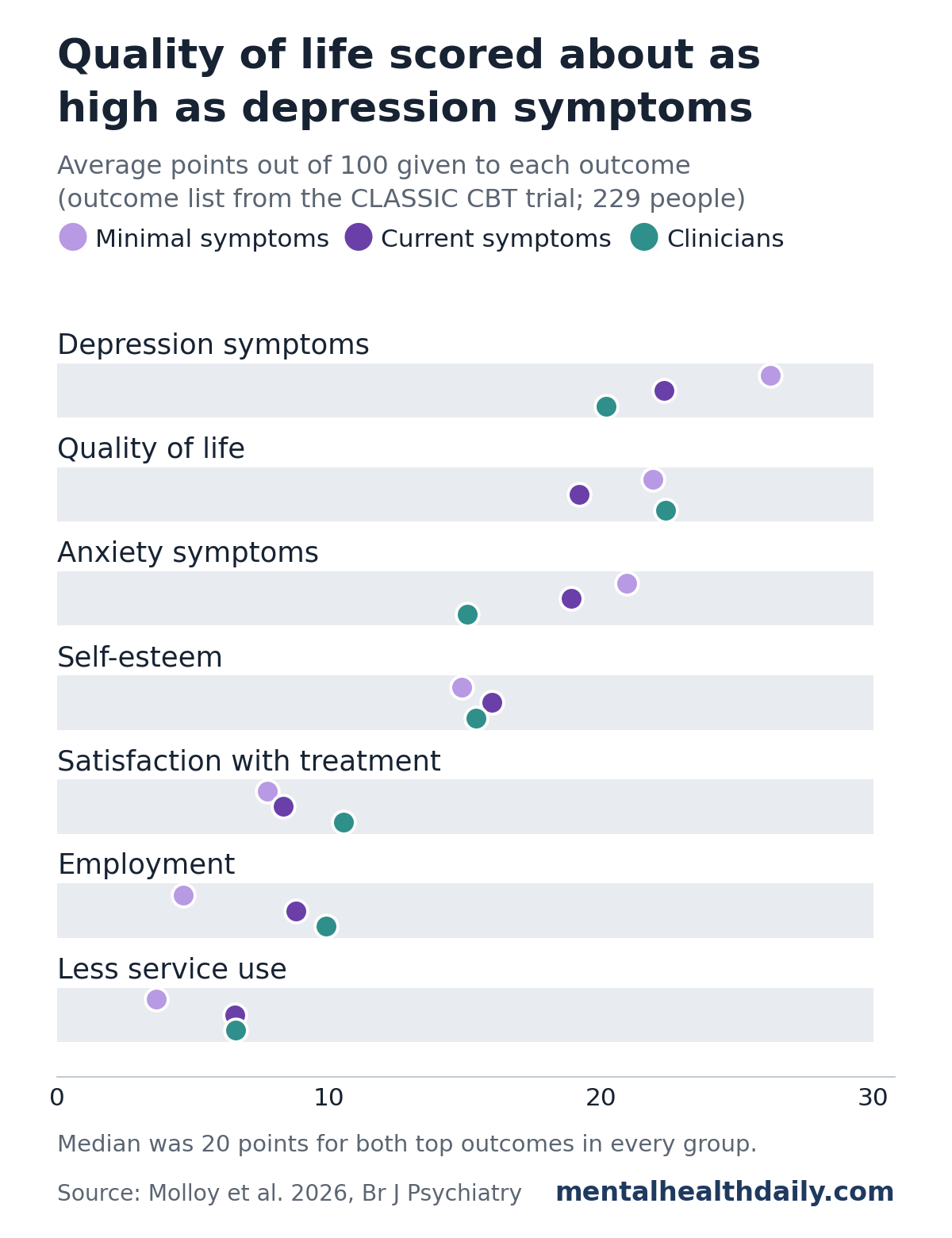
Across all groups, points clustered on 3 or 4 outcomes: depression symptoms, anxiety, daily functioning where it was on the list, and quality of life. On the CLASSIC list, service use and employment got the fewest points; the median for both was 0 in the minimal-symptom group.1
On the CoBalT list, average points for depression symptoms were nearly identical in all three groups (21.4, 21.2, and 21.3). Service users with minimal symptoms gave their highest share to remission (23.0 points). Less impact on daily activities from mental health problems scored close behind, at 19.6 to 21.1 points. Depression symptoms, remission, and mental-health impact on activities all had a median of 20 in every group.1
The averages hide a lot of individual variety. Standard deviations for depression symptoms ran as high as 16 points among service users, so some people gave symptoms far more than 20 points and others far fewer.1 The free-text answers explain why:
- Symptoms first: some saw symptom relief or remission as the foundation that everything else follows from.
- Living well with symptoms: others, including some with long-term depression, said full remission felt unrealistic and cared more about daily life and functioning. One currently symptomatic participant gave quality of life and daily tasks 50 of the 100 points.
- Anxiety varied: some described anxiety as more disabling than low mood; others barely experienced it.
Asked what was missing, participants named a sense of purpose and identity, emotional stability, social connection, and the skills to spot and manage a relapse on their own.1 None of these were on either trial’s list.
Where Clinicians and Service Users Differed
The overall pattern of points differed between groups, with small-to-moderate effects that were stronger for the CoBalT list. The clearest difference: compared with currently symptomatic service users, clinicians put relatively less weight on depression symptoms and more on the practical outcomes. On the CLASSIC list, clinicians weighted symptoms less relative to service use and employment. On the CoBalT list, they weighted symptoms, remission, and mental-health impact less relative to the impact of physical health on daily activities.1
Service users with minimal symptoms leaned the other way. On the CoBalT list, they gave more relative weight than currently symptomatic participants to symptoms, remission, and mental-health impact over physical-health impact.1 That fits the free-text answers, where the view of remission as the foundation for everything else showed up most in the minimal-symptom group.
Age predicted priorities across the whole sample. Older participants gave more weight to depression symptoms relative to employment and service use, and younger participants gave more weight to panic symptoms. Within the currently symptomatic group, age, education, and years lived with depression also predicted how points were spread; people with a postgraduate degree put less weight on anxiety than those with an undergraduate degree. Characteristics did not predict priorities in the minimal-symptom group, and no individual effects in the clinician group survived correction for multiple testing.1
A Gap Between What Trials Measure and What People Value
Quality of life stands out because it scored high in every group and yet is rarely a trial’s deciding outcome. The authors point to a review of 450 depression trials in which the EQ-5D, the most widely used quality-of-life questionnaire, was the primary outcome in 1% and a secondary outcome in 7%.1 That same review found 388 different outcome measures across the 450 trials. The most common one, the Hamilton scale, was used in at most 40% of trials and covered at most 47 of the 80 outcome areas that patients say matter.5
The authors’ proposed fix is a stakeholder-weighted composite outcome: a single trial score that combines several outcomes, with each one weighted by how much patients and clinicians value it. A treatment that improved quality of life and daily functioning but moved symptom scores only a little would then get more credit than it does today. The authors frame this as future work; the study shows that such weights can be collected, and it does not build or test a composite.1
What the Survey Can and Cannot Tell Us
This is a careful first attempt at weighting depression outcomes, with lived-experience advisers involved in the analysis and co-authoring the paper. It has clear limits:
- It says nothing about which treatment works. The survey measured preferences. It did not re-analyze CLASSIC or CoBalT or compare therapies.
- Short, borrowed lists. Participants could only weigh 6 or 7 outcomes from two UK CBT trials, and they named important outcomes that were not on either list.
- Fixed order. Outcomes always appeared in the same order. There was no sign that earlier items got extra points, but later-listed outcomes got slightly more.
- Online, UK-only, self-selected sample. Community participants self-reported depression with no diagnostic check, and some groups (such as ethnicity categories) had to be combined for analysis.
- Many exploratory tests. The analysis plan was not preregistered. The team corrected for multiple comparisons, but some of the smaller predictor findings could be chance.
- Not a universal scale. The authors expect weights to depend on context and population, so these numbers are a starting point for other trials, not a formula to copy.
The main result is consistent with earlier patient surveys going back two decades: people want to feel better, but they also want their lives back, and a symptom score alone does not capture that.46 What this study adds is a number. When forced to trade outcomes off against each other, people with depression and the clinicians who treat them gave quality of life roughly the same weight as the symptom scores that decide most trials.
References
- Molloy N, Fabian H, Madigan A, et al. Using point allocation to identify outcomes that matter: results from two cognitive behavioural therapy trials for depression. The British Journal of Psychiatry. 2026:1–9. doi:10.1192/bjp.2026.10765
- Horrell L, Goldsmith KA, Tylee AT, et al. One-day cognitive–behavioural therapy self-confidence workshops for people with depression: randomised controlled trial. The British Journal of Psychiatry. 2014;204(3):222–233. doi:10.1192/bjp.bp.112.121855
- Wiles N, Thomas L, Abel A, et al. Cognitive behavioural therapy as an adjunct to pharmacotherapy for primary care based patients with treatment resistant depression: results of the CoBalT randomised controlled trial. The Lancet. 2013;381:375–384. doi:10.1016/S0140-6736(12)61552-9
- Chevance A, Ravaud P, Tomlinson A, et al. Identifying outcomes for depression that matter to patients, informal caregivers, and health-care professionals: qualitative content analysis of a large international online survey. The Lancet Psychiatry. 2020;7(8):692–702. doi:10.1016/S2215-0366(20)30191-7
- Veal C, Tomlinson A, Cipriani A, et al. Heterogeneity of outcome measures in depression trials and the relevance of the content of outcome measures to patients: a systematic review. The Lancet Psychiatry. 2024;11(4):285–294. doi:10.1016/S2215-0366(23)00438-8
- Zimmerman M, McGlinchey JB, Posternak MA, et al. How should remission from depression be defined? The depressed patient’s perspective. American Journal of Psychiatry. 2006;163(1):148–150. doi:10.1176/appi.ajp.163.1.148