
Six widely used SSRI antidepressants showed broadly similar side effect reporting in Europe’s drug-safety database, with a few standouts: more dizziness reports for escitalopram and more drowsiness reports for fluvoxamine and paroxetine.1
Research Highlights
- Escitalopram and dizziness: dizziness made up a larger share of escitalopram’s reports than of the other SSRIs’ reports (reporting odds ratio 1.42, 95% CI 1.25–1.61).1
- Drowsiness with fluvoxamine and paroxetine: reporting odds ratios of 1.86 (1.27–2.72) and 1.58 (1.33–1.89). Sertraline stood out slightly for headache (1.17, 1.04–1.30).1
- No standouts for suicidal thoughts: no single SSRI had significantly higher reporting of suicidal ideation, anxiety, or insomnia than the other SSRIs.1
- Large real-world dataset: 21,665 reports covering 78,132 adverse events in adults aged 18–64, filed to EudraVigilance from 2020 through 2024.1
- Reports, not risk: the database has no count of how many people took each drug, so these numbers describe reporting patterns, not how often side effects happen.1
How the EudraVigilance SSRI Study Worked
SSRIs (selective serotonin reuptake inhibitors) block the recycling of serotonin back into nerve cells, which raises serotonin signaling in the brain. They are first-line treatment for depression and are also used for anxiety disorders, obsessive-compulsive disorder, and panic disorder.
Laino et al., a pharmacovigilance team in Naples, Italy, pulled every report in EudraVigilance that named 1 of 6 SSRIs as a suspected cause of an adverse event. EudraVigilance is the European Medicines Agency’s database of suspected drug reactions, filed by healthcare professionals, patients, and drug companies.1
- Drugs: sertraline, escitalopram, citalopram, fluoxetine, paroxetine, and fluvoxamine.
- Reports: 21,665 individual case safety reports from January 2020 through December 2024, restricted to adults aged 18–64.
- Events: 78,132 reported adverse events, about 3.6 per report.
- Who reported: 61.6% of reports came from healthcare professionals; 64.8% involved women.
The comparison method. Researchers used a reporting odds ratio (ROR): for each SSRI, they asked whether a given event made up a bigger share of that drug’s reports than of the other 5 SSRIs’ reports combined. An ROR of 1.0 means equal reporting. A “signal” was counted when the lower end of the 95% confidence interval sat above 1.1
Comparing SSRIs only with other SSRIs is a deliberate choice. People taking SSRIs tend to share similar conditions, so this approach cuts down on differences that come from the illness rather than the drug.
Which SSRI Side Effects Were Reported Most Often
Sertraline accounted for the most reported events (26,161; 33.4%), followed by escitalopram (16,950; 21.7%). Fluvoxamine had by far the fewest (1,383; 1.7%).1 Raw totals say little about risk, since they depend on how many people take each drug.
The 2 biggest categories were psychiatric and nervous system events:
- Psychiatric events (15,293; 19.6%): most often anxiety (1,135), insomnia (897), and suicidal ideation (813).
- Nervous system events (12,313; 15.8%): most often headache (1,392), dizziness (1,239), and somnolence, the medical term for drowsiness or excessive sleepiness (863).
- Sexual and reproductive events (2,319; 3.0%): led by sexual dysfunction (434) and erectile dysfunction (404).
- Heart-related events (2,229; 2.9%): led by palpitations (514) and fast heart rate (337).
- Metabolism and appetite events (1,683; 2.2%): led by decreased appetite (462) and low blood sodium (196).
Seriousness. The largest single group of events (43.1%) was classed as not serious. Another 25.1% were labeled “other medically important condition,” a regulatory catch-all for events judged significant that do not fit the other serious categories, and 16.8% involved hospitalization.1
About 5.2% of events were listed with a fatal outcome. Those reports cannot show the SSRI caused the death: every report named at least 1 other suspected drug, and overdose reports are part of the dataset. The outcome was simply unknown for 35.3% of events.1
Escitalopram, Paroxetine, Fluvoxamine, and Sertraline Each Stood Out for One Symptom
The team ran the drug-by-drug comparison on the 2 biggest categories and on their 3 most common symptoms each. Only 7 comparisons showed a clear signal of higher reporting for one drug:1
- Fluvoxamine, drowsiness: ROR 1.86 (1.27–2.72)
- Paroxetine, drowsiness: ROR 1.58 (1.33–1.89)
- Escitalopram, dizziness: ROR 1.42 (1.25–1.61)
- Sertraline, headache: ROR 1.17 (1.04–1.30)
- Fluvoxamine, all psychiatric events: ROR 1.15 (1.01–1.31)
- Paroxetine, all nervous system events: ROR 1.10 (1.04–1.16)
- Escitalopram, all psychiatric events: ROR 1.08 (1.03–1.13)
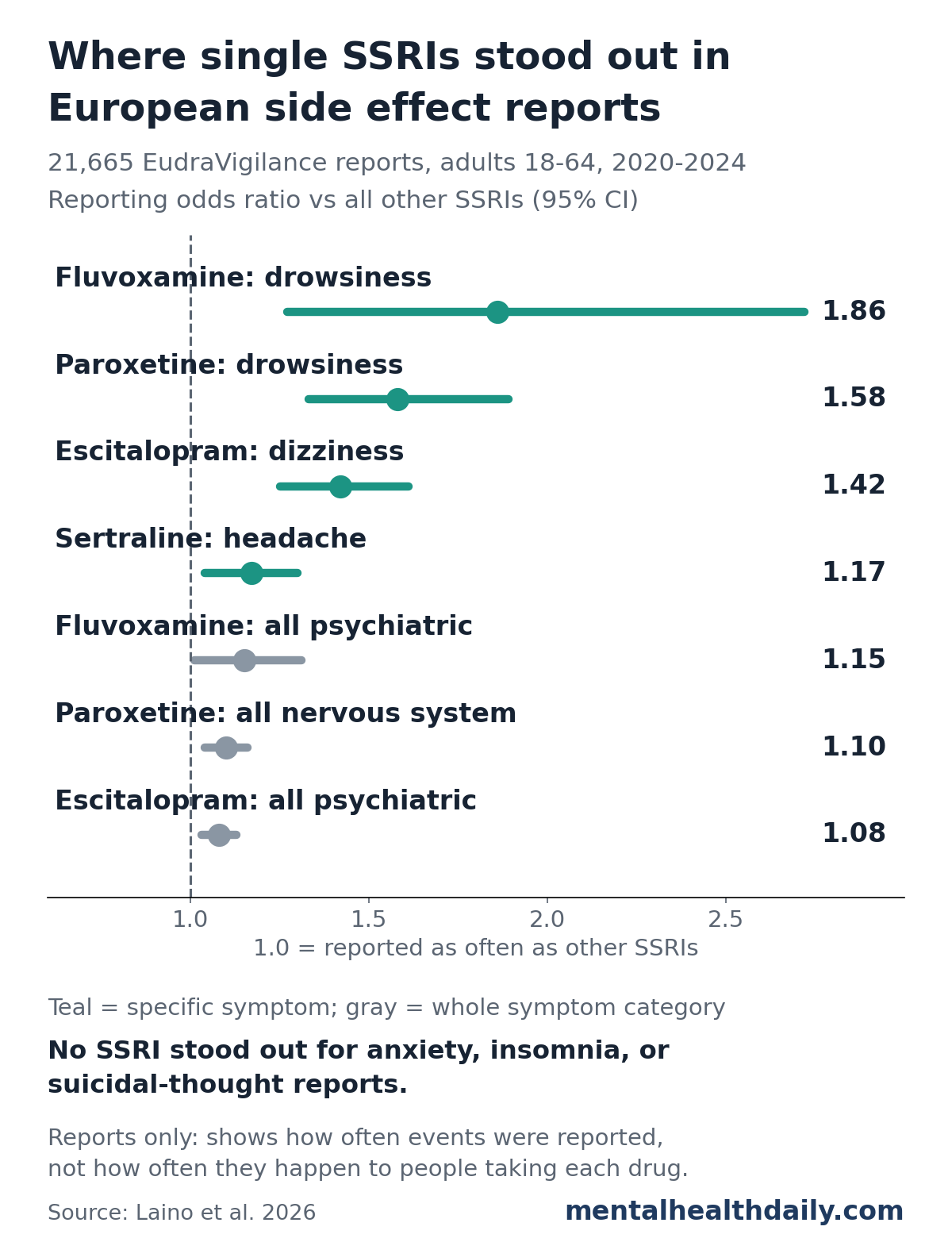
Specific symptoms told more than broad categories. Paroxetine’s nervous system signal turned out to be driven by drowsiness, not headache or dizziness. Escitalopram’s nervous system total looked ordinary (ROR 1.02), yet dizziness alone stood out. The researchers note that category-level results can hide clinically relevant differences that show up only at the symptom level.1
Fluvoxamine’s numbers are the least stable. With only 1,383 events, its intervals are wide; the drowsiness estimate spans 1.27 to 2.72. The researchers flag fluvoxamine results specifically as needing caution.1
No SSRI Had Significantly Higher Reporting of Suicidal Thoughts, Anxiety, or Insomnia
Within psychiatric events, none of the 6 drugs showed disproportionately higher reporting of anxiety, insomnia, or suicidal ideation compared with the other SSRIs. For suicidal ideation, every drug’s ROR fell between 0.86 and 1.08, with all intervals crossing 1.1
That is a comparison between SSRIs, not a comparison with no treatment. It says the individual drugs looked alike on this outcome in the reports, and it does not measure the overall suicidal-thinking risk linked to SSRIs, which is higher in children and teens.1
If you or someone you know is having thoughts of suicide, contact a crisis line right away. In the US, call or text 988 to reach the 988 Suicide & Crisis Lifeline.
How the Reporting Signals Compare With Randomized Trials
Randomized trials count side effects in people who were actually assigned a drug or placebo, so they can estimate how often side effects occur, which a reporting database cannot. Their results line up with some of the EudraVigilance signals and not others.
- Fluvoxamine and drowsiness: consistent. A 2023 network meta-analysis of 216 depression trials (64,696 patients) found 13 antidepressants raised the odds of somnolence vs placebo, with fluvoxamine ranked highest (OR 6.32, 95% CI 3.56–11.21). That fluvoxamine estimate came from a single 295-person trial and was rated very low certainty.3
- Headache: a small class effect, different drug. A 2018 meta-analysis of 117 placebo-controlled trials found SSRIs as a group only slightly raised headache risk (RR 1.06, 1.00–1.13). Escitalopram was the only individual SSRI with a significant increase (RR 1.18, 1.01–1.37); the authors concluded most headaches after starting an antidepressant are coincidental.2 In the European reports, sertraline stood out for headache and escitalopram did not quite reach the threshold (ROR 1.13, 0.99–1.27).1
- Dizziness: not confirmed in trials. The researchers note that an earlier meta-analysis of trials in older adults found no significant dizziness difference among SSRIs, so the escitalopram signal still needs confirmation.1
- Overall tolerability. In a 2018 network meta-analysis of 21 antidepressants (522 trials, 116,477 participants), citalopram, escitalopram, fluoxetine, and sertraline were among the drugs with the fewest dropouts in head-to-head trials, while fluvoxamine was among those with the highest.4
Limitations of This EudraVigilance SSRI Analysis
Evidence strength: a large, descriptive reporting study. It is good at flagging patterns worth checking and cannot tell you which SSRI causes more side effects. The researchers say so directly: differences between drugs should not be read as differences in their intrinsic safety.1
- No denominators. The database does not know how many people took each drug, so it cannot give rates or true risk.
- Reporting biases. Most reactions are never reported, and well-known effects or ones in the news get reported more.
- Other drugs in the picture. Every report named at least 1 other suspected drug, and 34.0% also listed other medicines taken at the same time.
- Different patients on different SSRIs. SSRIs are prescribed for conditions ranging from depression to obsessive-compulsive disorder. The database lacks diagnosis, severity, and treatment duration, so these differences cannot be adjusted for.
- Incomplete reports. The outcome was unknown for more than a third of events.
- Narrow testing. Only 2 categories and 6 symptoms were compared across drugs; sexual, metabolic, and heart events were counted but not compared. Children and adults 65 and older were excluded.
What This Means If You Take an SSRI
- The 6 SSRIs look more alike than different in real-world reports, consistent with trials that show only modest differences between individual SSRIs.
- Drowsiness with fluvoxamine or paroxetine is a known effect with trial support. The sleep meta-analysis authors suggest fluvoxamine may suit nighttime dosing, a question worth raising with a prescriber.3
- Dizziness with escitalopram and headache with sertraline are small reporting signals, not established differences.
- Do not switch or stop an SSRI based on this study. Stopping suddenly can cause withdrawal-type symptoms, and changes should be planned with a prescriber.
- Report side effects. Patients can file reports directly to national regulators in Europe (and to the FDA’s MedWatch in the US), which is how databases like this one find signals.
References
- Laino LV, Mascolo A, Di Napoli R, et al. Adverse event reporting patterns of selective serotonin reuptake inhibitors (SSRIs): disproportionality analysis using the European spontaneous reporting system. European Archives of Psychiatry and Clinical Neuroscience. 2026. doi:10.1007/s00406-026-02378-9
- Telang S, Walton C, Olten B, Bloch MH. Meta-analysis: second generation antidepressants and headache. Journal of Affective Disorders. 2018;236:60–68. doi:10.1016/j.jad.2018.04.047
- Zhou S, Li P, Lv X, et al. Adverse effects of 21 antidepressants on sleep during acute-phase treatment in major depressive disorder: a systemic review and dose-effect network meta-analysis. Sleep. 2023;46(10):zsad177. doi:10.1093/sleep/zsad177
- Cipriani A, Furukawa TA, Salanti G, et al. Comparative efficacy and acceptability of 21 antidepressant drugs for the acute treatment of adults with major depressive disorder: a systematic review and network meta-analysis. Lancet. 2018;391(10128):1357–1366. doi:10.1016/S0140-6736(17)32802-7