
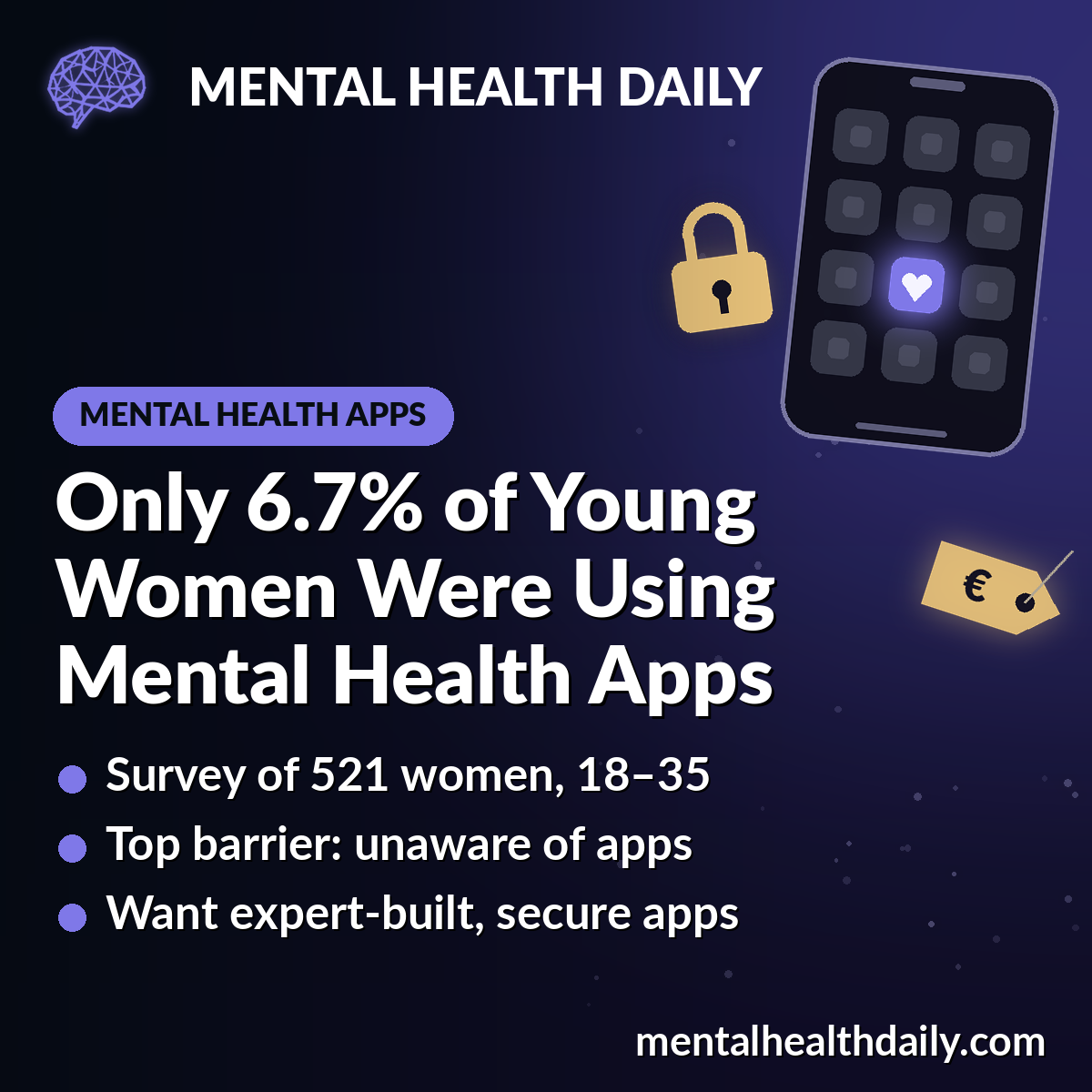
Most young women in a German online survey were not using mental health apps, even though more than a third reported severe distress. The most common reason for never trying one was simply not knowing which apps existed.1
Research Highlights
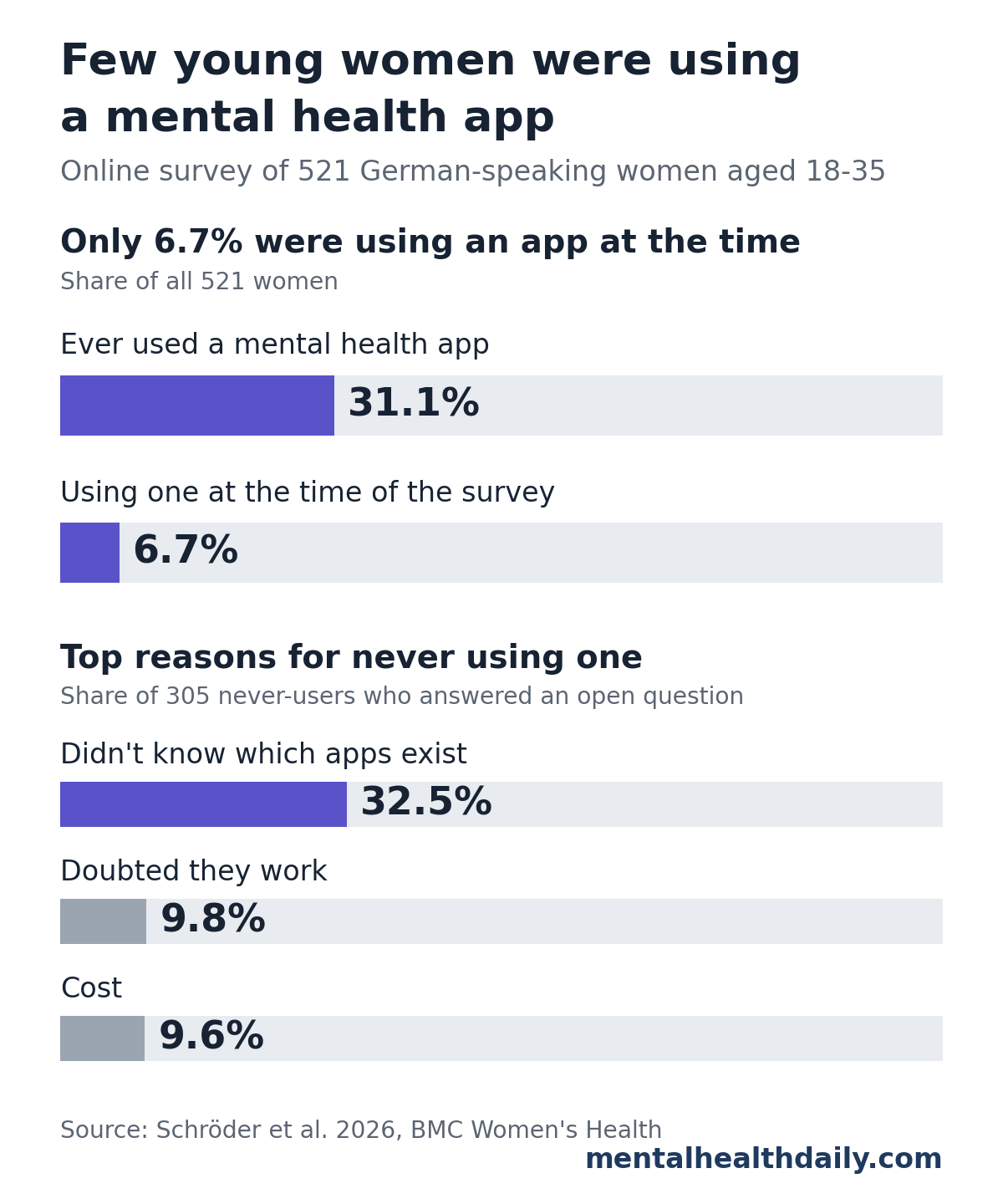
- Tried vs. using now: of 521 women aged 18 to 35, 31.1% had ever used a mental health app, but only 6.7% were using one at the time of the survey.1
- Interest was high: 85.5% of women who had never used an app said they would be willing to.1
- Top barrier was awareness: 32.5% of never-users who explained why named a lack of knowledge about available apps, well ahead of doubts about effectiveness (9.8%) and cost (9.6%).1
- Symptoms, not diagnoses, went with app use: anxiety and appetite or weight problems roughly doubled the odds of app use, while a past diagnosis of a mental disorder made no significant difference.1
- What they wanted: apps built by professionals, with an evidence base, data protection, and access to real people such as psychologists or peers.1
Who Was Surveyed: 521 Young Women, Most With Moderate or Severe Distress
Johanna Schröder et al. at Medical School Hamburg ran an anonymous online survey from March to May 2023 and published the results in BMC Women’s Health in 2026.1 It combined multiple-choice questions with open text answers, so it could count behavior and also capture what women wanted in their own words.
- Sample: 521 women aged 18 to 35 (average age 24.7)
- Recruitment: German-speaking LinkedIn and Instagram, plus the university’s student e-mail list
- Men: the survey was open to all genders, but only 28 men and 3 people of diverse gender took part, so the analysis focused on women
- Mental health history: 44.0% reported having been diagnosed with a mental disorder at some point
Distress was measured with the Kessler Psychological Distress Scale (K-10), a 10-question checklist about anxiety and depression symptoms over the past four weeks. By its cutoffs, only 4.8% of the women had no clinically relevant distress; 22.5% had mild, 37.8% moderate, and 34.9% severe distress.1
The most common ways distress showed up were fatigue or exhaustion (79.3%), worrying or brooding (78.7%), and tension (73.7%), followed by anxiety (64.9%), irritability (62.4%), and depressed mood (58.4%).1
31% Had Tried a Mental Health App, but Only 6.7% Were Using One
The survey defined mental health apps as software downloaded to a phone or tablet to support, maintain, or improve mental health. That covers everything from mood trackers and meditation apps to structured therapy programs.
Apps sat well down the list of places these women had turned to for help when distressed:
- Self-help books: 60.3%
- Psychotherapy: 51.3%
- Primary care: 51.3%
- Mental health apps (ever): 31.1%
- Online programs, often browser-based: 17.1%
Current use was far lower: only 6.7% of all 521 women were using a mental health app when they took the survey. Yet among the women who had never used one, 85.5% said they would be willing to try.1
This gap between interest and use is consistent with earlier research. A 2023 meta-analysis of 10 studies in people with mental disorders found that 72.80% considered apps useful and 78.97% were interested in using them, but only 23.29% actually used one for their condition.2
Real-world usage data show the same drop-off after download. An analysis of 93 popular Android apps for anxiety, depression, or emotional well-being found a median 15-day retention of 3.9% and 30-day retention of 3.3%: only a few percent of people who installed an app were still opening it a month later.3 The survey’s 31.1% vs. 6.7% split fits that pattern, although it did not track when or why women stopped.
Not Knowing Which Apps Exist Was the Top Barrier to Mental Health App Use
Women who had never used a mental health app were asked, in an open question, what had stopped them. Of the 305 who answered, the most common responses were:1
- Lack of knowledge (32.5%): not knowing which apps were available or what they could offer
- Doubts about effectiveness (9.8%): concern that an app would not actually help
- Cost (9.6%): subscription fees or other payment
Smaller groups mentioned not needing an app, lack of trust in an app’s quality or credibility, preferring personal contact, low motivation, and data security concerns.1
Cost in Germany: some certified digital health applications, including certain mental health apps, can be prescribed and paid for by statutory health insurance there. The researchers suggested that awareness of these routes could lower the cost barrier for eligible women, although the survey did not ask about them directly.1
The researchers also pointed to clinicians: many mental health professionals say they know too little about digital tools to recommend them, and a clinician’s recommendation is one of the ways people learn which apps are credible.1
Anxiety and Appetite or Weight Problems Were Linked to App Use
Using logistic regression, the researchers checked which features of distress went with having used a mental health app (at any point, including now). Results are given as odds ratios (ORs): an OR of 2 means about twice the odds of app use, and an OR of 1 means no difference.1
- Overall distress: each additional K-10 point raised the odds of app use by about 3% (OR 1.03, 95% CI 1.01–1.06, p = .012)
- Anxiety: OR 1.99 (95% CI 1.25–3.16, p = .004) with all 15 symptoms in the model together
- Appetite or weight problems: OR 1.95 (95% CI 1.27–2.99, p = .002) in the same model
- Depressed mood: no link (OR 0.85, 95% CI 0.55–1.33)
- Past diagnosis: 33.2% of women with a diagnosed mental disorder had used an app vs. 29.5% without one, not a significant difference (OR 1.19, p = .361)
The researchers read this as apps reaching women on the basis of how they feel rather than a formal diagnosis, which could make apps an early, low-barrier step into care for women whose distress has not been diagnosed.1
These are cross-sectional associations, so they show which symptoms went along with app use, not whether those symptoms led women to apps.
What Young Women Want in a Mental Health App
Two open questions asked how women recognize a professional app and what the most helpful app would offer. Answers were grouped into themes by one coder using reflexive thematic analysis, a qualitative method that sorts free-text answers into recurring patterns of meaning.1
Signs of a professional app (346 women answered):
- Developed by professionals such as therapists and doctors: 14.6%
- Reputation, including expert endorsements and user reviews: 14.1%
- User-friendly layout: 12.3%
- Evidence base that meets scientific standards: 11.7%
- Other trust signals: links with universities or clinics (7.0%), a clear legal notice (6.1%), a fair price with no hidden costs (5.3%), and no ads (4.4%)
Features of the most helpful app (461 women answered):
- Professional guidance, such as the option to contact a psychologist or psychotherapist: 16.7%
- Self-help exercises: 13.0%
- Peer support, such as anonymous exchange or virtual groups: 10.4%
- Help in a crisis, such as an SOS plan and clear emergency instructions: 8.2%
- Low-cost access, free or covered by insurance with no subscription: 8.0%
- Help finding a therapist or navigating the health system: 7.8%
The strong interest in human contact matches a 2023 review of engagement with digital mental health tools, which found that adding human support is one of the features that may keep people using them.4
Trade-offs: the researchers noted that the most-wanted features are also the hardest to deliver. Professional support raises costs, peer forums need constant moderation, and personalization requires collecting sensitive health data, which clashes with the privacy concerns women raised.1
Limitations of This Mental Health App Survey
This is a cross-sectional survey, so it describes who used apps and what they said, not what caused app use or whether apps helped. Other limits:
- Convenience sample: women recruited through social media and a university mailing list likely had above-average digital skills and education, so the 31.1% and 6.7% figures are not population rates.
- Women only, German-speaking: the results do not tell us about young men or other countries.
- Self-report: app use and distress were self-reported, with no usage data from phones.
- Mixed measures of use: the regression grouped past and current use together, so it cannot separate what drives trying an app from what keeps someone using it.
- One coder: a single psychology student coded the open answers, with the team discussing unclear cases.
- Timing: data were collected in spring 2023, and app markets change quickly.
- Competing interest: one co-author founded a company that develops a mental health app in Germany.
What the Findings Mean for Mental Health Apps and Young Women
- Awareness looks like the first gap to close. Among never-users who gave a reason, lack of knowledge was named about three times as often as doubts about effectiveness or cost.
- Credibility signals shape trust. Women looked for professional development, evidence, clear ownership, fair pricing, and data protection, which are also reasonable checks for anyone choosing an app.
- Uptake is not the same as benefit. This study measured use and preferences; whether a particular app helps depends on trials of that app.
- Apps are one step, not the whole path. The women themselves asked for links to therapists and crisis help. Severe or worsening distress calls for a clinician, and anyone in crisis should contact local emergency services or a crisis line.
References
- Schröder J, Miethe S, López L, Emde A, Trautmann S. Barriers and facilitators of mental health app use among young women – a multimethod study. BMC Women’s Health. 2026;26:477. doi:10.1186/s12905-026-04934-w
- Guracho YD, Thomas SJ, Win KT. Smartphone application use patterns for mental health disorders: a systematic literature review and meta-analysis. International Journal of Medical Informatics. 2023;179:105217. doi:10.1016/j.ijmedinf.2023.105217
- Baumel A, Muench F, Edan S, Kane JM. Objective user engagement with mental health apps: systematic search and panel-based usage analysis. Journal of Medical Internet Research. 2019;21(9):e14567. doi:10.2196/14567
- Lipschitz JM, Pike CK, Hogan TP, Murphy SA, Burdick KE. The engagement problem: a review of engagement with digital mental health interventions and recommendations for a path forward. Current Treatment Options in Psychiatry. 2023;10(3):119–135. doi:10.1007/s40501-023-00297-3