
How a young person with first-episode psychosis is managing work, study, and relationships in the early years of the illness says a lot about where they will be more than a decade later. In a Hong Kong cohort of 148 young people, 27.7% had persistently poor social and occupational functioning over 3 years early in the illness, and only 2 of the 29 still followed at 12 years (6.9%) had reached functional recovery. In the group that functioned well from the start, 7 of 10 had.1
The study is observational, so it shows who did well rather than what would change the outcome. Still, the early pattern held for more than a decade, and most people in the cohort were not on a good path.
Research Highlights
- Poor early functioning, poor recovery later: functional recovery at 12 years was 6.9% (2 of 29) in the persistently-poor group vs 70% (7 of 10) in the persistently-good group (overall p < 0.001).1
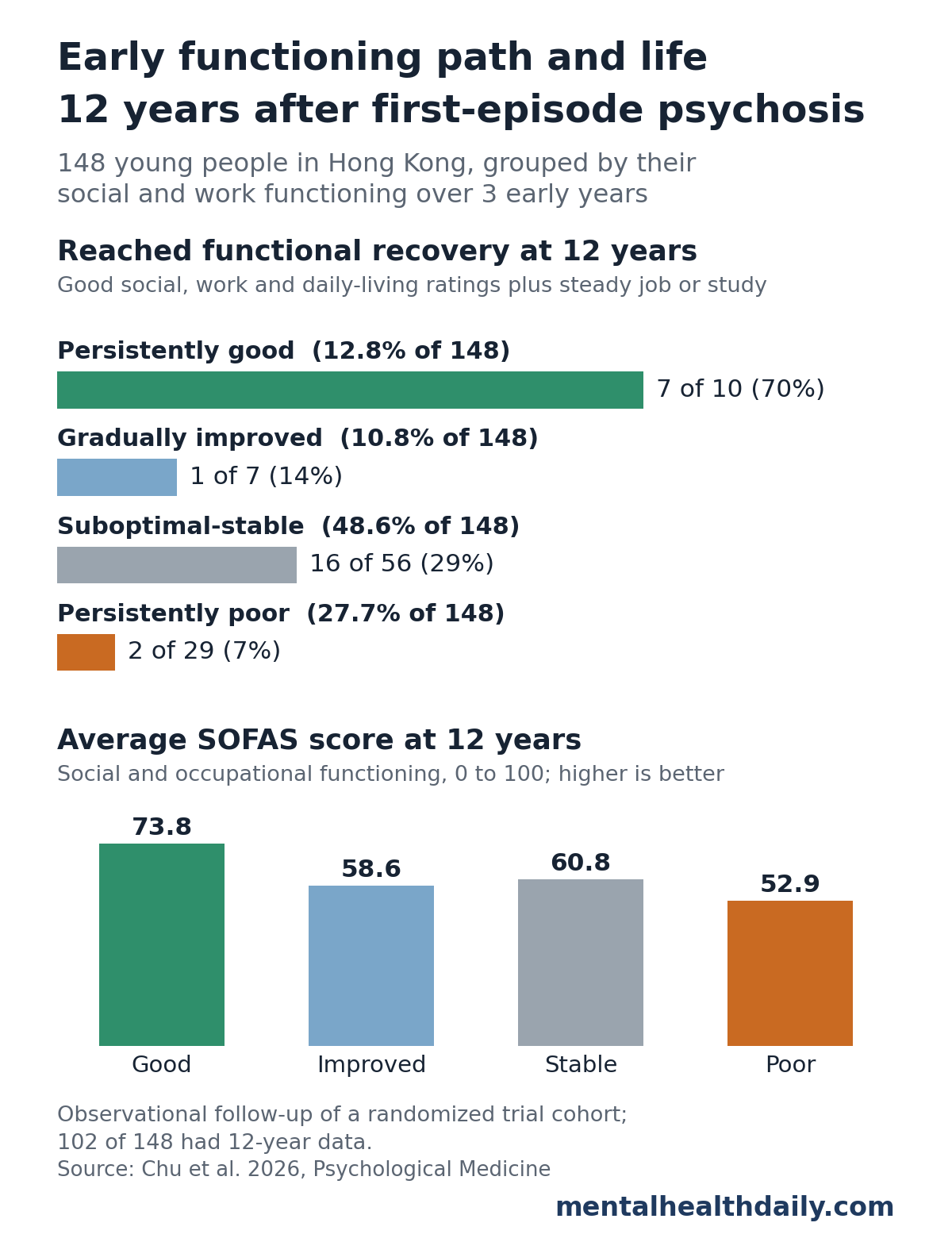
- Most people were not doing well early: of 148 patients, 12.8% functioned well throughout the 3 years and 10.8% improved steadily; 48.6% stayed at a middling level and 27.7% stayed low.1
- Worse work and social functioning at 12 years: the persistently-poor group scored lower at 12 years on overall functioning (SOFAS 52.9 vs 73.8), work, and wider social contact than the persistently-good group.1
- Negative symptoms marked the poor path from the start: baseline negative symptom scores averaged 16.3 in the persistently-poor group vs 8.4 in the persistently-good group, the only significant predictor in the adjusted model (p = 0.008).1
- Extra year of early intervention did not shift the paths: people from both trial arms were spread across all 4 groups, with no significant difference (p = 0.383).1
A 12-Year Follow-Up of Young People Treated Early for Psychosis
The patients came from EASY, Hong Kong’s publicly funded early intervention service for people aged 15 to 25 with a first episode of psychosis. After 2 years of EASY care, 160 of them joined a randomized trial between 2010 and 2011:1
- Extended early intervention (82 people): 1 more year of specialized care with a case manager, making 3 years in total.
- Step-down standard care (78 people): a regular outpatient clinic in the third year, without case management.
The trial itself asked whether the extra year helped. This new paper, by Natalie Chu, Wing Chung Chang, and colleagues at the University of Hong Kong, asks a different question. Setting the trial arms aside, it groups patients by how their day-to-day functioning changed over the 3 years after trial entry and then checks how each group was doing 12 years after entering the trial.1
Functioning was rated on the SOFAS (Social and Occupational Functioning Assessment Scale), a 0-to-100 clinician rating of how well someone manages work, study, and relationships, separate from symptom severity. Ratings were taken at trial entry and 1, 2, and 3 years later, so the “early” window began after 2 years of EASY care; participants were on average about 20 when psychosis began and 23 at trial entry. Everyone with a SOFAS rating at 3 or more of the 4 time points, including trial entry (148 people), was included. A statistical method called latent growth mixture modeling then sorted them into groups whose scores followed similar paths over time.
Four Early Paths, and Most Were Not Good
The model settled on 4 groups over the 3 years:1
- Persistently good (19 people, 12.8%): functioned well throughout.
- Gradually improved (16, 10.8%): started at a moderate level and climbed steadily.
- Suboptimal-stable (72, 48.6%): stayed at a moderate level without much change.
- Persistently poor (41, 27.7%): low functioning that improved only slightly.
So fewer than 1 in 4 either did well or clearly got better over these 3 years, even though everyone had already had 2 years of specialized early intervention. The authors note their share in the worst group sits at the low end of what other trajectory studies have found, and they still describe more than a quarter of the cohort as having severe, persistent functional deficits.1
Negative Symptoms Set the Poor Group Apart at the Start
Several baseline features differed across the groups: premorbid social and school adjustment, duration of untreated psychosis, positive, negative, and disorganized symptoms, depression, insight, and medication-related movement side effects. When these were entered together, only one clearly separated the persistently-poor group from the persistently-good group: negative symptoms, the flat emotion, low motivation, and social withdrawal of psychosis. The average PANSS negative symptom score was 16.3 in the persistently-poor group vs 8.4 in the persistently-good group (p = 0.008).1
Longer untreated psychosis (p = 0.053) and more movement side effects from antipsychotics (p = 0.073 and 0.051 in two comparisons) came close but did not reach significance. The authors treat these as borderline results.
Most earlier trajectory studies found the same link, the authors note. Negative symptoms respond poorly to current antipsychotics, and the authors point to psychosocial approaches such as cognitive behavioral therapy and cognitive remediation as the more promising routes.1
12 Years Later, the Early Pattern Still Showed
At 12 years, the groups differed on almost every functional measure:1
- Overall functioning (SOFAS): 73.8 in the persistently-good group vs 58.6 (gradually improved), 60.8 (suboptimal-stable), and 52.9 (persistently poor). The persistently-good group scored higher than every other group, and the suboptimal-stable group scored higher than the persistently-poor group.
- Role Functioning Scale: total score 25.2 in the persistently-good group vs 19.4 in the persistently-poor group (p < 0.001), with significant gaps in work (6.3 vs 4.1) and wider social contact (5.7 vs 4.4).
- Functional recovery: 70% (7 of 10) in the persistently-good group, 14.3% (1 of 7) gradually improved, 28.6% (16 of 56) suboptimal-stable, and 6.9% (2 of 29) persistently poor.
Functional recovery here was a demanding standard: a SOFAS score above 60, good ratings for independent living, close relationships, work, and wider social life, and steady full- or part-time work or full-time study over the previous 12 months.1
The gradually-improved group is a puzzle. Its members climbed over the 3 years, yet only 1 of 7 met recovery criteria at 12 years, and their SOFAS average was no better than the middling group’s. With only 7 people followed up, that result could easily be noise.
Personal recovery did not follow the same pattern. On a questionnaire about a person’s own sense of recovery and meaning, 70% of the persistently-good group and 37.9% of the persistently-poor group met the recovery cutoff, but the difference across groups was not significant (p = 0.205).1
Symptoms Improve More Often Than Work and Social Life
A companion paper on the same cohort shows the wider gap. Of the 106 people seen at 12 years, 74.5% were in symptomatic remission, but only 24.5% met criteria for functional recovery and 16% met criteria for full recovery.2 Baseline functioning was an important predictor of functional recovery in that analysis too.
Symptoms settling down is not the same as getting back to work, school, and friendships, and the functional side is where most people in this cohort stayed stuck.
How This Fits With Other Trajectory Studies
The finding is consistent with earlier studies that tracked functioning over time rather than comparing group averages at one point:
- English early intervention services, first year: among 764 people with first-episode psychosis, 66% followed a low, stable social recovery path, 27% a moderate, improving one, and 7% started high and declined. More negative symptoms and poorer premorbid adjustment predicted poor social recovery.5
- New York, 20 years: among 485 people first admitted for psychosis, social functioning followed 4 mostly stable paths from preserved to profoundly impaired. Poorer paths were strongly associated with worse real-world outcomes at 20 years, and the differences were already visible in childhood.4
The Hong Kong study adds what the authors describe as the first test of whether early-course social-occupational paths in an early psychosis sample predict functioning more than a decade later.1 Across these very different settings, the picture is the same: functional disability early in psychosis tends to persist.
The Extra Year of Early Intervention Did Not Shift the Paths
Because the cohort came from a randomized trial, it is tempting to read the trajectory results as a verdict on early intervention. They are not. Trial arm was not related to which path people followed: 46.3% of the persistently-poor group and 68.4% of the persistently-good group had been assigned to extended care, a difference that was not statistically significant (p = 0.383).1
That matches the trial’s earlier follow-up. The extended program improved some outcomes while it ran, but in the 2 years after the specialized service ended, the 2 arms no longer differed in functioning, symptoms, or service use.3 The trajectory paper’s authors call for more intensive help aimed directly at function, such as individual placement and support, a supported employment approach.1
Limitations
- Observational design. The groups were defined after the fact from functioning scores. The study shows that poor early functioning marks higher risk, not that improving it would change the 12-year outcome.
- Small groups at 12 years. Only 10 persistently-good and 7 gradually-improved patients had 12-year data, so their percentages are unstable.
- Dropout in both directions. People included in the trajectory analysis had better premorbid adjustment and role functioning than those left out, and 12-year completers had fewer schizoid and schizotypal traits than dropouts. The authors say this may understate poor outcomes. The paper reports 102 completers in its results and tables and 106 in its abstract.
- Data-driven groups. The statistical fit was similar across 2- to 5-group models, and the authors acknowledge that such groups can be mathematically distinct without being clinically meaningful.
- Narrow sample. All participants were Chinese, aged 15 to 25 at entry to one Hong Kong service. Cognition, self-stigma, and self-efficacy were not measured, and the study was not preregistered.
What It Means for People With Early Psychosis
For families and clinicians, the practical point is simple: watch functioning, not just symptoms. A young person whose symptoms have settled but who is still not working, studying, or seeing friends in the early years of the illness is on a path that, in this cohort, rarely led to full functional recovery a decade later. The authors argue for tracking functioning closely during the first years of illness, so that people who are stuck can be offered help aimed at work and social life early.1
Poor early functioning was a strong warning sign, and it did not rule out recovery: 2 people in the persistently-poor group did reach functional recovery, and many more in the middling group did.
References
- Chu NWT, Chu RST, Fung CCS, et al. Early-stage trajectories of social-occupational functioning and long-term functional outcome prediction in early psychosis: a 12-year follow-up of the randomized controlled trial on extended early intervention. Psychological Medicine. 2026;56:e276. doi:10.1017/S0033291726105741
- Chu RST, Fung VSC, Lei JHC, et al. Rate and predictors of remission and recovery in first-episode psychosis: a 12-year follow-up of randomized-controlled trial on early intervention. Molecular Psychiatry. 2026;31:2365–2375. doi:10.1038/s41380-025-03409-y
- Chang WC, Kwong VWY, Lau ESK, et al. Sustainability of treatment effect of a 3-year early intervention programme for first-episode psychosis. British Journal of Psychiatry. 2017;211(1):37–44. doi:10.1192/bjp.bp.117.198929
- Velthorst E, Fett AKJ, Reichenberg A, et al. The 20-year longitudinal trajectories of social functioning in individuals with psychotic disorders. American Journal of Psychiatry. 2017;174(11):1075–1085. doi:10.1176/appi.ajp.2016.15111419
- Hodgekins J, Birchwood M, Christopher R, et al. Investigating trajectories of social recovery in individuals with first-episode psychosis: a latent class growth analysis. British Journal of Psychiatry. 2015;207(6):536–543. doi:10.1192/bjp.bp.114.153486