
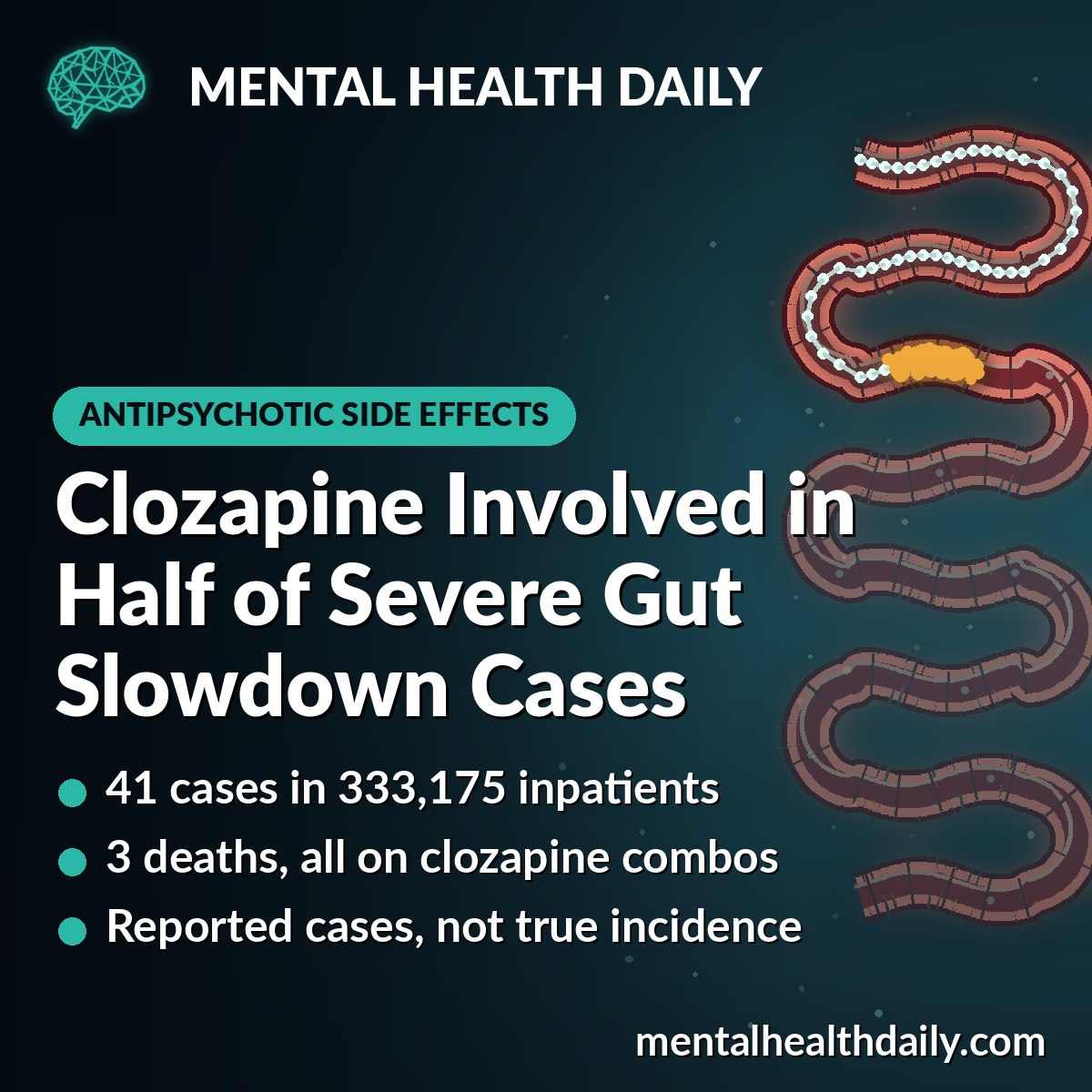
Clozapine was involved in almost half of the severe constipation and bowel-stall cases among 333,175 psychiatric inpatients on antipsychotics.1 Such cases were rare, 41 in all, but 3 patients died, all on clozapine combined with other drugs that slow the bowel.
Research Highlights
- Clozapine in half the cases: clozapine was implicated in 20 of 41 severe cases (48.8%), about 5 reports per 10,000 clozapine-treated inpatients. Quetiapine came next with 13 cases.1
- Rare but serious: 41 severe cases among 333,175 antipsychotic-treated inpatients (0.012%): 19 severe constipation, 13 subileus and 9 ileus.1
- 3 deaths: all from paralytic ileus, all in patients taking clozapine along with other strongly anticholinergic drugs.1
- Drug combinations were the rule: 29 of 41 cases (70.7%) had more than one implicated drug, often ones with strong anticholinergic effects.1
- Pirenzepine stood out: among clozapine users, severe cases were reported in 0.15% of those also taking pirenzepine vs 0.04% of those who were not (p = 0.027), a finding based on 5 vs 15 cases.1
What Antipsychotic-Related Gut Slowdown Is
Gastrointestinal hypomotility means the gut moves its contents along more slowly than it should. Mild forms look like ordinary constipation.
Severe forms can progress to subileus, a partial stall of the bowel, or ileus, where the intestine stops moving food and gas forward. Paralytic ileus can lead to bowel damage, infection and death.
Many antipsychotics slow the gut because they block receptors that drive bowel contractions. The main culprit is anticholinergic activity: blocking acetylcholine, the chemical messenger that tells the smooth muscle of the intestine to squeeze.
Blocking histamine and serotonin receptors, sedation and low physical activity add to the effect.1 Clozapine has especially strong anticholinergic and antihistamine effects, which is one reason it has a long record of bowel complications.
How the AMSP Drug Safety Program Counted Cases
The data come from AMSP, a drug safety program in German, Austrian and Swiss psychiatric hospitals, covering 1993 to 2016. The study was published online in the European Archives of Psychiatry and Clinical Neuroscience on September 19, 2026.1
Pharmacovigilance is the ongoing tracking of drug side effects after a medicine reaches everyday use. In AMSP, trained physicians at 119 participating psychiatric hospitals record serious reactions on standardized forms. Each case is reviewed by a senior physician, then at regional case conferences and again centrally.1
For this analysis, the researchers kept only cases that met AMSP criteria for a severe reaction, such as needing specific medical treatment, transfer to another ward, surgery, or posing a threat to life. Each case also had to be rated a probable or definite reaction to the antipsychotic.
Ordinary constipation was excluded.1
- Population: 495,615 psychiatric inpatients monitored from 1993 to 2016, of whom 333,175 received antipsychotics.
- Case types: 19 severe constipation (46.3%), 13 subileus (31.7%) and 9 ileus (22.0%).
- Who was affected: 20 men and 21 women, mean age 51 (range 21 to 82). Rates did not differ significantly by sex, age group or diagnosis. Schizophrenia was the most common diagnosis (24 cases), reflecting how many exposed patients had it.
Clozapine and Quetiapine Were the Most Often Implicated
Clozapine was implicated in 20 cases, 48.8% of the total, even though it was given to only 38,349 of the 333,175 exposed patients. That works out to about 5 reported severe cases per 10,000 clozapine-treated inpatients, compared with about 1.2 per 10,000 for antipsychotic users overall.1
Quetiapine was second with 13 cases (31.7%), 10 of them in combination with other drugs, most often an antidepressant.
Haloperidol was implicated in 6 cases, olanzapine in 4, amisulpride in 3, and risperidone and aripiprazole in 1 each.1 Olanzapine was the one drug where half its cases (2 of 4) had no other implicated drug.
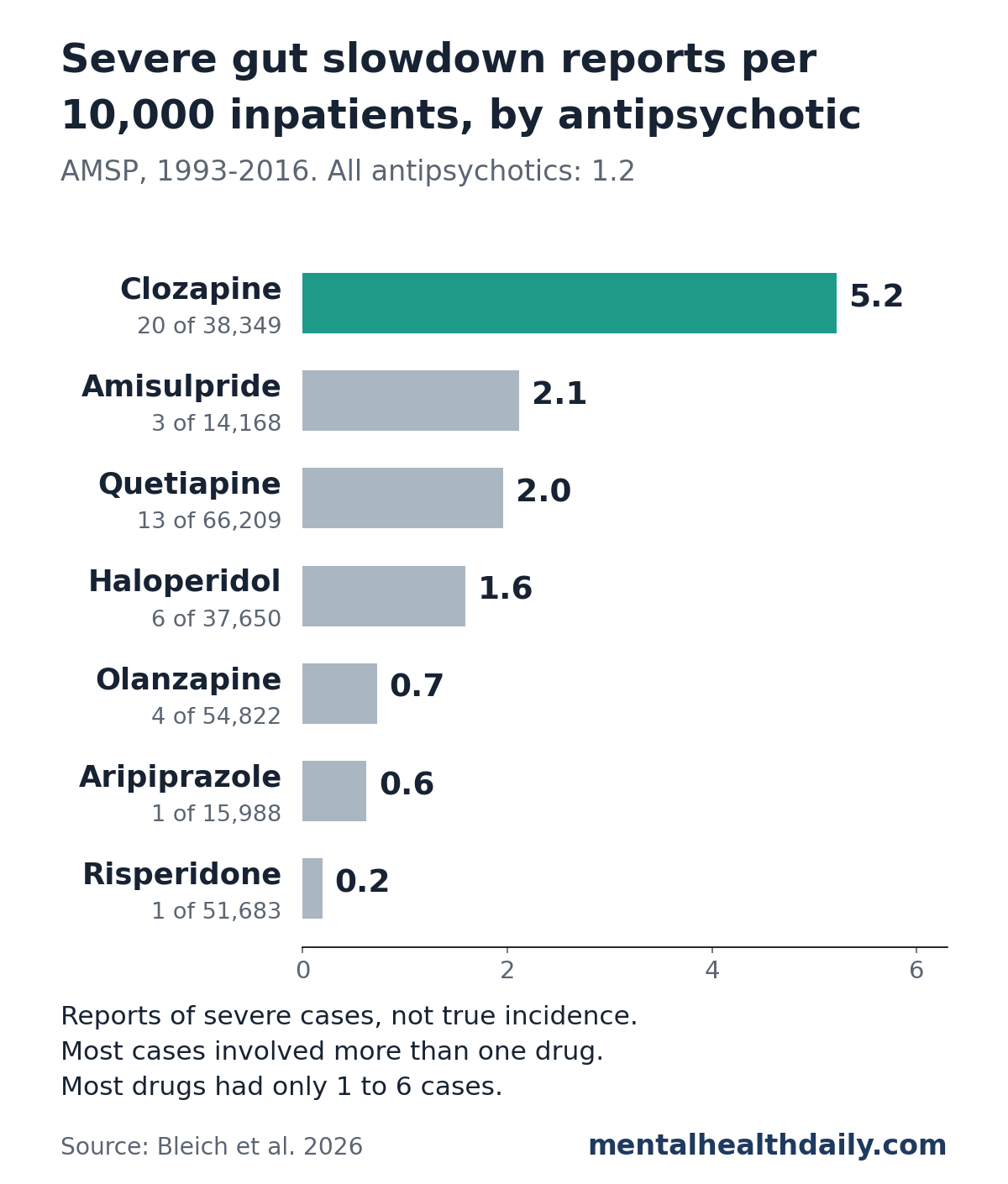
Clozapine’s bar is clearly the tallest. The rest are harder to rank. Amisulpride sits second on the chart on the strength of just 3 cases, all involving other drugs too, and a single extra case would reorder the middle of the list.
Drug Combinations and Anticholinergic Load
Most severe cases involved more than one implicated medicine: 29 of 41, or 70.7%. The co-implicated drugs were often strongly anticholinergic, including tricyclic antidepressants, promethazine and levomepromazine (which the study grouped with low-potency first-generation antipsychotics), and pirenzepine.1
Pirenzepine is an anticholinergic drug often prescribed off-label to reduce the heavy drooling that clozapine can cause.
Among clozapine users, 5 of 3,377 who also took pirenzepine had a severe gut slowdown case (0.15%), compared with 15 of 34,972 who did not (0.04%). The authors call this an exploratory result based on small numbers, but it fits the idea that anticholinergic effects add up.1
3 Deaths, All on Clozapine Combinations
Three patients (7.3% of cases) died of paralytic ileus. All 3 were taking clozapine with other strongly anticholinergic drugs.
In 2, pirenzepine was also implicated, one of them alongside 8 other psychiatric drugs. In the third, the antidepressant venlafaxine and the gut antispasmodic mebeverine were implicated along with clozapine.1 All 3 also had obesity, diabetes, earlier gut problems or low mobility.
The other 38 patients recovered or were recovering at the time of reporting, though 14 needed transfer to an internal medicine ward. Almost half of all cases (20 of 41) had earlier gut problems, mostly milder constipation.1
How This Fits With Earlier Clozapine Research
Other studies point the same way, and several suggest the problem is more common than AMSP’s numbers show.
- Australia and New Zealand reports: over 22 years, 160 serious clozapine-related gut slowdown cases were reported among 43,132 people who started clozapine, about 37 per 10,000. At least 29 died, and few had received laxatives beforehand. The authors called their own figure a likely underestimate.2
- Measured transit times: using swallowed X-ray markers, a New Zealand study found median colon transit of 104.5 hours on clozapine vs 23 hours on other antipsychotics. Eighty percent of clozapine-treated patients had slowed colon movement, compared with none of those on the other antipsychotics tested.3
- Danish registry: among 26,720 people with schizophrenia, clozapine, tricyclic antidepressants, anticholinergic drugs and opioids were each linked to higher ileus risk, and 9 of 123 ileus cases (7.3%) were fatal. Aripiprazole and amisulpride were not linked to ileus.4
The AMSP clozapine figure of about 5 per 10,000 is far below the 37 per 10,000 from Australia and New Zealand. AMSP counted only severe events recognized during a psychiatric hospital stay, and both research teams expect underreporting, so the true rate is likely higher than either figure.
Limits of Pharmacovigilance Data
- Reports, not incidence: the program relies on doctors noticing and recording a reaction. The authors say the database gives reporting frequencies rather than relative risks, and severe cases are likely undercounted.1
- Only severe cases: the 0.012% figure says nothing about everyday constipation, which the authors note a 2021 review put at about half of antipsychotic users.1
- Small numbers: 41 cases in total, and 1 to 6 cases for most individual drugs, so drug comparisons are rough.
- Missing context: dose, length of treatment, diet, fluid intake and activity were not available, and there was no adjustment for other factors. Clozapine is used for the most treatment-resistant illness, which may carry its own risk.
- Hospital setting: all patients were inpatients, so outpatient risk may differ.
What This Means for People Taking Clozapine or Other Antipsychotics
Serious gut slowdown is uncommon, but it can come on quietly. People on clozapine may not notice or report constipation the way others do, which is why researchers urge clinicians to check bowel function actively.2
- Tell the prescriber about constipation. Fewer bowel movements, straining or hard stools on clozapine are worth reporting early, not waiting out.
- Know the warning signs. Belly pain lasting more than an hour, especially with a swollen belly, vomiting or diarrhea, needs urgent medical attention in someone taking clozapine, and the treating team should be told about the clozapine.2
- Mention every medicine. Anticholinergic drugs, including pirenzepine for drooling, some antidepressants and older sedating antihistamines, can add to the effect.
- Do not stop an antipsychotic on your own. Clozapine is often the most effective option for treatment-resistant schizophrenia.2 Any change belongs in a conversation with the prescriber.
References
- Bleich L, Bleich S, Bleich K, et al. Severe antipsychotic-associated gastrointestinal hypomotility: AMSP pharmacovigilance data from 333,175 psychiatric inpatients. European Archives of Psychiatry and Clinical Neuroscience. 2026. doi:10.1007/s00406-026-02381-0
- Every-Palmer S, Ellis PM. Clozapine-induced gastrointestinal hypomotility: a 22-year bi-national pharmacovigilance study of serious or fatal ‘slow gut’ reactions, and comparison with international drug safety advice. CNS Drugs. 2017;31:699–709. doi:10.1007/s40263-017-0448-6
- Every-Palmer S, Nowitz M, Stanley J, et al. Clozapine-treated patients have marked gastrointestinal hypomotility, the probable basis of life-threatening gastrointestinal complications: a cross sectional study. EBioMedicine. 2016;5:125–134. doi:10.1016/j.ebiom.2016.02.020
- Nielsen J, Meyer JM. Risk factors for ileus in patients with schizophrenia. Schizophrenia Bulletin. 2012;38:592–598. doi:10.1093/schbul/sbq137