
In Germany, a doctor can prescribe a depression app and public health insurance pays for it. A 2026 meta-analysis of the randomized trials behind those apps found they lowered depression symptoms more than wait-list or usual care, by a moderate amount (standardized mean difference −0.49 across 17 trials and 3,869 participants).1
Most of that evidence comes from one app, Deprexis, which was tested in 12 of the 19 trials. The authors rated the certainty of the evidence as very low, mainly because trials lost many participants and relied on people rating their own symptoms without being blinded to their group.
Research Highlights
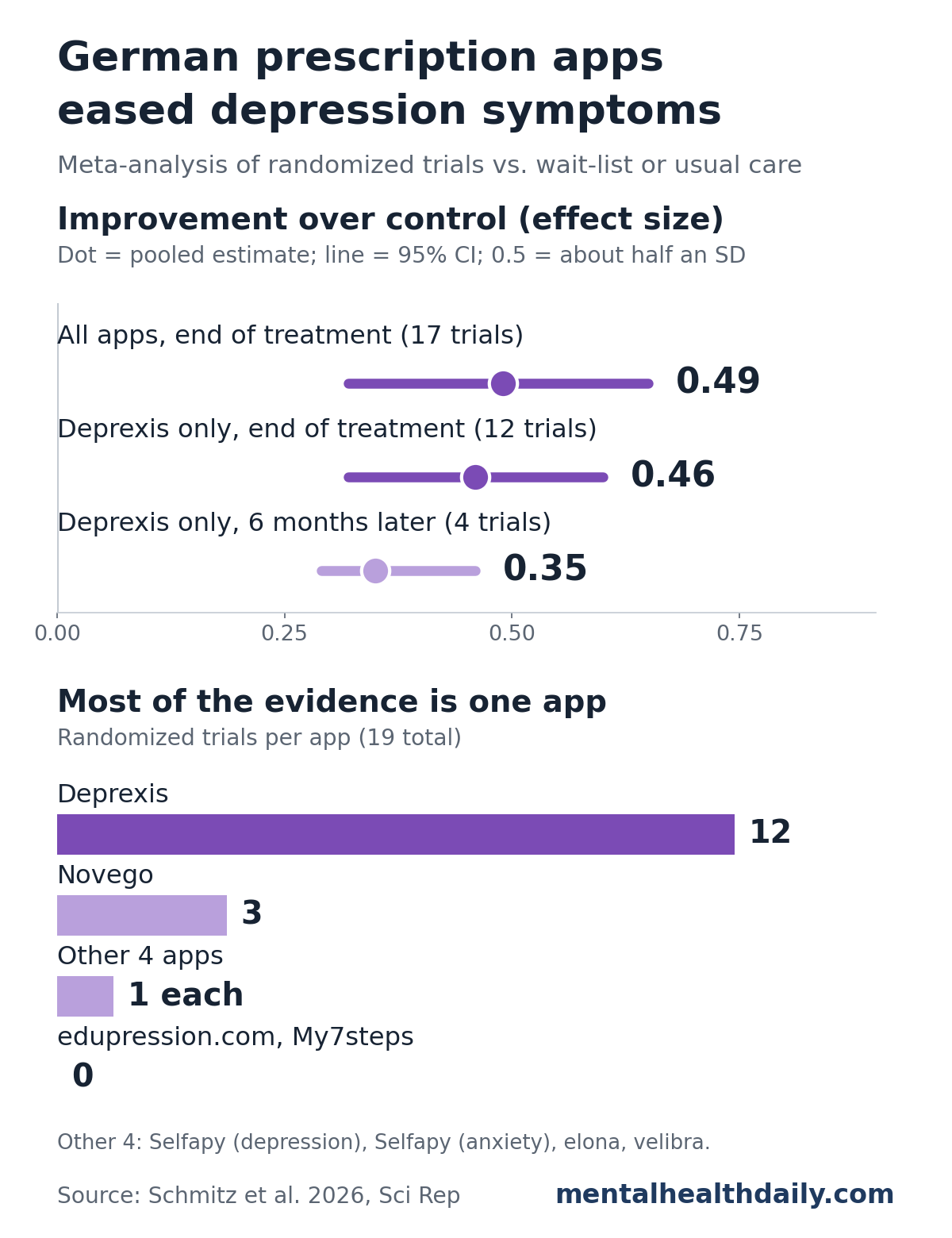
- Depression symptoms improved more with the apps: the pooled effect after treatment was −0.49 (95% CI −0.65 to −0.32) across 17 randomized trials of 5 apps.1
- Deprexis carries the result: 12 of 19 trials tested Deprexis, and its own pooled effect was −0.46. Two listed apps had no eligible published trial.1
- Benefit held at 6 months in 4 Deprexis trials: the follow-up effect was −0.35, based on 1,407 participants.1
- Too few anxiety trials: only 2 trials tested apps for generalized anxiety disorder, and their pooled result was not statistically significant.1
- Consistent with the wider app research: a 2025 meta-analysis of standalone smartphone apps found a similar depression effect before correcting for publication bias.2
How Germany Prescribes Apps for Depression
Germany calls these programs DiGA (Digitale Gesundheitsanwendungen, or digital health applications). A 2019 law, the Digital Healthcare Act, set up a system that has no close equivalent in the United States:1
- Who gets them: a physician or psychotherapist writes a prescription, or a patient with a qualifying diagnosis applies directly to their insurer. The insurer sends an activation code.
- Who pays: statutory health insurance, the public system that covers most people in Germany.
- How apps get listed: a “fast-track” lets an app be reimbursed provisionally while its maker gathers evidence. It stays in the national directory, run by the Federal Institute for Drugs and Medical Devices, only if it shows a positive effect on care. Otherwise it is removed.
- How long: a prescription usually covers 90 days and can be extended.
Part of the appeal is the wait for therapy. In German insurance claims data from 2024, 61% of adults waited longer than the recommended 14 days for an acute psychotherapy appointment, and the average wait was about 42 days.1
Which Apps and Trials Were Included
Researchers at the University of Bonn searched the official directory and found 8 permanently listed apps for depression or generalized anxiety disorder (GAD). All use some form of cognitive behavioral therapy (CBT), the structured skills-based therapy that targets unhelpful thoughts and behaviors. Most are self-guided online courses rather than live therapy.1
They then pooled every randomized controlled trial of those apps they could find: 19 trials with 4,078 participants, published from 2009 to 2024. Fifteen were run in Germany. Control groups were mostly a wait-list or treatment as usual, meaning whatever care people were already getting.
- Deprexis: 12 trials
- Novego (Coping with depression): 3 trials
- Selfapy depression course, Selfapy GAD course, elona therapy, velibra: 1 trial each
- edupression.com and My7steps: no eligible published randomized trial
Permanently listed apps must show the regulator evidence of benefit, but that evidence does not have to be a peer-reviewed publication, and 2 listed apps had no published trial to include.1
Depression Symptoms Improved More Than With Usual Care or Waiting
The main result is a standardized mean difference (SMD), which puts trials that used different depression questionnaires on one scale. A value of −0.49 means people using an app ended treatment about half a standard deviation lower on depression symptoms than people in the control groups; the paper calls this a moderate effect.1
The result held up across several checks:1
- Without the biggest outlier: dropping one trial with an unusually large effect (the only Selfapy depression trial, SMD −1.44) gave −0.42.
- Without guided versions: excluding app versions that came with human support gave −0.47, so fully self-guided use still helped.
- Without higher-risk trials or severe-depression trials: the effect stayed near −0.50.
- Publication bias: statistical tests found no sign that missing negative trials inflated the estimate.
Results still varied a lot from trial to trial (I² about 82%). The range of effects a new trial might show ran from a clear benefit to none at all. The type of app was the one factor that explained a significant share of that spread; setting, country, age, sex, and program length did not.
Six-Month Results Come From One App
Nine trials reported later follow-up, but only 4 could be pooled, and all 4 tested Deprexis in German-speaking adults over 10 to 12 weeks. Six months out, the app groups were still ahead (SMD −0.35), with little variation among those trials.1 That is good news for Deprexis in particular. It says nothing about whether the other apps last, and the pooled follow-up lasted only 6 months.
Anxiety Apps Had Only Two Trials
For generalized anxiety disorder, 2 trials qualified: one of the Selfapy GAD course and one of velibra. Both favored the app, but their effects were far apart, and the pooled estimate (−2.31, 95% CI −5.32 to 0.70) was not statistically significant.1 The authors say plainly that this does not allow firm conclusions about apps for GAD.
How This Fits With Guided and Unguided Online CBT
The German findings line up with the broader research on digital CBT for depression.
- Standalone apps in general: a 2025 meta-analysis of 72 trials found smartphone apps improved depression compared with inactive controls (Hedges’ g 0.45 across 33 comparisons). After adjusting for publication bias, the estimate fell to 0.18.2
- Guided versus unguided: a patient-level analysis of 39 trials with 9,751 participants found both guided and unguided internet CBT beat control conditions. Guided programs did slightly better right after treatment (0.8 points lower on the PHQ-9 depression questionnaire), mostly for people with moderate or worse symptoms, and no difference was found at 6 or 12 months.3
The authors note that the DiGA effect is similar in size to what face-to-face psychotherapy trials report. No trial compared the apps directly with therapy, though, so the two cannot be called equivalent. About 20% of participants were also in psychotherapy and about 30% were taking psychiatric medication when the trials began, so the measured benefit is often an app added to other care.1
Limitations
The authors graded the evidence as very low certainty for depression after treatment and low for the 6-month result.1 The main reasons:
- Every trial had high risk of bias. Many participants dropped out, and people rated their own symptoms while knowing whether they had the app, which tends to inflate effects.
- One app dominates. The pooled number mostly describes Deprexis, and several Deprexis trials were run before the 2020 approval system existed.
- Weak comparison groups. Wait-list and loosely described usual care are easier to beat than an active treatment.
- Manufacturer involvement. No included trial was fully independent of the app makers.
- Who was studied. Participants averaged about 39 years old and were mostly highly educated German speakers. There were no data on people over 70.
- Only approved apps. Apps that were rejected or dropped from the directory were not included, which may make the pooled effect look better than for digital therapy tools in general.
What It Means for Readers Outside Germany
Several of these programs, including Deprexis, are structured CBT courses, much like the internet CBT programs studied in other countries. The results support structured CBT-based self-help courses for depression, as a bridge while waiting for care or alongside it. They do not cover every mental health app in an app store, and they do not cover AI chatbots, which were not part of these trials.
Anyone whose depression is severe, getting worse, or includes thoughts of suicide should reach a clinician directly. In the US, the 988 Suicide & Crisis Lifeline is available by call or text at 988.
References
- Schmitz A, Frey S, Karimzadeh A, Neves AL, Mayr A, Weltermann B. Efficacy of prescription-eligible digital health applications for depression and generalized anxiety disorder in Germany: a systematic review and meta-analysis. Scientific Reports. 2026;16:28490. doi:10.1038/s41598-026-68875-y
- Kulke JK, Fuhrmann LM, Berking M, et al. Efficacy of standalone smartphone apps for mental health: an updated systematic review and meta-analysis. The Lancet Digital Health. 2025;7(11):100923. doi:10.1016/j.landig.2025.100923
- Karyotaki E, Efthimiou O, Miguel C, et al. Internet-based cognitive behavioral therapy for depression: a systematic review and individual patient data network meta-analysis. JAMA Psychiatry. 2021;78(4):361–371. doi:10.1001/jamapsychiatry.2020.4364