
Adults in Spain who often felt talked down to, ignored, or treated as less capable because of their age reported more depression, anxiety, and stress, according to a 2026 survey of 404 people aged 18 to 95.1 Feeling valued because of their age went with higher life satisfaction.
Research Highlights
- Negative ageism and distress: more frequent negative age-based treatment was linked to more symptoms of depression, anxiety, and stress, and to lower life satisfaction, after accounting for age.1
- Positive ageism and life satisfaction: being seen as wise or valued because of age was linked to higher life satisfaction, but not to fewer depression, anxiety, or stress symptoms.1
- Young and old felt it most: negative ageism followed a U shape across the lifespan, highest in the youngest and oldest adults and lowest in midlife.1
- No gap between women and men: both groups had the same median scores for negative and positive ageism.1
- A working Spanish questionnaire: the 8-question Perceived Ageism Questionnaire (PAQ) kept its 2-part structure in Spanish, with acceptable reliability, though the 3-question positive part was only moderately consistent.1
What Perceived Ageism Means and How the Questionnaire Measures It
Ageism is stereotyping, prejudice, or discrimination based on how old someone is. Perceived ageism is the personal side of it: how often you feel that other people treat you a certain way because of your age.
The Perceived Ageism Questionnaire (PAQ), first tested with Dutch adults in 2022, asks 8 questions that all start the same way: “How often in the past year have you had the feeling that…” Answers run from 1 (never) to 5 (very often).1
Negative ageism (5 questions) asks whether people:
- treat you as if you are a child
- don’t listen to you or take your opinion seriously
- hold negative stereotypes about you, such as weak, slow, or dull
- unjustly treat you as less capable, mentally or physically
- look down on your contribution to society
Positive ageism (3 questions) asks whether people value your advice because of your life experience, assume you are wise, or see you as a meaningful part of society because of your age.
A key idea behind the PAQ is that these are 2 separate experiences, not opposite ends of one scale. Someone can feel both dismissed and valued because of their age, or neither.
Who Took Part in the Spanish Ageism Survey
Researchers at Spanish, Argentine, and Portuguese universities translated the PAQ into Spanish, had 2 assessment experts review it, and tested the wording with 2 small focus groups of older and middle-aged adults.1 Then they gave the final version to 404 adults living in Spain between April 2024 and May 2026.
- Ages: 18 to 95 (average about 48): 146 aged 18–39, 171 aged 40–64, and 87 aged 65 or older.
- Gender: 308 women and 92 men.
- Recruitment: an online survey shared through LinkedIn and Instagram, plus paper questionnaires at Madrid City Council cultural centers for seniors (classes such as gymnastics and painting). About half of the 65-plus group answered on paper.
- Other measures: depression, anxiety, and stress symptoms (DASS-21, a 21-item symptom checklist), life satisfaction (Satisfaction With Life Scale), and a 5-item measure of how negatively people view their own aging.
How Often Spanish Adults Reported Positive and Negative Age-Based Treatment
On average, positive age-based treatment was reported more often than negative treatment.1
- Negative ageism: average total 8.67, with observed scores ranging from 5 to 20 (median 8). That works out to about 1.7 per question on the 1-to-5 scale, close to the “never” end.
- Positive ageism: average total 9.30 on a scale of 3 to 15 (median 9), about 3.1 per question, the middle of the scale.
Age pattern. Treating age as a continuous measure, the researchers found that negative ageism followed a U-shaped curve: higher in young adults and older adults, with a dip in midlife. Positive ageism followed the reverse shape, rising toward middle age and then leveling off.1
The higher negative scores among young adults fit a point the researchers make: ageism is not only something older people face. Being treated as inexperienced or not taken seriously at work is a common form for younger adults.
Gender. Women and men had identical medians on both parts of the questionnaire (8 for negative, 9 for positive), with no significant difference. With only 92 men, the comparison has limited power.1
Negative Ageism Linked to Depression, Anxiety, and Stress
To test whether PAQ scores lined up with mental health as expected, the researchers ran regression models that first accounted for age and then added both ageism scores at once.1 Adding the ageism scores improved every model.
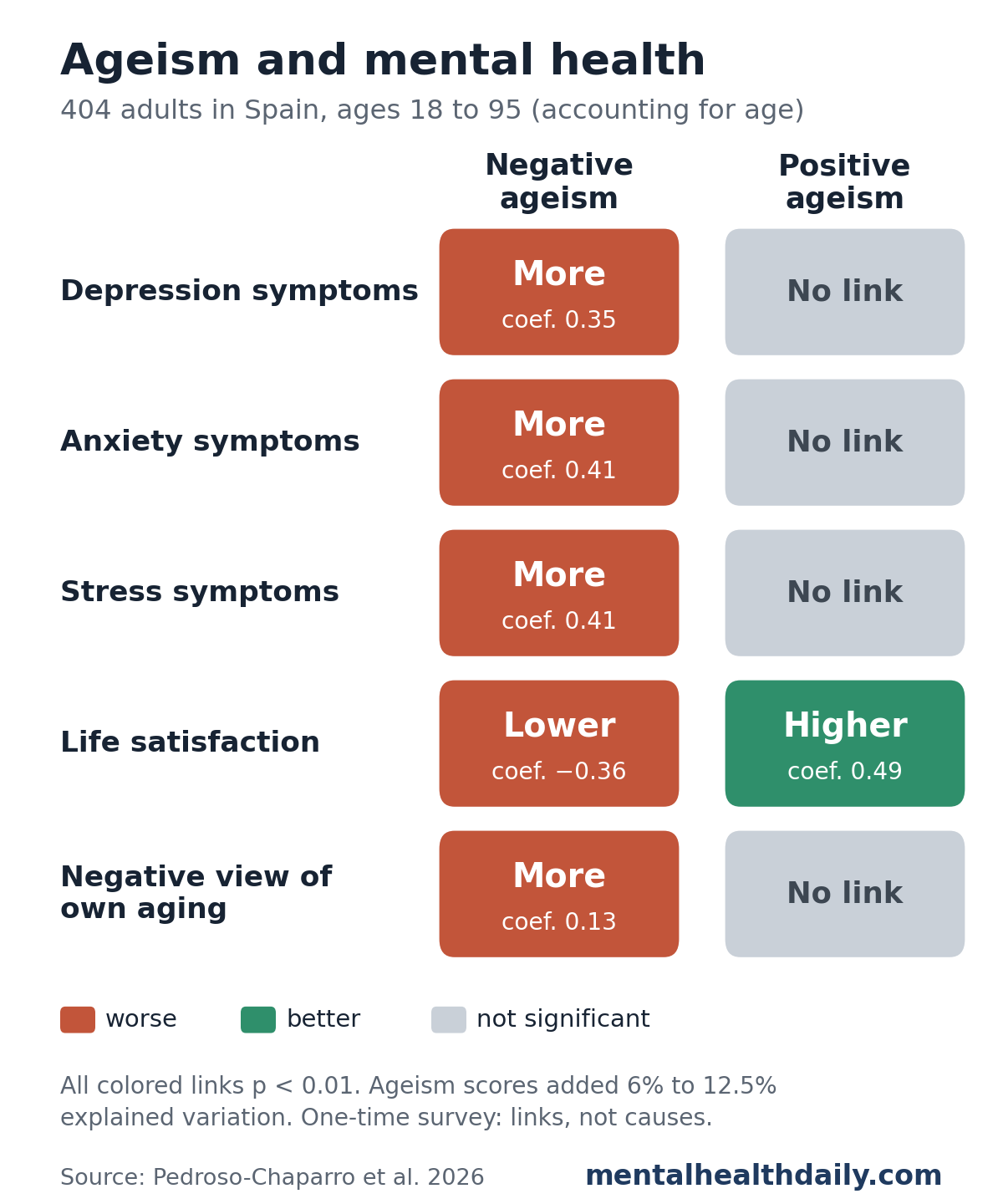
Higher negative ageism scores were linked to:
- More depression symptoms (coefficient 0.35)
- More anxiety symptoms (0.41)
- More stress symptoms (0.41)
- Lower life satisfaction (−0.36)
- A more negative view of one’s own aging (0.13), such as agreeing that you become less useful as you get older
All 5 links were statistically significant (p < 0.01). Together, the 2 ageism scores explained an extra 6% to 12.5% of the differences between people on these outcomes, beyond age alone.1 That is a meaningful but modest share: most of what drives depression or stress lies elsewhere.
Being Valued for Your Age Linked to Higher Life Satisfaction
Positive ageism had a different profile. It was linked to higher life satisfaction (coefficient 0.49), the largest single coefficient in the analysis, but showed no significant link with depression, anxiety, stress, or how people viewed their own aging.1
The researchers suggest a negativity bias may explain this: people notice and remember negative experiences more strongly than positive ones. Being dismissed may weigh on mood, while being valued shows up more in how people judge their life overall.
This split is why the researchers recommend scoring the 2 parts separately rather than combining them into one net score. A high positive score does not cancel out a high negative one.
Does the Spanish Ageism Questionnaire Hold Up?
For a questionnaire to be useful, it needs to measure the same thing consistently, and work the same way in different groups. In plain terms, the Spanish PAQ showed:1
- The same 2-part structure as the original. The 5 negative and 3 positive questions grouped exactly as in the Dutch version, and the model fit the data well.
- Good consistency for the negative part, moderate for the positive part. Cronbach’s alpha (a measure of whether questions in a set hang together; 0.70 or higher is usually considered good) was 0.79 for negative ageism and 0.66 for positive ageism. The researchers attribute the lower value to the positive part having only 3 questions.
- Fair comparisons between women and men. The questions worked the same way for both, so score differences reflect real differences rather than measurement quirks.
- Mostly fair comparisons across ages, with 3 exceptions. Being treated like a child, not being listened to, and being seen as a meaningful part of society were understood somewhat differently by different age groups. The researchers adjusted for these 3 questions when comparing ages.
On that last point, the researchers offer an explanation: a 25-year-old who feels “treated like a child” may be thinking of being dismissed as inexperienced at work, while a 75-year-old may be thinking of slow, simplified “elderspeak.” Being a “meaningful part of society” may also be linked to having a job, which changes with retirement.
How the Spanish Results Compare With Dutch, Portuguese, and Turkish Versions
By the researchers’ account, the PAQ has now been tested in Dutch (ages 55–93), Portuguese (ages 18–91), and Turkish (65 and older) versions, and every one found the same 2-part structure.1 The Spanish results are consistent with those earlier versions on the main mental health links:
- Negative ageism: linked to more distress and lower life satisfaction or quality of life in all 3 earlier versions.
- Positive ageism: linked to higher life satisfaction in all 3, with weaker or absent links to distress.
- Age pattern: the Portuguese version also found a U-shaped curve for negative ageism. It found positive ageism rising steadily with age, while the Spanish data leveled off after midlife.
The researchers suspect the difference in positive ageism comes from recruitment. Many older Spanish participants were reached in person at community centers rather than on social media, where they may see different portrayals of aging.
Limitations of This Spanish Ageism Survey
Evidence strength: a cross-sectional survey of a convenience sample. It shows which experiences go together, not whether ageism causes depression or whether low mood makes people notice ageism more.1
- Not a representative sample: participants were recruited through social media and senior cultural centers. About 76% were women, most had university degrees, and only 87 were 65 or older.
- No second sample to confirm the structure: unlike the Dutch and Portuguese studies, the team did not split off a separate group to confirm the 2-part model.
- Missing data: the life satisfaction and self-view-of-aging models used 300 of the 404 participants.
- A weak aging-attitudes measure: the 5-item scale for views of one’s own aging had low reliability (alpha 0.64), so that link deserves extra caution.
- No prevalence estimate: the study reports average scores, not the share of people in Spain who experience ageism.
What the Spanish Ageism Findings Mean
- Ageism affects younger adults too. In this sample, both young adults and older adults reported more negative age-based treatment than people in midlife.
- Being dismissed and being valued are separate experiences. They were linked to different parts of wellbeing, so it helps to ask about both.
- Researchers now have a Spanish tool. The PAQ can be used in Spanish-speaking studies across all adult ages, with the caution that it still needs testing in larger, more representative samples and outside Spain.
References
- Pedroso-Chaparro MdS, de la Vega Castelo A, Vara-García C, Brenlla E, Miguel I. Adaptation and psychometric properties of the Spanish Perceived Ageism Questionnaire (PAQ). Frontiers in Psychology. 2026;17:1823220. doi:10.3389/fpsyg.2026.1823220