
Tai Chi came out on top when researchers ranked 5 mind-body exercises for depressive symptoms in adults aged 60 and older, pooling 23 randomized trials in a 2026 network meta-analysis.1 Pilates, yoga, and qigong followed close behind, and square dancing came last.
The ranking is the headline, but it is not a verdict. In the network estimates reported in the Results text, Tai Chi’s comparison with each of the other exercises had a 95% confidence interval that included zero. Pilates, in second place, rested on just 2 trials. What the wider evidence supports is simpler: gentle mind-body exercise helps older adults with depressive symptoms, and the evidence cannot yet pick one style over the rest.
Research Highlights
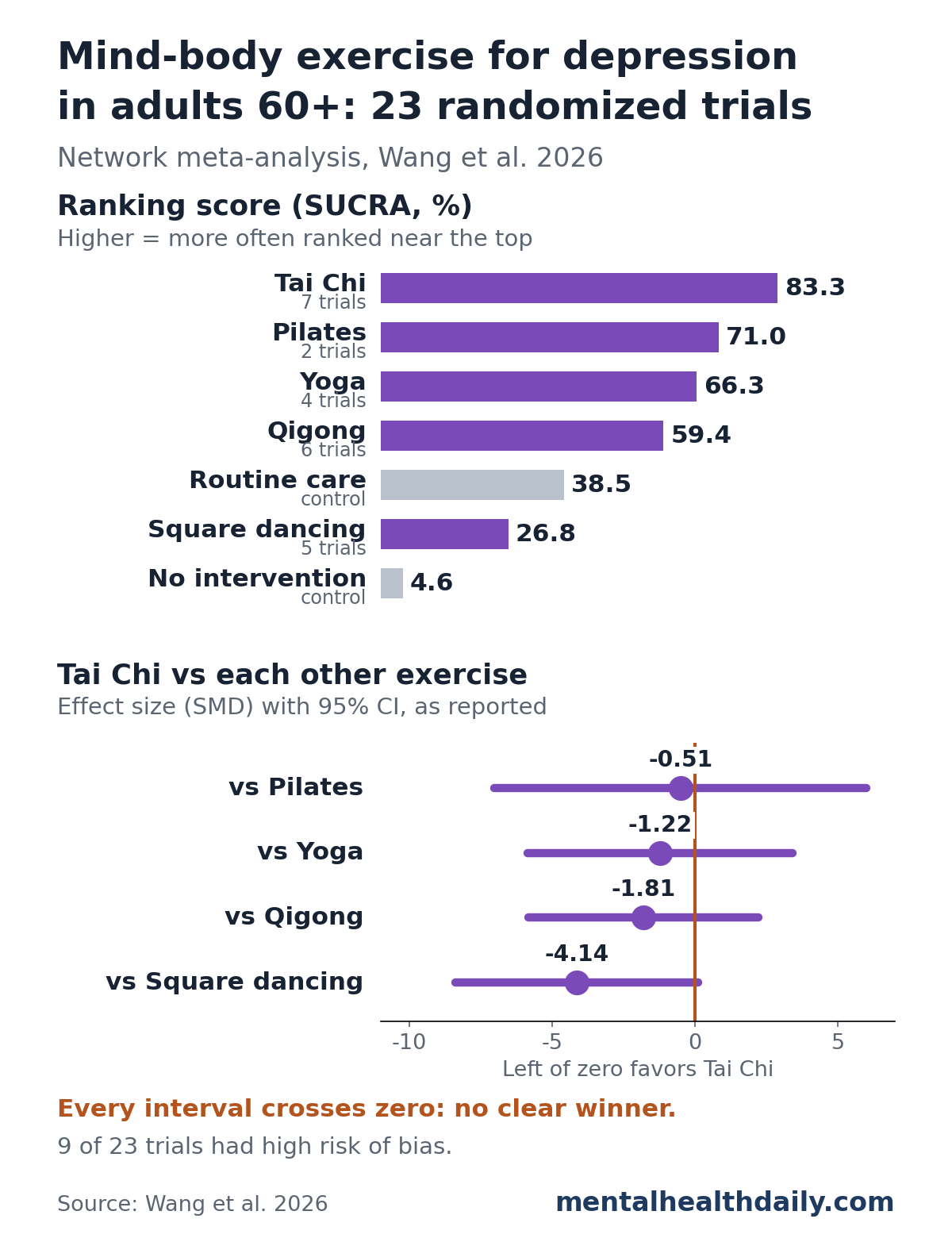
- Tai Chi ranked first: ranking scores (SUCRA) were 83.3% for Tai Chi, 71.0% for Pilates, 66.3% for yoga, 59.4% for qigong, and 26.8% for square dancing.1
- No clear head-to-head winner: Tai Chi’s comparisons with Pilates, yoga, qigong, and square dancing all had 95% confidence intervals that crossed zero.1
- Thin evidence for Pilates: its second place came from 2 trials, and dropping either one shifted its ranking substantially.1
- Square dancing ranked below routine care: 26.8% vs 38.5%, though that comparison was also imprecise.1
- Consistent with larger reviews: earlier analyses found mind-body exercise, including tai chi, qigong, and yoga, lowers depression scores compared with control conditions.2,3
What the Review Compared
Mind-body exercise combines slow, controlled movement with attention to breathing and body awareness. The review, by Wang and colleagues in Guangxi, China, and published in Frontiers in Public Health, searched 4 databases through December 2025 for randomized trials in people aged 60 and older.1 It found 23 trials published between 2004 and 2025, with 728 people in exercise groups and 757 in control groups.
The trials covered 5 exercise styles:
- Tai Chi (7 trials): slow, flowing movements coordinated with breathing.
- Qigong (6 trials): simpler, repetitive movement and breathing routines from the same tradition.
- Square dancing (5 trials): group dancing to simple steps and popular music.
- Yoga (4 trials): stretching, balance, and strength poses.
- Pilates (2 trials): core strengthening, body control, and breath regulation.
Control groups got either routine care (often health education or usual follow-up) or no intervention. Depression was measured on many different scales, including the Geriatric Depression Scale, the CES-D, and the Hamilton scale, so results were converted to a standardized mean difference (SMD), which puts every scale on a common footing.
A network meta-analysis lets researchers compare treatments that were never tested against each other. If Tai Chi beat routine care in some trials and yoga beat routine care in others, the model estimates how Tai Chi and yoga compare indirectly. It then produces a ranking score called SUCRA (surface under the cumulative ranking curve): 100% would mean a treatment is certain to rank best, 0% certain to rank worst.
The Ranking vs the Head-to-Head Numbers
Tai Chi had the highest SUCRA at 83.3%, and a 39.0% probability of being the single best option. Pilates had a 36.1% chance of being best and yoga 16.5%.1
A ranking score says how often a treatment lands near the top, not by how much it wins. For that, the effect estimates matter. As reported in the paper’s Results, Tai Chi compared with:1
- Pilates: SMD −0.51 (95% CI −7.02 to 6.00)
- Yoga: SMD −1.22 (95% CI −5.87 to 3.42)
- Qigong: SMD −1.81 (95% CI −5.84 to 2.22)
- Square dancing: SMD −4.14 (95% CI −8.40 to 0.12)
All 4 intervals include zero, so none of these differences is statistically clear. The Pilates interval runs from a large advantage for Tai Chi to a large advantage for Pilates. The authors say this themselves: Tai Chi should be regarded as “a promising and feasible option rather than the unequivocally optimal intervention.”1
The numbers themselves need care. Standardized differences of 4 or more are very large; for comparison, a 2020 network meta-analysis of older adults with clinical depression put mind-body exercise at roughly 0.9 to 1.4 standard deviations better than control.2 The paper’s league table (the grid of every pairwise comparison) also does not line up with its Results text: the Tai Chi vs Pilates estimate quoted in the text appears in a different row and column of the table, and the table’s upper and lower halves do not mirror each other. Individual effect sizes from this paper are hard to interpret, which puts more weight on the overall pattern than on any single number.
The Results text reports one comparison against a control, and it excluded zero: qigong vs no intervention, SMD −4.00 (95% CI −7.32 to −0.68).1
Square Dancing Ranked Below Routine Care
Square dancing scored 26.8% on the ranking, below routine care at 38.5% and above only no intervention at 4.6%.1 The authors suggest it may suit low-risk older adults with mild, loneliness-related low mood as a social activity. That is their interpretation; the trials did not test it. The square dancing estimate was also imprecise, so it does not show that dancing is useless.
How This Fits With Earlier Exercise Reviews
The broader evidence agrees that mind-body exercise helps. It disagrees on which style comes out ahead, which is what you would expect if the differences between styles are small.
- Older adults with clinical depression: a 2020 network meta-analysis compared aerobic, resistance, and mind-body exercise. Against controls, mind-body exercise showed the largest improvement (Hedges’ g −0.87 to −1.38), then aerobic and resistance exercise. The intervals were too wide to call a winner between the 3 exercise types.2
- Adults of all ages with major depression: a 2024 BMJ network meta-analysis of 218 studies and 14,170 participants found moderate benefits against active controls for walking or jogging (g −0.62), yoga (g −0.55), strength training (g −0.49), mixed aerobic exercise (g −0.43), and tai chi or qigong (g −0.42, 95% credible interval −0.65 to −0.21). Confidence in those estimates was low to very low, mainly because only 1 study was at low risk of bias.3
In the larger BMJ review, yoga’s estimate was a little larger than tai chi and qigong’s; here, Tai Chi ranked above yoga. Both reviews point to the same practical picture: several forms of mind-body exercise produce moderate improvements in depressive symptoms, and the rank order shifts from one analysis to the next.
Symptoms vs Diagnosed Depression
The review set out to study older adults without cognitive impairment or other physical or mental disorders, but the included trials were a mix.1 Some enrolled people diagnosed with depressive disorder or geriatric depression. Others enrolled community-dwelling or nursing-home residents who were not selected for depression, wheelchair users, or women with knee osteoarthritis. A drop of a few points on a depression scale means something different for someone with major depression than for a nursing-home resident with mild low mood, and the review did not analyze these groups separately.
The results apply to depressive symptoms in older adults broadly. They do not show that any of these exercises can replace treatment for major depression.
Limitations
The authors list several limits, and they bear directly on the ranking:1
- Mostly indirect comparisons. Most trials compared one exercise with a control group, so the ranking leans on comparisons routed through those controls.
- Inconsistency at the top. Node-splitting tests found significant disagreement between direct and indirect estimates for comparisons involving Tai Chi and Pilates, the two top-ranked exercises.
- Risk of bias. 9 of 23 trials (39%) were rated high risk overall, and trial arms were small, from 7 to 67 people.
- Uneven controls. “Routine care” ranged from health education to usual follow-up.
- English only. Chinese-language databases were not searched, which may have missed Tai Chi, qigong, and square dancing trials.
- Short-term only. Only immediate post-program scores were used, so the review says nothing about whether benefits last.
No publication bias turned up on Begg’s test (p = 0.812) or Egger’s test (p = 0.767), though these tests have limited power with 23 small trials.1
What This Means for Choosing an Exercise
The paper’s abstract calls Tai Chi the preferred non-drug option; its own conclusion calls it only a “tentative reference” option. The second reading fits the data better. For an older adult with depressive symptoms, the choice among Tai Chi, yoga, qigong, and Pilates can reasonably come down to what they enjoy, can do safely with their joints and balance, and will keep doing. Group classes also add social contact, which the authors point to as one way these exercises may help.
For diagnosed depression, the larger reviews support exercise as a treatment used alongside psychotherapy or antidepressants.2,3
References
- Wang Z, Zhu Y, Li W, et al. Effects of different types of mind–body exercises on depressive symptoms in older adults: a systematic review and network meta-analysis. Frontiers in Public Health. 2026;14:1888299. doi:10.3389/fpubh.2026.1888299
- Miller KJ, et al. Comparative effectiveness of three exercise types to treat clinical depression in older adults: a systematic review and network meta-analysis of randomised controlled trials. Ageing Research Reviews. 2020;58:100999. doi:10.1016/j.arr.2019.100999
- Noetel M, Sanders T, Gallardo-Gómez D, et al. Effect of exercise for depression: systematic review and network meta-analysis of randomised controlled trials. BMJ. 2024;384:e075847. doi:10.1136/bmj-2023-075847