
Major depression and suicidal thoughts and behaviors share a moderate portion of their genetic influences, according to a study of young adult Australian twins. Polygenic scores, the DNA-based risk scores built from large genetic studies, captured only a small slice of that shared risk.1
Research Highlights
- Moderate genetic overlap with depression: genetic correlations between DSM-IV major depressive disorder and suicidal thoughts, planning, and attempts ranged from 0.48 to 0.65.1
- Suicide outcomes overlapped almost completely with each other: genetic correlations among thoughts, planning, and attempts ran from 0.85 to 0.99.1
- DNA scores added little: a depression polygenic score and a suicide-attempt polygenic score correlated only 0.14 to 0.22 with suicide outcomes, and neither link to suicide attempt was statistically significant.1
- Different life experiences linked to each: individual environmental influences on depression and on suicide outcomes were largely distinct.1
- Small outcome sample: the suicide analyses rested on 148 complete twin pairs plus 453 single twins or siblings, so estimates came with wide uncertainty ranges.1
How the Brisbane Twin Study Measured Depression and Suicidal Behaviors
Researchers analyzed 2,876 people from the Brisbane Longitudinal Twin Study in Australia: 2,142 identical and fraternal twins plus 734 non-twin siblings. All were of European ancestry, 67% were female, and the average age was 25.9 (range 19 to 39).1 The paper appeared in Behavior Genetics, published online September 24, 2025.
Depression was a DSM-IV diagnosis of major depressive disorder (MDD) from a structured interview. Suicidal thoughts and behaviors were 3 yes/no questions asked only of people who reported at least 2 weeks of low or sad mood: had they, during that period, thought about, planned, or tried to take their own life?1
That design choice shapes the results. Because the suicide questions came up only in the context of a depressive episode, the suicide outcomes were measured in a subgroup, and the sample for them was much smaller than for depression:
- Depression analyses: 901 complete twin pairs plus 350 single twins or siblings
- Suicide analyses: 148 complete twin pairs (64 identical, 84 fraternal) plus 453 single twins or siblings
Among people who met criteria for MDD (16.7% to 19.7% of the sample, depending on twin group), 34.5% to 41.9% reported suicidal thoughts, 11.5% to 17.0% reported planning, and 4.7% to 8.8% reported an attempt.1
Twin Models and Polygenic Scores, Briefly Explained
Twin models compare identical twins, who share essentially all their genes, with fraternal twins, who share about half. If identical twins are more alike on a trait, genes likely play a role. From this, researchers estimate heritability: the share of differences between people in a given population that tracks with genetic differences.
A genetic correlation asks whether the same genetic influences affect 2 traits. It runs from −1 to 1: positive values mean shared genetic influences act in the same direction, negative values mean they act in opposite directions, and 0 means no genetic correlation.
Polygenic scores add up thousands of small genetic variants identified in huge genome-wide association studies (GWAS). This study used 2:
- Depression score: built from a GWAS of 246,363 people with depression and 561,190 without
- Suicide-attempt score: built from a GWAS of 43,871 suicide attempt cases and 915,025 controls, with the Brisbane sample left out to avoid overlap1
Depression and Suicidal Behaviors Shared Moderate Genetic Influences
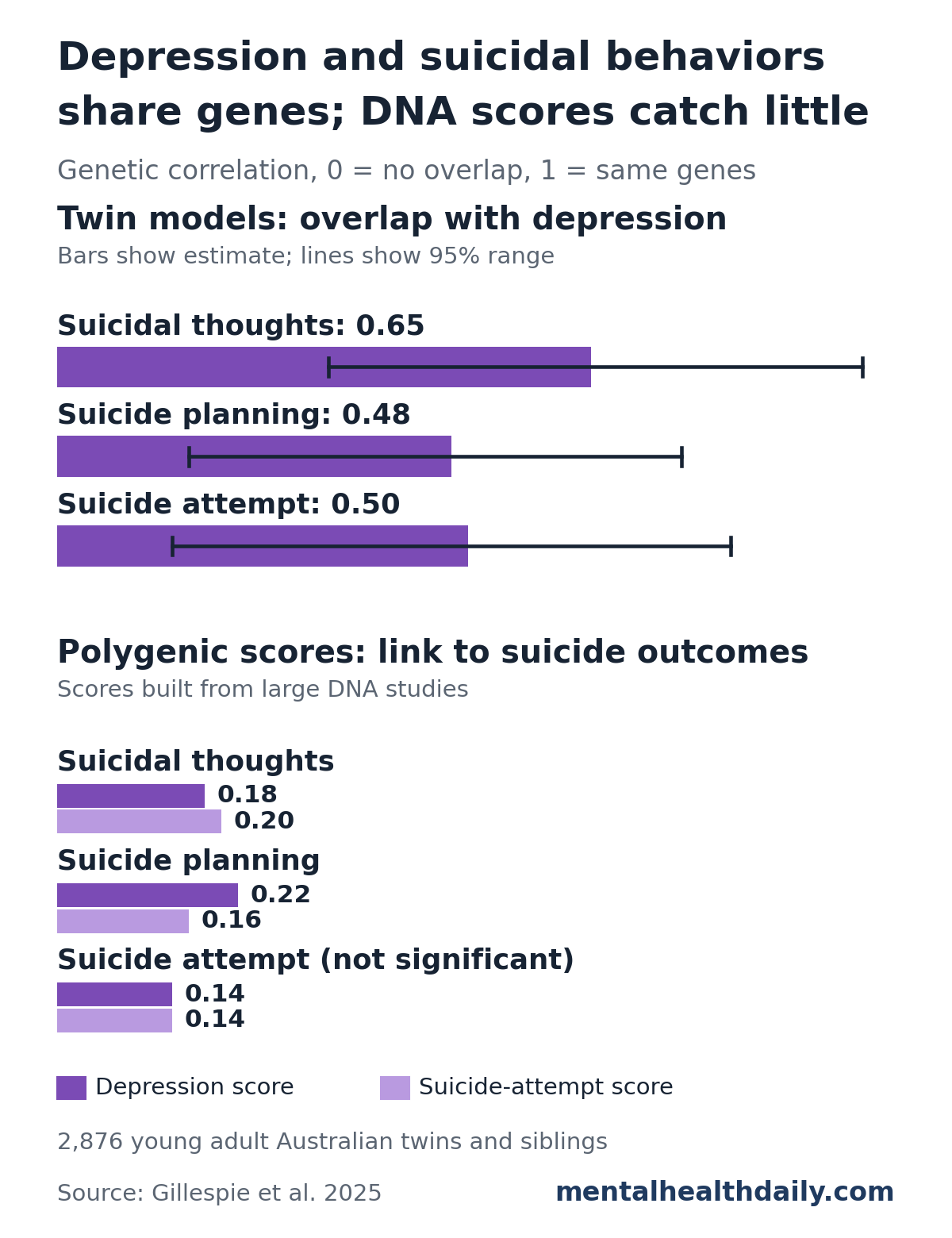
In the combined twin model, the genetic correlation between MDD and each suicide outcome was:1
- Suicidal thoughts: 0.65 (95% CI 0.33 to 0.98)
- Suicide planning: 0.48 (95% CI 0.16 to 0.76)
- Suicide attempt: 0.50 (95% CI 0.14 to 0.82)
These values mean the genetic overlap is real but partial. Some of the genetic influences on suicidal thoughts and behaviors are not shared with depression, which the authors describe as partially distinct genetic architectures.1
The 3 suicide outcomes were far more tightly linked to each other. Genetic correlations were 0.91 between thoughts and planning, 0.99 between planning and attempts, and 0.85 between thoughts and attempts.1
Heritability of Suicidal Behaviors Was High but Imprecise
The best-fitting models included genetic and individual environmental influences, with no detectable role for environment shared within families. Estimated heritability was:1
- MDD: 39% to 41%
- Suicidal thoughts: 51% to 53%
- Suicide planning: 59% to 62%
- Suicide attempt: 80%
The attempt figure is the least certain. When the authors resampled their data 1,000 times, heritability for suicide attempt came out at 74%, with a 95% range from 20% to 98%. Attempts were uncommon, and that rarity limits precision.1
Heritability is also a population statistic. It describes how much of the variation among these young adults tracked with genetic differences, not how much of any one person’s risk is fixed. The authors also note that genetic effects can change across the lifespan and shape how sensitive people are to their environment.1
Polygenic Scores Captured Only a Small Part of the Genetic Risk
Both DNA scores showed modest links with suicide outcomes:1
- Depression score: genetic correlations of 0.18 with suicidal thoughts, 0.22 with planning, and 0.14 with attempts (not significant); 0.24 to 0.25 with MDD itself
- Suicide-attempt score: 0.20 with thoughts, 0.16 with planning, and 0.14 with attempts (not significant); 0.01 to 0.24 with MDD across models
At the plain-association level, the scores correlated with depression and suicide outcomes at r = 0.01 to 0.15. The depression score tracked MDD more consistently than the suicide-attempt score did.1
The gap between twin-based estimates (around 0.5 to 0.65) and polygenic scores (around 0.14 to 0.22) shows that current scores capture only part of the genetic signal. The authors expect them to improve as genetic studies grow larger and more ancestrally diverse, but note that suicide-specific scores currently have very limited clinical use.1
Environmental Influences on Depression and Suicidal Behaviors Differed
Individual environmental influences (experiences not shared by twins, plus measurement error) told a different story from the genetics. Environmental correlations between MDD and suicide outcomes were weak, ranging from −0.36 for attempts to 0.12 for planning, and none was statistically significant.1
In other words, the life experiences that raised depression risk in this sample were largely separate from those linked to suicidal thoughts and behaviors. The authors say this highlights the need to identify specific environmental exposures that affect suicide risk.1
Other patterns in the sample:
- Age: for every 10 years of age, the odds of suicide planning were 44% lower (odds ratio 0.56) and the odds of an attempt were 55% lower (odds ratio 0.45). Suicidal thoughts and MDD did not change with age across this range.1
- Sex: MDD was more common in women, but suicidal thoughts, planning, and attempts showed no significant sex differences.1
How This Fits With Other Genetic Studies of Suicide Risk
- Large DNA study of suicide attempt: a GWAS of 29,782 people with a suicide attempt and 519,961 controls found strong genetic correlation between suicide attempt and psychiatric disorders, especially major depression. It also found genetic links with factors such as sleep problems, pain, and risk-taking that were not explained by psychiatric disorders.2
- Swedish family study: in 1,314,990 twins, full siblings, and half siblings, suicide attempt and death by suicide both showed moderate heritability and a substantial but incomplete genetic correlation with each other.3
- Attempts outside psychiatric illness: a large survey analysis estimated that 19.6% of people who had attempted suicide did so before meeting criteria for any psychiatric disorder.4
The Brisbane result is consistent with this work. Depression and suicide risk overlap genetically, but suicide risk is not simply a severe form of depression.
Limitations of This Twin and Polygenic Score Study
- Small suicide sample and wide intervals: estimates for suicide outcomes, especially attempts, were imprecise. The authors call this an important limitation.
- Suicide questions asked only after low mood: results describe suicidal thoughts and behaviors during depressive episodes, not in people who never reported low mood.
- European ancestry only: findings may not carry over to other populations.
- Men and women pooled: the models adjusted for sex but did not test whether genetic influences differ by sex.
- Broad depression score: the depression polygenic score came from a GWAS that mixed clinical and self-reported depression, not strict DSM-IV MDD, and no suicidal-thoughts score was available.
- Not a clinical test: neither polygenic score can predict an individual’s risk.
What the Findings Mean for Suicide Prevention
Genetic influence is not destiny. Even in these twins, individual environmental influences (which also include measurement noise) accounted for about 60% of the variation in depression and about half of the variation in suicidal thoughts.1 Life circumstances are where support, treatment, and prevention can make a difference.
The authors suggest that, for now, a family history of suicidal behavior, and to a lesser extent depression, can help flag people who may benefit from prevention efforts. A DNA score cannot. Any risk assessment should also weigh a wide range of risk and protective factors.1
Depression is treatable, and suicidal thoughts often pass with support. Talking to a doctor, therapist, or someone you trust is a good first step.
If you or someone you know is struggling or in crisis, help is available. In the United States, call or text the 988 Suicide & Crisis Lifeline at 988, or chat at 988lifeline.org. Elsewhere, contact local emergency services or a local crisis line.
References
- Gillespie NA, Su MH, Lannoy S, et al. Genetic overlap between DSM-IV major depressive disorder and suicidal behaviors: evidence from polygenic risk scores in young adult twins. Behavior Genetics. 2025;55:423–437. doi:10.1007/s10519-025-10234-0
- Mullins N, Kang J, Campos AI, et al. Dissecting the shared genetic architecture of suicide attempt, psychiatric disorders, and known risk factors. Biological Psychiatry. 2022;91:313–327. doi:10.1016/j.biopsych.2021.05.029
- Edwards AC, Ohlsson H, Mościcki E, et al. On the genetic and environmental relationship between suicide attempt and death by suicide. American Journal of Psychiatry. 2021;178:1060–1069. doi:10.1176/appi.ajp.2020.20121705
- Oquendo MA, Wall M, Wang S, Olfson M, Blanco C. Lifetime suicide attempts in otherwise psychiatrically healthy individuals. JAMA Psychiatry. 2024;81:572–578. doi:10.1001/jamapsychiatry.2023.5672