
The US opioid crisis now runs on illicit fentanyl mixed with other drugs, including stimulants, sedatives and newer adulterants such as xylazine and nitazenes, according to a 2026 review in Frontiers in Public Health.1 The researchers argue that responses built around a single opioid no longer match how people are dying.
Research Highlights
- A review, not a new dataset: a Florida International University team synthesized 86 publications and government reports from 2010 to 2026, with a regional focus on South Florida.1
- Stimulant deaths climbed: from 2012 to 2018, US overdose deaths involving cocaine rose from 1.4 to 4.5 per 100,000 people, and those involving methamphetamine-type stimulants rose from 0.8 to 3.9.1
- Sedatives often appear too: benzodiazepines were involved in 21.0% of US opioid overdose deaths in 2017, up from 8.7% in 1999.2
- Xylazine spread through fentanyl: the DEA reported xylazine in 30% of the fentanyl powder it seized in 2023 and has found xylazine–fentanyl mixtures in 48 of 50 states.1
- Treatment gap persists: in 2022, only 25.1% of US adults who needed opioid use disorder treatment received medication for it.3
What the 2026 Opioid Use Disorder Review Covered
Opioid use disorder (OUD) is a medical condition in which opioid use continues despite clear harm, often with cravings, tolerance and withdrawal. It can involve prescription painkillers, heroin or illicit fentanyl.
Mandapati et al. searched PubMed, Scopus and Google Scholar for work on OUD, fentanyl, polysubstance use, xylazine, nitazenes, treatment and policy. They screened 364 records, assessed 287 full texts and kept 86 for a narrative synthesis, meaning they summarized the evidence in prose rather than pooling numbers statistically.1
- Scope: how the epidemic changed, which drug combinations now drive deaths, who is most affected, and where treatment falls short
- Regional lens: South Florida, once a center of high-volume “pill mill” pain clinics
- Output: a proposed policy framework for responding to a drug supply that changes quickly
Evidence strength: no pooled estimates were calculated and no formal risk-of-bias assessment was done. Most underlying data are observational, so the review describes trends and proposes policy; it does not test whether those policies work.
4 Waves of the US Opioid Epidemic
The review organizes the past 3 decades into 4 overlapping waves:1
- Prescription opioids (1990s to about 2011): heavy prescribing and wide availability of high-dose and extended-release pills.
- Heroin (after 2010, peaking around 2017): some people dependent on prescription opioids moved to cheaper, high-purity heroin as pills became harder to get.
- Synthetic opioids (from about 2014): deaths involving illicitly made fentanyl and fentanyl analogs rose sharply, first in the Northeast and Midwest and later in the West.
- Stimulants and polysubstance use (emerging from about 2012): cocaine and methamphetamine increasingly appear alongside opioids in overdose deaths.
The researchers treat these waves as a historical map rather than separate eras. Today the substances coexist, and the mix shifts faster than the wave model can track.
Stimulants and Sedatives Increasingly Appear in Opioid Overdose Deaths
Polysubstance use means using more than one drug at once or close together, either on purpose or unknowingly when a drug is contaminated. The review describes it as a defining feature of the current crisis.1
Stimulants: CDC data cited in the review show that from 2012 to 2018, the US overdose death rate involving cocaine roughly tripled, from 1.4 to 4.5 per 100,000 people. The rate involving psychostimulants such as methamphetamine rose about fivefold, from 0.8 to 3.9.1 Synthetic opioids are frequently involved in these stimulant deaths.
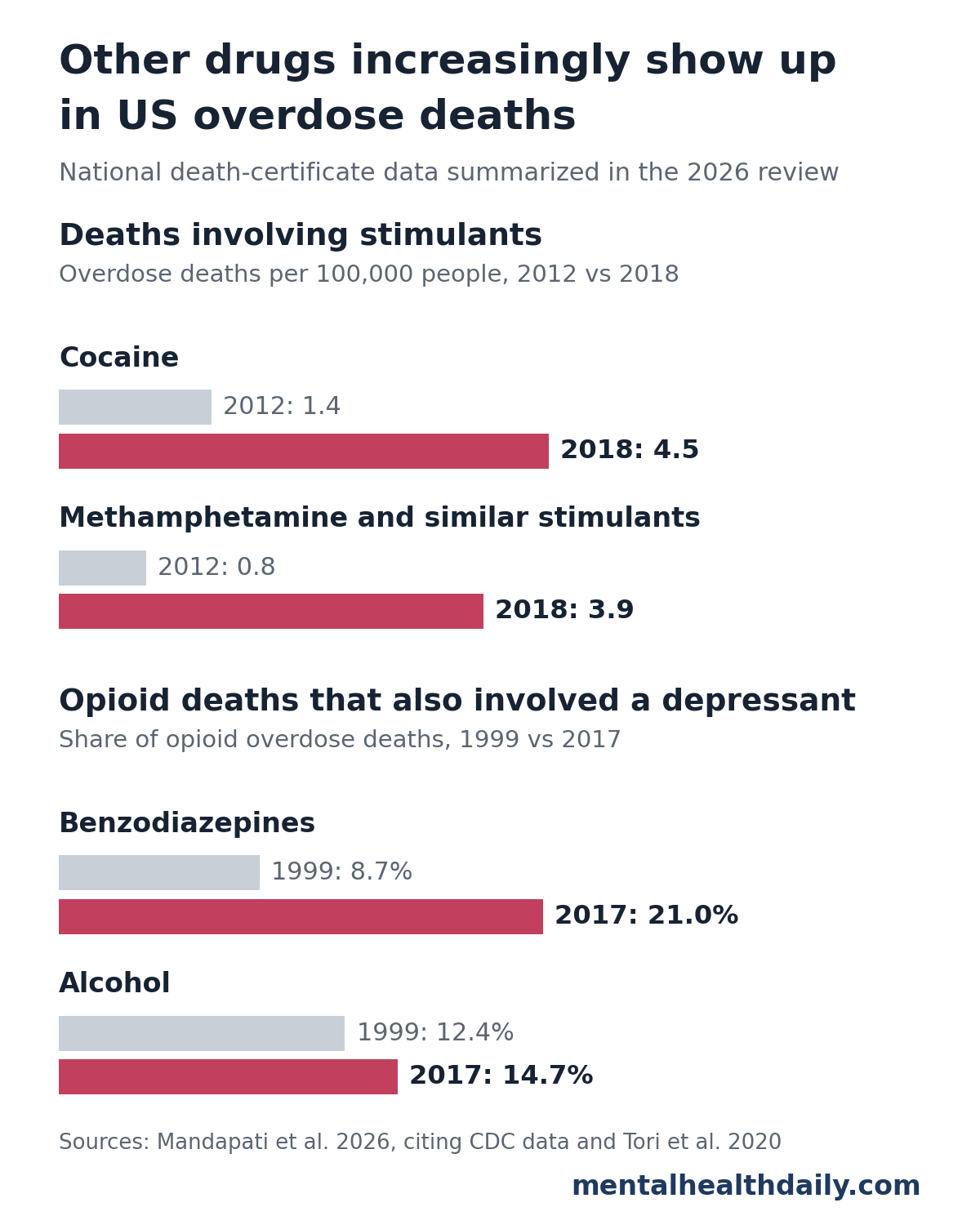
Sedatives: a national analysis of 399,230 opioid overdose deaths from 1999 to 2017 found that benzodiazepine involvement rose from 8.7% to 21.0%, and alcohol involvement rose from 12.4% to 14.7%.2 In 2017, benzodiazepines appeared in 33.1% of prescription opioid deaths and 17.1% of synthetic opioid deaths.
Benzodiazepines (sedatives such as alprazolam) and alcohol both slow breathing, so combining them with opioids deepens sedation and raises overdose risk. The review notes that alcohol’s role is often under-recognized in routine surveillance.1
Opioid–stimulant combinations: the review describes how a stimulant can temporarily mask early signs of opioid overdose. Regional reports show how common these combinations have become:
- A 2022 Nevada state report found that nearly one-third of overdoses there involved both fentanyl and methamphetamine.
- In a 2019 survey of syringe-services clients in Seattle, 55% reported using heroin and methamphetamine mixed together in the past 3 months, and the share calling it their main drug rose from 10% in 2017 to 20% in 2019.
- Some people combine the 2 drug types deliberately; others take fentanyl unknowingly in what they believe is a stimulant-only supply.1
Xylazine and Nitazenes in the Fentanyl Supply
Xylazine is a veterinary sedative that is not approved for people. It has become a common adulterant in illicit fentanyl.1
- How common: the DEA reported xylazine in 30% of the fentanyl powder it seized in 2023 and in 6% of seized fentanyl pills, and has identified xylazine–fentanyl mixtures in 48 of 50 states.
- Why it complicates care: xylazine is not an opioid, so naloxone does not reverse its sedating effects. It can also worsen tissue damage and make withdrawal more complicated.
- What responders should still do: the review stresses that a suspected overdose still calls for naloxone, because opioids are likely involved too, together with breathing support and emergency care.1
Nitazenes are a separate group of extremely potent synthetic opioids. They have turned up mixed with fentanyl, heroin and cocaine, which sharply raises overdose risk.1
South Florida: From Pill Mills to Fentanyl Mixtures
During the first wave, unregulated South Florida pain clinics distributed a disproportionately large share of the nation’s oxycodone. When those clinics were shut down and prescription monitoring tightened, demand shifted to illicit sources.1
Florida data cited in the review show how mixed today’s deaths are:
- Cocaine rarely acted alone: Florida’s Medical Examiners Commission reported that 2,499 of 2,882 cocaine-related deaths involved other drugs.
- Fentanyl usually contributed to the death: when found in a fatal case, fentanyl was judged a cause of death 90% of the time, fentanyl analogs 84%, methamphetamine 75%, cocaine 66% and xylazine 57%.
- Carfentanil returned: carfentanil, an extremely potent fentanyl analog, caused 1,190 Florida deaths in 2016–2017, and South Florida accounted for about 68.8% of the state’s carfentanil deaths in 2018–2023.1
Prescription drug monitoring programs and Florida’s 3-day limit on opioid prescriptions for acute pain reduced prescription opioid misuse and the amount of opioids dispensed. The review argues that those tools fit the earlier prescription wave and should no longer be the central response now that illicit fentanyl dominates.1
Only 1 in 4 US Adults Who Needed OUD Treatment Got Medication in 2022
Medications for opioid use disorder include methadone and buprenorphine, which act on opioid receptors to ease cravings and withdrawal, and naltrexone, which blocks opioid effects. Methadone and buprenorphine substantially lower the risk of overdose death.3
Use still lags far behind need. A CDC analysis of the 2022 National Survey on Drug Use and Health estimated that 3.7% of US adults needed OUD treatment. Of those, 55.2% received any treatment and only 25.1% received medication.3
Access to any OUD treatment was uneven:1,3
- Age: 44.9% of adults 50 and older vs 58.9% to 67.8% of younger groups
- Race and ethnicity: 60.3% of White adults vs 43.8% of Black and 45.7% of Hispanic adults
- Severity: 53.0% with severe OUD vs 20.5% with mild or moderate OUD
The review lists cost, time, fear of losing a job and stigma as major barriers, and points to telehealth, outpatient programs and job-protected medical leave as ways to lower them.1
The Review’s Proposed Response: Detect, Identify, Act, Evaluate
The researchers propose an “adaptive polysubstance response framework” built on 4 steps:1
- Detect changes in the drug supply by linking emergency department, ambulance, medical examiner, toxicology and community drug-checking data.
- Identify who is affected and how they are exposed.
- Activate predefined responses, such as rapid alerts to hospitals and harm-reduction programs.
- Evaluate results using time from detection to alert to action, rather than the number of reports produced.
Several specific recommendations follow from that framework:
- Match the response to intent: people who combine opioids and stimulants on purpose should be offered OUD medication plus treatment for stimulant use and mental health conditions. Unknowing exposure calls for drug checking, fentanyl test strips, targeted alerts and naloxone.
- Lower the barrier to medication: same-day treatment starts in emergency departments, clinics and mobile units, with walk-in access and telehealth where allowed. Medication should not be withheld because someone still uses other substances or declines counseling.
- Keep treatment going through incarceration and release, with naloxone and a community appointment arranged before release.
- Put naloxone everywhere people need it: pharmacies, shelters, treatment programs, emergency departments and correctional release programs.
- Use prescription monitoring as a safety tool, not as a trigger to cut patients off abruptly.
- Validate AI screening first: machine-learning tools that flag OUD risk need external testing, bias checks and human review, and every alert should lead to an offer of care.
Limitations of This Opioid Epidemiology Review
- Narrative, not quantitative: studies differed too much to pool, and there was no formal risk-of-bias assessment.
- Mostly observational data: the trends show association, not cause.
- Toxicology has limits: finding 2 drugs in a death cannot show whether the mix was intentional or how much each contributed, and testing varies by jurisdiction.
- Uneven sources: some figures come from state reports, agency statements and web pages, and several lack a stated year.
- US focus and lag: the findings center on the US and South Florida, and published data trail a drug supply that changes month to month.
What the Review Means for People Affected by Opioid Use
- Fentanyl can turn up in other drugs, including stimulants and counterfeit pills.
- Naloxone is still the first step for a suspected overdose, even when xylazine may be involved. It is sold over the counter in the US. Call 911 as well.
- Medications for OUD work. Methadone and buprenorphine lower the risk of overdose death and remain the core treatment.
- Help is available: the SAMHSA National Helpline (1-800-662-4357) offers free, confidential treatment referrals 24 hours a day.
References
- Mandapati NK, Tovar DC, Bindlish R, Hernandez YL, Alves MJ, Baum MK, Aggarwal S. The evolving epidemiology of opioid use disorder: polysubstance use, drug supply transformation, and policy implications. Frontiers in Public Health. 2026;14:1861122. doi:10.3389/fpubh.2026.1861122
- Tori ME, Larochelle MR, Naimi TS. Alcohol or benzodiazepine co-involvement with opioid overdose deaths in the United States, 1999–2017. JAMA Network Open. 2020;3(4):e202361. doi:10.1001/jamanetworkopen.2020.2361
- Dowell D, Brown S, Gyawali S, et al. Treatment for opioid use disorder: population estimates — United States, 2022. MMWR Morbidity and Mortality Weekly Report. 2024;73(25):567–574. doi:10.15585/mmwr.mm7325a1