
Real-time brain feedback while watching the drug film Trainspotting lowered movie-cue craving more than sham feedback in 20 people being treated for opioid use disorder. Their mood improved too, in a small study posted as a preprint.1
Research Highlights
- Brain target borrowed from peers: scans of 37 people with opioid use disorder, taken before and after 8 weeks of group therapy, defined a prefrontal “recovery” pattern that told the two scan sessions apart 77.5% of the time.1
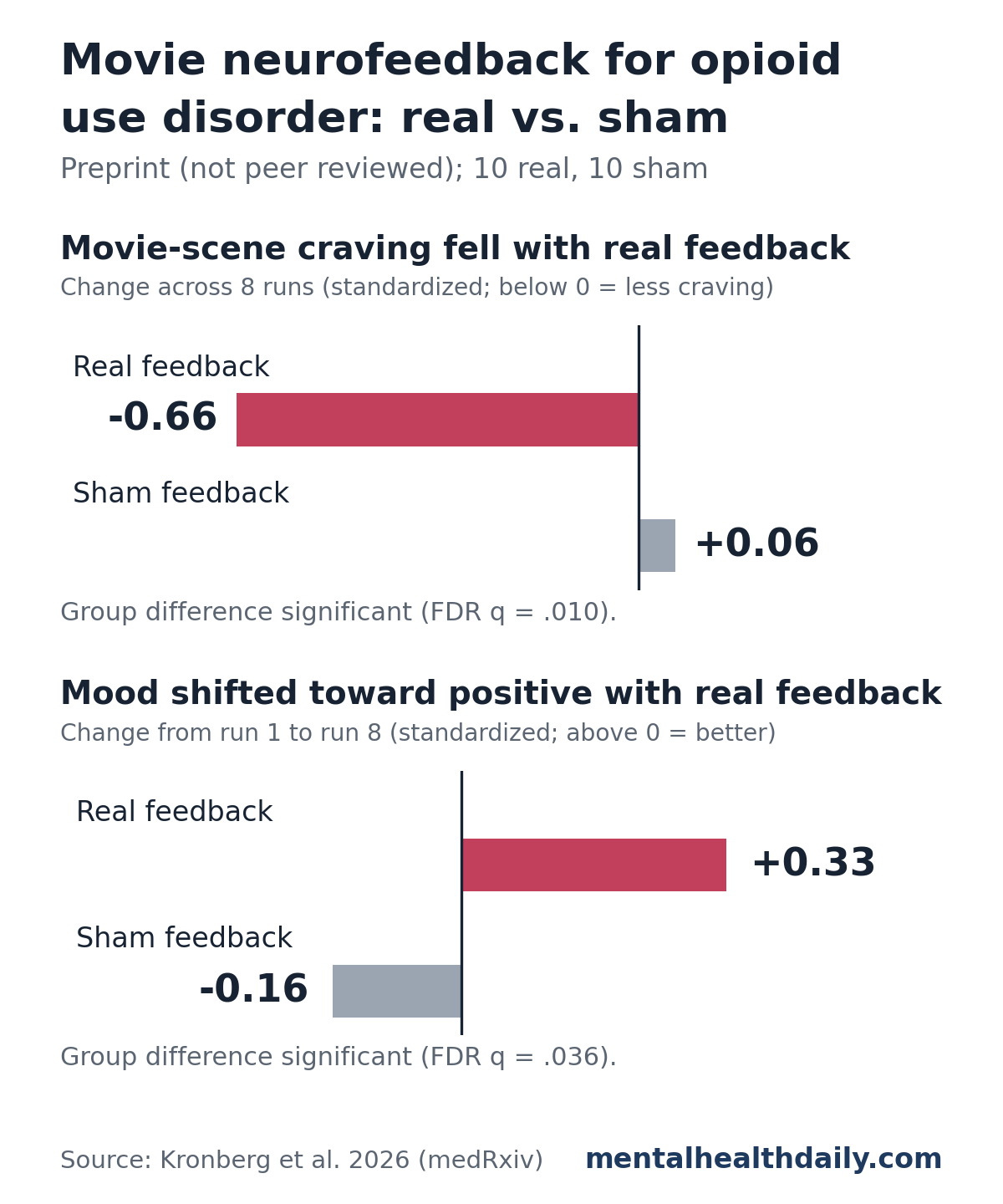
- Craving fell with real feedback: over up to 8 viewings, craving for heroin scenes dropped in the 10 people who got real feedback and stayed flat in the 10 who got sham feedback (group difference FDR q = .010).1
- Mood improved too: positive versus negative mood shifted upward with real feedback and not with sham (q = .036).1
- Learning was mixed: scores rose over the first 4 runs with real feedback, but that rise was not significantly steeper than sham.1
- Early-stage evidence: a medRxiv preprint (not yet peer reviewed) with 20 participants, groups recruited one after the other rather than randomized, and no follow-up on drug use.1
What Peer-Guided Movie Neurofeedback Is
Neurofeedback shows people a live readout of their own brain activity, here from a functional MRI (fMRI) scanner, so they can learn to steer it. Most addiction neurofeedback studies train one brain region while people look at still pictures of drugs.1
The Mount Sinai and Princeton team tried something different. They used a movie full of drug scenes and a target taken from other patients further along in recovery, so the goal was for each new participant’s brain to respond to the film more like theirs.1
The film choice builds on the group’s earlier work. In 30 inpatients with heroin use disorder, the orbitofrontal cortex (OFC, a brain area that weighs how valuable things are) tended to sync up across viewers during drug scenes in Trainspotting. That drug bias faded over 15 weeks of treatment, alongside a drop in craving.3
How the Study Worked
The study ran in two stages, both with inpatients in a medication-assisted rehab program who had heroin as their main drug.1
- Finding the target. 37 patients watched the same 17-minute Trainspotting segment in the scanner before and after 8 weeks of add-on group therapy. A model searched for a signal that changed in the same way across people. The best one came from the dorsolateral and dorsomedial prefrontal cortex, areas involved in self-control and rethinking how you react to something.
- Training a new group. 20 different patients watched the same segment up to 8 times over as many as 4 visits. After each of 8 scored scenes, the movie paused and showed a score from 0 to 100 for how closely their prefrontal signal matched the post-therapy pattern rather than the pre-therapy one.
Real feedback group: 10 people saw scores computed from their own brains.
Yoked sham group: 10 people, each matched to a real-group participant on time abstinent, saw that partner’s scores instead. Sham participants got the same movie, the same pauses, and believable scores that had nothing to do with their own brain.1
Participants were not told what mental strategy to use. They got some suggestions and were asked to work out what raised their score. Everyone was abstinent (about 171 days on average) and stable on medication for opioid use disorder, and all but one participant were men.1
Craving Fell Only With Real Feedback
The main outcome was scene-induced craving: after each visit, outside the scanner, participants rated short clips from the film, and the analysis focused on heroin-related clips.1
- Real feedback: craving fell across runs 1 to 4 and across all 8 runs (FDR q = .023 and .002)
- Sham feedback: no drop in either window
- Real vs. sham: the decline was steeper with real feedback in both windows (q = .023 for runs 1 to 4, q = .010 for runs 1 to 8), with large effect sizes (Cohen’s d near 1.9)
The real group reported higher craving than the sham group right after the first run. Craving measured before any neurofeedback did not differ, though, and adjusting for it did not change the result.1
People whose feedback scores rose the most over all 8 runs also had the biggest drops in craving (Spearman ρ = −.446, n = 19). That link was not seen over the first 4 runs alone.1
Mood Improved With Real Feedback
Mood was measured with the PANAS, a standard questionnaire scoring positive and negative feelings, before the first run and after the last one. The balance tipped toward positive feelings in the real group and not in the sham group, and the difference between groups was significant.1
Bigger gains in feedback scores went along with bigger mood gains (ρ = .544, n = 17). Because these ratings were not about the movie, the authors suggest the training may have lifted participants’ general emotional state.1
Did People Actually Learn the Brain Pattern?
Partly. Over runs 1 to 4, scores rose in the real group (d = 1.10) and not in the sham group. But the difference in slopes between groups was not statistically significant (q = .145).1
After run 4, learning faded. The authors link this to tiring sessions and real-time processing delays that made the feedback less reliable in later runs.1
A Link to the Brain’s Valuation Area
In the real group, moments when the prefrontal signal matched the target lined up with the shared OFC response more closely than in the sham group (average correlation 0.052 vs. 0.021). People with stronger coupling had larger craving drops over the first 4 runs (ρ = −.584, n = 16).1
An exploratory timing analysis found that matching the target tended to come before the OFC response in the real group. The authors read this as support for prefrontal control reshaping how the drug story is valued, while noting it is correlational.1
Limitations
The authors call this a proof-of-concept study showing feasibility and promise, not clinical efficacy.1
- Preprint. The paper has not been peer reviewed, and its banner says it should not guide clinical practice.
- Not randomized. The real group was recruited first and the sham group later, so differences between the two cohorts cannot be ruled out. After correcting for multiple comparisons, the groups did not differ on any measured baseline trait.
- Small and narrow sample. 10 people per group, almost all men, all inpatients with heroin as the main drug and on medication treatment.
- Short-term craving ratings only. Craving was rated in response to clips from the same film. There was no follow-up on relapse, drug use, or staying in treatment.
- Results split across time windows. Learning showed up in runs 1 to 4 but tracked craving only over runs 1 to 8, and the OFC findings showed the reverse pattern. The tests were one-sided, though corrected for multiple comparisons.
- Hard to scale. The method needs an MRI scanner. The authors suggest testing cheaper tools such as EEG in future work.
Where Neurofeedback for Addiction Stands
A 2024 systematic review of fMRI neurofeedback in substance use disorders found 16 studies with 446 participants, all involving alcohol, tobacco, or cocaine. Neurofeedback groups often differed from control groups, but changes in craving and prefrontal-striatal brain activity over time were less consistent.2
Against that background, the authors describe their study as the first to train people with a psychiatric disorder toward a movie-evoked brain pattern taken from peers who had already been through treatment.1 It gives a strong early signal in favor of the approach. A randomized trial with longer follow-up would show whether lower movie-cue craving carries over to fewer relapses.
References
- Kronberg G, McClain NE, Boros M, et al. Peer-guided movie neurofeedback to facilitate recovery in opioid use disorder. medRxiv (preprint, not peer reviewed). Posted September 20, 2026. doi:10.64898/2026.09.18.26363414
- Murphy E, et al. Real-time fMRI-based neurofeedback to restore brain function in substance use disorders: a systematic review of the literature. Neuroscience & Biobehavioral Reviews. 2024;165:105865. doi:10.1016/j.neubiorev.2024.105865 (PubMed)
- Kronberg G, Ceceli AO, Huang Y, et al. Shared orbitofrontal dynamics to a drug-themed movie track craving and recovery in heroin addiction. Brain. 2025;148(5):1778–1788. doi:10.1093/brain/awae369