
For college students who caught COVID-19, anxiety was linked less to the infection itself than to how many physical symptoms lingered during recovery. Memory problems and chest pain stood out in a 2026 study that surveyed college students in China in March 2023.1
Research Highlights
- Each extra recovery symptom, higher anxiety: among 298 infected students, every additional physical symptom during recovery was linked to about 22% higher odds of being in a higher anxiety category (OR 1.22, 95% CI 1.04 to 1.45).1
- Infection alone was not linked to anxiety: students with confirmed COVID-19 had similar anxiety levels to uninfected students (OR 0.89, 95% CI 0.55 to 1.44).1
- Memory decline and chest pain stood out: each was linked to roughly double the odds of higher anxiety; 4 other symptoms were not.1
- Recovery time was not linked to anxiety: how long students took to feel basically recovered showed no clear link to anxiety.1
- One survey, one moment: the data come from a single online questionnaire in March 2023, so the study cannot show which came first, the symptoms or the anxiety.1
How the College Student COVID Survey Worked
Guo et al. surveyed college students online in March 2023, a few months into what the researchers describe as a concentrated infection period after COVID-19 policies were relaxed. Most students had already been exposed, so the question had shifted from whether they caught the virus to how they recovered.1
The questionnaire ran on Wenjuanxing, a Chinese survey platform, and spread through convenience and snowball sampling (students passing it to other students). It was published in Frontiers in Psychiatry.
- Sample: 394 valid responses after 33 straight-line answers (the same response to every item) were removed
- Infection comparison: 372 students who knew their status — 298 with confirmed infection and 74 uninfected; 22 unsure students were left out
- Recovery analyses: the 298 infected students only
- Adjusted for: gender, school year, poverty status, only-child status, introversion, physical health before the pandemic, living alone during the pandemic, and exercise frequency
How Anxiety and Symptoms Were Measured
Anxiety was scored with 7 items adapted from the GAD-7, a widely used self-report questionnaire for generalized anxiety symptoms such as nervousness, uncontrollable worry, trouble relaxing, restlessness, and irritability.2 Each item ran from 0 to 3, giving a total of 0 to 21.
Students were then grouped by the standard GAD-7 cutoffs: no anxiety (0–4), mild (5–9), moderate (10–14), and severe (15–21). The items held together very well (Cronbach’s alpha 0.935, a measure of internal consistency).1 This is a symptom score, not a clinical diagnosis of an anxiety disorder.
Recovery-phase symptoms were physical problems students reported while recovering from infection. The researchers counted 6 of them, for a score from 0 to 6:
- Reduced physical strength
- Long-lasting cough or shortness of breath
- Memory decline
- Palpitations (a racing or pounding heartbeat)
- Chest pain
- Loss or change of smell or taste
These overlap with common long COVID symptoms, but the survey did not use a formal long COVID definition or a minimum duration.
COVID Infection Itself Was Not Linked to Higher Anxiety
Among the 372 students with a clear infection status, confirmed COVID-19 was not linked to anxiety level, either before adjustment (OR 0.98, 95% CI 0.62 to 1.55) or after it (OR 0.89, 95% CI 0.55 to 1.44).1
An odds ratio (OR) above 1 means higher odds of being in a more anxious category; an OR near 1 means no clear difference. With only 74 uninfected students, this comparison is not very precise.
The researchers argue that infection status is a crude marker once most of a campus has been infected. Anxiety was common across the board: 185 of the 298 infected students (62.1%) scored in at least the mild range.1
More Physical Symptoms During Recovery, Higher Anxiety
Among infected students, anxiety rose with the number of recovery symptoms, with the clearest rise from 2 symptoms upward. Before any adjustment, 55% of students with no lingering symptoms had at least mild anxiety, compared with 76% of those with 4 to 6 symptoms.1
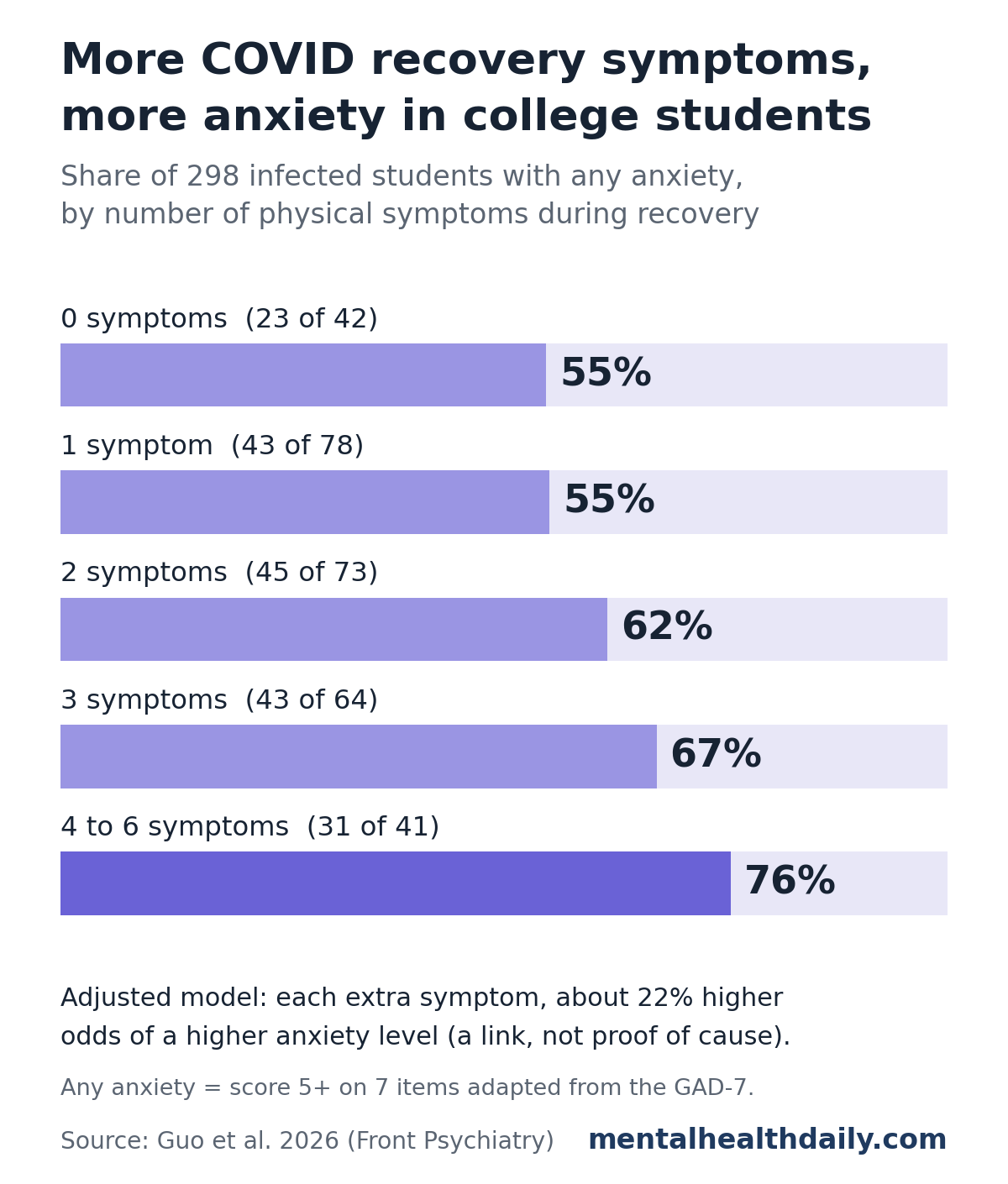
The adjusted model confirmed the pattern: each additional symptom was linked to 22% higher odds of a higher anxiety category (OR 1.22, 95% CI 1.04 to 1.45, p = 0.018), even after accounting for recovery time and the background factors listed above.1
Checks with other anxiety outcomes. The researchers reran the analysis 3 other ways. Results pointed the same direction each time but were borderline:
- Moderate-to-severe anxiety (score 10+): OR 1.21 per symptom, p = 0.049
- Any anxiety (score 5+): OR 1.20, p = 0.063
- Total anxiety score: about 0.59 points higher per symptom, p = 0.059
The researchers call the effect relatively limited, and the numbers support that: a consistent, modest link rather than a large one.
Memory Decline and Chest Pain Were the Symptoms Most Linked to Anxiety
When the 6 symptoms were examined one by one in the same model, 2 stood out:1
- Memory decline: OR 2.04 (95% CI 1.17 to 3.55), p = 0.012
- Chest pain: OR 2.19 (95% CI 1.15 to 4.18), p = 0.018
- Not significant: cough or shortness of breath (OR 1.54, p = 0.063), palpitations (OR 1.39), reduced physical strength (OR 0.72), and smell or taste changes (OR 0.67)
The researchers did not correct for testing 6 symptoms at once, which raises the chance that one of these results is a fluke. Treat the memory and chest pain findings as leads for future studies.
Why these 2 symptoms might worry students. The researchers draw on health anxiety theory, the idea that anxiety grows when people read bodily sensations as signs of serious illness. Chest pain is easy to interpret as possible heart or lung damage. Memory problems hit the thing students depend on for classes and exams. The survey did not measure health worry directly, so this explanation is untested here.1
How Long Recovery Took Was Not Linked to Anxiety
Students also reported how long it took them to basically recover, from within 3 days to more than a month. Recovery time showed no link to anxiety in the model with symptom count (OR 0.98, 95% CI 0.75 to 1.29, p = 0.90) or in the model with individual symptoms (OR 0.90, p = 0.44).1
One small group is worth noting: all 7 students who took more than a month to recover reported anxiety. That is too few people to draw conclusions, and the researchers say the study cannot rule out a link with longer recovery.1
A plausible reading is that ongoing symptoms that interfere with daily life weigh more than the number of days a student was sick. A large French survey found the same pattern in adults with post-COVID-19 condition (the formal term for long COVID): time since infection was not linked to anxiety levels.3
How the Findings Fit With Long COVID Research
Anxiety is one of the more common lingering problems after COVID-19. A 2022 meta-analysis of 51 studies and 18,917 patients, followed for an average of 77 days after infection, estimated these pooled rates:4
- Sleep problems: 27.4%
- Fatigue: 24.4%
- Objective cognitive impairment: 20.2%
- Anxiety: 19.1%
Results varied widely between the studies in that review.
Tebeka et al. surveyed a representative sample of French adults in March and April 2022. Among people who had been infected, those with post-COVID-19 condition (1,095 people) were more likely to have anxiety than those without it (1,021 people), with an adjusted OR of 1.29.3
That French study also found that a history of chronic anxiety was by far the strongest predictor of current anxiety (adjusted OR 4.43). The college survey did not ask about mental health before infection, which is one of its biggest gaps.3
Both lines of evidence fit the college survey: among people who have had COVID-19, those with lingering symptoms tend to report more anxiety. Which comes first is still unsettled.
Limitations of This COVID Recovery and Anxiety Survey
- Cross-sectional design. Symptoms and anxiety were measured at the same time. Anxiety could make students notice and report more physical symptoms, just as symptoms could raise anxiety.
- Not a representative sample. Convenience and snowball recruitment online means the students may differ from college students in general. The paper does not name the universities or regions.
- Everything was self-reported. Infection, symptoms, and recovery time came from students’ own answers, and the anxiety items were adapted from the GAD-7 rather than used as the original validated scale.
- Missing information. The survey did not record prior mental health, COVID-19 severity, vaccination, time since infection, social support, or academic pressure.
- Small subgroups and multiple tests. Only 74 students were uninfected and 7 had recovery longer than a month, and the 6 individual symptom tests were not corrected for multiple comparisons.
School year also showed up. Fourth-year students had about 4 times the odds of a higher anxiety category than first-year students (OR 4.02, 95% CI 1.56 to 10.36), possibly reflecting graduation and job pressure. The survey did not measure those pressures directly.1
What It Means for Students Recovering From COVID-19
- Ask about symptoms, not just infection. The researchers suggest that campus health services ask students about lingering physical symptoms, memory changes, and chest discomfort, rather than only whether they had COVID-19.
- Check in a few weeks after infection. They propose a brief questionnaire 2 to 4 weeks after infection covering symptom count, effects on studying, health worries, and anxiety. That is a suggestion from the authors, not a tested program.
- Get chest pain checked. Chest pain after an infection deserves a medical evaluation in its own right, and a clear answer can also ease worry.
- Support for memory and focus problems. Students struggling with memory or concentration after COVID-19 may benefit from both academic accommodations and mental health support.
References
- Guo D, Liu T, Xu Y, Xie L. Recovery-phase symptoms after COVID-19 infection and anxiety levels among college students. Frontiers in Psychiatry. 2026;17:1921410. doi:10.3389/fpsyt.2026.1921410
- Spitzer RL, Kroenke K, Williams JBW, Löwe B. A brief measure for assessing generalized anxiety disorder: the GAD-7. Archives of Internal Medicine. 2006;166(10):1092–1097. doi:10.1001/archinte.166.10.1092
- Tebeka S, Carcaillon-Bentata L, Decio V, et al. Complex association between post-COVID-19 condition and anxiety and depression symptoms. European Psychiatry. 2024;67(1):e1. doi:10.1192/j.eurpsy.2023.2473
- Badenoch JB, Rengasamy ER, et al. Persistent neuropsychiatric symptoms after COVID-19: a systematic review and meta-analysis. Brain Communications. 2022;4(1):fcab297. doi:10.1093/braincomms/fcab297