
Anesthesia drugs such as dexmedetomidine, ketamine and propofol, plus nerve blocks and acupuncture, are still experimental as treatments for chronic insomnia, according to a 2026 review by anesthesiologists in China.1 Their best trials were done around surgery, and cognitive behavioral therapy for insomnia (CBT-I) remains the first-line treatment.
Research Highlights
- No proven insomnia treatment yet: none of the anesthesia-based approaches has shown benefit for chronic insomnia in an adequately powered randomized trial of people with insomnia.1
- Dexmedetomidine is the closest to natural sleep: this sedative produces brain-wave patterns resembling stage 2 non-REM sleep more closely than propofol does.1
- Best evidence comes from surgery: dexmedetomidine, opioid-sparing pain control and melatonin improve sleep in the nights after an operation, which says little about insomnia that has lasted for years.1
- Safety is a big unknown: repeated dosing raises concerns about withdrawal, heart rate and blood pressure, untreated sleep apnea, and (for ketamine) bladder damage and misuse.1
- CBT-I stays first: the review places these approaches as research options for refractory insomnia, after CBT-I and at least two classes of sleep medication have failed.12
What the Anesthesia and Insomnia Review Covered
Wu et al. searched four medical databases through June 2026 and wrote a narrative review: a guided summary of the literature, without the fixed selection rules or pooled statistics of a systematic review or meta-analysis. Each treatment claim was graded on the Oxford CEBM levels-of-evidence scale, where level 1 is a systematic review of randomized trials and level 5 is reasoning from mechanism alone.1
Insomnia affects roughly 10% to 30% of adults. CBT-I works and lasts, but trained therapists are scarce in many places, some people respond only partly, and sleep medications carry risks of tolerance, dependence and next-day impairment.1
Anesthesiologists spend their careers switching consciousness off and on, so the review asks whether their drugs can do something more delicate: push the brain into real, restorative sleep for people whose insomnia has resisted everything else.
How Anesthesia and Natural Sleep Share Brain Circuits
Sleep, sedation and general anesthesia are different states. Natural sleep can be interrupted by an important sound, cycles between non-REM and REM (rapid eye movement) stages through the night, and supports memory and brain repair. General anesthesia produces unconsciousness, amnesia, pain relief and stillness, and normal sleep structure is usually absent.1
Several anesthetics still act on the same brain switches that run the sleep–wake cycle:
- Ventrolateral preoptic nucleus (VLPO): a cluster of sleep-promoting neurons in the hypothalamus that quiets arousal centers. Propofol and some inhaled anesthetics activate it.
- Locus coeruleus: a brainstem hub that releases noradrenaline to keep the brain awake. Dexmedetomidine turns it down.
- Orexin system: hypothalamic neurons that stabilize wakefulness, the target of newer insomnia drugs called dual orexin receptor antagonists (DORAs).
The overlap is partial. In animal studies, isoflurane can produce unconsciousness without an intact VLPO, so anesthesia and sleep are not the same state at the circuit level.1
Dexmedetomidine Produces Sleep-Like Brain Waves
Dexmedetomidine is an intravenous sedative used in operating rooms and intensive care units. It stimulates alpha-2 adrenergic receptors in the locus coeruleus, which lowers noradrenaline release and releases the brakes on the VLPO.1
That route through the brain’s own sleep circuit is why researchers call its effect “biomimetic sleep.” Recordings from electrodes placed inside the brain show that dexmedetomidine produces sleep spindles, slow waves and network changes closer to natural stage 2 non-REM sleep than propofol does.1
Sleep-like brain waves come with a catch. In one study of healthy young adults, daytime dexmedetomidine sedation combined with sound pulses timed to slow brain waves cut deep (N3) sleep the following night by 17.1 minutes (95% CI −30.0 to −8.2). The drug-induced state appears to pay off some of the brain’s deep-sleep pressure in advance, leaving less for the night that follows. Whether these states restore the brain the way natural sleep does is still unproven.1
Dexmedetomidine for Insomnia: Three Ways to Give It
Dexmedetomidine normally runs through an IV line. The review covers three ways researchers have tried to adapt it for sleep.
Under the tongue or inside the cheek. The strongest non-surgical study is a placebo-controlled crossover trial by Schnider et al. In 17 healthy young men with mild, subclinical insomnia, a 40-microgram dose dissolved in the cheek shortened the time to fall asleep by 11.5 minutes and added 37.2 minutes of non-REM sleep. Night-time cortisol, melatonin and heart rate were unchanged, and next-morning alertness was unaffected.3
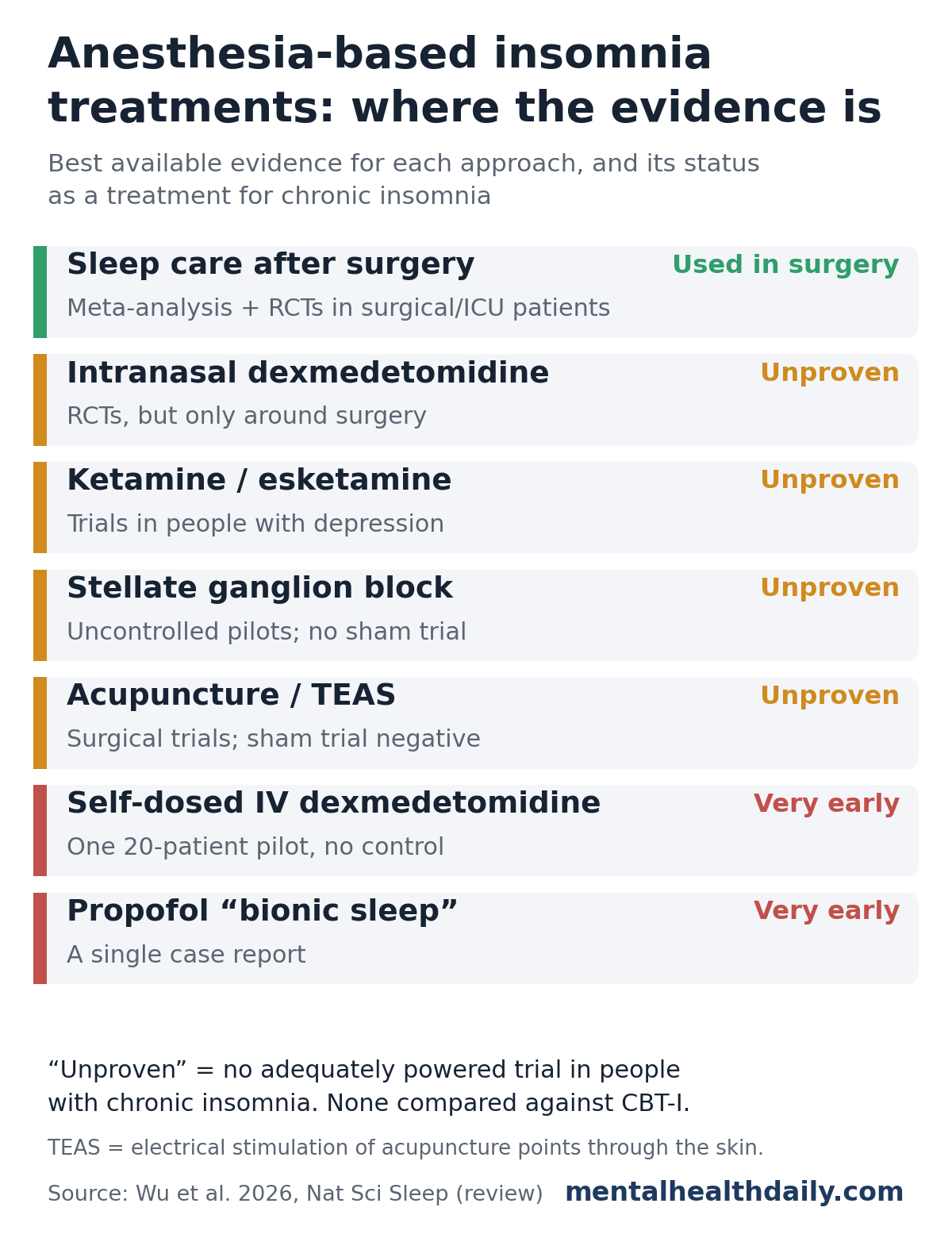
Through the nose. Intranasal dexmedetomidine has several randomized trials, nearly all before or after surgery. The largest enrolled 110 older adults with chronic insomnia having hip or knee replacement and found better postoperative sleep than placebo. Its outcomes were measured only after the operation, so evidence in people with insomnia who are not having surgery is still missing.1
Patient-controlled IV pump. In patient-controlled sleep (PCSL), a pump delivers a low background infusion and lets the patient press a button for extra doses, with a 10-minute lockout. In a 2020 pilot by An et al., 15 of 20 people with long-standing insomnia that had failed at least two sleep medications completed treatment. Pittsburgh Sleep Quality Index scores (a 0-to-21 questionnaire where higher means worse sleep) fell from 14.3 to 8.4, and 12 of 15 improved.14
That pilot had no control group, and nearly all PCSL data come from the same research group. It also needs IV access and monitoring, which limits it to specialized centers.1
Ketamine, Esketamine and Propofol for Sleep
Ketamine blocks NMDA receptors, a type of glutamate receptor, and esketamine is its more potent mirror-image form, approved as a nasal spray for treatment-resistant depression. A single ketamine infusion increased total sleep, slow-wave sleep and REM sleep in people with treatment-resistant depression, and the slow-wave gains tracked brain-derived neurotrophic factor (BDNF, a growth factor for brain cells) only in people whose depression responded.1
In a randomized trial of 78 people with insomnia and depression, adding esketamine to dexmedetomidine increased total sleep time by 163 minutes vs. 112 minutes with dexmedetomidine alone. Mood improved in parallel, so the sleep gain cannot be separated from the antidepressant effect.1
Propofol “bionic sleep therapy” combines a controlled propofol infusion with dexmedetomidine to induce a sustained sleep-like state. Its whole insomnia evidence base is one case report: a person with 21 years of refractory insomnia whose measured sleep efficiency rose from 0% to 51% after three sessions. The review calls it hypothesis-generating only, and propofol carries risks of airway problems, heart and breathing depression, and misuse.1
Nerve Blocks, Acupuncture and Brain Stimulation for Insomnia
A stellate ganglion block (SGB) is an injection of local anesthetic next to a bundle of sympathetic nerves in the neck, meant to calm the “fight or flight” overdrive linked to insomnia. In a single-arm pilot of 72 people with insomnia disorder, sleep quality scores improved from 15.4 to 10.6, but with no comparison group the researchers could not rule out placebo effects or natural improvement. No sham-controlled trial exists.1
Acupuncture and TEAS (transcutaneous electrical acupoint stimulation, which stimulates acupuncture points with skin electrodes) improved self-rated sleep around surgery in a meta-analysis of 9 trials with 719 patients.1 A sham-controlled trial in 138 patients with breast cancer and chemotherapy-related insomnia found real acupuncture no better than sham on its primary insomnia score (difference −0.4 points, P = 0.609).5
Repetitive transcranial magnetic stimulation (rTMS), which uses magnetic pulses to change activity in the cortex, was combined with dexmedetomidine in one randomized trial of 42 people with chronic insomnia. The combination improved sleep quality more than dexmedetomidine alone through 6 months. It has not been replicated.1
Sleep After Surgery Is Different From Chronic Insomnia
Up to 69.4% of surgical patients have disturbed sleep afterward. Perioperative sleep care has real trial support and is used in hospitals now:1
- Dexmedetomidine: a meta-analysis of randomized trials found better postoperative sleep quality, and a 2025 ICU guideline update conditionally favors it over propofol for ventilated adults when light sedation or delirium prevention is the priority.
- Opioid-sparing pain control: combining acetaminophen, anti-inflammatories, nerve blocks and other drugs reduces opioids, which suppress REM sleep.
- Melatonin and environment: melatonin, eye masks, earplugs, dim night light and daytime light exposure help protect sleep in hospital.
These results don’t transfer directly to chronic insomnia. Sleep problems after surgery come from pain, noise and drug effects and usually fade within days or weeks. Chronic insomnia is kept going for months or years by hyperarousal, a bed that the brain has learned to link with wakefulness, and disrupted body clocks. Most perioperative trials also track only the first 1 to 3 nights.1
Safety Problems With Repeated Anesthesia-Drug Use
These drugs were developed for short-term use in operating rooms and ICUs. Using them night after night raises risks that have barely been studied:1
- Dexmedetomidine withdrawal: after ICU infusions of 72 hours or longer, roughly one-third of adults had clinically significant withdrawal, mostly rebound high blood pressure. Dose-dependent slow heart rate and low blood pressure are known effects.
- Sleep apnea: sedatives can relax the upper airway, and comorbid insomnia and sleep apnea affects an estimated 30% to 50% of each patient group. The review calls apnea screening an ethical requirement before any trial.
- Ketamine and esketamine: repeated use carries risks of bladder inflammation and misuse.
- Propofol: misuse potential and, with long infusions, propofol infusion syndrome make any use outside monitored settings unacceptable.
- Devices and regulation: IV pumps add infection, clotting and misuse risks, and every one of these uses is off-label.
CBT-I Remains First-Line for Chronic Insomnia
The European Insomnia Guideline recommends CBT-I, in person or digital, as the first-line treatment for chronic insomnia in adults, and the review agrees. CBT-I retrains sleep habits and the thoughts that keep people awake, with sleep restriction and stimulus control as its most active parts.2 Approved sleep medications, including DORAs, are the second option.1
The review’s own ranking of these approaches:1
- Dexmedetomidine (nasal, mouth or PCSL): a research option for refractory insomnia only, after CBT-I and two classes of sleep medication have failed and sleep apnea has been ruled out.
- Ketamine and esketamine: relevant mainly when insomnia comes with treatment-resistant depression, as an add-on to depression care.
- SGB, acupuncture, TEAS, rTMS combinations and sound stimulation: investigational add-ons.
- Bionic sleep therapy: hypothesis-generating only.
- Sleep care around surgery: ready for use in surgical and ICU patients now, but not a treatment for chronic insomnia.
The researchers call for head-to-head trials of the most developed option, low-dose dexmedetomidine by nose or mouth, against CBT-I and DORAs, with sleep-lab measurements and long-term safety follow-up.1
Limitations of This Anesthesia and Insomnia Review
- Narrative design: no formal risk-of-bias scoring or pooled estimates, so selection and publication bias are possible.
- Borrowed populations: most evidence comes from surgical, critically ill or depressed patients rather than people with primary chronic insomnia.
- Few independent groups: some approaches, such as PCSL, rest on one team’s work.
- Missing comparisons: no approach has been tested head-to-head against CBT-I or approved sleep drugs.
- Some preprints: a few cited studies were preprints or in press when the review was written.
The review was written by anesthesiologists at a single hospital and reported no external funding or competing interests.1
References
- Wu Y, Yu X, Sun H, Huang F, Wang J. Anesthesia-informed approaches to insomnia: shared neural circuits, biomimetic sleep, and emerging interventional strategies. Nature and Science of Sleep. 2026;18:636790. doi:10.2147/NSS.S636790
- Riemann D, Espie CA, Altena E, et al. The European Insomnia Guideline: an update on the diagnosis and treatment of insomnia 2023. Journal of Sleep Research. 2023;32(6):e14035. doi:10.1111/jsr.14035
- Schnider LK, Ratajczak M, Wespi R, et al. Effects of subanesthetic oromucosal dexmedetomidine on sleep in humans: a randomized, controlled pharmacokinetics–pharmacodynamics study. Anesthesiology. 2025;142(3):476–487. doi:10.1097/ALN.0000000000005314
- An JX, Williams JP, Fang QW, et al. Feasibility of patient-controlled sleep with dexmedetomidine in treating chronic intractable insomnia. Nature and Science of Sleep. 2020;12:1033–1042. doi:10.2147/NSS.S262991
- Zhang J, Qin Z, So TH, et al. Acupuncture for chemotherapy-associated insomnia in breast cancer patients: an assessor-participant blinded, randomized, sham-controlled trial. Breast Cancer Research. 2023;25(1):49. doi:10.1186/s13058-023-01645-0