
Adults with obsessive-compulsive disorder (OCD) who scored higher on a questionnaire of autistic traits had more severe symptoms, especially compulsions, throughout 6 months of medication treatment. They improved at the same pace as everyone else.1
Research Highlights
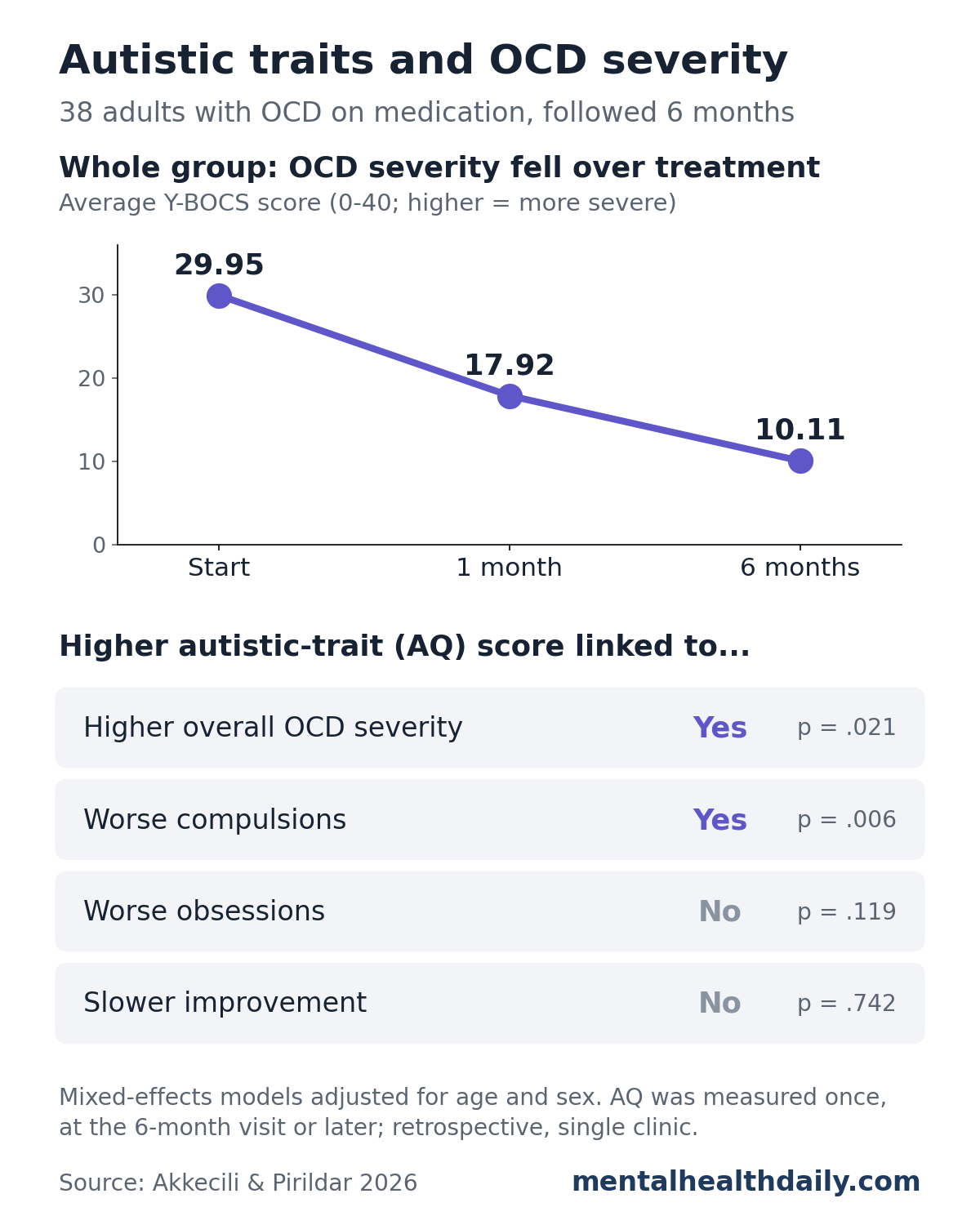
- More autistic traits, more severe OCD: in 38 adults treated at a clinic in Türkiye, higher Autism Spectrum Quotient (AQ) scores were linked to higher OCD severity across all 3 assessments (p = .021), after adjusting for age and sex.1
- Compulsions drove the link: AQ scores were linked to compulsion severity (p = .006) but not to obsession severity (p = .119).1
- Same pace of improvement: average OCD severity fell from 29.95 to 10.11 on a 0–40 scale over 6 months, and autistic-trait scores did not change how fast people improved (p = .742).1
- Social skills and attention switching stood out: in exploratory analyses, these 2 trait areas were linked to severity; attention to detail was not.1
- Small, retrospective study: autistic traits were measured only once, at the end of the 6 months, so they may partly reflect how people saw themselves after treatment.1
Why Researchers Look at Autistic Traits in OCD
OCD involves obsessions (unwanted, distressing thoughts, images, or urges) and compulsions (repeated actions or mental rituals done to ease that distress or prevent a feared outcome). Autism also involves repetitive behavior and a strong pull toward sameness, which is one reason the 2 conditions can be hard to tell apart.
The repetition usually serves a different purpose. Compulsions in OCD tend to feel unwanted and anxiety-driven, while repetitive behaviors in autism are more often calming, predictable, or enjoyable in themselves.1
The 2 conditions also travel together. A Danish national registry study found that people first diagnosed with autism had about twice the risk of a later OCD diagnosis, and people first diagnosed with OCD had nearly 4 times the risk of a later autism diagnosis.2
Autistic traits are autism-like characteristics, such as preferring routine, finding social situations hard, or struggling to shift attention, that vary across everyone and show up in many people with no autism diagnosis. Researchers increasingly treat them as a sliding scale rather than a yes-or-no category.
How the 6-Month OCD Clinic Study Worked
Yunus Akkeçili and Şebnem Pırıldar used routine clinic records to follow adults through 6 months of OCD treatment. The study was published in Frontiers in Psychiatry in September 2026.1
- Who: 38 adults aged 18 to 65 with OCD diagnosed by a psychiatrist; average age about 38; 26 women and 12 men. None had a documented autism diagnosis.
- Where: the psychiatry outpatient clinic of Dinar State Hospital in Türkiye. Of 45 eligible patients, 38 agreed to take part.
- Treatment: standard medication, mainly selective serotonin reuptake inhibitors (SSRIs, the first-line antidepressant class for OCD). The most common regimen was escitalopram alone, followed by escitalopram plus a low dose of the antipsychotic aripiprazole.
- OCD severity: the Yale–Brown Obsessive-Compulsive Scale (Y-BOCS), a clinician-rated scale from 0 to 40 with separate obsession and compulsion scores. The same psychiatrist rated it at the start, at 1 month, and at 6 months.
- Autistic traits: the Autism Spectrum Quotient (AQ), a 50-item self-report questionnaire covering social skills, attention switching, attention to detail, communication, and imagination. It measures traits on a scale and does not diagnose autism. Patients filled it out once, at their 6-month visit or later.
The main analysis used linear mixed-effects models, which track each person’s repeated scores over time. The models tested 2 separate questions: whether higher AQ scores went with higher OCD severity overall, and whether they changed the rate of improvement.
Higher Autistic-Trait Scores Went With More Severe Compulsions
The group as a whole improved a lot. Average Y-BOCS scores dropped from 29.95 at the start to 17.92 after 1 month and 10.11 after 6 months.1
Within that improvement, people with higher AQ scores stayed more symptomatic at every assessment. The average AQ score was 24.03 out of 50.
- Overall OCD severity: linked to AQ (p = .021)
- Compulsions: linked to AQ (p = .006)
- Obsessions: not significantly linked (p = .119)
- Rate of improvement: no difference by AQ (p = .742 overall; p = .690 for compulsions)
A second statistical approach, repeated-measures analysis of covariance, gave the same pattern: AQ was linked to overall severity (p = .009) and compulsions (p = .005), not to obsessions (p = .059), with no effect on the rate of change.1
Age and sex did not predict severity in any model. Men scored higher on the AQ than women (27.67 vs 22.35), but adjusting for sex did not remove the link.1
Social Skills and Attention Switching, Not Attention to Detail
The researchers also checked each of the 5 AQ areas separately. These were exploratory tests, and the researchers called them hypothesis-generating.1
- Social skills: the strongest link, both with overall severity (p = .001) and with compulsions (p = .002)
- Attention switching (difficulty shifting focus from one thing to another): linked to overall severity (p = .004) and compulsions (p = .003)
- Attention to detail, communication, imagination: no significant link
Attention to detail was a surprise. Contrary to the researchers’ initial expectation, this trait, which sounds closest to OCD’s perfectionism and checking, had essentially no link with severity (p = .920).1
Possible explanations: difficulty switching attention fits the idea that mental rigidity makes it harder to stop a compulsion once it starts. Social difficulties could add stress and isolation that keep compulsions going. The study did not test either mechanism directly.
People With More Autistic Traits Improved at the Same Pace on OCD Medication
A separate test asked whether OCD scores fell more slowly in people with higher AQ scores. They did not: people with more autistic traits started more symptomatic and stayed more symptomatic, but their scores fell at a similar rate.1
The result is consistent with the 2 closest earlier studies:
- Adults in Japan: in 81 adult OCD outpatients, 35% had high AQ scores (32 or more), and this group had more depression, anxiety, social impairment, and lower quality of life. High traits had a smaller effect than expected on OCD symptoms themselves and on 48-week treatment outcome.3
- Children and teens in Scandinavia: in 257 young people receiving 14 weeks of exposure-based cognitive behavioral therapy (CBT), those with autistic traits had a different clinical profile, including more ordering symptoms and lower insight. CBT worked equally well with and without the traits.4
Together, these studies point the same way across medication and therapy, adults and youths: autistic traits go with a heavier OCD burden, not with a weaker response to standard treatment.
Limitations of This Retrospective OCD Study
The study was small and observational, so it shows associations only. Several design features limit what it can say:
- Traits measured at the end: the AQ was filled out once, after 6 months of treatment, with no instruction to describe childhood or pre-OCD behavior. Remaining OCD symptoms could have raised some answers, so the AQ cannot serve here as a baseline predictor.
- 38 people from 1 clinic: too few to detect small differences in improvement rate, so a modest slowdown could have been missed.
- Treatment completers only: people who dropped out before 6 months were not included.
- Routine clinical data: diagnoses and other conditions were not checked with structured interviews, and depression and anxiety were not adjusted for. Mood symptoms could explain part of the link.
- No comparison group: medication was not standardized or compared with anything, so the 6-month drop shows how patients changed, not how much the drugs caused.
- No autism diagnoses: the findings describe autistic traits in people with OCD, not autistic people with OCD.
What This Means for People With OCD and Autistic Traits
- Expect progress: in this study and the earlier ones, autistic traits were not linked to slower or weaker improvement with standard OCD treatment.
- Expect more remaining symptoms: people with more traits started from a higher level and stayed higher, especially for compulsions, so more symptoms tended to remain at the end of 6 months.
- Tell repetition types apart: clinicians can ask whether a repetitive behavior feels distressing and unwanted (typical of OCD) or calming and chosen (more typical of autism).
- Social difficulties are worth attention: the social-skills link is exploratory, but it suggests social support may be part of the picture in harder-to-treat OCD.
References
- Akkeçili Y, Pırıldar Ş. Autistic traits and obsessive–compulsive symptom severity: a retrospective six-month follow-up study. Frontiers in Psychiatry. 2026;17:1940901. doi:10.3389/fpsyt.2026.1940901
- Meier SM, Petersen L, Schendel DE, Mattheisen M, Mortensen PB, Mors O. Obsessive-compulsive disorder and autism spectrum disorders: longitudinal and offspring risk. PLoS One. 2015;10(11):e0141703. doi:10.1371/journal.pone.0141703
- Mito H, Matsuura N, Mukai K, et al. The impacts of elevated autism spectrum disorder traits on clinical and psychosocial features and long-term treatment outcome in adult patients with obsessive-compulsive disorder. Comprehensive Psychiatry. 2014;55(7):1526–1533. doi:10.1016/j.comppsych.2014.05.005
- Højgaard DRMA, Arildskov TW, Skarphedinsson G, et al. Do autistic traits predict outcome of cognitive behavioral therapy in pediatric obsessive-compulsive disorder? Research on Child and Adolescent Psychopathology. 2023;51:1083–1095. doi:10.1007/s10802-023-01078-5