
In a 4-week randomized trial involving 100 adults in India, daily in-person sound meditation with singing bowls and recorded tones lowered anxiety scores 2.55 points more than remotely streamed music.1 Depression scores, cortisol, and blood pressure also came out lower in the sound meditation group.
Research Highlights
- Lower anxiety than the music group: after adjusting for starting scores, anxiety on the HADS scale was 2.55 points lower with sound meditation (95% CI −3.62 to −1.48; P < 0.001).1
- Lower depression scores too: the adjusted difference was 2.39 points (95% CI −3.36 to −1.43; P < 0.001).1
- Body measures moved the same way: morning saliva cortisol was 2.54 nmol/L lower and systolic blood pressure 7.62 mmHg lower than in the music group.1
- Everyone finished: all 100 participants completed the 4 weeks, and no adverse events were reported.1
- Unequal comparison: the meditation group met in person with instructors and practiced at home; the music group listened over video call on their own speakers. The study cannot say which ingredient did the work.1
How the Sound Meditation Trial Was Set Up
Sound meditation (often marketed as a sound bath) uses tones from singing bowls, gongs, and bells as the focus of attention. Instead of following a breath or a spoken script, the listener rests and keeps attention on the sound, which is meant to quiet distracting thoughts and settle the body’s stress response.
Ravikumar and Sathyanarayanan enrolled 100 adults aged 21 to 65 from meditation centers and nearby communities in Tamil Nadu, India, between January and April 2025. A lottery assigned 50 people to each group.1
- Sound meditation group: 60-minute supervised group sessions every day for 4 weeks at a study center. Each session played recorded sound, including 528-Hz audio, through a surround-sound system, with live singing bowls, gongs, bells, and tingshas (small hand cymbals). There was no spoken guidance. Participants were also asked to practice at home for 40 minutes a day with recorded 528-Hz sound.
- Music control group: 60-minute supervised sessions every day for 4 weeks over Google Meet, cameras on. They heard 2 licensed relaxing music tracks repeated through the hour with 3-minute silences in between, played on their own laptop or Bluetooth speakers. No home practice was assigned.
- Who took part: average age about 46, half women. Average anxiety and depression scores started in the borderline range, and average blood pressure was about 130/80 mmHg.
The main outcome was anxiety on the Hospital Anxiety and Depression Scale (HADS), a 14-item questionnaire with separate anxiety and depression scores. Each runs from 0 to 21: 0 to 7 is normal, 8 to 10 borderline, and 11 or higher abnormal.1
Researchers also measured salivary cortisol, a stress hormone sampled in a standard morning window, plus seated blood pressure. Staff measuring blood pressure and running the cortisol lab tests did not know who was in which group.
Anxiety and Depression Scores Fell More With Sound Meditation
The sound meditation group’s average anxiety score dropped from 10.68 to 7.68, moving from borderline into the normal range. In the music group it went from 9.92 to 10.32, essentially unchanged.1
Depression scores fell from 9.90 to 7.40 with sound meditation and from 10.48 to 9.80 with music.1
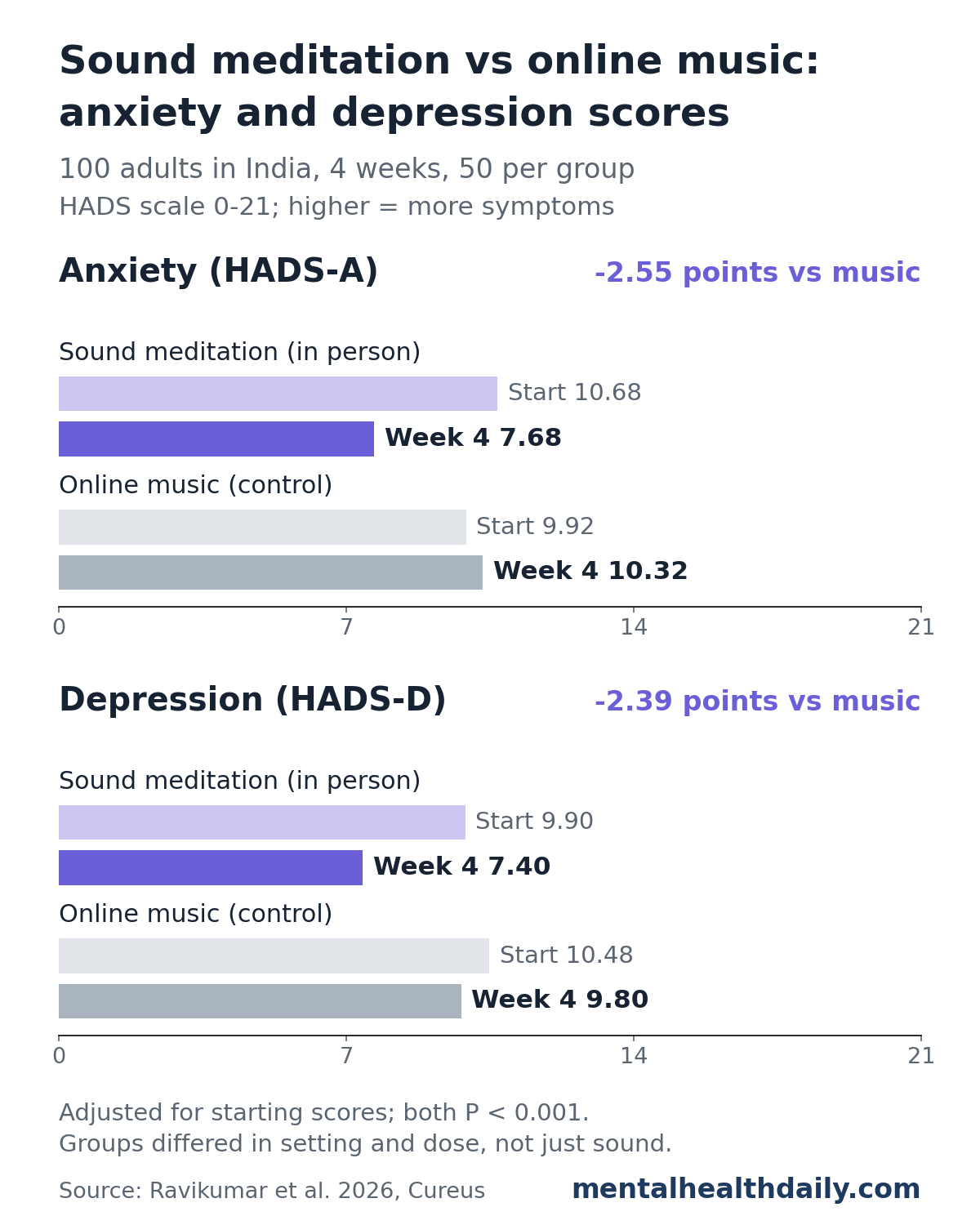
Those raw before-and-after numbers are descriptive. The formal test compared week-4 scores between groups while adjusting for where each person started (an approach called ANCOVA), with a Holm correction for testing 5 outcomes at once:1
- Anxiety: 2.55 points lower with sound meditation (95% CI −3.62 to −1.48)
- Depression: 2.39 points lower (95% CI −3.36 to −1.43)
Both differences held after the correction (P < 0.001). The researchers caution that a statistically large effect does not by itself show a clinically meaningful one.
Cortisol and Blood Pressure Were Also Lower Than in the Music Group
The physical measures pointed the same direction. Baseline-adjusted differences, sound meditation vs music, were:1
- Salivary cortisol: 2.54 nmol/L lower (95% CI −2.95 to −2.13). The meditation group’s average fell from 15.20 to 12.22 nmol/L.
- Systolic blood pressure: 7.62 mmHg lower (95% CI −9.36 to −5.89). The meditation group’s average went from 130.08 to 120.60 mmHg.
- Diastolic blood pressure (an exploratory outcome): 2.22 mmHg lower (95% CI −3.00 to −1.43).
The cortisol effect was the largest in statistical terms (partial eta squared 0.61, where 0.14 already counts as large). That is an unusually strong and tight result for a 4-week behavioral program, and it comes from 1 morning sample per time point analyzed in 1 lab.
Limitations of This Sound Meditation Trial
Evidence strength: a single, small, short trial with an unequal comparison. The researchers themselves call the findings preliminary and exploratory.1 The main problems:
- The groups differed in more than sound. The meditation group traveled to a center, sat with others and instructors, were monitored by a team of 4 psychologists, and added 40 minutes of home practice a day. The music group joined remotely by video call, on whatever speakers they had. Social contact, setting, total time, and expectations all favored the meditation group.
- Blinding is doubtful. The paper says participants were blinded to their group, but people could see whether they were in a sound meditation hall or on a music video call. Anxiety and depression were self-rated, so expectations could shift the scores.
- No single ingredient can be credited. The 528-Hz audio, the instruments, the meditation itself, and the home practice were bundled together. The trial says nothing about whether 528 Hz has any special effect.
- A registered outcome is missing. The trial registration listed a mood questionnaire (POMS-SF) alongside HADS, but those data were not reported.
- Narrow, likely receptive sample. Most people came from meditation centers, scores started in the borderline rather than clinical range, and there was no follow-up after week 4.
- Funding. The study was funded by UNS Digital Technologies, and an author is affiliated with UNS Research Council. The paper states the funder had no role in the analysis.
Earlier Singing Bowl Studies Were Small and Mostly Uncontrolled
Meditation in general: a 2014 review of 47 randomized trials found that mindfulness meditation programs improved anxiety and depression modestly compared with time-matched control activities, with standardized effects around 0.3 to 0.4 at 8 weeks. Meditation did not outperform specific active treatments such as exercise, relaxation training, or cognitive behavioral therapy.2
Singing bowls specifically: the evidence base is thin. A 2020 systematic review found only 4 peer-reviewed studies and could not recommend singing bowl therapy because of the small number of studies and risk of bias.3
One of the better-known studies tracked 62 adults before and after singing bowl meditation and found less tension, anger, fatigue, and depressed mood afterward, with no control group.4 The new trial adds randomization and a comparison group, which is a real step up.
For a different, much lighter approach, MHD covered a remote trial in which 10 minutes a day of app-based meditation reduced anxiety and mind wandering.
What This Means If You Are Curious About Sound Baths
- Low risk, possible benefit: no adverse events were reported, and daily group sound meditation was linked to lower anxiety than a month of streamed music sessions joined remotely.
- Not a treatment for anxiety or depressive disorders: participants mostly had borderline symptoms, and people with severe psychiatric conditions were excluded.
- Skip the frequency claims: nothing here shows that 528 Hz, or any specific tone, matters.
- Blood pressure: the 7.62-mmHg gap is interesting but needs confirmation; it is not a reason to change blood pressure treatment.
A fair test would compare in-person sound meditation with an equally social, in-person relaxation session, over months rather than weeks.
References
- Ravikumar H, Sathyanarayanan S. Effects of a sound-based meditative intervention on anxiety, depression, salivary cortisol levels, and blood pressure: a randomized controlled trial. Cureus. 2026;18(9):e115693. doi:10.7759/cureus.115693
- Goyal M, Singh S, Sibinga EMS, et al. Meditation programs for psychological stress and well-being: a systematic review and meta-analysis. JAMA Internal Medicine. 2014;174(3):357–368. doi:10.1001/jamainternmed.2013.13018
- Stanhope J, Weinstein P. The human health effects of singing bowls: a systematic review. Complementary Therapies in Medicine. 2020;51:102412. doi:10.1016/j.ctim.2020.102412
- Goldsby TL, Goldsby ME, McWalters M, Mills PJ. Effects of singing bowl sound meditation on mood, tension, and well-being: an observational study. Journal of Evidence-Based Complementary & Alternative Medicine. 2017;22:401–406. doi:10.1177/2156587216668109