
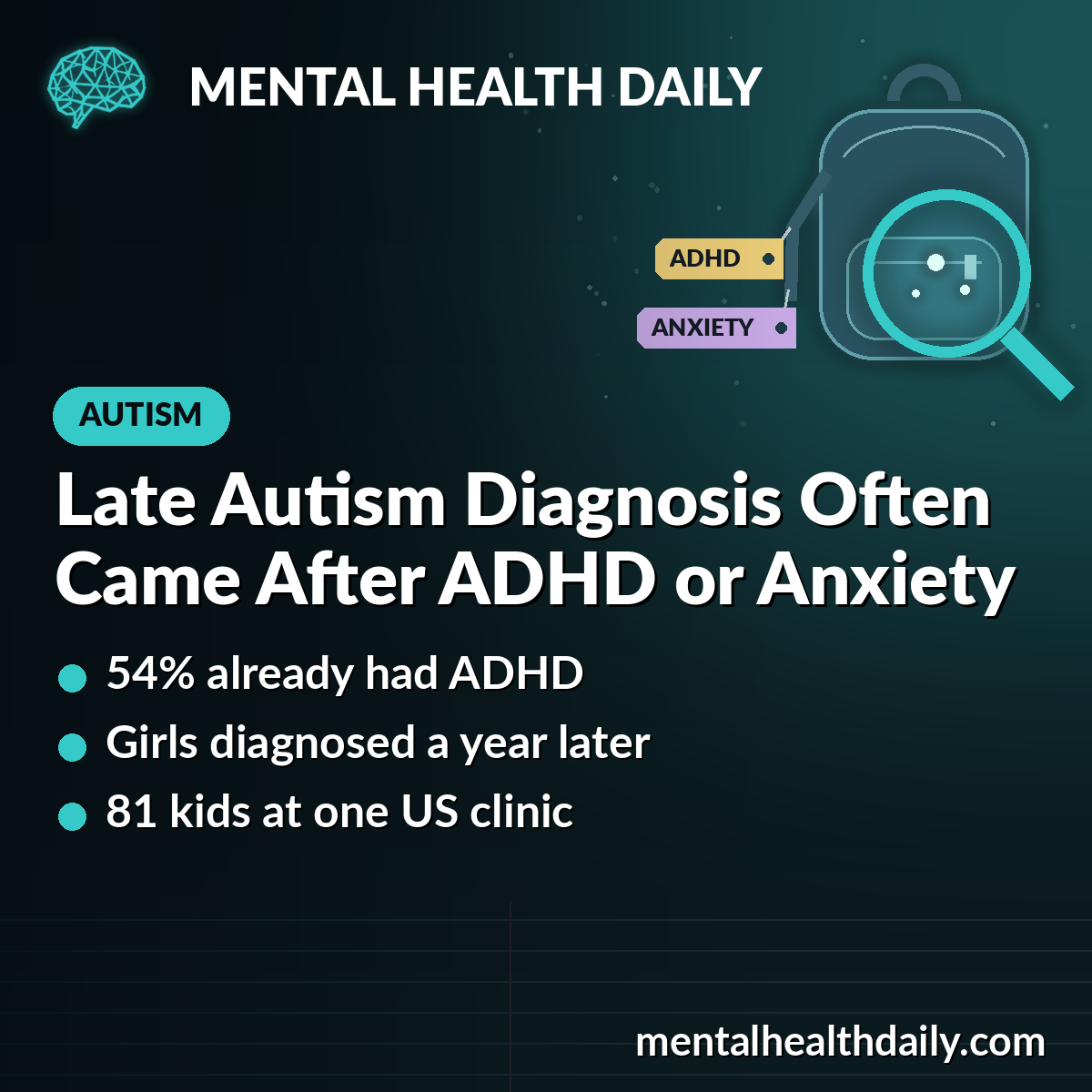
More than half of children first diagnosed with autism at school age (5 to 13) already had an ADHD diagnosis, and more than a third already had an anxiety diagnosis, according to a 2026 study of 81 children at a US autism clinic.1
Girls were diagnosed about a year later than boys.
Research Highlights
- Other diagnoses came first: 44 of 81 children (54%) already had ADHD and 29 (36%) already had anxiety when they were diagnosed with autism. Only 20 (25%) had no earlier diagnosis.1
- Girls were older at diagnosis: 9.7 years on average vs. 8.5 years for boys.1
- Many were already getting help: 59% had school accommodations and 23% were taking psychiatric medication, but only 38% were in behavioral therapy.1
- Parents saw more problems than teachers: parents rated every emotional, behavioral and social scale higher than teachers did.1
- Average IQ, lower daily skills: the children scored in the average range on an IQ test but in the moderately low range on everyday living skills.1
Who Was in This School-Age Autism Study?
Kimberly Burkhart and colleagues at University Hospitals in Cleveland reviewed the charts of every child seen at their autism clinic for school-aged kids (ages 5 to 13) over 3 years, from September 2022 to September 2025.1
Of 145 children assessed, 81 received a first-time diagnosis of autism spectrum disorder (ASD) Level 1. That is the mildest of 3 support levels in the DSM-5, the standard US diagnostic manual: the child needs support, but less than at Levels 2 and 3.
Level 1 is close to what people often call “high-functioning autism,” an informal term for autism without intellectual disability. These children are less likely to be identified early than children with more obvious delays.1
- Sex: 58 boys (72%) and about 23 girls
- Race: 79% White, 14% Black
- Insurance: 54% commercial, the rest public
- Who referred them: primary care doctors (44%), parents themselves (27%), psychiatrists (16%) and therapists (9%); only 1 child was referred by a school
Each child had a full evaluation by a psychologist, sometimes joined by a developmental-behavioral pediatrician. Parents and teachers filled out standard questionnaires about behavior, mood and social skills.1
Most Children Already Had ADHD, Anxiety or Both
Before their autism diagnosis, 3 of every 4 children had already been diagnosed with something else.1
- ADHD alone: 25 children
- ADHD and anxiety: 14 children
- ADHD, anxiety and another condition: 5 children
- Anxiety alone: 10 children
- Language disorder or another condition: 7 children
- No earlier diagnosis: 20 children
Altogether, that is 54% with ADHD and 36% with an anxiety disorder.
Researchers suggest these earlier diagnoses can hide autism. Clinicians call this diagnostic overshadowing: once a child has a label that explains some of the trouble, such as poor focus or social worry, the autism behind it can be missed.1
Earlier work points the same way. In a US national survey of nearly 1,500 autistic children, those diagnosed with ADHD first got their autism diagnosis about 3 years later than children diagnosed with ADHD at the same time as or after autism, in the adjusted analysis.2
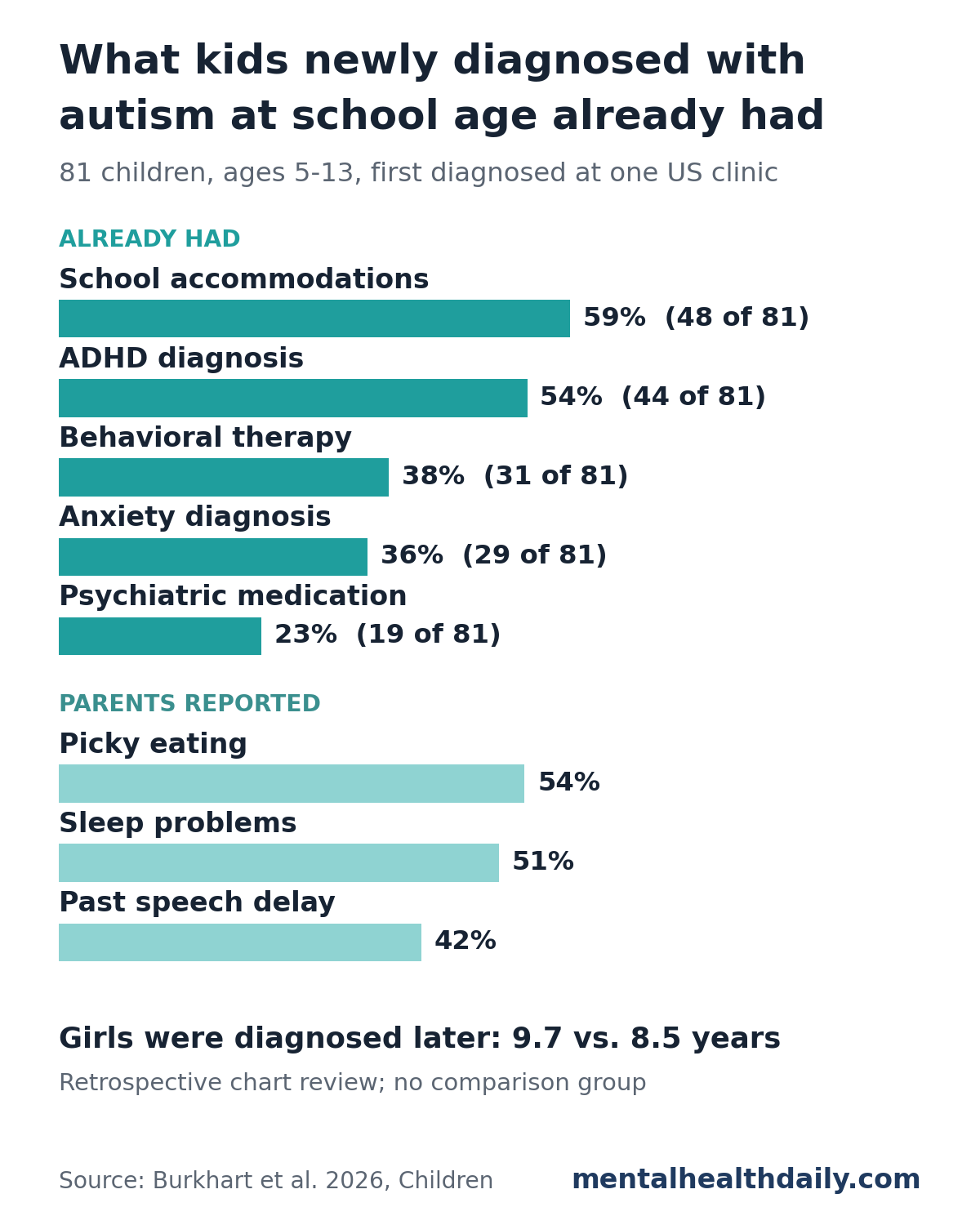
Picky eating, sleep problems and speech delay were common. Parents also described problems that are common in autism but easy to see as separate issues:1
- Picky eating (food selectivity): 54%
- Sleep problems: 51%
- Delayed speech as a young child: 42%
- Delayed fine motor skills: 20%
- Stomach and gut problems: 12%
Many families were already getting some kind of help. 59% of children had school accommodations or a modified curriculum, and 23% were taking psychiatric medication.
Only 38% were in behavioral health therapy, even though the clinic is in an area with plenty of mental health services. Burkhart’s team thinks medication and school supports may have made needs seem met, lowering the urgency to look further.1
Average IQ, moderately low everyday skills. On a brief IQ test (the KBIT-2), the children averaged 104, right in the average range of 85 to 115.1
But on the Vineland-3, a parent-rated measure of everyday skills scored on the same scale, they averaged 77, in the moderately low range. Social skills scored lowest (73), followed by communication (81) and daily living skills such as dressing and hygiene (82).
This gap between intelligence and day-to-day functioning matters for planning support, Burkhart and colleagues note. A child can do well on a test and still struggle with daily life.1
Why Were Girls Diagnosed With Autism Later Than Boys?
Girls were diagnosed at 9.7 years on average, compared with 8.5 years for boys, a statistically significant difference.1
That matches older research. A Dutch survey of 2,275 people with autism found that girls with milder autism (then called Asperger’s syndrome) were identified later than boys.3
On the questionnaires, girls and boys did not differ significantly on any scale.
But some of their average scores fell into different severity bands. Several came from the Social Responsiveness Scale (SRS-2), a 65-item rating of autism-related social difficulties:
- Parents on the SRS-2 rated girls’ social communication in the severe range (average 76) and boys’ in the moderate range (72).
- Teachers on the SRS-2 rated girls’ social communication and social motivation in the moderate range and boys’ in the mild range.
- Aggression: on a separate behavior checklist, parents rated boys in the borderline range and girls in the average range.
Researchers offer several explanations. Girls’ social difficulties may have to become more severe before anyone notices them, or raters may expect different things from girls and boys.
These band differences were not statistically significant, so they are a pattern to test in larger samples.1
Parents Rated Every Problem Higher Than Teachers Did
Parents filled out the Child Behavior Checklist and teachers filled out a matching form. Both score children against same-age peers, where 50 is average, 65 to 69 is borderline, and 70 or higher is in the clinical range.
Parents rated children higher than teachers on every scale, and every gap was statistically significant.1
- Attention problems: 69 by parents vs. 62 by teachers
- Depression problems: 66 vs. 59
- Anxiety problems: 67 vs. 61
- Autism-related social difficulties (SRS-2 total): 74 vs. 67
Most parent scores landed in the borderline range, with thought problems in the clinical range. Teacher scores on the same checklist all averaged below the borderline cutoff.
One possible reason is that school supports were working. With accommodations in place for most children, problems may have been less visible in class. Earlier research also suggests that some autistic children, especially girls, mask their difficulties more at school.1
Limitations of This Autism Diagnosis Study
This was a descriptive chart review from 1 clinic, so it shows what these children looked like at diagnosis, not what caused the delay.
- Small sample: 81 children, with only about 23 girls, too few to detect most sex differences.
- No comparison group: children who were assessed but not diagnosed, or diagnosed at a younger age, were not included.
- Narrow population: mostly White families, mostly referred by doctors, at one Midwest academic center.
- Timing not reported: earlier ADHD and anxiety diagnoses were listed without the age at which they were made.
- Same-sex norms: the rating scales compare girls with girls and boys with boys, which can hide real sex differences.
What This Means for Parents of School-Age Kids
- An ADHD or anxiety diagnosis does not rule out autism. In this clinic, most children diagnosed with autism at school age already had one or both.
- Girls may be identified later. If social struggles persist, they deserve a closer look even when a girl seems to be coping.
- Home and school can tell different stories. Ratings from both settings give a fuller picture.
- Average IQ does not mean daily life is easy. Everyday skills were the weakest area for these children.
References
- Burkhart K, Palumbo A, Sanford K, Olczyk A, Minich N. Clinical profile of first-time diagnosis of autism spectrum disorder in school-aged youth. Children. 2026;13(9):1220. doi:10.3390/children13091220
- Miodovnik A, Harstad E, Sideridis G, Huntington N. Timing of the diagnosis of attention-deficit/hyperactivity disorder and autism spectrum disorder. Pediatrics. 2015;136(4):e830–e837. doi:10.1542/peds.2015-1502
- Begeer S, Mandell D, Wijnker-Holmes B, et al. Sex differences in the timing of identification among children and adults with autism spectrum disorders. Journal of Autism and Developmental Disorders. 2013;43(5):1151–1156. doi:10.1007/s10803-012-1656-z