
During Shanghai’s 2022 COVID-19 lockdown, men and women reported similar levels of depression and anxiety, but their symptoms fit together differently: depression was the most connected symptom in men, while anxiety and intrusive thoughts were the most connected in women.1
Research Highlights
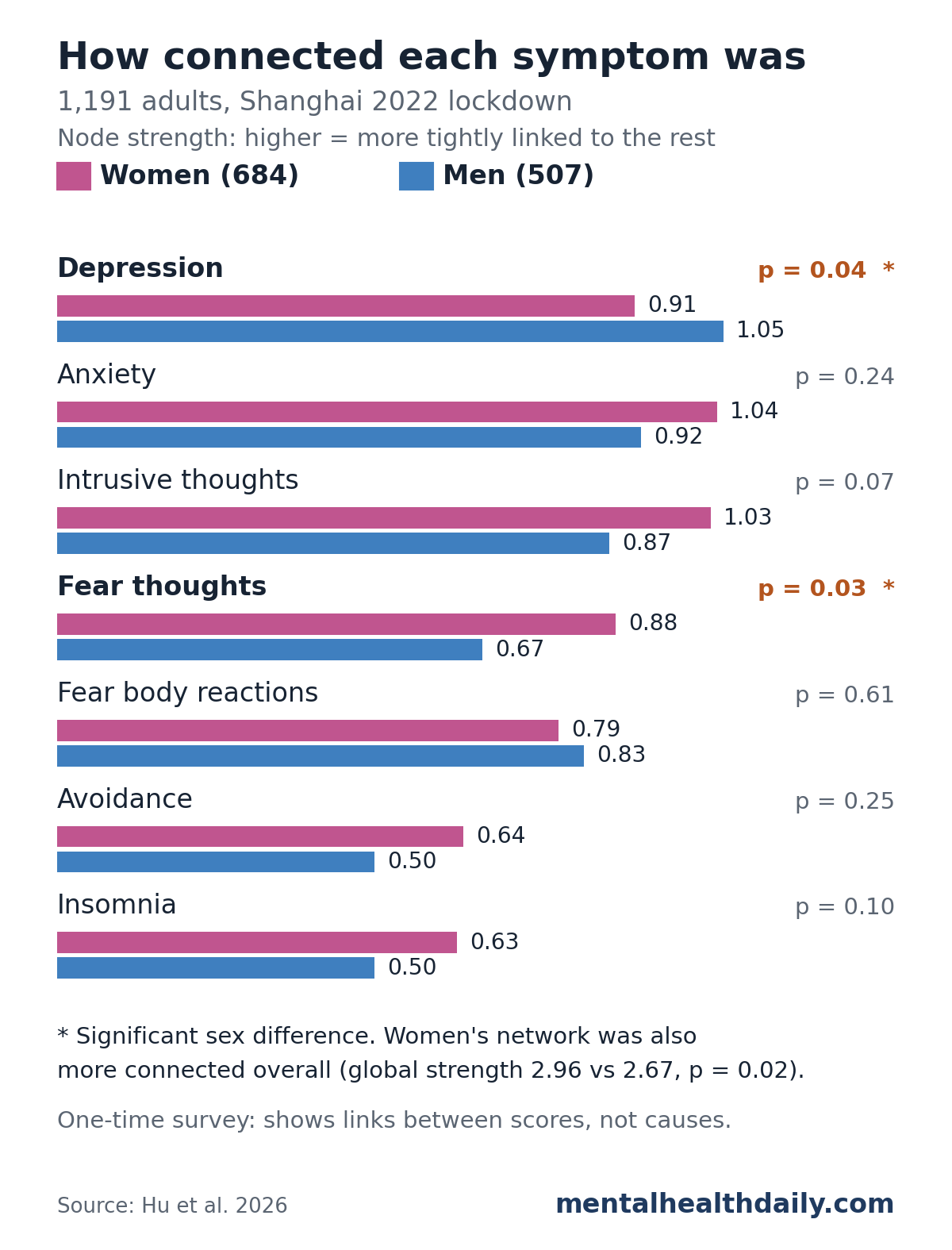
- Depression was more central for men: its connection strength was 1.05 in men vs 0.91 in women (p = 0.04), the largest of any symptom in men’s network.1
- Women’s symptoms were more tightly linked overall: global network strength was 2.96 in women vs 2.67 in men (p = 0.02).1
- Fear-related thoughts mattered more in women: worried thoughts about COVID-19 were significantly more connected in women (0.88 vs 0.67, p = 0.03).1
- Same symptom levels, different wiring: average depression, anxiety, insomnia, and trauma-stress scores did not differ by sex.1
- One survey, ages 18 to 40: 1,191 Shanghai adults answered once, so the study shows how symptoms were linked, not which caused which.1
Who Was Surveyed During the Shanghai Lockdown
Shanghai went through one of China’s longest and strictest citywide lockdowns from April to June 2022. Hu et al. ran an online survey from April 18 to July 12, 2022, and published the results in Depression and Anxiety in 2026.1
- Sample: 1,191 adults aged 18 to 40 who lived in Shanghai during the lockdown (684 women, 507 men), out of 1,840 completed responses.
- Exclusions: 213 were outside the age range, 395 were not in Shanghai, and 41 failed attention-check questions.
- Sex: self-reported. Gender identity, gender roles, and caregiving load were not measured.
- Setting: a general online survey panel, not a clinic. Participants were paid 2 yuan (about 30 US cents).
Everyone completed 5 standard questionnaires, scored as 7 “nodes” in the network:
- Depression: PHQ-9 (Patient Health Questionnaire)
- Anxiety: GAD-7 (Generalized Anxiety Disorder scale)
- Insomnia: Insomnia Severity Index
- Intrusive thoughts and avoidance: 2 parts of the Impact of Event Scale, a trauma-stress questionnaire adapted for COVID-19
- Fear thoughts and fear body reactions: 2 parts of the Fear of COVID-19 Scale, separating worried thinking from physical signs like clammy hands
Women and men scored almost the same on depression (7.78 vs 7.89), anxiety (6.40 vs 6.20), insomnia (8.61 vs 8.65), and trauma stress (26.87 vs 26.30). Only fear of COVID-19 was higher in women (18.84 vs 17.66, p = 0.001), mainly because of fear thoughts.1
What a Symptom Network Shows
A symptom network treats each symptom score as a point (a node) and draws a line (an edge) between 2 points when they rise and fall together after accounting for every other symptom. Thick lines mean a strong link; missing lines mean no link once the rest is accounted for.
A central symptom is one with many strong links. Researchers usually measure this with strength, the sum of a node’s link weights. The idea behind network research is that easing a well-connected symptom might ease others too, though a one-time survey cannot test that.
Each node here was a questionnaire score, such as the total depression score, rather than a single symptom like poor appetite. The researchers built separate networks for women and men and compared them with permutation tests, which reshuffle people between the 2 groups thousands of times to see whether a difference could arise by chance.1
Depression Was the Most Connected Symptom in Men
In men, depression had the highest strength of any node (1.05), and it was significantly more central than in women (0.91; p = 0.04). Anxiety, intrusive thoughts, and physical fear reactions followed.1
In women, anxiety (1.04) and intrusive thoughts (1.03) were the most central nodes, essentially tied. Neither was significantly more central in women than in men (anxiety p = 0.24; intrusion p = 0.07).1
Strongest link in both sexes: depression and anxiety, at 0.61 in women and 0.63 in men, with no difference between them (p = 0.57).1
Depression and sleep: the depression–insomnia link was 0.42 in men vs 0.30 in women. That gap fell just short of significance (p = 0.06), so it is a pattern worth watching rather than an established difference.1
Women’s Symptoms Were More Tightly Linked
Women’s network was denser. Global strength, the total of all link weights, was 2.96 in women vs 2.67 in men (p = 0.02), and the overall structure of the 2 networks also differed (p = 0.02). Of 21 possible links, 13 were present in women and 9 in men.1
Two specific links differed by sex:1
- Intrusive thoughts and fear thoughts were linked in women (0.20) but not at all in men (0.00).
- Intrusive thoughts and physical fear reactions were linked more strongly in men (0.32 vs 0.17).
Fear thoughts were also more central in women overall (0.88 vs 0.67, p = 0.03). The researchers read this as women’s lockdown distress being organized more around worried thinking, and men’s leaning slightly more toward physical reactions, though the men’s physical-reaction difference itself was not significant.1
Bayesian Networks Point to Intrusive Thoughts as a Hub in Women
The team also ran a Bayesian network analysis, which draws arrows instead of plain lines. An arrow from A to B means A’s score helps predict B’s score better than the reverse, given the other symptoms. With one-time survey data, these arrows are statistical guesses about direction, not proof that one symptom causes another.1
Arrows were kept only if they showed up in at least 85% of 5,000 resampled datasets. Women’s network had 9 arrows and men’s had 6.1
- Women: intrusive thoughts sat upstream of 5 other nodes — avoidance, fear thoughts, fear body reactions, anxiety, and insomnia. Depression pointed toward anxiety and insomnia, and anxiety toward insomnia.
- Men: intrusive thoughts pointed to avoidance, fear body reactions, and anxiety. Anxiety pointed to depression, and depression pointed to insomnia.
- Both: intrusive thoughts led toward avoidance, and mood symptoms led toward insomnia.
The researchers compared the 2 arrow maps only by eye, without a formal statistical test.1
Earlier Studies Found No Sex Difference in PTSD Networks
Two earlier network studies of trauma symptoms found that women reported more symptoms but that their networks looked much like men’s:
- Mexico and Ecuador: in adults exposed to natural disasters and accidents, the global structure and global strength of men’s and women’s PTSD networks did not differ significantly.2
- Oslo bombing, 2011: among government employees, women reported higher symptom levels, but there were no significant gender differences in the networks.3
The Shanghai study covered a broader mix of symptoms — depression, anxiety, sleep, and fear alongside trauma stress — during a long, citywide lockdown rather than a single traumatic event. That wider set of nodes, or the different kind of stress, may explain why it found differences the PTSD-only studies did not.
Limitations of This Lockdown Network Study
Evidence strength: this is a cross-sectional study, meaning everyone was surveyed once. It can show which symptom scores moved together, not which came first or which drove the others.
- No causal direction: the Bayesian arrows are conditional links, and the researchers say they need testing in studies that follow people over time.
- Group patterns, not individual ones: a network built from many people does not show how symptoms connect inside any one person.
- Scores, not single symptoms: each node was a whole questionnaire or subscale, which hides symptom-level detail.
- Small differences: only 2 of 7 nodes differed significantly in strength, and the “most central” ranking in women (anxiety 1.04 vs intrusion 1.03) was a near tie.
- Sex vs gender: participants were grouped by self-reported sex, so differences could reflect biology, gender roles, caregiving load, or all of these.
- Measurement: answers were self-reported online, and the trauma questionnaire predates DSM-5 and misses some PTSD symptoms, such as persistent negative beliefs and mood.
- Narrow setting: adults 18 to 40 in one city during an unusually strict lockdown; results may differ in other crises, age groups, or countries.
What the Findings Suggest for Crisis Mental Health Support
The researchers suggest that crisis support could be tailored by sex: help with intrusive thoughts and fear-related worry for women, and closer attention to depression and sleep problems in men, whose distress may be less openly expressed.1
Those ideas fit the data but have not been tested as interventions. For now, the main lesson is that men and women with similar symptom scores may be struggling in different ways, so asking about depression, sleep, intrusive thoughts, and fear separately can give a fuller picture than a single total score.
References
- Hu J, Huang Y, Westhoff M, Ren Q, Hofmann SG. Mapping sex differences in depression, anxiety, and co-occurring symptoms in adults under stress: a Bayesian network approach. Depression and Anxiety. 2026;2026:6640438. doi:10.1155/da/6640438
- Gay NG, Wisco BE, Jones EC, Murphy AD. Posttraumatic stress disorder symptom network structures: a comparison between men and women. Journal of Traumatic Stress. 2020;33(1):96–105. doi:10.1002/jts.22470
- Birkeland MS, Blix I, Solberg Ø, Heir T. Gender differences in posttraumatic stress symptoms after a terrorist attack: a network approach. Frontiers in Psychology. 2017;8:2091. doi:10.3389/fpsyg.2017.02091