
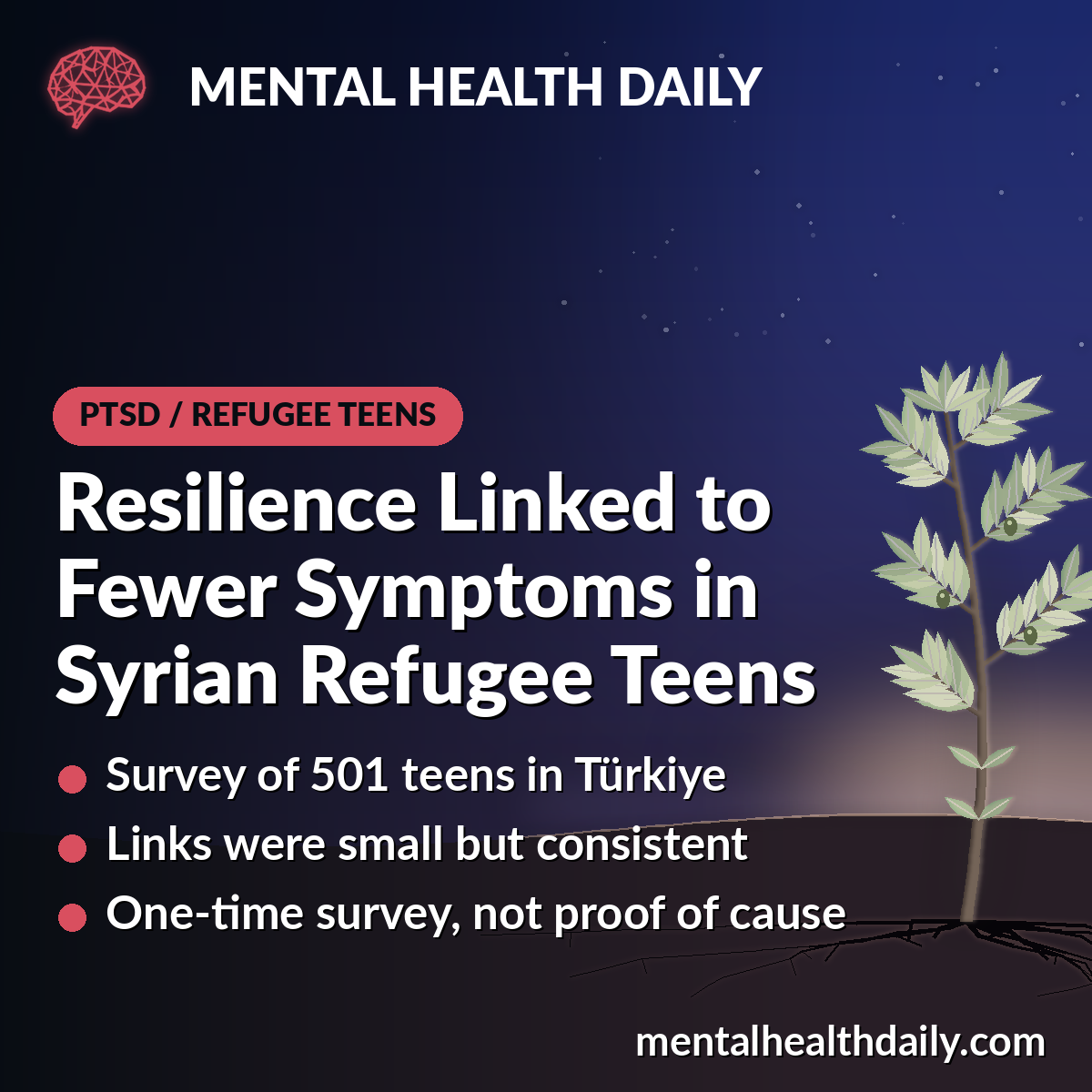
Syrian refugee teens in Türkiye who scored higher on resilience reported fewer symptoms of depression, anxiety, stress, and post-traumatic stress, according to a 2026 school survey of 501 students in Ankara. The links held across every measure, but each one was small.1
Research Highlights
- Fewer symptoms on all 5 measures: after accounting for age and gender, higher resilience was linked to lower depression, anxiety, stress, intrusive memories, and avoidance of trauma reminders.1
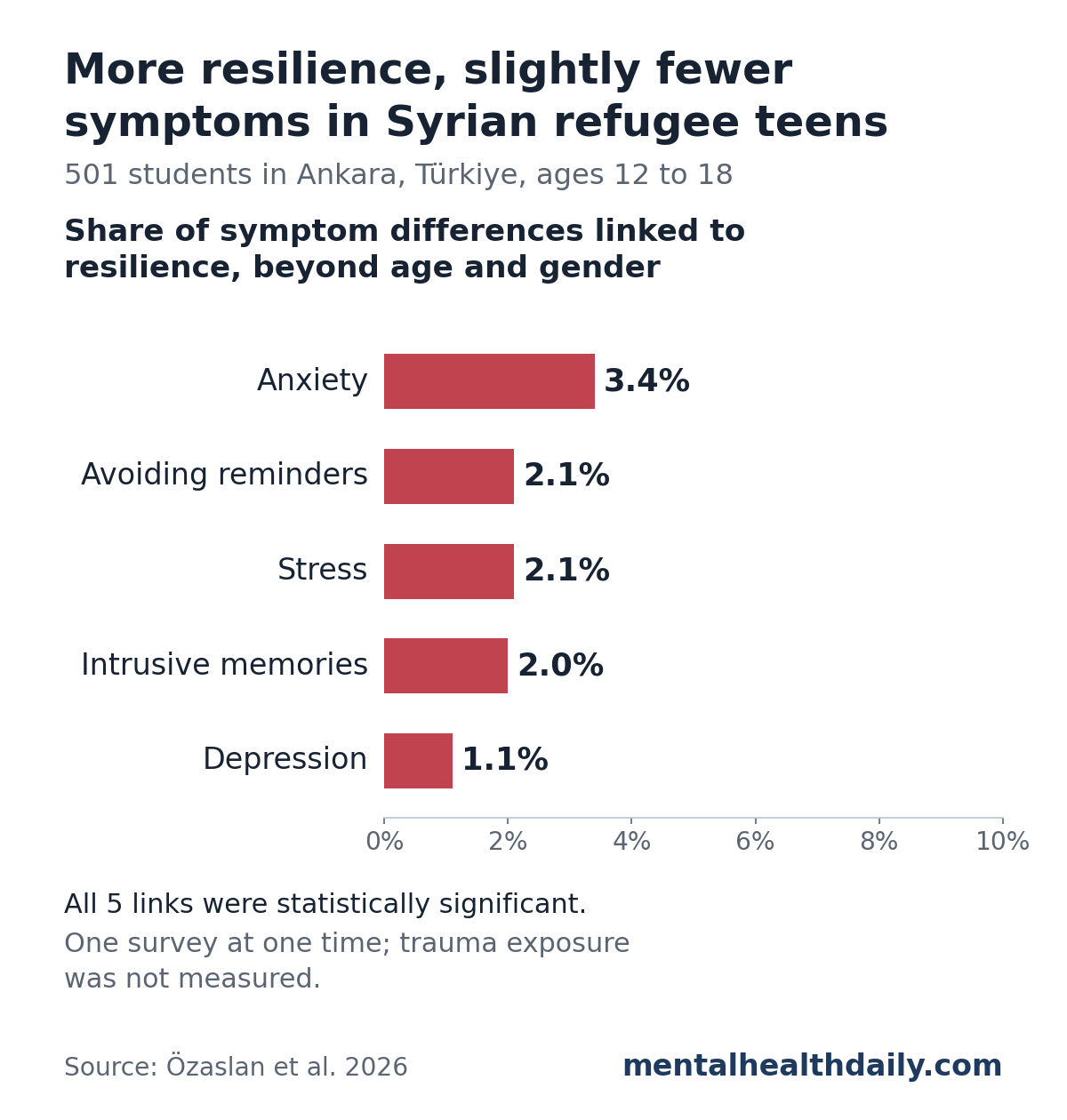
- Small effects: resilience explained an extra 1.1% (depression) to 3.4% (anxiety) of the differences in symptoms between students.1
- Anxiety showed the strongest link, depression the weakest: the depression link was also the least certain (p = 0.016, vs. p ≤ 0.001 for the other 4 outcomes).1
- Girls reported fewer symptoms than boys on all 5 outcomes, the reverse of the pattern often seen in refugee studies.1
- One snapshot in time: the survey cannot show whether resilience protects against symptoms or whether symptoms wear resilience down, and trauma exposure was not measured.1
How Researchers Measured Resilience in 501 Syrian Refugee Teens
Refugee children carry a heavy mental health load. A 2020 meta-analysis of diagnostic studies in 779 child and adolescent refugees and asylum seekers found pooled rates of 22.71% for post-traumatic stress disorder (PTSD), 13.81% for depression, and 15.77% for anxiety disorders.2
Many refugee youth still adapt well, which is why researchers study resilience: here, the ability to bounce back from stress. The study measured it with the 6-item Brief Resilience Scale, where students rate how quickly they recover from hard situations (total score 6 to 30).1
Ahmet Özaslan et al. at Gazi University and partner institutions surveyed students from 15 secondary and high schools in 3 Ankara districts where Syrian students made up roughly a third of each class.1
- Sample: 501 Syrian refugee students aged 12 to 18 (average 15.7 years; 64% boys)
- Recruitment: randomly selected schools and classes; 96.1% of invited students in class took part
- Timing: late 2019 to 2022, including periods of pandemic remote schooling
- Language: students chose Turkish (92%) or Arabic (8%) versions of the questionnaires
Students also completed 2 symptom questionnaires about the past week:
- DASS-21 (Depression Anxiety Stress Scale): 7 items each for depression, anxiety, and stress
- CRIES-8 (Children’s Revised Impact of Event Scale): 4 items on intrusion (unwanted memories and nightmares) and 4 on avoidance (steering clear of reminders), two core clusters of post-traumatic stress
Statistical models first accounted for age and gender, then asked how much extra variation in each symptom score lined up with resilience.
Higher Resilience Was Linked to Fewer Symptoms on All 5 Measures
Every outcome moved in the same direction: students with higher resilience scores reported fewer symptoms. The extra share of symptom differences linked to resilience was:1
- Anxiety: 3.4% (standardized β = −0.19, p < 0.001)
- Stress: 2.1% (β = −0.15, p = 0.001)
- Avoidance: 2.1% (β = −0.15, p = 0.001)
- Intrusion: 2.0% (β = −0.14, p = 0.001)
- Depression: 1.1% (β = −0.11, p = 0.016)
A standardized β (beta) shows how many standard deviations a symptom score shifts for each standard-deviation rise in resilience. Values between −0.11 and −0.19 are small.
Why anxiety and not depression? The researchers suggest that “bouncing back” from stress is closer to the tense, keyed-up side of distress than to the loss of interest and pleasure at the center of depression.1
Girls reported fewer symptoms than boys on all 5 outcomes after adjustment, and girls also scored higher on resilience. Refugee studies often find the opposite. The researchers point to possible differences in trauma exposure, which they did not measure, and to a sample that was nearly two-thirds boys.1
Why Resilience Explained Only 1% to 3% of Symptom Differences
Age and gender together accounted for a similar 2% to 5% of symptom differences, so resilience carried about as much weight as those basic demographic factors. Even the full models explained no more than 7.3% of the variation in any symptom score.1
Two measurement problems pull the estimate in opposite directions:
- A noisy resilience score. The Brief Resilience Scale had very low internal consistency in this sample (Cronbach’s alpha = 0.40, where 0.70 or higher is usually expected). Measurement noise this large tends to shrink associations, so the true link could be stronger.
- Everything was self-reported. When the same student fills out every questionnaire, mood and answering style can make scores line up, which tends to inflate associations.
The researchers say the net effect of these opposing biases is uncertain.1 The resilience scale also measures only personal coping, so family closeness, friendships, and school support (all linked to refugee children’s mental health in earlier work) were left out.1
Syrian Refugee Children in Jordan Showed a Similar Pattern
A 2022 survey of 339 Syrian refugee children aged 10 to 17 in Jordan found the same direction. Every child reported at least one traumatic event, and resilience was strongly inversely related to depression; relational support was the most protective resilience factor.3
The Jordan study used a broader resilience measure that included family and social support, which may explain why it found a stronger link to depression than the brief, individual-focused scale used in Ankara. Both studies were cross-sectional.
Limitations of This Cross-Sectional Resilience Survey
A cross-sectional survey captures one moment, so it can show which traits travel together but not which comes first. The main limits:1
- Direction unknown: resilience may reduce symptoms, or ongoing symptoms may erode a teen’s sense of bouncing back.
- No trauma measure: war and displacement experiences, the strongest known risk factors, were not recorded or adjusted for.
- Unanchored post-traumatic stress items: students answered the CRIES-8 about any self-chosen stressful event, which may not have been war- or migration-related.
- Missing context: time in Türkiye, family income, language skills, discrimination, and family separation were not measured.
- School clustering ignored: school identifiers were not recorded, so p-values may look somewhat stronger than they should.
- Narrow sample: school-attending teens in one city, mostly boys, surveyed before large return movements to Syria began in December 2024.
What the Findings Mean for Schools Supporting Refugee Teens
Refugee youth often do not reach specialist mental health services, and an earlier study from the same Ankara project found that self-stigma stood between symptoms and seeking help among Syrian teens. Schools are where most of these teens can be reached.1
- Screening: school checks that cover both general distress and post-traumatic stress could flag teens who need referral, with low resilience scores as one extra marker.
- Programs: classroom programs led by trained teachers or counselors already teach coping and build social support. This study does not show that adding resilience training would reduce symptoms; it marks resilience as a reasonable target for future trials.
- Next studies: following the same students over time, recording trauma exposure, and measuring family and community support would show whether resilience actually buffers the effects of trauma.
References
- Özaslan A, Yıldırım M, Öztürk FN, et al. The role of resilience in relation to depression, anxiety, stress, and post-traumatic stress symptoms among Syrian refugee adolescents in Türkiye. Children. 2026;13(9):1183. doi:10.3390/children13091183
- Blackmore R, Gray KM, Boyle JA, et al. Systematic review and meta-analysis: the prevalence of mental illness in child and adolescent refugees and asylum seekers. Journal of the American Academy of Child and Adolescent Psychiatry. 2020;59(6):705–714. doi:10.1016/j.jaac.2019.11.011
- Dehnel R, Dalky H, Sudarsan S, Al-Delaimy WK. Resilience and mental health among Syrian refugee children in Jordan. Journal of Immigrant and Minority Health. 2022;24:420–429. doi:10.1007/s10903-021-01180-0