
Teens who played on high school sports teams several times a week had fewer depression and anxiety symptoms at age 15, according to a 2026 study that followed 2,766 urban US youth. By age 22, a lower chance of depression showed up only in young men.1
Research Highlights
- Lower symptoms at 15: frequent team players scored about a quarter of a standard deviation lower on depression (−0.23) and anxiety (−0.22) than teens who never played, with nearly identical results in boys and girls.1
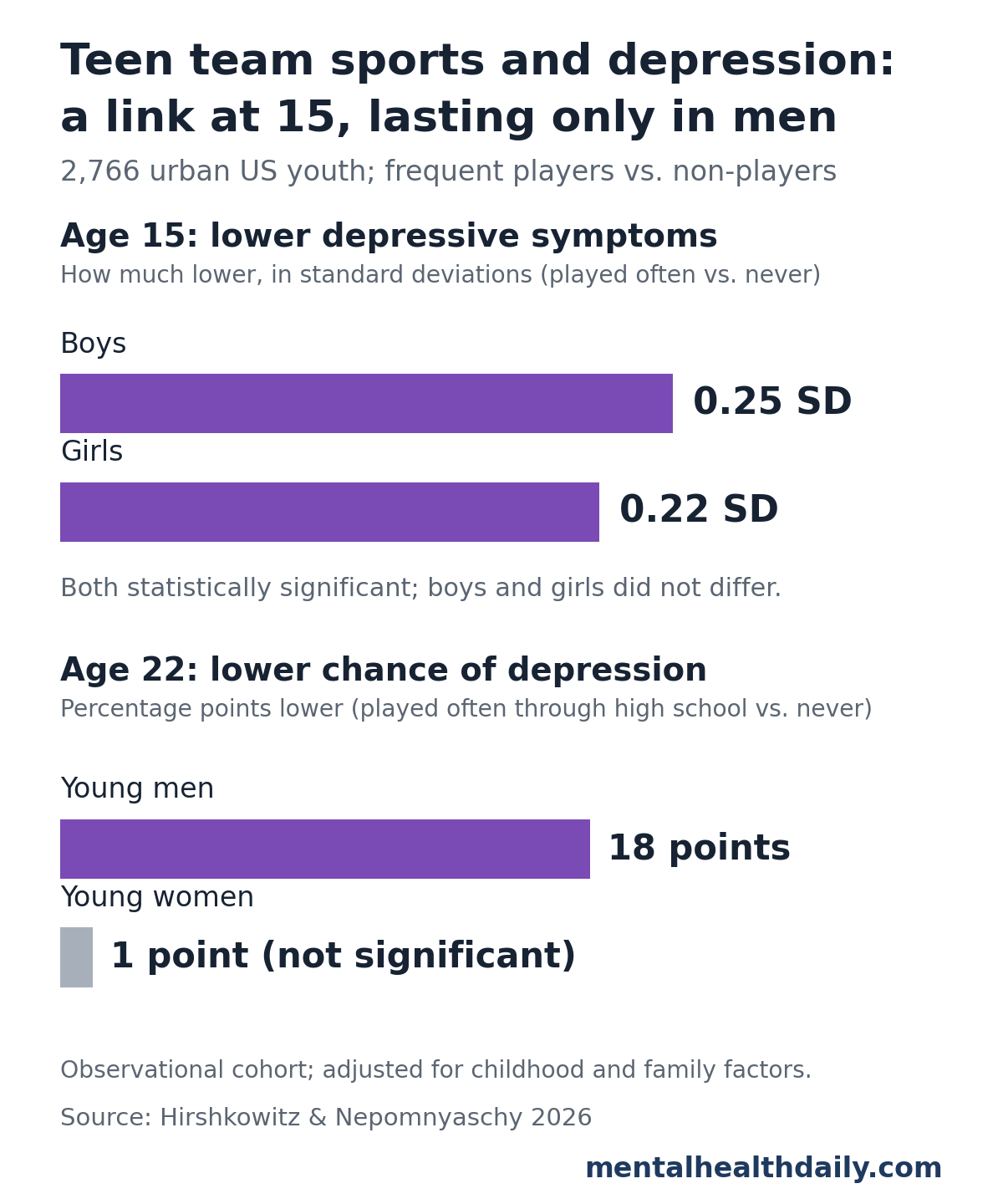
- Depression at 22 in young men: men who played often throughout high school were 18 percentage points less likely to meet criteria for depression than men who never played.1
- No lasting link in young women: women who played often had essentially the same depression rate at 22 as women who never played (1.1 points lower, not significant).1
- Some groups showed the opposite: in exploratory analyses, frequent sports were linked to more depression and anxiety among Black young women.1
- Observational design: the study adjusted for childhood mental health and family background, but teens who were already doing well may have been more likely to join and stay on teams.1
How the Future of Families Study Tracked Teen Team Sports
Malya Hirshkowitz and Lenna Nepomnyaschy of Rutgers University used the Future of Families and Child Wellbeing Study, a birth cohort that has followed 4,898 children born in large US cities between 1998 and 2000. The study deliberately oversampled births to unmarried parents, so the sample is more racially diverse and lower-income than the US as a whole.1
Their analysis included 2,766 young people interviewed at about age 15 (2014–2017) and again at about age 22 (2020–2024):
- Sample: 52% female; 48% non-Hispanic Black, 27% Hispanic or Latino, 18% non-Hispanic white
- Team sports at 15: 41% played often (several times a week), 27% sometimes, and 32% never
- Across high school: 33% reported playing often both at 15 and when asked again at 22; the researchers call them “sustainers”
- Sex gap: 48% of boys vs. 34% of girls played often at 15
At 15, depression and anxiety were measured as symptom scores on short self-report scales. At 22, researchers used a structured interview (the CIDI short form) to classify each person as a probable case of major depression or generalized anxiety disorder (persistent, hard-to-control worry lasting 6 months or more).1
What the models adjusted for: race and ethnicity, birth weight, the mother’s education, age, marital status and depression, family income, the father’s incarceration history, BMI, and how often parents played sports with the child.
Most important, the models included mother-reported emotional and behavior problems at age 9, before high school, to account for kids who were already struggling.1
Frequent Team Sports Were Linked to Fewer Teen Depression and Anxiety Symptoms
At 15, teens who played on teams often scored 0.23 standard deviations lower on depressive symptoms and 0.22 lower on anxiety symptoms than those who never played (both p < 0.001). A standard deviation is the typical spread of scores in the group, so frequent players scored about a quarter of that spread lower.1
- Boys: 0.25 lower on depression and 0.19 lower on anxiety
- Girls: 0.22 lower on depression and 0.24 lower on anxiety
- Occasional players: teens who played only sometimes did not differ from those who never played
Formal tests found no difference between boys and girls at this age. Sports and symptoms were measured in the same survey, so this part of the analysis cannot show which came first.1
Lower Depression at 22 Showed Up Only in Young Men
At 22, 39% of the sample met the study’s criteria for depression (29% of men and 48% of women), and 13% met criteria for anxiety. The researchers compared people who played often throughout high school with those who never played.1
- Everyone combined: 8.3 percentage points less likely to have depression, about 20% lower than the sample average
- Young men: 18 percentage points less likely, about 46% lower; even men who played sometimes were 11 points less likely
- Young women: 1.1 points less likely, not statistically significant
The gap between men and women was statistically significant. A supplementary analysis using a continuous depression score showed the same pattern.1
Anxiety at 22: there was no link in the full sample. Men who played often or sometimes were about 5 to 6 points less likely to have anxiety, but the difference between men and women was not statistically significant, so this result is less certain.1
Earlier work found a similar pattern. In the US Add Health study of 9,668 people, team sports in grades 7 to 12 among those with adverse childhood experiences were linked to lower odds of a depression diagnosis at ages 24 to 32 (adjusted odds ratio 0.76, or about 24% lower odds). In stratified results, men showed lower depression and anxiety, while women showed lower anxiety only.2
Exploratory Results Differed by Race and Family Income
The researchers also split the age-22 results by race, ethnicity, and family poverty at age 9. These subgroups were much smaller, and few of the differences between groups passed formal tests.1
- Young men: the lower depression link was strongest for white and Latino men and for men from families above the poverty line (22 points lower). For anxiety, only Black men showed a lower rate.
- Black young women: frequent sports were linked to a higher chance of depression (11 points) and anxiety (9 points). The anxiety difference from white women was statistically significant.
- Women from poor families: frequent players had a 12-point higher depression rate, a borderline result, and differed significantly from women in non-poor families.
The study did not test why. The researchers point to possible stressors in sport such as discrimination, body-image pressure, injury, and cost, along with barriers that make it harder for girls to stay involved.1
Limitations of This Team Sports and Depression Study
The findings are associations, and the researchers state plainly that the design cannot show cause and effect:
- Healthier teens may choose sports. Teens with more athletic ability, social confidence, or good past experiences in sport may be more likely to join and stay on teams, and those same traits may protect mood.
- Direction is unclear at 15. Depression can make teens quit or avoid sports, and sports were only measured during high school.
- Partly recalled exposure. The “played often throughout high school” group combined a report at 15 with a memory of high school at 22.
- One question about sports. There was no information on sport type, level of competition, or team climate.
- Dropout from the cohort. The 2,766 analyzed were somewhat more advantaged than those lost to follow-up.
- Specific population. Urban youth born around 2000, mostly from lower-income families; results may differ elsewhere.
A 2021 Australian study helps with the direction question. Using repeated surveys of more than 3,000 teens aged 12 to 17, it found that more team sport participation predicted fewer depression and anxiety symptoms at later ages within the same person.3
What This Means for Teens and Parents
- Regular team sports go with better teen mood. The link appeared in boys and girls who played several times a week, not in occasional players.
- The lasting link differed by sex. At 22, lower depression appeared in young men who had played often, not in young women.
- Not every teen had the same experience. The worse results for Black young women and young women from poor families, though exploratory, suggest that team climate and access deserve as much attention as participation rates.
- Sports are not a substitute for care. A teen with ongoing low mood, anxiety, or thoughts of self-harm needs a professional evaluation; in the US, call or text 988 for immediate help.
References
- Hirshkowitz M, Nepomnyaschy L. Sports team participation in high school and adolescent and young adult depression and anxiety across sex, race/ethnicity, and socioeconomic status. Journal of Research on Adolescence. 2026;36:e70246. doi:10.1111/jora.70246
- Easterlin MC, Chung PJ, Leng M, Dudovitz R. Association of team sports participation with long-term mental health outcomes among individuals exposed to adverse childhood experiences. JAMA Pediatrics. 2019;173(7):681–688. doi:10.1001/jamapediatrics.2019.1212
- Graupensperger S, Sutcliffe J, Vella SA. Prospective associations between sport participation and indices of mental health across adolescence. Journal of Youth and Adolescence. 2021;50(7):1450–1463. doi:10.1007/s10964-021-01416-0