
Mice born without GPR55, a cannabinoid-related receptor in the brain, showed more anxiety-like and depression-like behavior than normal mice in every emotional test researchers ran, according to a 2026 mouse study in Frontiers in Pharmacology.1
Research Highlights
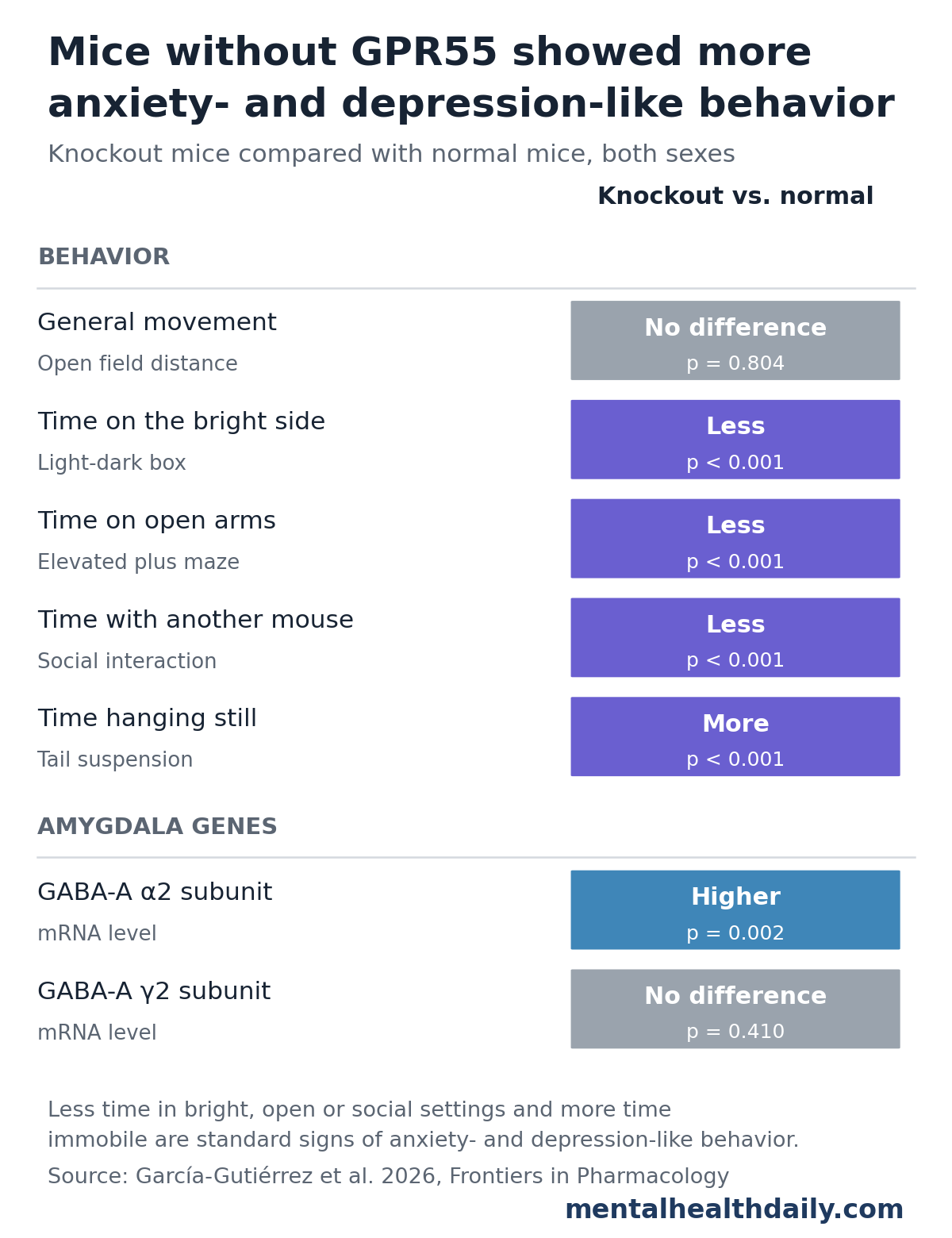
- More anxiety-like behavior in 3 tests: knockout mice spent less time on the bright side of a light-dark box (p < 0.001), less time on the open arms of a raised maze (p < 0.001) and less time interacting with another mouse (p < 0.001).1
- More depression-like behavior: hung by the tail, knockout mice stopped struggling for longer than normal mice (p < 0.001).1
- Same in males and females: none of these effects differed by sex, and general movement was unchanged (p = 0.804), so the mice were not simply less active.1
- Amygdala gene change: mRNA for the α2 subunit of the GABA-A receptor, a brake-pedal receptor linked to calming, was higher in the amygdala of knockout mice (p = 0.002).1
- Stress genes responded normally: 30 minutes of restraint stress triggered the same stress-gene response in both genotypes, though knockout males had lower baseline levels of one stress gene.1
- Mouse study only: no people, no drug tested. An earlier knockout study found no anxiety change, so the result needs replication.1,3
What GPR55 Is and Why Researchers Study It
GPR55 is a receptor on the surface of brain cells that responds to some cannabinoid compounds and to lipid signaling molecules the body makes itself. It was first labeled an unusual cannabinoid receptor, but it signals differently from CB1 and CB2, the two classic cannabinoid receptors.1
It sits in emotion-related brain regions, including limbic and cortical areas. Earlier rodent work found that drugs activating GPR55 had anxiety-reducing and antidepressant-like effects, while blocking it tended to increase anxiety-like behavior.1
María S. García-Gutiérrez et al., at the Instituto de Neurociencias in Alicante, Spain, asked the reverse question: what happens to emotional behavior when the receptor is missing from birth?1
How the GPR55 Knockout Mouse Study Worked
A knockout mouse carries a deliberately disabled gene. Here, part of the Gpr55 gene was replaced, removing the receptor throughout the body for life. Knockout and normal (wild-type) littermates came from the same breeding pairs.1
Two groups of mice:
- Behavior group: male and female mice, 9 to 12 per sex and genotype in most tests (48 in the movement test), went through 5 behavior tests. Their amygdalas were analyzed the day after testing ended.
- Stress group: a separate set of mice spent 30 minutes in a restraint tube or stayed in their home cage, then stress-related genes were measured 2.5 hours later.
Mice were 6 weeks old when the experiments began.1
Knockout Mice Avoided Bright, Open and Social Settings
Rodent anxiety tests use a simple conflict: mice want to explore, but they also avoid bright, exposed or unfamiliar places. More avoidance is read as more anxiety-like behavior.1
- Light-dark box: knockout mice spent less time in the lit compartment, in both sexes (genotype F = 36.2, p < 0.001).
- Elevated plus maze: a raised, cross-shaped maze with 2 walled arms and 2 open ones. Knockout mice spent much less time on the open arms (F = 16.9, p < 0.001).
- Social interaction: pairs of unfamiliar mice of the same sex and genotype were placed together. Knockout pairs spent less time interacting (F = 43.6, p < 0.001) and had fewer interactions (p = 0.003).
Arm-to-arm movements in the maze were the same in both genotypes (p = 0.929), and total distance in an open arena did not differ (p = 0.804). The avoidance was not a sign of sluggish or impaired movement.1
Longer Immobility in the Tail Suspension Test
In the tail suspension test, a mouse is hung briefly by its tail and observers time how long it stays still rather than trying to escape. Antidepressants shorten that immobility, so longer stillness is treated as depression-like behavior.1
Knockout mice stayed still longer than normal mice over the 6-minute test (F = 36.6, p < 0.001), with an almost identical effect in males and females (interaction p = 0.979).1
Higher GABA-A α2 Levels in the Amygdala
GABA is the brain's main calming, or inhibitory, chemical messenger. The GABA-A receptor is the channel it acts on most, and it is the same receptor that benzodiazepines such as diazepam boost.1
Each GABA-A receptor is built from several subunits. The α2 version is closely linked to anxiety relief, and γ2 is another core piece. The researchers measured both in the amygdala, an almond-shaped region that flags threats and drives fear responses.1
- α2 subunit: mRNA was higher in knockout mice of both sexes (F = 11.4, p = 0.002).
- γ2 subunit: no genotype difference (p = 0.410), although females and males differed overall (p < 0.001).
Reading the direction: more α2 mRNA alongside more anxiety-like behavior can seem backward for a calming receptor. The study measured gene activity only, not receptor protein or how well the receptors worked, and the researchers said the functional meaning of the change still needs to be tested.1
Stress-Hormone Genes Still Responded to Acute Stress
The HPA axis (hypothalamic-pituitary-adrenal axis) is the hormone chain that releases cortisol-type stress hormones. The team measured 2 of its genes after restraint stress:1
- Crf in the hypothalamus: the gene for corticotropin-releasing factor, the starting signal of the stress response. Restraint raised it in both genotypes and both sexes (p < 0.001).
- Nr3c1 in the hippocampus: the gene for the glucocorticoid receptor, which helps switch the stress response off. Restraint lowered it in both genotypes and both sexes (p ≤ 0.001).
One sex difference: unstressed knockout males had lower baseline Crf than unstressed normal males (genotype p = 0.011). Females showed no such gap, and a 3-way analysis showed a sex-by-genotype interaction (p = 0.007).1
No stress hormones were measured in blood, so these are gene-activity results only.1
Earlier GPR55 Studies in Rodents Point Both Ways
Consistent with drug studies: Shi et al. reported in 2017 that a GPR55-activating drug reduced anxiety-like behavior in acutely stressed male mice. Knocking down GPR55 in the medial orbital cortex, a front-of-brain region, removed that benefit, and 21 days of restraint stress lowered GPR55 protein there.2
At odds with an earlier knockout: Wu et al. characterized a GPR55 knockout line in 2013 and found no effect on anxiety or depressive behaviors. Those mice instead showed poorer coordination on harder motor tasks.3
The 2026 paper did not discuss that earlier finding. Differences in mouse lines, genetic background, age or test conditions could explain the gap, and neither study tested which one matters.
Limitations of This GPR55 Mouse Study
This is early mechanism research in animals. It shows that losing GPR55 changes emotional behavior in these mice, not that the receptor affects anxiety or depression in people.
- Mice only: anxiety-like and depression-like behavior are inferred from standard rodent tests, not from mood.
- Lifelong, whole-body knockout: the receptor was missing everywhere from birth, so the study cannot say which brain region or cell type matters, and the brain may have adapted during development.
- Gene activity only: GABA-A and stress genes were measured as mRNA, without protein, receptor function or hormone levels.
- Small social test: only 5 pairs of mice per group in the social interaction test.
- Acute stress only: chronic stress, which is closer to how depression develops, was not tested.
- Blinding not reported: the methods do not say whether behavior scorers knew which mice were knockouts.
- Conflicting earlier result: a separate GPR55 knockout line showed no anxiety change.3
No treatment implication: no drug was tested, and the findings say nothing about cannabis or CBD products. They point to GPR55 as a receptor worth studying further in anxiety and mood research.1
References
- García-Gutiérrez MS, Illescas L, Gasparyan A, Manzanares J. GPR55 deletion increases anxiety- and depression-like behaviors and modifies amygdalar GABAAα2 expression. Frontiers in Pharmacology. 2026;17:1766492. doi:10.3389/fphar.2026.1766492
- Shi QX, Yang LK, Shi WL, et al. The novel cannabinoid receptor GPR55 mediates anxiolytic-like effects in the medial orbital cortex of mice with acute stress. Molecular Brain. 2017;10:38. doi:10.1186/s13041-017-0318-7
- Wu CS, Chen H, Sun H, et al. GPR55, a G-protein coupled receptor for lysophosphatidylinositol, plays a role in motor coordination. PLoS ONE. 2013;8(4):e60314. doi:10.1371/journal.pone.0060314