
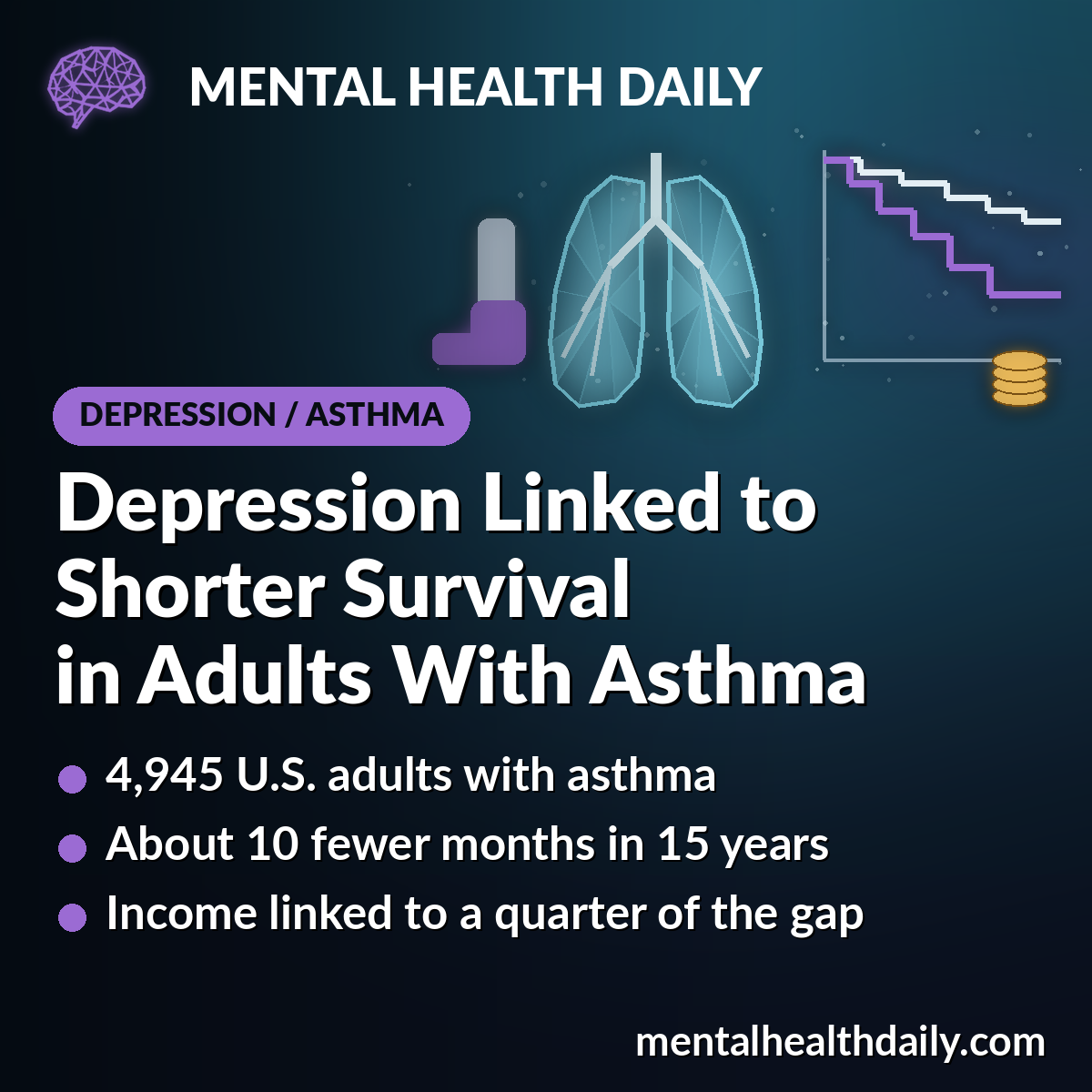
U.S. adults with asthma who had moderate-to-severe depressive symptoms died sooner than those without, in a 2026 study that followed 4,945 people for up to 15 years. In an exploratory analysis, lower household income accounted for about a quarter of that gap.1
Research Highlights
- About 10 fewer months alive: over a 15-year window, people with depressive symptoms lived an average of 155.2 months vs 165.1 months for those without, a 9.9-month difference before adjustment.1
- Higher death risk after adjustment: moderate symptoms (PHQ-9 score 10–18) carried a 41% higher risk of death (HR 1.41, 95% CI 1.10–1.82) after accounting for age, smoking, income, diabetes, and other factors.1
- Income explained 23.8% of the link: in an exploratory mediation analysis, the poverty-income ratio accounted for 23.8% of the association between depressive symptoms and shorter survival (95% CI 14.4%–40.0%).1
- Poverty was twice as common: 47.98% of people with depressive symptoms lived near or below the poverty line, vs 23.50% of those without.1
- Observational snapshot: depression and income were measured once, at the same visit, so the study cannot show which came first or prove that either one caused the deaths.1
How the NHANES Asthma and Depression Study Worked
Zhiyi Wang and Xiaojing Teng drew on the National Health and Nutrition Examination Survey (NHANES), a long-running CDC survey designed to represent the U.S. civilian population.
They selected adults interviewed between 2005 and 2018 who said a doctor had told them they had asthma, then linked them to the National Death Index to see who had died by the end of 2019.1
- Sample: 4,945 adults with asthma, out of 12,603 who reported asthma (most exclusions were for a missing depression score)
- Depression measure: the PHQ-9 questionnaire, scored 0 to 27
- Income measure: the poverty-income ratio
- Outcome: death from any cause
The PHQ-9 (Patient Health Questionnaire-9) asks how often 9 depression symptoms bothered a person over the past 2 weeks. A score of 10 or more marks moderate-to-severe symptoms. It is a screening score, not a diagnosis of major depressive disorder.
By that cutoff, 698 people had depressive symptoms and 4,247 did not.1
The poverty-income ratio (PIR) divides family income by the federal poverty threshold. A PIR below 1.30 (under 130% of the poverty line) counted as low income, and 3.50 or higher counted as high income.1
Depressive Symptoms Were Linked to Shorter Survival in Asthma
Deaths were nearly twice as common among people with depressive symptoms: 11.68% vs 6.40% (survey-weighted percentages).1 Some of that gap reflects who those people were, so the researchers ran 3 Cox models, each adjusting for more factors.
Hazard ratios for death, PHQ-9 10–18 vs 9 or lower:
- Unadjusted: HR 1.83 (95% CI 1.45–2.32)
- Adjusted for age, sex, and race/ethnicity: HR 2.17 (1.71–2.76)
- Also adjusted for education, smoking, diabetes, income, marital status, body mass index, and high blood pressure: HR 1.41 (1.10–1.82)
A hazard ratio (HR) compares the rate of death between groups over time; 1.41 means a 41% higher rate. Each extra point on the PHQ-9 carried about 4% higher risk in the full model (HR 1.04, 1.02–1.06).1
The most severe group did not reach significance. For PHQ-9 scores above 18, the fully adjusted HR was 1.23 (0.72–2.08). The researchers note that this subgroup may have been too small to detect a difference, so the result does not mean severe symptoms carry less risk.1
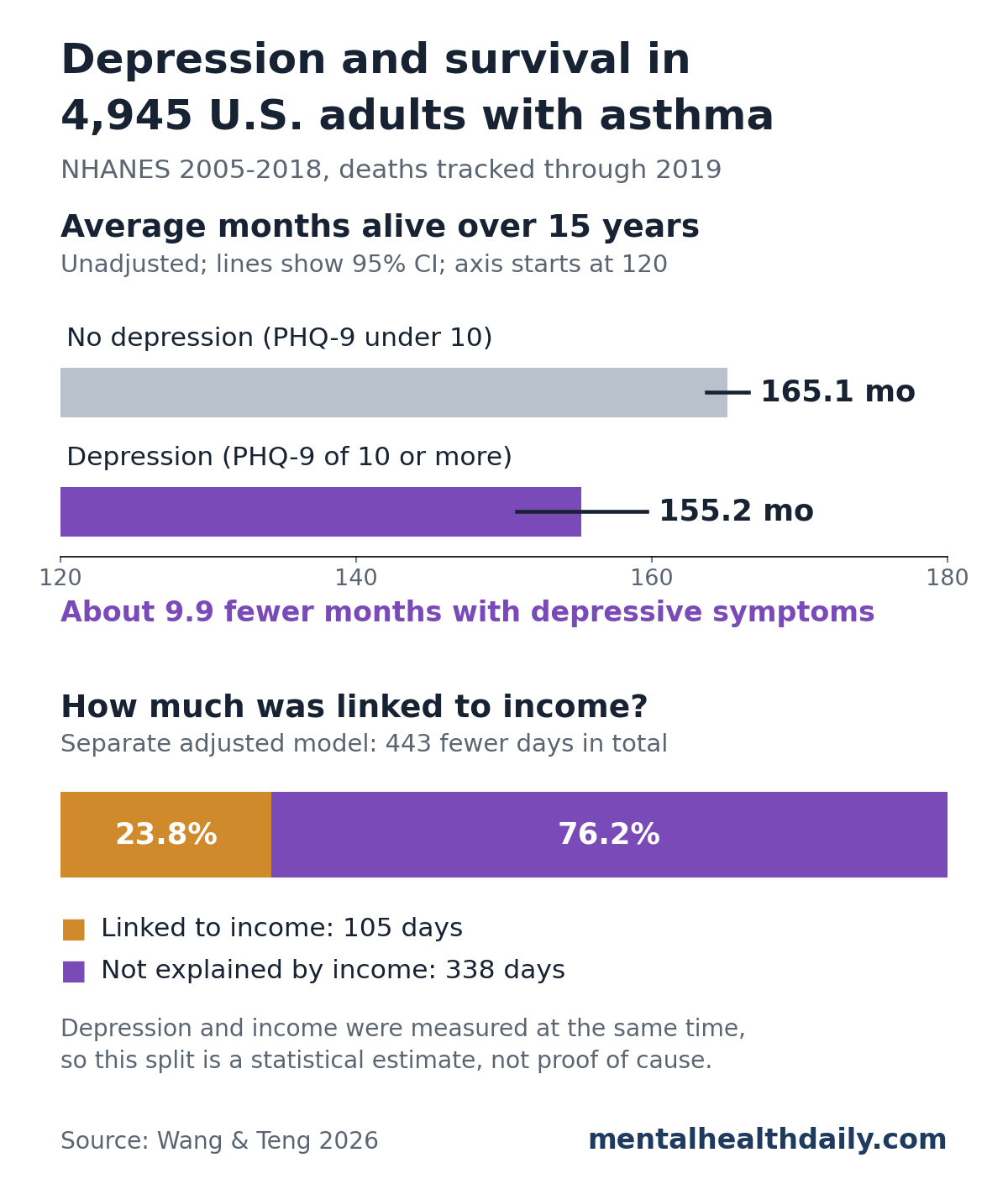
Restricted mean survival time (RMST) turns survival curves into a plain number: the average months a person was alive within a fixed window, here 180 months (15 years). People with depressive symptoms averaged 155.2 months vs 165.1 months, a difference of about 9.9 months.1
That 9.9-month figure is unadjusted and covers only the 15-year window, not a lifetime. The survival curves began to separate within the first 2 years and kept widening.1
Lower Income Accounted for About a Quarter of the Survival Gap
Mediation analysis estimates how much of a link between 2 things could run through a third factor. Here the question was how much of the depression–survival association traveled through income.
In a model adjusted for demographics, education, smoking, marital status, high blood pressure, body mass index, and diabetes, depressive symptoms were linked to about 443 fewer days of survival.1
- Linked to income: about 105 days (95% CI 55–192)
- Not explained by income: about 338 days (95% CI 156–652)
- Share through income: 23.8% (95% CI 14.4%–40.0%)
Income also stood out on its own. Compared with high-income participants, those with low income had more than twice the risk of death (HR 2.23, 1.60–3.11), and middle income carried a 72% higher risk (HR 1.72, 1.26–2.35).1
People with depressive symptoms were far more likely to be poor: 47.98% had a PIR below 1.30 vs 23.50% of those without symptoms. Only 18.68% had high income, vs 42.32%.1
Possible pathways the researchers describe:
- Depression can cut work and earnings, adding financial strain
- Financial strain can make asthma medications and regular care harder to afford
- Low income can delay treatment and weaken long-term disease control
None of these pathways was measured directly in this study.
Other Differences Between People With and Without Depressive Symptoms
People with depressive symptoms differed in ways that independently affect survival. Compared with those without symptoms, they were:1
- More likely to smoke: 69.50% vs 44.26%
- More likely to have diabetes: 19.37% vs 9.77%
- Less likely to have finished high school: 26.07% vs 11.74% did not
- Slightly older: average age 45.6 vs 43.7
Adding these and other factors, including income, shrank the hazard ratio from 2.17 to 1.41, but a significant link remained. The association also looked similar in people without asthma (p for interaction = 0.70), which suggests the depression–mortality link is not unique to asthma.1
Earlier Studies Also Linked Depression to Higher Mortality
An earlier NHANES analysis of 1,865 adults with asthma (2005–2014) found the same direction.2
Depression was linked to higher mortality after adjusting for age, sex, race/ethnicity, and body mass index (HR 2.71, 1.58–4.66), but the link lost significance after adjusting for many other illnesses (HR 1.92, 0.82–4.45).2
The 2026 study used a larger, overlapping sample and kept a significant association after its fullest adjustment.
In the general population, a 2025 meta-analysis of 268 studies found depression roughly doubled all-cause mortality (relative risk 2.10, 95% CI 1.87–2.35).3 The asthma estimates sit in a similar range before full adjustment.
Limitations of This NHANES Mortality Analysis
Evidence strength: this is a large, nationally representative observational study with solid mortality linkage. It can show that depressive symptoms and lower income are linked to shorter survival in asthma. It cannot show that treating depression or raising income would extend life.
- One-time measurement: depression and income were recorded at the same visit. Depression can lower income, and low income can worsen depression, so the 23.8% figure depends on assumptions about direction.
- No asthma severity data: asthma was self-reported, and NHANES lacked consistent data on severity, control, attacks, medications, or heart disease history. Severe asthma could drive both depression and death.
- Screening score: a PHQ-9 of 10 or more reflects symptoms over 2 weeks, not a confirmed diagnosis.
- Unadjusted survival gap: the 9.9-month figure did not account for age, smoking, or other differences.
- Missing data: 7,246 people with asthma were dropped for a missing PHQ-9 score.
- U.S.-specific income cutoffs: poverty thresholds and health care access differ in other countries.
- All-cause deaths only: the study did not report what people died from.
Practical Takeaways for People With Asthma and Depression
- Depressive symptoms deserve attention in asthma care. A PHQ-9 score of 10 or more was linked to higher death risk even after adjustment for smoking, income, and diabetes.
- Money problems are part of the picture. Cost barriers to inhalers and follow-up visits are a plausible pathway, and clinicians can ask about them directly.
- Smoking stands out. Nearly 7 in 10 people with depressive symptoms smoked, a changeable risk for worse asthma and earlier death.
- Treatment effects remain untested. No trial has shown that treating depression or providing financial support lengthens survival in asthma.
References
- Wang Z, Teng X. The association between depression and survival in asthma: the mediating role of income. Depression and Anxiety. 2026;2026:8153352. doi:10.1155/da/8153352
- Lin P, Li X, Liang Z, Wang T. Association between depression and mortality in persons with asthma: a population-based cohort study. Allergy, Asthma & Clinical Immunology. 2022;18:29. doi:10.1186/s13223-022-00672-4
- Chan JKN, Solmi M, Lo HKY, et al. All-cause and cause-specific mortality in people with depression: a large-scale systematic review and meta-analysis of relative risk and aggravating or attenuating factors, including antidepressant treatment. World Psychiatry. 2025;24(3):404–421. doi:10.1002/wps.21354