
In 5,128 people who had already had a stroke or a transient ischemic attack (TIA, or “mini-stroke”), higher blood pressure over the next 18 months was linked to a greater chance of cognitive decline or dementia over the following years.1
Research Highlights
- Higher average systolic pressure, higher risk: each 15 mm Hg higher average systolic reading was linked to an 18% higher relative risk of cognitive decline or dementia (RR 1.18, 95% CI 1.06–1.31).1
- Diastolic load had the strongest link: cumulative diastolic pressure across 18 months carried a 23% higher risk per standard deviation (RR 1.23, 95% CI 1.12–1.36).1
- 567 of 5,128 people (11.1%) had the outcome over a median of 4 years: 27.5% of those with low starting cognitive scores vs 8.6% of those with normal scores.1
- Swings mattered only with normal starting cognition: visit-to-visit variability in systolic, diastolic and mean arterial pressure was linked to risk in people without low baseline scores, but not in those with them.1
- Observational, not randomized: the data came from a 1990s blood pressure trial, but these comparisons are associations, so residual confounding is possible.1
How Researchers Tracked Blood Pressure in the PROGRESS Stroke Trial
PROGRESS (Perindopril Protection Against Recurrent Stroke Study) was a randomized, placebo-controlled trial that enrolled 6,105 people from 172 centers in Asia, Australasia and Europe between 1995 and 1997. Everyone had a stroke or TIA in the previous 5 years.1
The active arm took the blood pressure drug perindopril, with the diuretic indapamide added when the doctor judged it suitable. The placebo arm took inactive pills. The trial’s main goal was preventing another stroke; dementia and cognitive function were prespecified secondary outcomes.1
Shajahan et al. went back to this dataset and asked a different question: regardless of which arm people were in, did the pattern of their blood pressure predict later cognitive problems? That makes this a secondary observational analysis, with treatment allocation adjusted for rather than compared.1
Who was included: 5,128 people with six blood pressure readings (at months 1, 3, 6, 9, 12 and 18 after randomization) and at least 2 cognitive tests. Mean age was 64, 30% were women, and 41% lived in Asia. People with dementia at the start were excluded.1
Blood Pressure Measures Compared
From the six readings, the team calculated several summaries for each type of pressure:1
- Mean and maximum: the average reading and the single highest one.
- Variability: how much readings swung from visit to visit (their standard deviation).
- Cumulative load: total blood pressure exposure summed across the 18 months, similar to the area under a curve.
- Slope and last reading: whether pressure trended up or down, and the final reading.
These were calculated for systolic pressure (the top number, during a heartbeat), diastolic pressure (the bottom number, between beats), pulse pressure (the gap between the two, a marker of stiff arteries) and mean arterial pressure (the average pressure over a full heartbeat cycle).
Outcome: a drop of 3 or more points on the Mini-Mental State Examination (MMSE, a 30-point screening test of memory and thinking) or a dementia diagnosis confirmed by an adjudication committee.1
Average and Cumulative Blood Pressure Had the Clearest Links to Cognitive Decline and Dementia
After adjusting for age, sex, education, region, baseline blood pressure, trial treatment, baseline MMSE, body mass index, kidney function, smoking, drinking and diabetes, these measures stood out (relative risk per 1 standard deviation higher):1
- Diastolic load: RR 1.23 (95% CI 1.12–1.36)
- Mean arterial pressure load and mean: RR 1.20 each (95% CI 1.09–1.33 and 1.08–1.33)
- Mean systolic (SD 15 mm Hg): RR 1.18 (95% CI 1.06–1.31)
- Mean diastolic (SD 8.3 mm Hg): RR 1.18 (95% CI 1.06–1.32)
- Systolic load and maximum: RR 1.16 each (95% CI 1.05–1.28 and 1.05–1.27)
An RR of 1.18 means an 18% higher relative risk, not an 18-point jump in absolute risk. Against an overall event rate of about 11%, the absolute difference per standard deviation is roughly 2 percentage points.
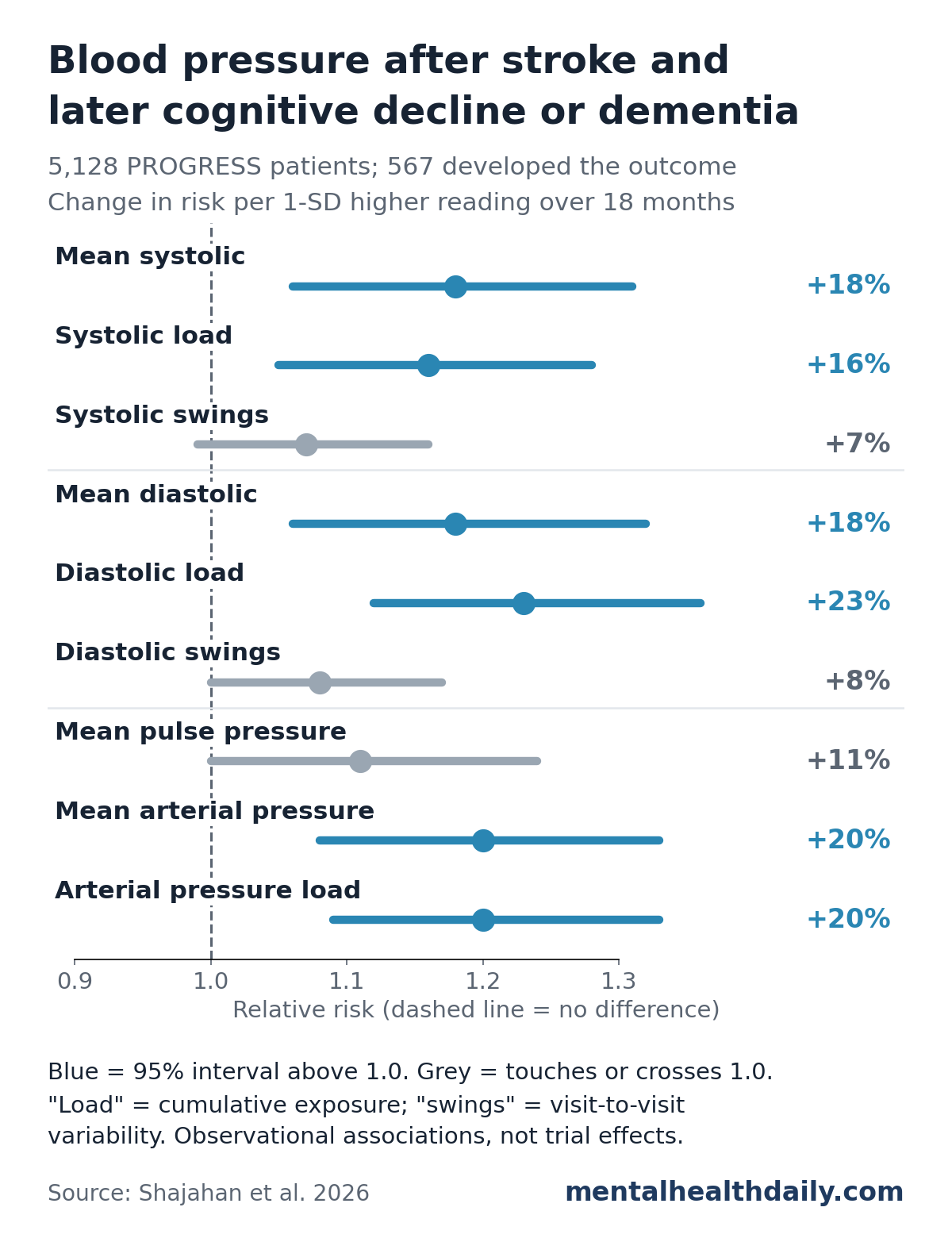
Weaker measures: mean pulse pressure was the only pulse pressure measure linked to risk, and only at the edge of significance (RR 1.11, 95% CI 1.00–1.24). Systolic variability was borderline (RR 1.07, 95% CI 0.99–1.16) and shrank further after adjusting for average systolic pressure (RR 1.05, 95% CI 0.97–1.14).1
Diastolic variability (RR 1.08, 95% CI 1.00–1.17) and mean arterial pressure variability (RR 1.09, 95% CI 1.01–1.18) were small associations whose intervals sat right at or just above no difference.1
Blood Pressure Swings Were Linked to Risk Only in People With Normal Starting Cognition
Researchers split participants by baseline MMSE. A score below 28 was labeled mild cognitive impairment (MCI); 657 people (12.8%) fell in that group, with a median score of 24.1
In people with normal starting scores, each standard deviation of extra visit-to-visit swing was linked to higher risk. In those with low starting scores, there was no such link:1
- Systolic swings: RR 1.13 (1.03–1.24) without MCI vs 0.92 (0.80–1.04) with MCI; interaction p = 0.02
- Diastolic swings: RR 1.16 (1.06–1.27) vs 0.89 (0.77–1.03); p = 0.01
- Mean arterial pressure swings: RR 1.18 (1.07–1.29) vs 0.90 (0.78–1.02); p < 0.01
The researchers suggest that once substantial brain damage is present, blood pressure has less room to change the course. That pattern runs opposite to a SPRINT MIND analysis, in which people with greater systolic variability after an MCI diagnosis developed probable dementia more often (21.7% in the highest quartile vs 8.5% in the lowest).4
The researchers also warn that they ran many interaction tests, so some of these subgroup differences could be false positives.1
Later Blood Pressure Readings Predicted Risk Better Than Baseline
The last recorded reading was linked to later outcomes for systolic (RR 1.11, 95% CI 1.02–1.22), diastolic (RR 1.13, 1.02–1.24) and mean arterial pressure (RR 1.13, 1.03–1.24). Baseline readings were not.1
Readings taken closer to when cognitive problems appear seem more informative than a single number at study entry. A rising diastolic slope was also linked to risk (RR 1.11, 95% CI 1.01–1.22), and both systolic and diastolic slopes showed a J-shaped curve.1
Average diastolic pressure had a non-linear relationship with risk (p for non-linearity = 0.01). The researchers read this as a reason to watch for blood pressure that runs too low as well as too high after stroke.1
Limitations of This PROGRESS Blood Pressure Analysis
Evidence strength: a large cohort with standardized research blood pressure readings and adjudicated dementia diagnoses, but an observational analysis. It shows which blood pressure patterns go with higher risk; it cannot show that changing a given measure would change the risk.
- Not randomized: blood pressure patterns were not assigned, so other health differences could explain part of the links despite adjustment.
- Crude cognitive test: the MMSE misses milder impairment, and the MCI cutoff here (below 28) is a screening threshold, not a clinical diagnosis.
- Selection: only people with all six readings and at least 2 cognitive tests were included.
- Variability may be noise: readings were taken at different times of day, so some swings may reflect normal daily fluctuation.
- Overlapping measures: pulse pressure and mean arterial pressure are calculated from systolic and diastolic readings, so their results are not independent.
- Older data: participants enrolled in 1995–1997 and follow-up ended in 2001, before current blood pressure targets.
Lowering Blood Pressure to Prevent Dementia: What Randomized Trials Show
The randomized side of PROGRESS was reported in 2003. Active treatment reduced cognitive decline from 11.0% to 9.1% (a 19% risk reduction), while dementia rates of 6.3% vs 7.1% were not significantly different. Most of the benefit came from preventing decline that followed a repeat stroke.2
A 2022 pooled analysis of 5 placebo-controlled trials covering 28,008 people found that lowering blood pressure by an average of 10/4 mm Hg over a median 4.3 years reduced the odds of dementia (adjusted odds ratio 0.87, 95% CI 0.75–0.99).3
Those trials test treatment directly. The new PROGRESS analysis adds a different layer: among stroke and TIA survivors, the average and the accumulated burden of blood pressure over time tracked with cognitive outcomes more clearly than a single starting reading.
What This Means for Stroke and TIA Survivors
- Repeated readings tell more than one: pressure that stayed high across follow-up visits went with higher risk, while the baseline value alone did not.
- Both numbers count: diastolic and mean arterial measures were linked to risk about as strongly as systolic ones.
- Variability is not yet a target: the overall links were small and close to no difference, and were clear only in people with normal starting cognition.
- No change to treatment from this study alone: blood pressure goals after stroke should be set with a doctor, who can weigh the risks of pressure that is too low as well as too high.
References
- Shajahan S, Woodward M, Anderson CS, et al. Blood pressure parameters and cognitive decline and dementia after stroke or transient ischemic attack: results from the PROGRESS trial. American Journal of Hypertension. 2026;39(9):1151–1159. doi:10.1093/ajh/hpag056
- Tzourio C, Anderson C, Chapman N, et al. Effects of blood pressure lowering with perindopril and indapamide therapy on dementia and cognitive decline in patients with cerebrovascular disease. Archives of Internal Medicine. 2003;163(9):1069–1075. doi:10.1001/archinte.163.9.1069
- Peters R, Xu Y, Fitzgerald O, et al. Blood pressure lowering and prevention of dementia: an individual patient data meta-analysis. European Heart Journal. 2022;43(48):4980–4990. doi:10.1093/eurheartj/ehac584
- de Havenon A, Muddasani V, Anadani M, Prabhakaran S. Impact of mean blood pressure and blood pressure variability after diagnosis of mild cognitive impairment and risk of dementia. Journal of Clinical Hypertension. 2021;23(12):2124–2128. doi:10.1111/jch.14391