
Genetic testing of 31 Rwandan children with autism, done alongside both of their parents, found a likely genetic cause in 4 of them, or about 1 in 8.
Counting variants that fit a child’s symptoms but are not yet proven, the figure rose to 9 of 31 children.1
Research Highlights
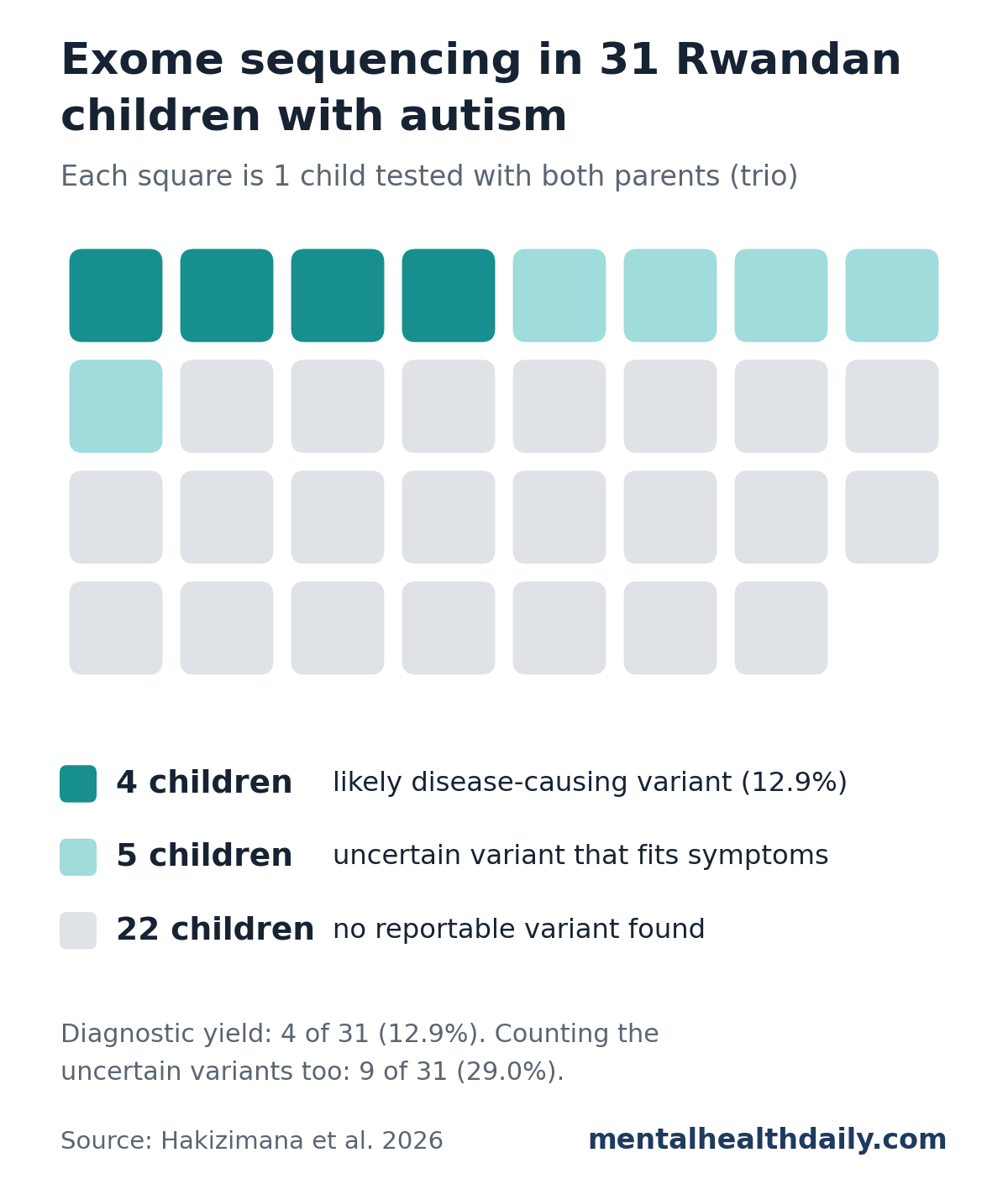
- Diagnostic yield of 12.9%: 4 of 31 children carried a variant classified as likely pathogenic (likely disease-causing) under standard genetics guidelines.1
- 29.0% with uncertain variants added: 5 more children carried variants of uncertain significance that matched their symptoms, for 9 of 31 in total.1
- Most findings were new in the child: 3 of the 4 likely pathogenic variants were absent in both parents, which only testing the parents could show.1
- Complex cases: all 4 children with a likely cause had severe autism, and 3 of the 4 had syndromic autism (autism with extra features such as seizures, developmental delay or unusual physical features).1
- A small first look: the study is one of the few of its kind in sub-Saharan Africa, and with 31 families it cannot pin down an exact yield.1
How Trio Exome Sequencing Works
The exome is the part of the genome that holds the instructions for making proteins. Whole-exome sequencing (WES) reads those regions letter by letter, looking for rare spelling changes (variants) that could disrupt how a gene works.
In trio sequencing, the lab sequences the child plus both biological parents. Comparing the three shows where each variant came from:
- De novo: the variant is in the child but in neither parent, so it arose new in the egg, sperm or early embryo. New variants in key brain genes are a well-known cause of autism with other developmental problems.
- Inherited: the variant came from a parent. If that parent has no symptoms, the finding is harder to interpret.
- One from each parent: for recessive conditions, a child can be affected only when both copies of a gene are changed.
Labs grade each variant on a 5-step scale set by the American College of Medical Genetics and Genomics, from benign to pathogenic. A likely pathogenic variant has enough evidence to treat it as the probable cause of a child’s condition. A variant of uncertain significance (VUS) does not: it might matter, but the evidence is not there yet.
Diagnostic yield is the share of tested people who come away with a likely or confirmed genetic explanation. It is the main way to judge how useful a genetic test is for a group of patients.
31 Children Tested at a National Psychiatric Hospital in Kigali
Hakizimana et al. recruited children aged 2 to 18 who had been diagnosed with autism at Ndera Neuropsychiatric Teaching Hospital, Rwanda’s national referral hospital for psychiatric and developmental conditions. Only families where both biological parents could give a blood sample took part.1
- Recruited: 34 children (27 boys, 7 girls)
- Removed before sequencing: 3 children who tested positive for Fragile X syndrome, the most common inherited cause of intellectual disability; guidelines recommend testing for it first
- Sequenced: 31 children and their parents
- Laboratory: DNA was extracted in Kigali and sequenced at an accredited clinical genetics lab at the University of Liège in Belgium
These were mostly children with severe, complex autism. On a standard rating scale, 22 of 31 had severe autism, 8 moderate and 1 mild. Intellectual disability was present in 30 of 31, delayed speech in 25, global developmental delay in 17 and seizures in 8.1
The analysis focused on 233 genes already linked to autism and related neurodevelopmental conditions, plus larger deleted or duplicated stretches of DNA called copy-number variants (CNVs).
4 Children Had a Likely Disease-Causing Variant
Across the 31 children, the lab flagged 11 rare variants of possible clinical importance in 9 children. Four children had a likely pathogenic finding, giving a diagnostic yield of 12.9%.1
The 4 likely pathogenic findings:
- GABRB3 (new in the child): a single-letter change in an 8-year-old boy with seizures and intellectual disability. GABRB3 builds part of a receptor for GABA, the brain’s main calming chemical messenger, and the change is predicted to weaken that inhibitory signal.
- SYNGAP1 (new in the child): a change near a splice site in a 9-year-old boy with global developmental delay and seizures. Computer models predicted it causes a section of the gene to be skipped, and earlier lab studies of this change showed disrupted splicing. SYNGAP1 helps control how connections between neurons strengthen.
- Chromosome 1p35.3-p35.2 deletion (new in the child): a missing stretch of about 3.5 million DNA letters covering 29 protein-coding genes, in a 10-year-old boy with low muscle tone, seizures and developmental delay.
- GNAS deletion (inherited): a small 35-letter deletion inside the GNAS gene in an 11-year-old boy with intellectual disability and delayed motor development. He inherited it from his mother, who did not have the condition, which makes this finding harder to interpret.
Trio design in action: 3 of the 4 variants were confirmed as de novo only because both parents were sequenced. Testing the child alone would have left their origin unknown.1
5 More Children Carried Variants of Uncertain Significance
Seven variants of uncertain significance turned up in 5 other children. Each fit the child’s symptoms, which is why the researchers also reported an expanded yield of 29.0% (9 of 31).1
- SHANK3: a new variant in a 3-year-old boy. SHANK3 is a well-established autism gene that shapes synapses, the contact points between neurons.
- SYNJ1 and KIF15: in 2 separate children, each carried 2 variants in the same gene, one from each parent, a pattern that fits recessive conditions.
- HUWE1: a new X-chromosome variant in a boy with seizures and cataracts.
- EPG5: a variant in a gene involved in clearing waste inside cells.
The 29% figure is best read as an upper bound. A variant of uncertain significance is not a diagnosis, and clinicians do not base care decisions on one until more evidence arrives, such as lab tests of how the variant affects the gene or other patients with similar variants and symptoms.
Missing African Data Makes Genetic Variants Harder to Classify
African populations hold the greatest human genetic diversity, yet they remain markedly underrepresented in the reference databases labs use to judge variants, according to the researchers.1
Those databases tell a lab how common a variant is in healthy people. A variant that looks rare simply because few people with similar ancestry have been sequenced can be flagged as suspicious when it is actually harmless and common in that population.
The researchers say this gap likely contributed to the large number of uncertain variants in their Rwandan cohort.
Their conclusion is direct: genetic studies of autism in African populations are scarce, diagnostic yields there are not yet well established, and more African genomic data is needed for accurate variant classification.1
How the 13% Yield Compares With Other Autism Exome Studies
The researchers note that trio exome studies of autism and related conditions typically report yields of about 10% to 30%, depending on who is tested.1 The Rwandan result sits within that range.
A 2019 meta-analysis by Srivastava et al., which pooled 30 studies of exome sequencing in neurodevelopmental disorders, found a similar pattern:2
- All neurodevelopmental disorders: 36% yield
- Studies of mainly autism: 16% yield
- Developmental disorders plus other medical problems: 53% yield
That meta-analysis recommended exome sequencing as a first-line test for unexplained neurodevelopmental disorders, in place of the older chromosomal microarray, a test that scans for large missing or extra pieces of DNA.2 The Rwandan finding that most likely causes appeared in children with additional features fits the same trend, although 4 cases are far too few to test it statistically.
Limitations of This Small Rwandan Exome Study
This was an exploratory study with clear limits:1
- Small sample: with 31 families, one more or one fewer positive finding shifts the yield by about 3 percentage points, and no confidence interval was reported.
- One referral hospital: nearly all children had intellectual disability and most had severe autism, so the yield would likely be lower among all autistic children in Rwanda.
- Fragile X removed first: the 3 children with Fragile X are not counted in the 12.9%.
- What exome testing misses: variants outside protein-coding regions, some structural changes and genes outside the 233-gene panel were not examined.
- No new lab tests of function: the researchers did not test how the variants actually affect their genes, which leaves the uncertain variants unresolved.
What Exome Testing Can Offer Families of Autistic Children
A genetic diagnosis does not treat autism. For families, it can still end years of searching for an explanation, help doctors watch for linked problems such as seizures, and inform the chance that a future child could be affected.1
Genetic testing works best alongside genetic counseling, especially when a result is uncertain or inherited from a parent without symptoms.
References
- Hakizimana O, Hitayezu J, Uyisenga JP, et al. Clinical utility of trio exome sequencing in Rwandan children with autism spectrum disorder. Molecular Genetics & Genomic Medicine. 2026;14:e70294. doi:10.1002/mgg3.70294
- Srivastava S, Love-Nichols JA, Dies KA, et al. Meta-analysis and multidisciplinary consensus statement: exome sequencing is a first-tier clinical diagnostic test for individuals with neurodevelopmental disorders. Genetics in Medicine. 2019;21(11):2413–2421. doi:10.1038/s41436-019-0554-6