hit counter

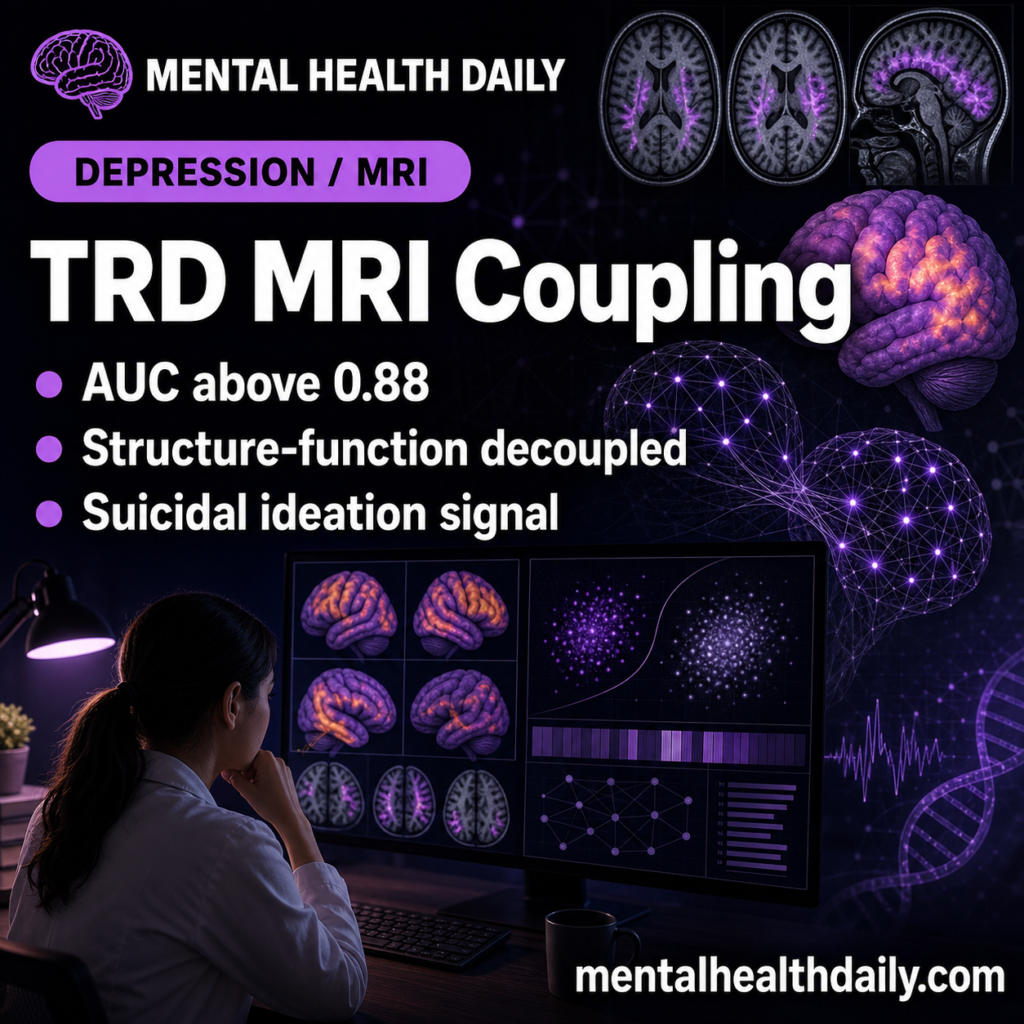
TRD MRI Coupling Classified Depression Resistance Above 0.88 AUC

A 2026 multimodal MRI study found that treatment-resistant depression had lower coordination between brain structure and brain activity than non-treatment-resistant depression in frontal, parietal, motor, and temporal regions. Machine-learning models using those structure-function coupling measures classified treatment-resistant vs. non-treatment-resistant depression with AUC values from 0.886 to 0.950 in the primary atlas analysis.1 Research Highlights TRD …

Read more

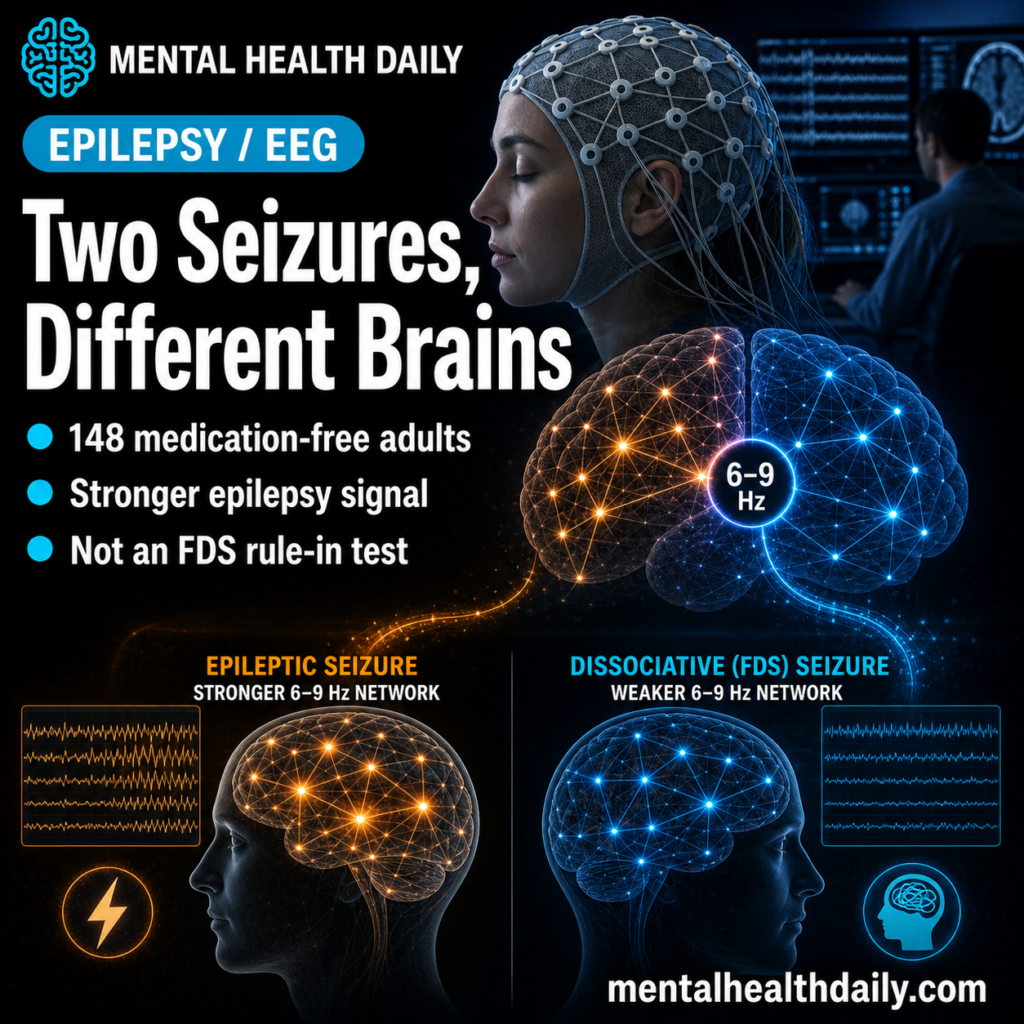
Resting EEG Supports Epilepsy More Than Functional Seizures

Photoreal illustration of EEG waveforms over a stylized brain, conveying network-based discrimination between two seizure-like disorders.

A 2026 diagnostic-accuracy preprint found that resting-state EEG network features separated non-lesional epilepsy from functional/dissociative seizures (FDS) at 67.5% balanced accuracy, but the signal was not symmetrical: sensitivity was 81.8% for epilepsy and only 53.3% for FDS.1 In plain clinical terms, the model looked more useful as an epilepsy-supporting marker than as a positive test …

Read more

Friedreich Ataxia MRI Study Finds 3 Progression Subtypes

Photoreal illustration of brain regions affected in Friedreich ataxia with overlay of MRI imaging modalities, conveying multi-pattern subtypes.

A 2026 longitudinal MRI preprint involving 54 people with Friedreich ataxia and 57 controls found 3 biologically interpretable progression subtypes: microstructure-dominant, macrostructure-dominant, and minimal/no progression.1 The clusters make biomarker heterogeneity visible at the research level, while the classifier remains too early to assign individual patients to treatment paths. Research Highlights 3 MRI progression subtypes emerged: …

Read more

fMRI Biotypes Predicted tDCS Anxiety Response in Older Adults

Photoreal illustration of a clinician fitting a tDCS device on an older adult, with brain network biotype overlays.

A 2026 BETA analysis of 199 older adults found that resting-state fMRI could separate 4 anxiety-related tDCS response patterns, but the result was narrower than “brain scan predicts treatment”: only the Robust tDCS Responder subtype showed a statistically reliable Active vs. Sham anxiety advantage across all participants.1 Research Highlights Only 1 subtype cleared the Active …

Read more

Machine Learning Predicts Clozapine Initiation in Schizophrenia

Photoreal illustration of an electronic health record dashboard with clinical text and a model output highlighted, representing ML prediction in psychiatry.

Clozapine is the only medication with proven efficacy for treatment-resistant schizophrenia, yet most eligible patients wait years before starting it. A 2026 paper by Perfalk and colleagues trains a machine-learning model on routine electronic health record data to flag candidates earlier.1 Research Highlights Clozapine is the only evidence-based treatment for treatment-resistant schizophrenia (TRS), but the …

Read more

Quetiapine Dosing for Depression Optimized with XGBoost Algorithm (2024 Study)

Depression is a globally pervasive mental illness that often requires complex treatment strategies. One such strategy involves the use of Quetiapine, an antipsychotic medication, as an augmentation to antidepressants. However, determining the optimal dose of Quetiapine is challenging due to individual variability. A recent study utilizes machine learning techniques to develop a predictive model for …

Read more