
A 4-week online course built on cognitive behavioral therapy (CBT) reduced self-reported condomless anal sex more than standard HIV prevention education in a small randomized trial of 50 men who have sex with men (MSM) in Wuhan, China.1
Research Highlights
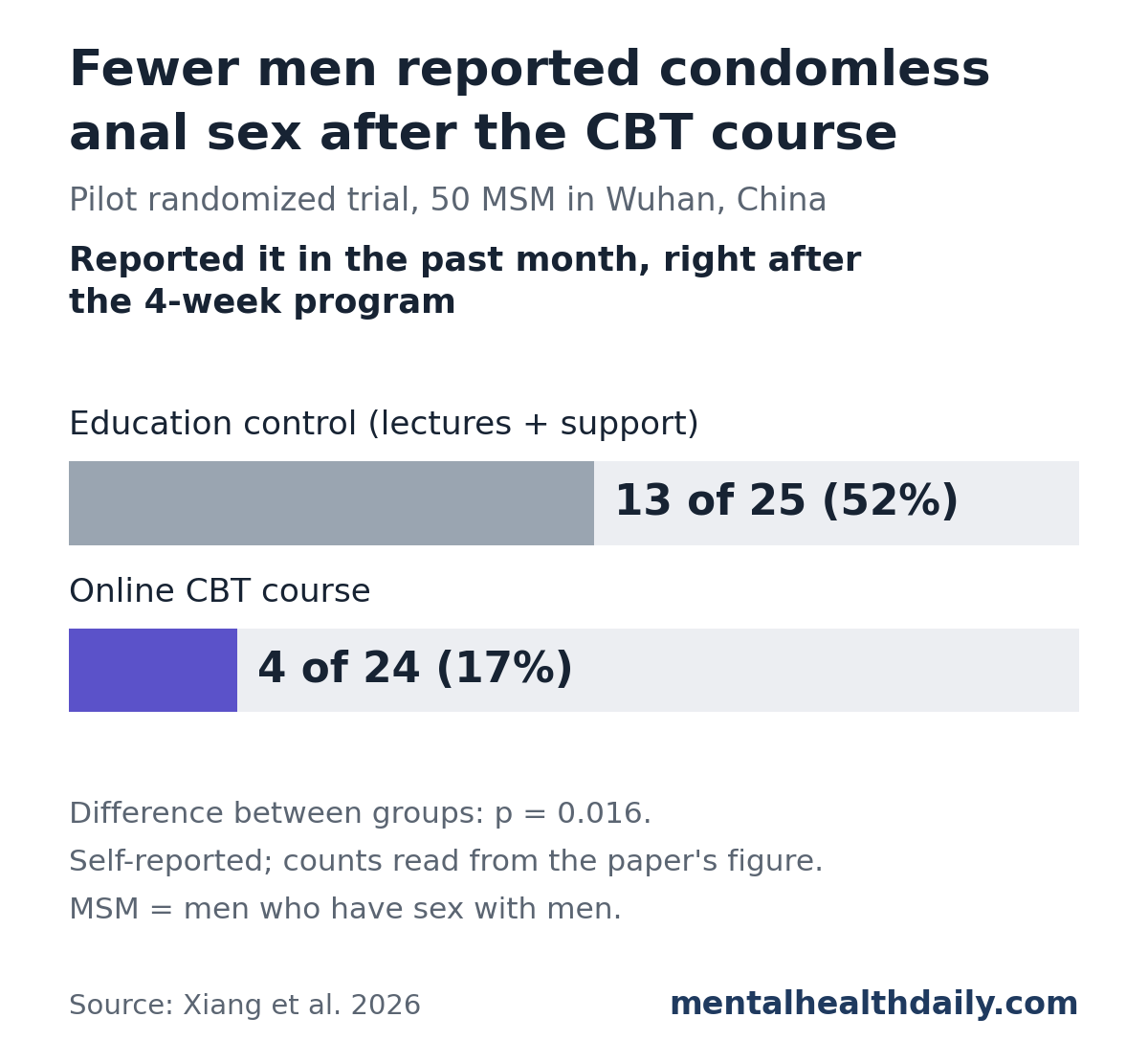
- Fewer men reported condomless sex after CBT: right after the program, 4 of 24 men in the CBT group and 13 of 25 in the education group reported condomless anal sex in the past month (p = 0.016).1
- Only the CBT group changed: condomless sex dropped significantly within the CBT group (p = 0.004) and did not change in the education group.1
- Knowledge was already high: both groups scored about 74 to 75 out of 100 on an HIV and sexually transmitted infection knowledge test before the program, yet many still reported condomless sex.1
- Short, self-reported, and early: behavior was measured by online questionnaire immediately after 4 weeks, with no longer follow-up and no infection testing.1
- Consistent with earlier trials: a Cochrane review found behavioral HIV prevention programs for MSM reduced unprotected anal sex by 27% compared with little or no intervention.2
Why HIV Knowledge Alone Often Doesn’t Change Condom Use
MSM is a public health term based on behavior rather than identity. It includes gay and bisexual men as well as men who do not use those labels. In China, as elsewhere, condomless anal sex is a main route for HIV and other sexually transmitted infections (STIs) among MSM.
A 2014 meta-analysis of 82 studies estimated that 53% of MSM in China had recently had condomless anal sex with a male partner.3
Standard prevention programs focus on teaching facts: how HIV spreads, how condoms work, and why regular testing helps. Xiang et al. argue that this approach runs into a gap between knowing and doing. The men in their trial illustrate it:
- Knowledge scores: 75.25 in the CBT group and 73.50 in the control group out of 100, with no difference between groups (p = 0.79)
- Attitudes: all 25 men in the CBT group and 24 of 25 in the control group said they were willing to use condoms
- Behavior: a substantial share in both groups still reported recent condomless anal sex at the start
How the Online CBT Course Worked
Cognitive behavioral therapy (CBT) is a structured approach that helps people notice the thoughts and beliefs that drive a behavior, test whether those beliefs hold up, and practice new responses. Here, the course aimed to correct mistaken beliefs about risk, shift negative attitudes, and improve how men make decisions about sex, using standard CBT tools such as restructuring unhelpful thoughts and practicing new behaviors.1
The course ran on WeChat, the Chinese messaging platform, with 8 sessions of about 10 to 15 minutes, twice a week for 4 weeks. Sessions covered:
- How CBT works
- Basic facts about HIV and other STIs and their prevention (2 sessions)
- Mapping each person’s own situation and patterns
- Spotting automatic thoughts
- Identifying underlying beliefs and rules
- Identifying and correcting core beliefs
- Systematic desensitization and behavior shaping (gradual practice of new habits)
Control group: the same 8 sessions on the same schedule, delivered as lecture-style HIV and STI prevention education covering transmission, risk reduction, and regular testing, plus one-on-one supportive counseling that answered questions without CBT techniques. Control participants had no cognitive homework or behavioral practice. A supervising psychologist reviewed control scripts weekly to keep CBT content out.1
Participants: 50 adult self-identified MSM aged 18 to 60, recruited through peer referral starting in May 2023 and randomized 25 to each group by computer-generated random numbers. One man in the CBT group dropped out.1
Condomless Anal Sex Fell in the CBT Group
The main outcome was whether a participant reported condomless anal sex in the past month. Before the program, the groups did not differ. After the 4-week course, fewer men in the CBT group reported it than in the education group (p = 0.016).1
Other measures pointed the same way:
- Change within each group: condomless sex decreased significantly in the CBT group (p = 0.004) and did not change significantly in the education group
- Condom-use frequency: on a 0-to-3 score for how much condom use changed, the CBT group scored higher (p = 0.008)
- Men with recent condomless sex at the start: more in the CBT group were rated as improved and fewer as not improved (p = 0.009)
A reporting problem: the paper’s text gives starting rates of 36% in the control group and 44% in the CBT group, but its figure shows different starting counts, and the text never gives the post-program numbers. The post-program counts above come from the figure, and they match the text’s claim that the CBT group improved. The exact size of the drop is still less certain than the chart suggests.
How This Compares With Other HIV Prevention Trials in MSM
The result is consistent with a large body of earlier work. A Cochrane review of 44 studies covering 58 behavioral programs and 18,585 participants found that these programs reduced occasions of or partners for unprotected anal sex among MSM:2
- By 27% compared with minimal or no prevention programming
- By 17% beyond standard or other prevention programs
That second figure is the closer comparison here, because the Wuhan control group also got prevention education. In this trial, the CBT group’s rate after the program was about a third of the control group’s (17% vs. 52%), a much larger difference than either pooled estimate. Small pilot trials often produce large effects that shrink in bigger studies.
CBT designed for gay and bisexual men has worked before. In the ESTEEM trial, 63 young gay and bisexual men in the US were randomized to LGB-affirmative CBT (CBT adapted to address stress from stigma and rejection) or a 3-month waitlist. Compared with waitlist, therapy reduced depressive symptoms, alcohol problems, and condomless sex with casual partners over the past 90 days, and the effects generally held at follow-up.4
ESTEEM was a fuller therapy with a broader mental health focus. The Wuhan course was much shorter, delivered through a messaging app, and aimed squarely at sexual decision-making.
Gut and Anal Bacteria Results Are Exploratory
The researchers also collected stool samples and anal swabs right after the program, to see whether bacterial communities differed between groups. Some did:1
- Bacterial richness: stool samples from the CBT group had a higher Chao1 richness score (an estimate of how many bacterial species are present), 185.5 vs. 128.9 (p = 0.038)
- Specific bacteria: Prevotella copri made up 40.6% of stool bacteria in the CBT group vs. 14.2% in the control group, and several other groups, including Bifidobacterium longum in anal swabs, differed between arms
The researchers call these findings hypothesis-generating. No samples were taken before the program, so the groups may have differed from the start. The bacterial comparisons were not corrected for testing many species at once, and the study did not record which sexual role men took, which can shape the rectal environment. These results cannot show that the course changed anyone’s microbiome.
Limitations of This Online CBT Trial
Randomization and an active education control make this stronger than a before-and-after study. Its limits are substantial:
- Small: 49 men analyzed, recruited through peer networks in one city, which can over-represent socially connected men
- Self-reported: condom use was measured by online questionnaire, and men who received the more intensive course may have been more inclined to report safer behavior; no HIV or STI tests were used as outcomes
- Short: behavior was measured right after a 4-week course, so it is unknown whether any change lasted
- Reporting gaps: no trial registration, allocation concealment, or blinding was described, and the baseline numbers in the text and figure disagree
- New questionnaire: the knowledge and behavior questionnaire was built for this study and checked only by expert review
What the Trial Means for HIV Prevention Programs
- Skills went further than facts here. Men in this trial already knew the basics, and a course aimed at decision-making shifted reported behavior where lectures did not.
- Online delivery offers privacy. Eight short sessions on a messaging app could reach men who avoid in-person services, which helps when stigma keeps many MSM from seeking care openly.
- A larger trial is the next step. It would need more participants, a registered protocol, follow-up of at least several months, and STI or HIV testing alongside self-report.
References
- Xiang X, Zhai X, Lei Y, Feng J, Wang Q. The effectiveness of the intervention model based on cognitive behavioral therapy in reducing risky sexual behaviors among MSM. Frontiers in Public Health. 2026;14:1870879. doi:10.3389/fpubh.2026.1870879
- Johnson WD, Diaz RM, Flanders WD, et al. Behavioral interventions to reduce risk for sexual transmission of HIV among men who have sex with men. Cochrane Database of Systematic Reviews. 2008;(3):CD001230. doi:10.1002/14651858.CD001230.pub2
- Wu J, Hu Y, Jia Y, et al. Prevalence of unprotected anal intercourse among men who have sex with men in China: an updated meta-analysis. PLoS One. 2014;9(5):e98366. doi:10.1371/journal.pone.0098366
- Pachankis JE, Hatzenbuehler ML, Rendina HJ, Safren SA, Parsons JT. LGB-affirmative cognitive-behavioral therapy for young adult gay and bisexual men: a randomized controlled trial of a transdiagnostic minority stress approach. Journal of Consulting and Clinical Psychology. 2015;83(5):875–889. doi:10.1037/ccp0000037