
Large DNA changes found in autistic children but not in their parents were more likely than their siblings’ changes to be predicted to disrupt DNA folding around brain-cell genes, a 2026 study using an AI model and lab-grown neurons found.1
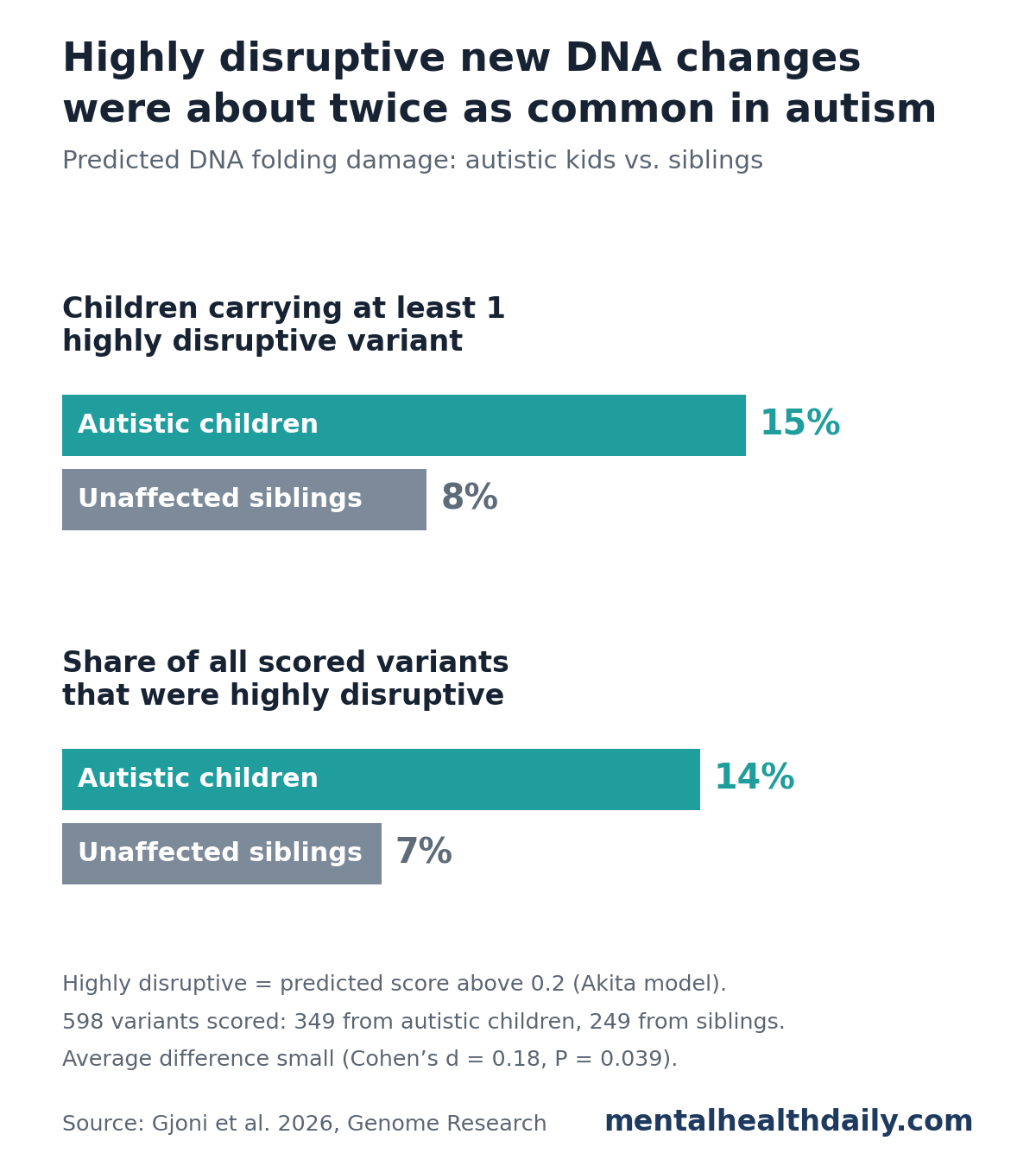
The difference was small on average, but the most disruptive changes turned up in 15% of autistic children vs. 8% of their brothers and sisters.
Research Highlights
- About twice as common in autism: highly disruptive variants made up 14% of the new DNA changes found in autistic children vs. 7% of those in siblings.1
- Small average gap: across 598 scored variants, the average difference was statistically significant but small (Cohen’s d = 0.18), driven mostly by a minority of large variants.1
- Neuron gene switches hit harder: the gap grew when scoring focused on contacts between neuron genes and their distant on-off switches (p = 0.006).1
- 1 prediction confirmed in the lab: a 23,000-letter deletion from an autistic child changed DNA folding in human neurons much as predicted, and altered the activity of 1,102 genes.1
- A research tool, not a test: the method ranks variants for lab study; it cannot tell whether an individual child has autism or why.1
What Are De Novo Structural Variants and Distant Gene Switches?
Most of a child’s DNA is inherited from the parents. A de novo variant is a change that is new in the child: it is not found in either parent’s DNA.
A structural variant is a large change rather than a single-letter typo. A whole stretch of DNA is deleted, duplicated, flipped end to end (an inversion) or rearranged.
In this study, half of the scored variants were longer than about 4,000 DNA letters (base pairs), and the largest quarter were longer than 32,000.1
De novo variants that break protein-coding genes are already well linked to autism. The largest exome sequencing study, which read the protein-coding DNA of 35,584 people including 11,986 with autism, identified 102 autism risk genes.4
But many structural variants do not break a gene at all. The question was whether they could still change how nearby genes are switched on.
How DNA folding works: each cell packs about 2 meters of DNA into its nucleus by folding it into loops and neighborhoods called topologically associating domains (TADs). Genes inside one neighborhood contact each other often; contact across neighborhood borders is limited.
Folding brings genes close to regulatory elements: stretches of DNA that act like on-off switches or volume dials for a gene. These switches can sit tens or hundreds of thousands of letters away along the strand.
A distal regulatory interaction is that physical contact between a gene’s starting point (its promoter) and a faraway switch. Researchers called these contacts cis-regulatory element interactions, or CREints.
Neighborhood borders are often marked by a protein called CTCF, which helps hold loops in place like a bookend.
Removing or rearranging DNA can break a border and let a switch reach the wrong gene.
A 2015 study showed this directly: deletions, inversions or duplications that altered one neighborhood caused distinct human limb malformations, and in mice the misplaced limb switches turned on a different gene.
That rewiring occurred only when a CTCF-marked border was disrupted.2
How an AI Model Scored 598 Variants From Autism Families
Ketrin Gjoni, Katherine Pollard et al. at the Gladstone Institutes and the University of California, San Francisco used structural variants previously found in the Simons Simplex Collection, a US research cohort of families in which only 1 child has autism.1
Comparing autistic children with their unaffected siblings sharpens the test, because siblings share much of the same family genetic background.
The data set held 869 de novo structural variants: 521 from autistic children and 348 from siblings. Of these, 598 could be scored.
Insertions, chromosome swaps (translocations) and 73 variants longer than 700,000 letters could not be scored with this method.
The model: Akita is a deep-learning model that predicts how a roughly 1 million-letter stretch of DNA folds, using only the DNA sequence.
Researchers ran it twice for each variant, once on the normal sequence and once with the variant, and compared the 2 predicted folding maps.
The score: a disruption score near 0 means the variant barely changed the predicted folding. Scores above 0.2 were the most disruptive.
Autistic Children’s Variants Disrupted Genome Folding More Than Siblings’
Variants from autistic children had higher average disruption scores than variants from siblings (p = 0.039).1
But the effect was small (Cohen’s d = 0.18, a standardized gap where 0.2 is conventionally “small”). Most variants in both groups barely changed predicted folding.
The difference came from the top of the range:
- Share of variants that were highly disruptive: 14% in autistic children vs. 7% in siblings
- Share of people carrying at least 1: 15% of autistic children vs. 8% of siblings
Size mattered: longer variants caused bigger predicted changes. After grouping variants by length, the difference between autistic children and siblings was concentrated in the longest quarter.
Duplications were the most disruptive type and inversions the least, but both groups had a similar mix of types.
CTCF borders: among the longest variants, those overlapping a CTCF site were more disruptive in autistic children (p = 0.006) but not in siblings (p = 0.63).
Researchers read this as a sign that the variants in autistic children tended to break folding borders that matter more.
Contacts Between Neuron Genes and Their Switches Were Hit Harder
Next, researchers asked whether the predicted changes landed on contacts that control genes in excitatory neurons, the brain cells that activate other neurons and the cell type most implicated in autism.1
They mapped these gene-switch contacts using published data from excitatory neurons taken from developing human brain tissue.
Then they built a weighted score that counts disruption at those contacts more heavily. They added it to their publicly available SuPreMo software so other teams can use it.
For variants close to at least 1 such contact, the gap between autistic children and siblings grew as the score focused on gene-switch contacts:
- No weighting: p = 0.014
- Gene-switch contacts counted 10 times as heavily: p = 0.006
- Only gene-switch contacts scored: p = 0.008
Half of autistic children’s variants (50%) scored higher when weighted toward these contacts, compared with 36% of siblings’ variants.
This fits earlier work using a different deep-learning model. A 2019 study of 1,790 autism families found that small de novo changes outside protein-coding DNA in autistic children had a larger predicted effect on gene regulation than those in their siblings.3
Lab Test: A 23,000-Letter Deletion Rewired DNA Contacts in Human Neurons
Researchers ranked variants using 7 required criteria, including being near but not inside a known autism gene. 9 variants passed all 7, and 3 deletions from autistic children stood out.1
- Chromosome 17, 160 letters: lowered predicted contacts near RAI1, the gene behind Smith-Magenis syndrome
- Chromosome 9, 1,600 letters: slightly lowered predicted contacts of STXBP1, an autism-linked gene involved in releasing chemical messengers
- Chromosome 10, 23,000 letters: removed a CTCF border in a region with several brain-development genes
They tested the chromosome 10 deletion. Using CRISPR gene editing, they cut a similar deletion into human stem cells and grew them into excitatory neurons.
They then mapped DNA folding with Hi-C, a lab method that captures which DNA stretches touch each other.
Folding: the measured change closely matched the AI prediction, though the lab effects were somewhat larger. Contacts strengthened between 2 regions that the border had previously kept apart.
Gene activity: the deletion changed the activity of 1,102 genes across the genome. These genes were enriched for neuron development and for known autism genes.
One affected gene, DDIT4, sits 1.2 million letters from the deletion and was turned down. Genes in its pathway, mTOR signaling, were over-represented among the changed genes (about 6-fold higher odds than expected).
Researchers proposed that the deletion may alter DDIT4’s distant contacts and set off a chain of changes. They described this mechanism as speculative.
Can Genome Folding Predict Autism in a Child?
No. The method ranks rare DNA changes so researchers know which ones to test in the lab. It is not a diagnostic or screening test.
In this data set, siblings without autism also carried highly disruptive variants (8% of them), and most autistic children (85%) did not.
Researchers noted that a variant changing DNA contacts, even with gene activity changes, does not by itself show that it caused a child’s autism.
Limitations that bear on these findings:
- Predictions, not measurements: most results are AI estimates. Akita was trained on non-brain cell types, so neuron-specific effects were added through separate neuron data.
- Small effect: the average difference between groups was small and driven by a minority of large variants.
- 1 locus tested: only the chromosome 10 deletion was checked in neurons. Researchers said the method’s accuracy for autism variants in general remains to be established.
- Imperfect lab copy: the edited neurons lost both copies of the stretch, while the child carried 1 copy, which may exaggerate gene activity changes. The edit also damaged a nearby gene, USP54, differently than the child’s variant.
- Mixed causes: researchers could not separate effects of the folding change, the lost CTCF border, unmarked switches or the USP54 damage.
- Variants, not people: the main comparison counted variants, and some variant types and very large variants were left out.
Bottom line: new large DNA changes in autistic children were somewhat more likely than their siblings’ to be predicted to disrupt DNA folding around neuron genes.
Researchers described this as the first cohort-scale evidence that disrupted genome folding may play a role in a subset of autism cases. One predicted case held up in lab-grown neurons; many more need testing.
References
- Gjoni K, Ren X, Everitt A, Shen Y, Pollard KS. De novo structural variants in autism spectrum disorder disrupt distal regulatory interactions of neuronal genes. Genome Research. 2026;36:1825–1835. doi:10.1101/gr.280394.124
- Lupiáñez DG, Kraft K, Heinrich V, et al. Disruptions of topological chromatin domains cause pathogenic rewiring of gene-enhancer interactions. Cell. 2015;161(5):1012–1025. doi:10.1016/j.cell.2015.04.004
- Zhou J, Park CY, Theesfeld CL, et al. Whole-genome deep-learning analysis identifies contribution of noncoding mutations to autism risk. Nature Genetics. 2019;51:973–980. doi:10.1038/s41588-019-0420-0
- Satterstrom FK, Kosmicki JA, Wang J, et al. Large-scale exome sequencing study implicates both developmental and functional changes in the neurobiology of autism. Cell. 2020;180(3):568–584.e23. doi:10.1016/j.cell.2019.12.036