
A single 30-minute session of moderate cycling lowered anxiety in young adults prone to anxiety, a 2026 study involving 42 Chinese university students found.1
The same workout made both anxiety-prone and calmer students faster and more accurate on a classic attention test, and their brainwave responses during the test shifted.
Research Highlights
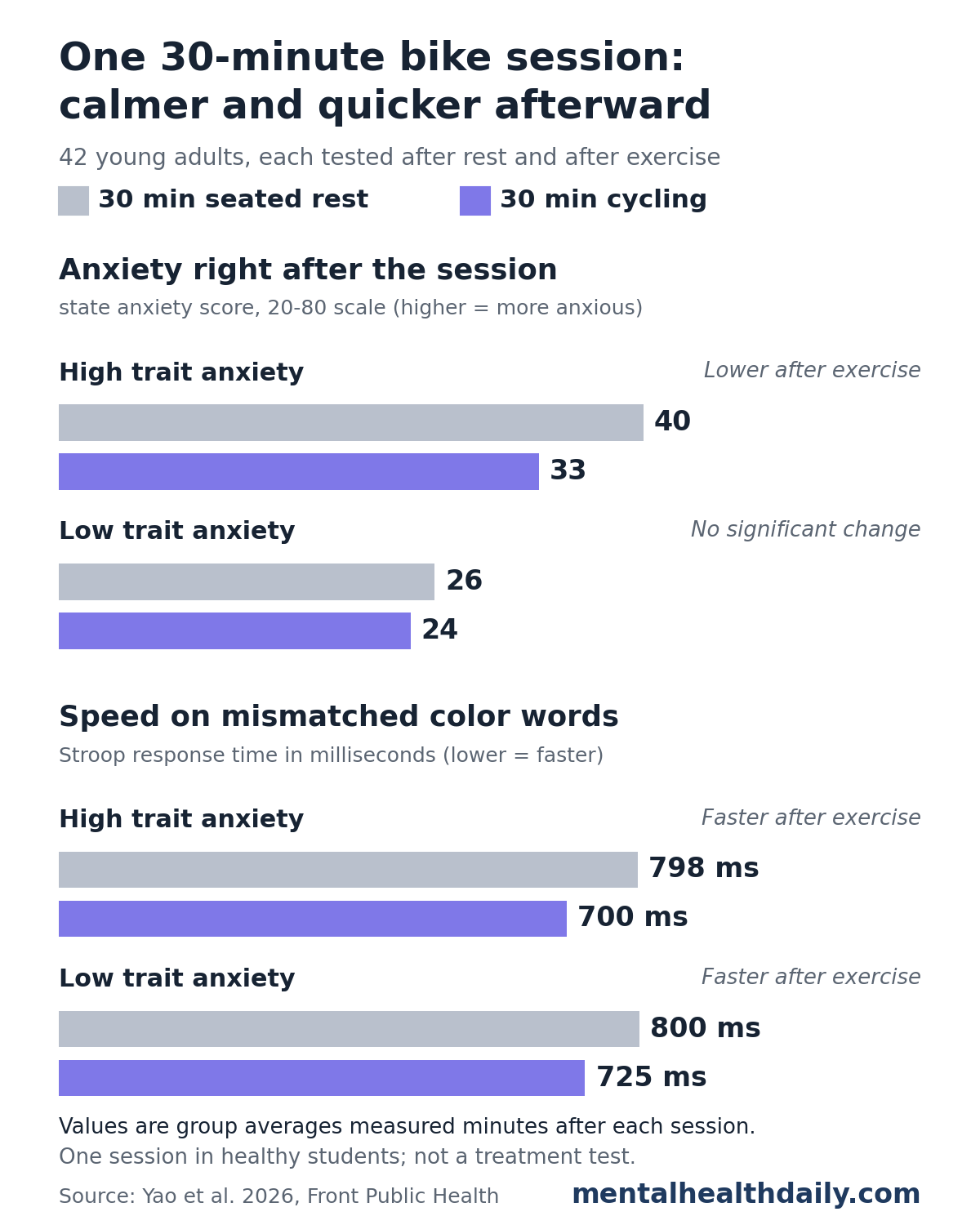
- Lower anxiety in anxiety-prone students: after cycling, students high in trait anxiety scored 33 on a 20–80 anxiety scale vs. 40 after 30 minutes of seated rest (p < 0.001).1
- Little change in calmer students: students low in trait anxiety scored 24 after cycling vs. 26 after rest, a difference that was not statistically significant.1
- Faster and more accurate in both groups: on the Stroop color-word test, responses averaged 664 milliseconds after cycling vs. 747 after rest, and errors were 3.5% after cycling vs. 6.2% after rest.1
- Brain responses shifted after exercise: 2 brainwave signals linked to handling conflicting information changed in both groups.1
- One session in healthy students: no one had a diagnosed anxiety disorder, and effects were measured only minutes after each session.1
How Researchers Tested Trait Anxiety, Exercise and the Stroop Test
Psychologists separate 2 kinds of anxiety. State anxiety is how tense or worried you feel right now. Trait anxiety is a lasting personality tendency to feel anxious across many situations.
High trait anxiety is not a diagnosis. It describes people who worry more easily, measured with a questionnaire.
Anxiety can also crowd out mental resources. Worry competes with inhibitory control, the ability to hold back an automatic response and do what a task actually requires.
The Stroop test measures inhibitory control. A color word appears in colored ink, and the person must name the ink color while ignoring the word.
When the word and ink match (the word "red" in red ink), the task is easy. When they clash (the word "red" in blue ink), people slow down and make more errors.
Li Yao et al. at Chengdu Sport University in China screened 871 students with the trait part of the State-Trait Anxiety Inventory (STAI), a standard anxiety questionnaire.1
From the highest and lowest scorers, they enrolled 42 healthy, right-handed students aged 18–25 (14 women, 28 men):
- High trait anxiety group: 21 students with an average trait score of 54 on a 20–80 scale
- Low trait anxiety group: 21 students with an average trait score of 30
The 2 groups had similar estimated aerobic fitness.
Each student came in on 2 separate days, 2–3 days apart, with the order balanced across students:
- Exercise session: 30 minutes on a stationary bike, including 20 minutes at 60–70% of estimated maximum heart rate
- Rest session: 30 minutes of sitting quietly
Heart rate averaged about 137 beats per minute during cycling, confirming moderate effort.
Right after each session, students rated their current (state) anxiety on the STAI. They then took the Stroop test while wearing a 64-electrode EEG cap that recorded brain activity.
Cycling Lowered Anxiety Only in the High Trait Anxiety Group
In the high trait anxiety group, state anxiety averaged 33.1 after cycling vs. 40.3 after seated rest, a significant drop.1
In the low trait anxiety group, scores were 24.2 after cycling vs. 25.9 after rest (p = 0.10), so there was no significant difference.
Researchers suggested that the calmer students felt so little anxiety after rest that their scores had little room to drop.
They noted that other explanations, such as group differences in emotion regulation or stress responses, could not be ruled out.
Cycling did not erase the difference between the groups. Even after cycling, the high trait anxiety group scored higher on state anxiety (33.1) than the low trait anxiety group did after rest (25.9).
Both Groups Got Faster and More Accurate on the Stroop Test
Cycling improved Stroop performance in both groups, on matching and clashing trials alike:1
- Response time, all students: 664 ms after cycling vs. 747 ms after rest, about 11% faster
- Error rate, all students: 3.5% after cycling vs. 6.2% after rest
- Clashing trials, high trait anxiety group: 700 ms vs. 798 ms
- Clashing trials, low trait anxiety group: 725 ms vs. 800 ms
The speed and accuracy gains did not differ significantly between the high and low trait anxiety groups.
A detail the study’s abstract plays down: cycling sped up matching and clashing trials by about the same amount.
So the extra time students needed on clashing trials, the classic Stroop cost, did not shrink after cycling.
The extra errors on clashing trials did shrink slightly: clashing trials added 2.7 percentage points to the error rate after rest vs. 1.7 points after cycling.
So cycling mostly made students faster and more accurate on every kind of trial, with a small added accuracy benefit on the hardest trials.
What the Brainwave (ERP) Recordings Showed After Cycling
Researchers analyzed event-related potentials (ERPs): tiny voltage changes in the EEG that are time-locked to an event, such as a word appearing on screen.
Averaging many trials reveals how the brain responds millisecond by millisecond. Researchers focused on 2 signals linked to conflict in the Stroop test:
- N400: a negative dip about 350–450 ms after the word, thought to reflect detecting a conflict. It was more negative on clashing trials, as expected.
- Sustained positive potential (SP): a later positive wave about 600–800 ms after the word, thought to reflect resolving the conflict and adjusting the response
After cycling, the N400 was less negative than after rest. At a front-midline electrode (Fz), it averaged 3.85 microvolts after cycling vs. 2.63 after rest.1
The SP grew after cycling, mainly on clashing trials.
At a central electrode (Cz), the SP on clashing trials exceeded the SP on matching trials by 0.94 microvolts after cycling, vs. −0.09 after rest.
Neither brain signal differed significantly between the high and low trait anxiety groups, and the exercise-related shifts were similar in both.
Researchers cautioned that these shifts are brain correlates of changed conflict processing. They do not prove that exercise made the brain's conflict monitoring more efficient.
Limitations of This Single-Session Exercise Study
- One short session: effects were measured within minutes of one 30-minute ride, with no follow-up on how long they lasted
- No before-session anxiety score: state anxiety was measured only after each session, so researchers compared cycling with rest rather than tracking change within a session
- Expectations: students knew whether they had cycled or rested. Researchers explained the purpose only afterward, but expectations may still have played a role.
- Order balanced, not described as randomized: about half the students did each session first
- Narrow sample: 42 students at a sports university, mostly men, aged 18–25, with no reported mental disorders
- Neutral test: the Stroop words were plain color names, which may miss anxiety-related attention to threatening information
- EEG data loss: more brainwave trials were discarded as noisy after cycling. In the low trait anxiety group, 33% were dropped after cycling vs. 14% after rest, which makes the after-cycling brain averages less precise.
- No stress biology: cortisol and heart rate variability were not measured
What This Means for People With High Trait Anxiety
The results fit earlier research. A randomized crossover study found that 20 minutes of moderate aerobic exercise improved inhibitory control in both high- and low-anxious college-aged adults, compared with sitting and watching a neutral video.2
An individual participant data meta-analysis, which pooled raw data from many acute exercise studies, found general benefits of a single aerobic bout for cognitive performance. The benefits were larger in people who performed worse at the start.3
For anxiety, a randomized study of young adults found that the anxiety relief after each workout grew over 9 weeks of training in people with high starting anxiety, but not in those with low anxiety.4
Together, these studies suggest that a single moderate workout can bring short-term calm to people who worry easily, plus a brief boost in speed and accuracy on attention tests for young adults across anxiety levels.
Yao’s study tested one session in healthy students. It does not show that a single workout treats an anxiety disorder, and it did not test regular exercise. Anyone with persistent or disabling anxiety should talk with a doctor or mental health professional.
Bottom line: in 42 young adults, 30 minutes of moderate cycling lowered anxiety right afterward in those high in trait anxiety and made both anxiety-prone and calmer students faster and more accurate on the Stroop test.
References
- Yao L, Huang S, Bai J, Zhu Z. The effect of acute aerobic exercise on inhibitory control in young adults with trait anxiety: an ERP study. Frontiers in Public Health. 2026;14:1944238. doi:10.3389/fpubh.2026.1944238
- Pontifex MB, Parks AC, Delli Paoli AG, Schroder HS, Moser JS. The effect of acute exercise for reducing cognitive alterations associated with individuals high in anxiety. International Journal of Psychophysiology. 2021;167:47–56. doi:10.1016/j.ijpsycho.2021.06.008
- Ishihara T, Drollette ES, Ludyga S, Hillman CH, Kamijo K. The effects of acute aerobic exercise on executive function: a systematic review and meta-analysis of individual participant data. Neuroscience & Biobehavioral Reviews. 2021;128:258–269. doi:10.1016/j.neubiorev.2021.06.026
- Lucibello KM, Parker J, Heisz JJ. Examining a training effect on the state anxiety response to an acute bout of exercise in low and high anxious individuals. Journal of Affective Disorders. 2019;247:29–35. doi:10.1016/j.jad.2018.12.063