
A 4-week course of generic ketamine injected under the skin helped about 30% of people with highly treatment-resistant depression, but much of that benefit faded within a month of stopping: 17% still met the bar for response 4 weeks later, and 11% at 6 months.1 People who had responded to ketamine before usually responded again. Some participants had blood pressure rises or new urinary symptoms during follow-up.
Research Highlights
- Short-term response in a minority: 30% of 116 people had their depression scores cut at least in half by the end of 8 twice-weekly injections, and 18% reached remission.1
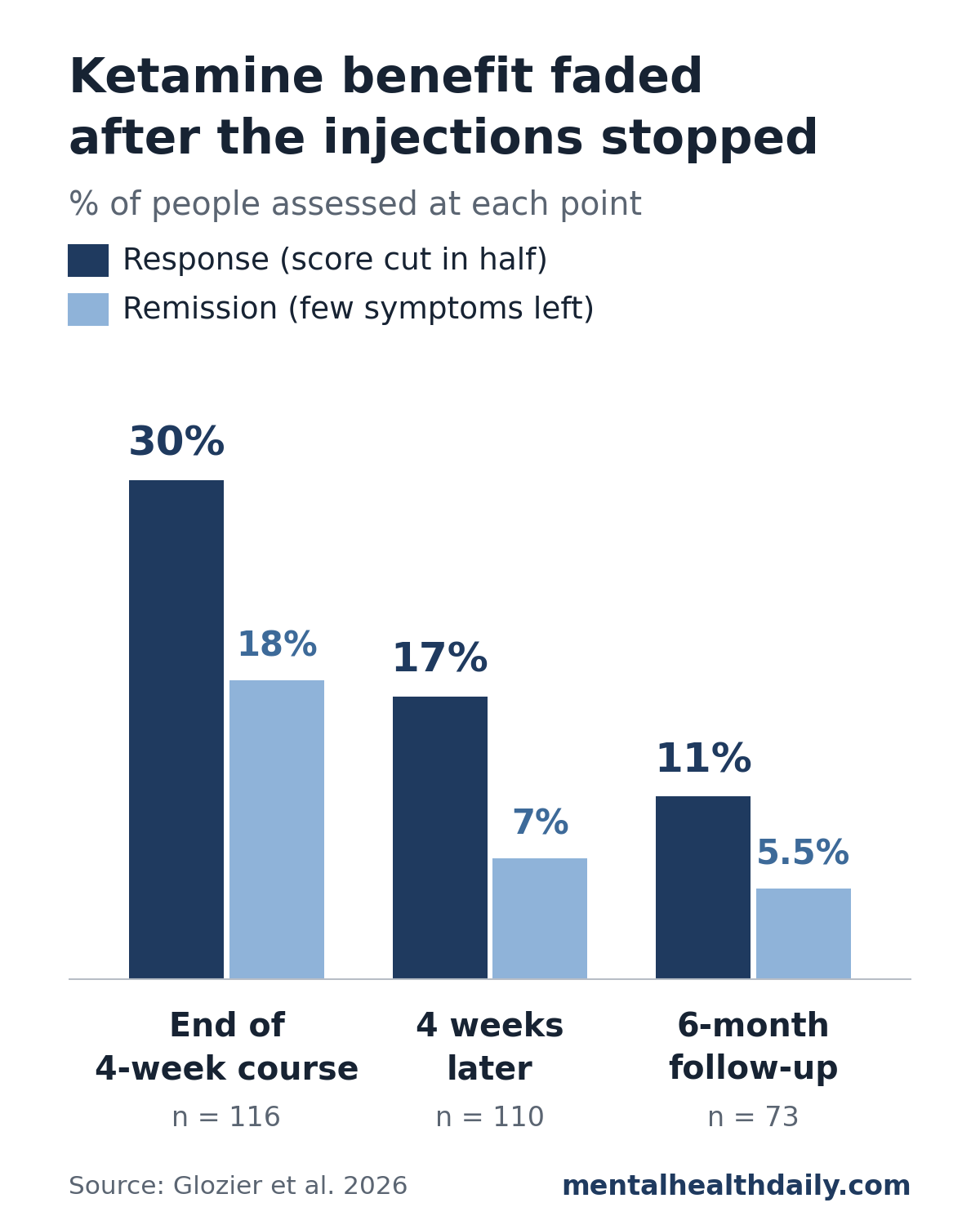
- Benefit faded after the last dose: Response fell to 17% at 4 weeks and 11% at 6 months, and remission to 7% and 5.5%.1
- A second course usually worked for prior responders: 9 of 11 people who had responded to ketamine in the original trial, then relapsed, responded again.1
- Earlier ketamine did not blunt a new course: Prior exposure dampened only the first retreatment dose, by 3.2 points on a 60-point scale, with no difference afterward.1
- No unexpected harms over 6 months: About 12% had a clinically relevant blood pressure rise, 11% a new urinary symptom, and no one was admitted for suicidal behavior or self-harm.1
Racemic ketamine is the cheap, off-patent anesthetic that has been used for decades. It differs from esketamine (Spravato), the patented nasal spray built from one of ketamine's 2 mirror-image forms. Most research on racemic ketamine for depression has used intravenous (IV) infusions, which typically run about 40 minutes through a drip.6
Subcutaneous injection — a quick shot into the fat of the belly — is quicker and easier to give.1 The Australian and New Zealand KADS program was built to test whether that route works, and this 6-month extension asks the question patients and prescribers face next: what happens after the course ends?
How the KADS Ketamine Extension Worked
The original KADS trial randomized adults with treatment-resistant depression to twice-weekly subcutaneous ketamine or midazolam, a sedative used as an "active placebo" because it causes noticeable effects without treating depression. Four weeks after that trial ended, anyone still at least moderately depressed could enter a 4-week open-label course of ketamine.1
- Who entered: 130 of 151 trial participants (86%) who still scored 20 or higher on the MADRS, a clinician-rated depression scale from 0 to 60.
- How resistant: on average 3 to 4 failed antidepressants in the current episode and 5 to 6 over a lifetime; 16–28% had also failed ECT this episode.
- Dosing: 32 people got a fixed 0.5 mg/kg per injection. The other 98 started at 0.5 mg/kg and stepped up to 0.6, 0.75, then 0.9 mg/kg if they had not improved by half.
- Setting: injections at a specialist clinic, observation for 2 to 4 hours afterward, and no driving that day.
- Follow-up: MADRS before every dose, at the end of the course, 4 weeks later, and at a 6-month follow-up.
Two facts make this sample harder to treat than most. Anyone who had improved and stayed improved after the original trial was not eligible, so the extension selected for people whose depression had resisted or quickly returned. And 34% reported active suicidal thoughts at entry.1
Everyone knew they were getting ketamine, and there was no comparison group, so the extension's numbers alone cannot separate the drug's effect from expectation or natural recovery.
30% Responded to Subcutaneous Ketamine; 11% Still Responding at 6 Months
Response here means a MADRS drop of at least 50%. Remission means a score of 10 or lower, roughly the range of minimal symptoms. Glozier et al. reported both:1
- End of the 4-week course: 30% responded (35 of 116), 18% remitted.
- 4 weeks later: 17% responded (19 of 110), 7% remitted.
- 6 months: 11% responded (8 of 73), 5.5% remitted.
Average scores followed the same pattern. Mean MADRS fell from 28.8 to 20.3 over the course, an 8.6-point drop, with the biggest single improvement after the first injection. It then drifted back up to 23.0 at 4 weeks and 24.8 at 6 months — still below where people started, but more than half the gain had eroded.1
The flip side matters just as much. More than half of participants were nonresponders at every assessment, meaning their scores fell by less than 25%. By 6 months that was 79% of those assessed.1
Clinicians' global ratings were somewhat kinder than the symptom scale. At the end of treatment, 45% of patients were rated "much" or "very much" improved, falling to 32% at 4 weeks and 17% at 6 months. The researchers suggested clinicians may also weigh daily function and relationships alongside symptom counts.1
Parent RCT Showed the Same Fade Under Blinded Control
The extension had no control group, but the original KADS trial did. In its flexible-dose cohort, 19.6% remitted on ketamine vs. 2.0% on midazolam at the end of 4 weeks. Four weeks after the last injection, remission was down to 8.0% vs. 2.1%, and the difference was no longer statistically significant.2
The fixed 0.5 mg/kg cohort did not beat midazolam even at the end of treatment (6.3% vs. 8.8% remission). Partway through the trial, the safety board had recommended switching to the stepped-up flexible dosing.2
So the extension's 18% remission after a course closely matched the trial's flexible-dose arm, and the rapid fade after stopping matched too. An open-label result lining up with a blinded one is some reassurance that the extension numbers are not mostly expectation.
The fade is not unique to injections. In an earlier open-label IV series, 24 people with treatment-resistant depression received up to 6 infusions over 12 days. About 71% responded, but among responders, the median time to relapse after the last infusion was just 18 days.3
Why 30% Looks Low Next to Other Ketamine Trials
Other outpatient ketamine studies have often reported response rates around 50%.1 In ELEKT-D, 403 patients referred for ECT were randomized to IV ketamine or ECT, and 55.4% responded to 3 weeks of ketamine vs. 41.2% to ECT.6
Several differences make that comparison lopsided:
- Enriched resistance: the KADS extension excluded people who had improved and stayed well after the first trial.
- Different yardstick: ELEKT-D measured response with a patient self-report scale; KADS used the clinician-rated MADRS.
- Very low placebo response: only 5.6% (5 of 88) responded to midazolam in the parent KADS trial, vs. about 21% in other treatment-resistant depression trials, suggesting this population was unusually hard to shift.1
- Dose ceiling: the maximum was 0.9 mg/kg, and the researchers raised the possibility that higher doses or longer courses might be needed.
For someone who has already failed many treatments, 30% short-term response is a realistic expectation from this protocol, not a failure of the drug.
Does a Second Ketamine Course Work?
This is the question the extension was uniquely placed to answer, because some participants had received ketamine in the original trial and some had received midazolam — and when they entered the extension, neither they nor staff knew which.
Prior ketamine did not make a second course less effective overall. People who had received ketamine in the trial improved 3.2 MADRS points less after their first extension dose than those who had received midazolam. At every later time point, the 2 groups tracked together.1 The researchers found no sign that earlier exposure built tolerance or, conversely, primed a stronger response.
Prior response was the stronger signal:1
- Prior responders who relapsed: 9 of 11 (82%) responded again.
- Prior ketamine nonresponders: 11 of 44 (25%) responded on the second try.
- Prior midazolam nonresponders: 13 of 58 (22%) responded when they finally got ketamine.
In practice, someone who responded once and then relapsed has good odds with a repeat course. A first nonresponse does not rule out a later one, since about 1 in 4 responded the second time. The authors could not tell whether that reflects a cumulative effect, the stress of blinded treatment, or life events.
These analyses were exploratory, and the 82% figure rests on 11 people. Treat it as encouraging rather than settled.
Keeping the Benefit Probably Requires Continued Dosing
If a 4-week course fades, the obvious next question is whether ongoing doses hold the gains. The KADS extension did not test that for subcutaneous ketamine, so the evidence comes from other forms of ketamine:
- Esketamine, randomized withdrawal: in SUSTAIN-1, people in stable remission after 16 weeks of esketamine plus an oral antidepressant were randomized to keep taking it or switch to placebo spray. Relapse was 26.7% on esketamine vs. 45.3% after switching, a 51% lower risk (HR 0.49). Among stable responders, relapse was 25.8% vs. 57.6%.5
- IV ketamine, weekly maintenance: in a trial of 41 patients by Phillips et al., 59% responded after 6 open-label infusions over 2 weeks, needing a median of 3 infusions to get there. Responders' scores did not change during 4 further weekly infusions.4
Both point the same way: the benefit is maintained while dosing continues and tends to decay when it stops. Neither directly tests the subcutaneous racemic protocol, and the Phillips maintenance phase was short and uncontrolled. How often, how long, and at what dose to continue subcutaneous ketamine remain open questions the KADS authors list themselves.1
Dissociation, Blood Pressure, Bladder, and Suicidality Over 6 Months
Safety was the part of the report with the fewest surprises:1
- Suicidality: no deaths and no suicidal behavior or self-harm requiring hospital admission, despite 34% having active suicidal thoughts at entry. Of 3 serious adverse events, all were judged unlikely to be ketamine-related; one was a voluntary admission for depression 87 days after the last dose.
- Dissociation: feelings of detachment rose briefly during each session, as expected. Higher doses in the flexible regimen caused more dissociation, the only side effect that remained significantly different after correcting for multiple comparisons.
- Blood pressure: clinically relevant rises occurred in 12.9% of the fixed-dose group and 11.3% of the flexible-dose group. No one needed medication to bring it down.
- Bladder: 11% reported at least one new urinary symptom, but no one scored in the clinically significant range on a validated bladder-pain questionnaire after the course.
- Craving and misuse: 4 people reported mild craving once, all in the first 2 weeks. One person reported 3 episodes of recreational ketamine-plus-drug use with friends in the 2 months after treatment, then none.
- Dropouts for side effects: 1 person withdrew because of acute effects; 3 were withdrawn for lack of improvement or worsening.
These results apply to 8 supervised injections with 2 to 4 hours of monitoring, and 130 people followed for 6 months cannot rule out rarer or slower harms from open-ended maintenance.
Limits of an Open-Label Extension
- No control arm: without a comparison group, expectation, natural fluctuation, and regression toward the average can all contribute to improvement.
- Follow-up thinned: 90% were assessed at the end of the course, 85% at 4 weeks, and 56% at 6 months. Responders were less likely to return at 6 months (53% vs. 68%), so late response may be underestimated.
- Regimens were not randomized: the fixed-dose group enrolled first and was more depressed at entry. The 2 regimens showed no consistent difference, but the comparison is weak.
- Small subgroups: the prior-response findings rest on groups of 11 to 58 people.
- Trial volunteers: everyone had agreed to randomization first, which may make them different from typical clinic patients.
- Minor reporting mismatch: the abstract lists 36 responders at the end of treatment while the results table lists 35; both round to 30%.
Questions About Repeat Subcutaneous Ketamine
How long does subcutaneous ketamine last for depression after a course ends?
For most people, weeks rather than months. Response fell from 30% to 17% within 4 weeks of the last injection, and to 11% by 6 months.1 In an IV series, responders relapsed a median of 18 days after the last infusion.3
If ketamine worked for me before, will it work again?
Probably. In this study, 9 of 11 prior responders who relapsed responded to a second course. The group was small, but prior response was the most useful predictor the study found.1
Does having had ketamine before make it stop working?
Not in this study. Prior exposure slightly reduced the benefit of the first retreatment dose only, with no difference by the end of the course or afterward.1
Is subcutaneous ketamine as good as IV ketamine or esketamine?
No trial has compared them head-to-head. Subcutaneous ketamine beat midazolam at adequate doses in the KADS trial (19.6% vs. 2.0% remission), but differences in patients and rating scales make cross-trial comparisons with IV studies unreliable.2 The strongest randomized evidence that continued dosing prevents relapse comes from esketamine.5
Can ketamine injections damage the bladder?
Over 8 supervised doses, 11% reported a new urinary symptom, but none reached a clinically significant score.1 The study did not test long-term maintenance, where cumulative exposure is higher.
Did subcutaneous ketamine increase suicide risk?
No suicide or self-harm requiring admission was reported during treatment or up to 6 months later, in a group where 34% had active suicidal thoughts at entry. The study was too small and uncontrolled to measure a protective effect.1
References
- Effectiveness and safety of repeat dose subcutaneous ketamine for treatment-resistant depression, and the impact of prior ketamine treatment: open label extension of the KADS study. Glozier N, et al. Br J Psychiatry. 2026 (published online; accepted May 9, 2026):1-7. doi:10.1192/bjp.2026.10692
- Efficacy and safety of a 4-week course of repeated subcutaneous ketamine injections for treatment-resistant depression (KADS study): randomised double-blind active-controlled trial. Loo C, et al. Br J Psychiatry. 2023;223(6):533-541. doi:10.1192/bjp.2023.79
- Rapid and longer-term antidepressant effects of repeated ketamine infusions in treatment-resistant major depression. Murrough JW, et al. Biol Psychiatry. 2013;74(4):250-256. doi:10.1016/j.biopsych.2012.06.022
- Single, Repeated, and Maintenance Ketamine Infusions for Treatment-Resistant Depression: A Randomized Controlled Trial. Phillips JL, et al. Am J Psychiatry. 2019;176(5):401-409. doi:10.1176/appi.ajp.2018.18070834
- Efficacy of Esketamine Nasal Spray Plus Oral Antidepressant Treatment for Relapse Prevention in Patients With Treatment-Resistant Depression: A Randomized Clinical Trial. Daly EJ, et al. JAMA Psychiatry. 2019;76(9):893-903. doi:10.1001/jamapsychiatry.2019.1189
- Ketamine versus ECT for Nonpsychotic Treatment-Resistant Major Depression. Anand A, et al. N Engl J Med. 2023;388(25):2315-2325. doi:10.1056/NEJMoa2302399