
A 2026 case report from New York described a 40-year-old man who developed low mood, loss of pleasure, and apathy within days of switching from olanzapine to the combination pill olanzapine–samidorphan (Lybalvi), then recovered within 1 to 2 days of switching back; he stayed symptom-free for more than 6 months.1 A standard adverse-reaction checklist scored the episode as a “probable” drug reaction. It is one person with no control condition, so it cannot say how often this happens.
Randomized trials of the combination have not flagged depression as a problem.2 Clinicians should watch for mood changes, but one case does not show that the drug commonly causes depression.
Research Highlights
- Fast on, fast off: symptoms began on days 3 to 7 after the switch, peaked on days 8 to 13, and resolved within 1 to 2 days of returning to olanzapine alone.1
- Probable drug reaction: the Naranjo Adverse Drug Reaction Probability Scale score was 6 (the “probable” range), though no depression rating scale was used during the episode.1
- Trials have not flagged mood problems: in a 24-week phase 3 trial, symptom improvement was similar with and without samidorphan, and the combination caused less weight gain (4.21% vs 6.59%).2
- A proposed mechanism: partial activation of kappa-opioid receptors (brain receptors linked to dysphoria) is one possible route, not yet tested in people taking this drug.1
- Practical step: ask about mood after starting or switching to the combination, especially in people with prior mood problems.1
What Happened After the Switch to Olanzapine–Samidorphan
Olanzapine–samidorphan pairs the antipsychotic olanzapine with samidorphan, a drug that blocks mu-opioid receptors (brain receptors involved in reward and appetite) to limit the weight gain and metabolic changes olanzapine often causes. The FDA approved it in 2021 for schizophrenia and bipolar I disorder.1
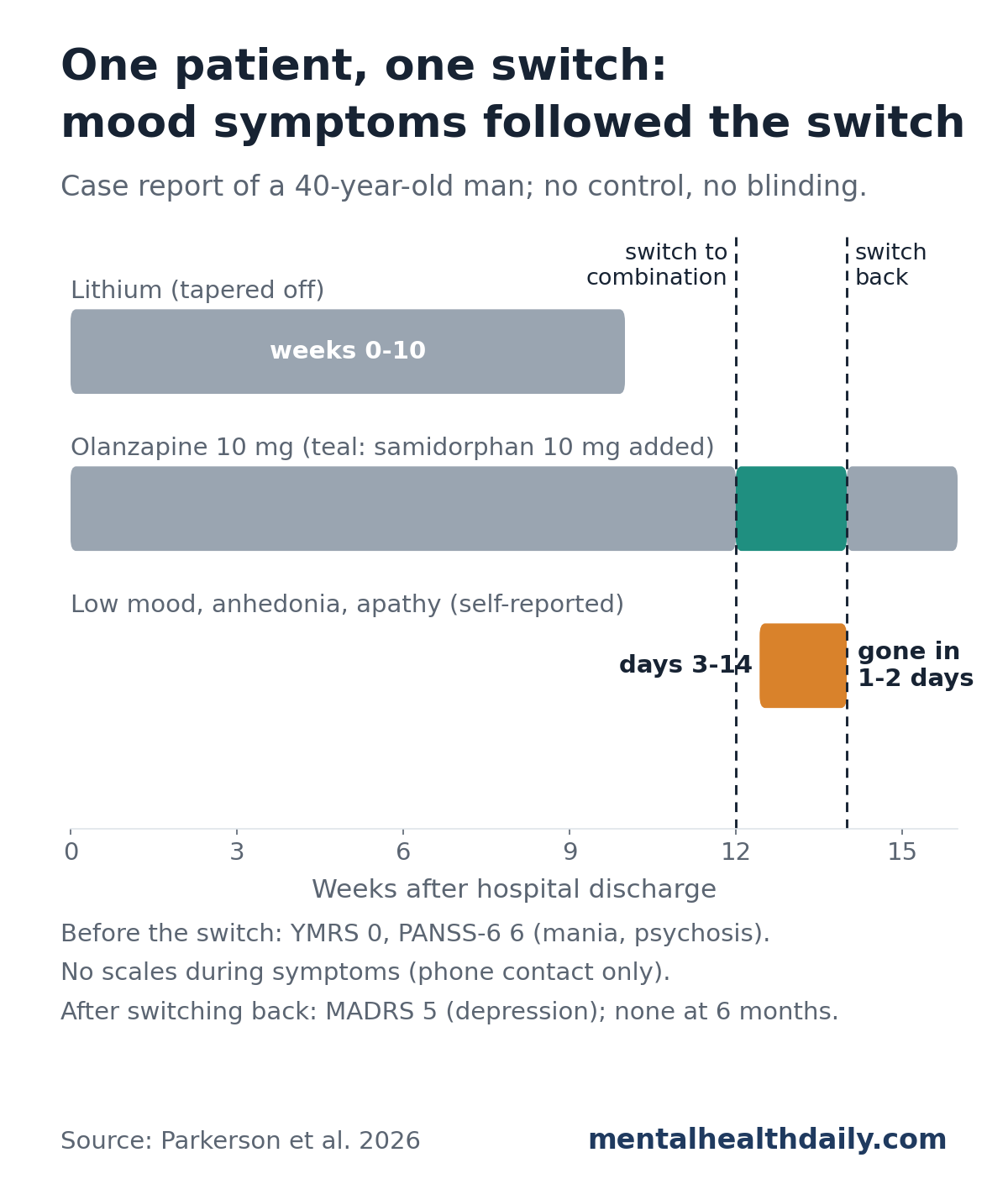
The patient had no earlier psychiatric history. He was admitted involuntarily after 3 days without sleep, grandiose delusions, and disorganized behavior, and was discharged with a diagnosis of brief psychotic disorder on olanzapine 10 mg at bedtime plus lithium. He preferred to stop lithium, which was tapered off over about 2 months. On olanzapine alone he reported only increased appetite and sleep, and his ratings stayed low: a mania scale (Young Mania Rating Scale, YMRS) of 0 and a 6-item psychosis scale (PANSS-6) of 6.1
About 12 weeks after discharge, worried about metabolic effects (his BMI was 30 at baseline), he chose to switch to olanzapine–samidorphan 10 mg/10 mg. The timeline that followed:1
- Days 3 to 7: low mood, marked anhedonia (loss of pleasure), and apathy emerged
- Days 8 to 13: fatigue and amotivation, with reduced energy and impaired concentration; no suicidal thoughts, insomnia, or manic or psychotic symptoms
- Day 14: he called his psychiatrist and asked to go back to olanzapine alone
- 1 to 2 days later: symptoms remitted; a depression scale (MADRS) score was 5, YMRS 0, PANSS-6 6
- Six months on: no recurrence on olanzapine alone
A Single Case Cannot Show That Samidorphan Caused the Low Mood
Evidence-strength note: a case report documents one person’s course. It can suggest a hypothesis and prompt monitoring. It cannot give an incidence, rule out coincidence, or show cause and effect, and the authors say so.1
The strongest features are the tight timing and the prompt reversal after the drug was removed (a dechallenge). The Naranjo scale awards points for each such feature: 2 for the reaction following the drug, 1 for improvement on stopping, 2 for no alternative cause, and 1 for objective confirmation, totaling 6.1 Weaker points:
- No scale ratings at the time. The episode began and ended between visits and was assessed by telephone, so severity rests on his own report.
- No rechallenge. Restarting the drug to see whether symptoms return is rarely ethical, so a single on-off sequence remains the only test.
- Other explanations. A first psychotic or manic episode can be followed by mood swings during recovery, lithium had been stopped only about 2 weeks earlier, and sleep disruption or expectations about side effects could contribute. The authors note that the picture is better described as an acute dysphoric syndrome than a full major depressive episode.
- Expectation effects. He had voiced concern about medication effects and chose the switch himself, which could have produced a nocebo response (symptoms caused by expecting side effects).
The authors argue that rapid onset, equally rapid resolution, and no recurrence make the alternatives unlikely as the only explanation, though one person cannot test that.1
Could Samidorphan’s Kappa-Opioid Activity Explain Dysphoria?
Samidorphan is a close chemical relative of naltrexone. It strongly blocks mu-opioid receptors, but it also partially activates kappa-opioid receptors.1 Kappa activation suppresses dopamine release in reward circuits and, in animal and human work cited by the authors, produces aversion, dysphoria, and anhedonia. On that logic, samidorphan could lower mood in some susceptible people, depending on their baseline opioid signaling.1
This is a proposed mechanism. The authors call it speculative and hypothesis-generating; they did not measure receptors, and olanzapine acts on several other systems (serotonin, histamine, dopamine) that the proposal leaves out.1
Opioid blockade has a mixed record for mood. Early reports linked naltrexone to dysphoria, but a randomized trial in opioid dependence (42 people assigned to naltrexone, 38 continuing methadone) found no worsening of depressive symptoms with naltrexone.3 At the other end, buprenorphine/samidorphan was tested as an antidepressant; a 2023 meta-analysis of 11 studies (1,699 patients) found a small benefit for depressive symptoms (Hedges’ g = 0.17, 95% CI 0.05 to 0.29), driven by 6 buprenorphine/samidorphan trials.4 Samidorphan is paired there with buprenorphine, which has different receptor effects, so that result does not apply directly to olanzapine–samidorphan.
What Phase 3 Trials Found for Olanzapine–Samidorphan
The pivotal 24-week phase 3 trial randomized adults aged 18 to 55 with schizophrenia to the combination or olanzapine alone. Average weight gain was 4.21% with the combination versus 6.59% with olanzapine (difference −2.38%), schizophrenia symptom improvement was similar, and the combination was well tolerated.2 That abstract does not report mood as a separate outcome.
The case report authors add that adverse events reported with the combination have largely matched those of olanzapine alone, altered mood or anxiety appeared only as rare events in the trials, and no formal case of severe depression has been published.1 Trials in schizophrenia also are not built to detect a rare reaction in a small subset, so a handful of individual cases and a quiet trial record can coexist.
Practical Takeaways for Monitoring Mood on Olanzapine–Samidorphan
- Ask about mood early. New low mood, loss of pleasure, or apathy in the first weeks after starting or switching is worth reporting, especially with prior depression or other mood problems.1
- Rate it when it happens. A depression scale during the episode, not afterward, would have made this case far more informative.
- Weigh benefits and risks together. The combination reduced weight gain in a randomized trial; a rare mood reaction calls for monitoring and shared decision-making while keeping that benefit in view.12
- Do not change doses alone. Stopping an antipsychotic abruptly carries its own relapse risk; changes belong with the prescriber.
Pharmacovigilance databases and larger observational studies would show whether this is an isolated event or a pattern, and whether any subgroup carries more risk.
References
- Parkerson JA, Chaia AI, Lynch ST, Sterchele AN. Samidorphan sadness: does the addition of samidorphan to olanzapine have pro-depressive effects? International Clinical Psychopharmacology. 2026;41(4):258–263. doi:10.1097/YIC.0000000000000617
- Correll CU, Newcomer JW, Silverman B, et al. Effects of olanzapine combined with samidorphan on weight gain in schizophrenia: a 24-week phase 3 study. American Journal of Psychiatry. 2020;177:1168–1178. doi:10.1176/appi.ajp.2020.19121279 · PubMed
- Dean AJ, Saunders JB, Jones RT, Young RM, Connor JP, Lawford BR. Does naltrexone treatment lead to depression? Findings from a randomized controlled trial in subjects with opioid dependence. Journal of Psychiatry & Neuroscience. 2006;31(1):38–45. doi:10.1139/jpn.0605 · PubMed
- Riblet NB, Young-Xu Y, Shiner B, Schnurr PP, Watts BV. The efficacy and safety of buprenorphine for the treatment of depression: a systematic review and meta-analysis. Journal of Psychiatric Research. 2023;161:393–401. doi:10.1016/j.jpsychires.2023.03.037 · PubMed