
A 2026 randomized trial of 375 young adults in Chennai, India, found that reading 3 short educational suicide-prevention news articles lowered scores on a suicidal-ideation scale by 2.20 points compared with reading articles about diabetes (95% CI −4.03 to −0.36; standardized mean difference, SMD, 0.15), and the gap was still 2.76 points 14 days later.1 The effect is small for any one reader. The authors argue that small shifts across a huge readership could add up, though the trial did not test that.
Versions of the articles that added brief survivor stories did not clearly do better than the educational articles alone.
Research Highlights
- Small, measurable drop: educational articles lowered ideation scores by 2.20 points right after reading (SMD 0.15, p = 0.019) and 2.76 points at 14 days (SMD 0.17, p = 0.038).1
- Bigger in more vulnerable readers, post hoc: among people with above-median baseline scores, the drop reached SMD 0.25 right after reading and SMD 0.32 at 14 days.1
- Survivor stories added no clear benefit: the version with stories showed no significant effect right after reading (SMD 0.05) and a borderline one at 14 days (SMD 0.16, p = 0.053).1
- Knowledge rose the most: suicide-prevention knowledge improved by SMD 0.36 to 0.52 in both versions, and stigma fell modestly.1
- Fits earlier trials: a pooled analysis of trials from Austria and Australia found a similar small effect of recovery stories (SMD −0.22).2
What 375 Young Adults in Chennai Read, and What Changed
News coverage of suicide can push in 2 directions. Reporting that highlights a celebrity’s death, and especially the method, has been followed by more suicides; a meta-analysis found a 13% higher suicide rate after celebrity suicide reports (rate ratio 1.13, 95% CI 1.08 to 1.18) and a 30% rise in deaths by the same method when it was reported (rate ratio 1.30).3 This is the Werther effect. The reverse, the Papageno effect, is the idea that stories of coping with and surviving a suicidal crisis can protect readers by modeling help-seeking and showing that a crisis can pass.2
Until this trial, every experiment on protective content had been done in Austria or Australia. India has among the highest suicide rates in the world, roughly 18 to 21 deaths per 100,000 people per year, and youth aged 15 to 29 die at about twice the national rate. Attempting suicide was a crime there until 2017, and the trial team notes that routine coverage tends to be brief and explicit, while hopeful stories of survival are almost nonexistent.1
The trial design:
- Who: 375 adults aged 18 to 29 in Chennai, recruited through Facebook ads and snowball sampling (65% male, 70% students, 86% with some higher education)
- Arms: 125 controls, 124 in intervention group 1, 126 in intervention group 2, randomized 1:1:1; participants, research assistants, and the analyst were blinded
- Exposure: 3 Tamil-language articles of about 600 words each, read on a tablet in a single session
- Group 1 (educational): coverage of India’s national suicide prevention strategy, real prevention programs, myth-busting, expert commentary, encouragement to seek help, and messages that people can get through a crisis with support
- Group 2 (educational plus stories): the same articles, each with one roughly 250-word account of a young adult who coped with suicidal thoughts (based on real experiences, with fictional identities), which cut the space for expert commentary
- Control: 3 articles about diabetes
- Follow-up: measurements at baseline, right after reading, and 14 days later; 16 participants (4.3%) were lost by day 14
The primary outcome was the Survival and Coping Beliefs subscale of the Reasons for Living Scale, scored so that higher numbers mean more suicidal ideation. Participants rate how important each of 23 reasons for not dying by suicide is to them (for example, “I believe I can learn to cope with my problems”), so the scale uses weaker coping beliefs as a proxy for ideation and does not count suicidal thoughts directly. About 12% of participants (46) reported seriously thinking of killing themselves in the past 12 months.
Educational Articles Lowered Ideation Scores by 2.2 to 2.8 Points
Control-group scores averaged 41.7 at baseline and 39.9 right after reading, with a standard deviation of about 16 points. Adjusted for age and baseline score, group 1 scored lower than controls:1
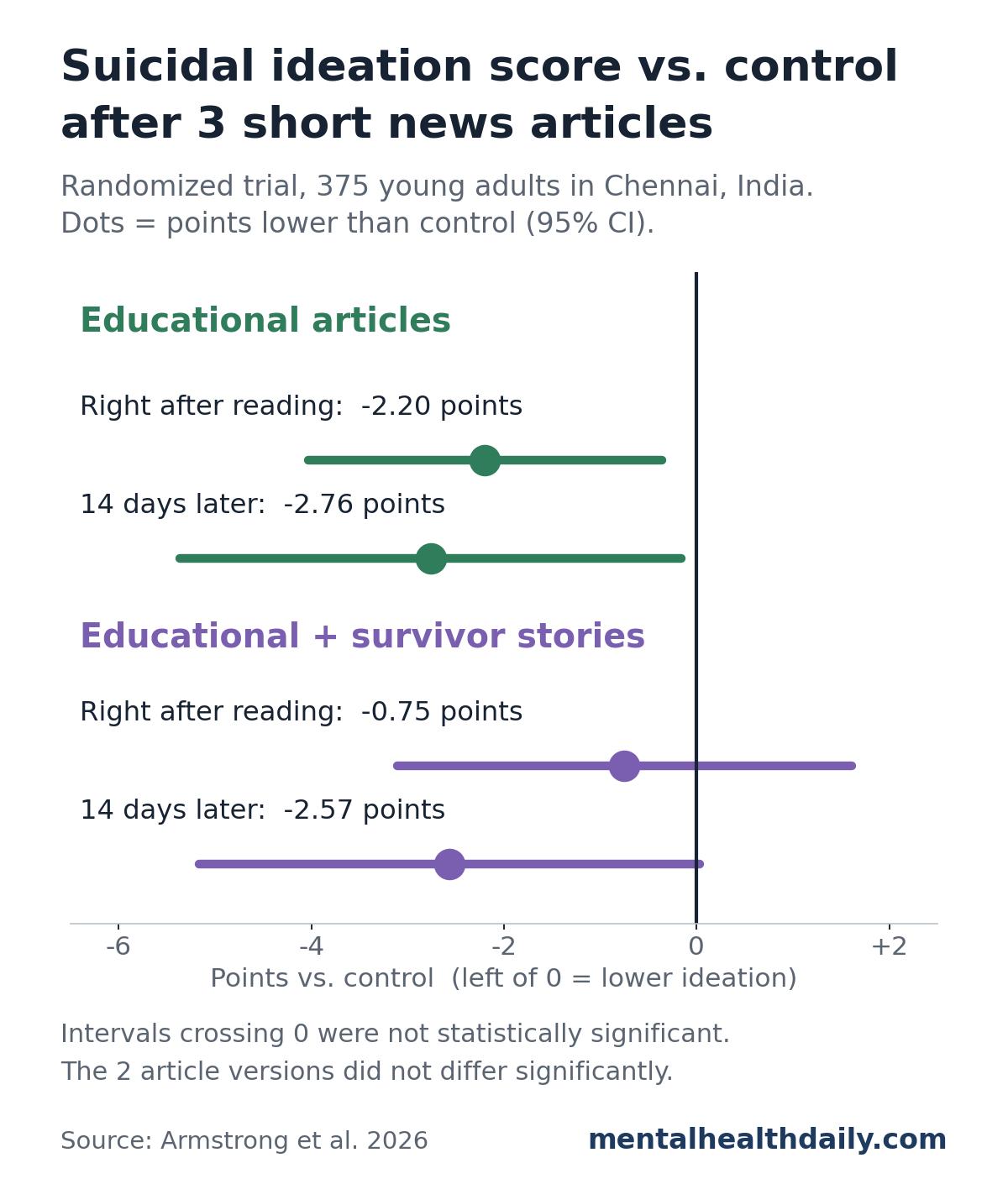
- Right after reading: 2.20 points lower (95% CI −4.03 to −0.36; SMD 0.15, p = 0.019)
- 14 days later: 2.76 points lower (95% CI −5.37 to −0.16; SMD 0.17, p = 0.038)
- Above-median baseline ideation (post hoc): 3.68 points lower right after reading (SMD 0.25, p = 0.039) and 5.63 points lower at 14 days (SMD 0.32, p = 0.023)
An SMD expresses the gap in standard-deviation units; 0.2 is conventionally called small and 0.5 medium. The trial’s effects are small.
Adding Survivor Stories Did Not Clearly Help
Earlier Papageno research suggested that hopeful survival stories would add protection. In this trial, group 2 showed no significant change right after reading (0.75 points lower, 95% CI −3.11 to 1.61; SMD 0.05, p = 0.534). At 14 days the difference was 2.57 points (95% CI −5.17 to 0.03; SMD 0.16, p = 0.053), close to group 1’s size but short of significance. Among the above-median subgroup, the delayed effect was significant (5.23 points, SMD 0.32, p = 0.024). The 2 intervention groups did not differ significantly from each other at either time point.1
The researchers offer 3 explanations, none of them tested:
- Too small a dose. Most earlier tests used a full recovery story; here a 250-word vignette sat inside an article whose expert commentary had been trimmed to keep length equal.
- Delayed processing. Hopeful survival narratives are nearly absent from Indian media, so readers may have needed time to absorb them.
- Cultural fit. The vignettes may not reflect the help-seeking paths that feel realistic to every young adult in this setting.
The authors do not take the result as evidence against the Papageno effect in India. A pooled analysis of 6 earlier trials (633 participants with some vulnerability) found a small reduction with hope-and-recovery stories, SMD −0.22 (95% CI −0.39 to −0.04), with low heterogeneity.2 That is close to the 0.15 to 0.17 seen here for the educational version, so both kinds of content appear to have similarly small effects.
Knowledge and Stigma Shifted; Intended Help-Seeking Did Not Last
Secondary outcomes improved:1
- Suicide prevention knowledge: moderate gains in both groups that held at 14 days (SMD 0.52 and 0.50 for group 1; 0.36 and 0.44 for group 2; all p < 0.001)
- Stigma: small reductions in both groups at both time points (SMD 0.16 to 0.26)
- Intended help-seeking: group 1 rose at post-test (SMD 0.16, p = 0.011) but the gain was gone at 14 days (SMD 0.02); group 2 showed none (SMD 0.03)
Stigma shifts of this kind have been hard to produce with brief media in countries that already run suicide-prevention campaigns; the authors suggest that low prior exposure in India may have left more room to change.1 The trial measured intentions only, not whether anyone sought help.
What a 14-Day, Self-Report Trial in a Convenience Sample Can and Cannot Show
What it supports: in a randomized, blinded comparison, brief educational content lowered a self-reported ideation score for at least 2 weeks without any sign of harm on that measure, and improved knowledge of suicide prevention. It is the first experiment of its kind in South Asia.
What it cannot support:
- Clinical meaning. A difference of 2 to 3 points on a scale with a standard deviation near 16 is small for an individual. Ideation was measured by questionnaire, without clinical evaluation.
- Suicide deaths or attempts. No behavior was measured, and effects on ideation scores have not been shown to change suicide rates.
- The vulnerable-reader result. The subgroup above the median was a post hoc analysis, and people selected for high baseline scores tend to score lower on retest regardless of treatment; control scores also drifted down slightly (41.7 to 39.9).
- Generalizability. The sample was educated, student-heavy, and recruited online, in a city, and the exposure was 3 articles in one supervised session with paid follow-up. Real newspaper readers meet articles at random, in different moods, amid very different headlines. The paper does not describe adjusting for testing several outcomes at once.
- The population-level claim. The authors point to about 400 million newspaper copies circulated daily in India and propose that routine educational content could shift risk across many readers. The trial supports the small individual effect; the population payoff is a projection.
Practical Takeaways for Media and Public Health Teams
- Educational content is low-risk and modestly helpful. Articles covering prevention programs, myths, expert input, and where to get support lowered ideation scores and raised knowledge; no group showed worse scores than controls.
- Survivor stories need more than a sidebar. Whether a longer or better-tailored recovery narrative adds protection in India is still open.
- Reporting choices still carry risk. The protective findings sit alongside strong evidence that method detail and celebrity coverage are followed by more deaths, so the guidance to avoid method description stays in place.3
- If you or someone you know is in crisis, contact local emergency services or a crisis line. In the United States, call or text 988.
References
- Armstrong G, Mohanraj R, Kumar S, Haregu T, Spittal MJ, Niederkrotenthaler T, Pirkis J, Nisha B, Selvan D, Vijayakumar L. Reducing suicidal ideation through protective media content in India: randomized controlled trial. British Journal of Psychiatry. 2026. doi:10.1192/bjp.2026.10799
- Niederkrotenthaler T, Till B, Kirchner S, et al. Effects of media stories of hope and recovery on suicidal ideation and help-seeking attitudes and intentions: systematic review and meta-analysis. The Lancet Public Health. 2022;7:e156–e168. doi:10.1016/S2468-2667(21)00274-7
- Niederkrotenthaler T, Braun M, Pirkis J, et al. Association between suicide reporting in the media and suicide: systematic review and meta-analysis. BMJ. 2020;368:m575. doi:10.1136/bmj.m575