
A 2026 systematic review of 14 studies found that long-read sequencing picked up large DNA rearrangements, new mutations, and full-length gene transcripts that standard short-read sequencing misses in autism, schizophrenia, bipolar disorder, and other psychiatric conditions.1 Most of the studies were small and exploratory.
Research Highlights
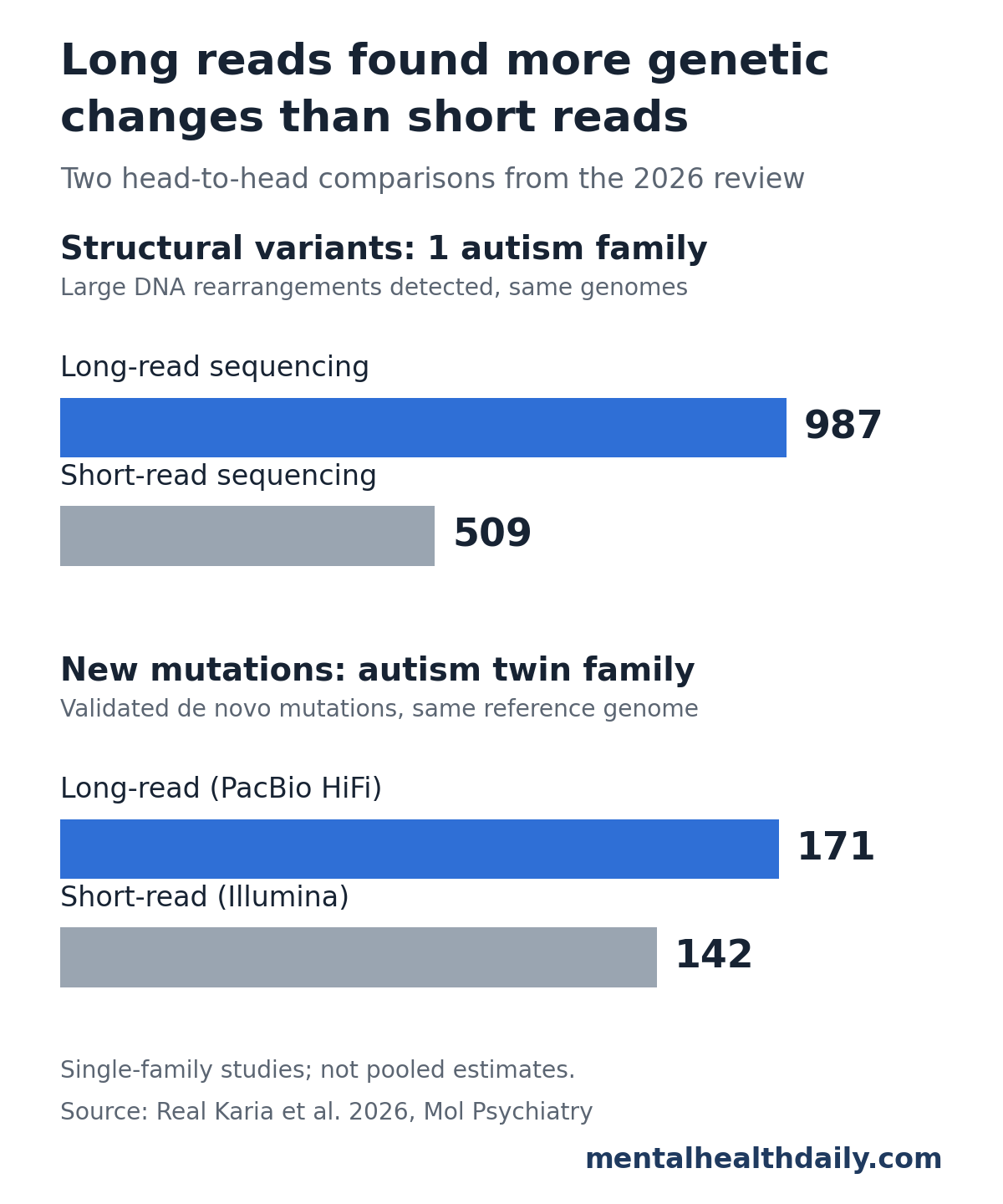
- Nearly twice as many structural variants: in one family with 3 autistic children, long-read sequencing found 987 structural variants vs 509 with short reads on the same genomes.2
- About 20% more new mutations: in an autism twin family, long reads found 171 validated de novo mutations vs 142 with short reads.3
- Full-length transcripts: a long-read map of the developing human cortex found 214,516 distinct gene transcripts, 72.6% of them never cataloged before.4
- Methylation results were weak: only 2 studies used long reads to measure DNA methylation, and neither found a difference between patients and controls.1
- A research tool for now: the review screened 2,166 unique records, and the 14 studies it kept were mostly single families or small cohorts. None measured whether long-read results changed patients’ diagnosis or care.1
How Long-Read Sequencing Differs From Short-Read Sequencing
Most genetic research on mental illness uses short-read sequencing, which chops DNA into millions of small pieces, reads each one, and then reassembles them by matching them to a reference genome. Short-read platforms such as Illumina typically read up to 600 DNA letters (bases) at a time.1
Think of it as shredding a book into scraps of a few words and rebuilding it by comparing the scraps to another copy. That works well for single-letter typos. It struggles when a whole paragraph has been deleted, flipped, copied twice, or sits in a stretch of text that repeats the same phrase over and over.
Long-read sequencing reads whole paragraphs instead. The two main platforms, Pacific Biosciences (PacBio) and Oxford Nanopore Technologies (ONT), produce reads from 10,000 to more than 100,000 bases long, with some over 2.3 million.1
- PacBio watches a single DNA-copying enzyme build a strand in real time and records a flash of light for each letter added. Reading a looped DNA molecule several times produces highly accurate “HiFi” reads up to about 25,000 bases.
- Oxford Nanopore threads DNA or RNA through a tiny protein pore and reads the letters from changes in electrical current as each stretch passes through.
Both read native DNA, so they can also detect chemical tags such as DNA methylation (small methyl groups on DNA that help switch genes on and off) without a separate chemical treatment.1
Long reads help most with 3 kinds of biology that short reads handle poorly:
- Structural variants: deletions, insertions, duplications, and flipped segments (inversions) of 50 or more DNA letters, often in repetitive regions.
- Gene isoforms: one gene can be spliced into several different RNA versions (isoforms) by including or skipping sections called exons. Long reads capture each version end to end instead of inferring it from fragments.
- Allele-specific methylation: methylation patterns that differ between the two copies of a gene a person carries, one from each parent.
What the Long-Read Psychiatry Review Included
Bruno Takao Real Karia et al., at the Federal University of São Paulo and Yale, searched PubMed, Web of Science, and Scopus through August 29, 2025, for long-read studies in mental disorders.
The search returned 3,927 records, or 2,166 after removing duplicates; 2 reviewers screened them independently, and 14 studies met the criteria.1
- Genomic (8 studies): DNA variants in autism (4), anorexia nervosa, bipolar disorder, schizophrenia, and anxiety and depression symptoms
- Transcriptomic (4 studies): full-length RNA in autism, bipolar disorder, and schizophrenia
- Methylation (2 studies): high-functioning autism and schizophrenia
The review is a qualitative synthesis. It did not pool results into a single effect size, because the studies used different platforms, tissues, and questions.1
Long Reads Found More Structural Variants and New Mutations
Two studies compared long and short reads directly on the same DNA.
Structural variants in an autism family. Ghausia Begum et al. sequenced an Emirati family with 3 autistic children whose clinical exome testing had been negative. At about 15-fold coverage, long reads detected 987 structural variants vs 509 with short reads, a highly significant difference.2
Long reads also caught variants overlapping 604 noncoding RNAs. These gene-regulating molecules often trip up short reads because many contain repetitive DNA.2
New mutations in an autism twin family. A de novo mutation is a DNA change present in a child but in neither parent. Michelle Noyes et al. sequenced parents and twins, one with autism, on 3 platforms.
PacBio HiFi found 171 validated de novo mutations vs 142 with Illumina short reads, a 20% gain. Aligning to a more complete reference genome raised the count to 195.3
Even with more mutations in view, none of them explained the twin’s autism. The researchers pointed instead to inherited or polygenic causes, and estimated that 11.7% of true de novo mutations were still missed.1
Other genomic studies in the review found variants that earlier testing had missed:
- Autism, India: in 23 children and teens who had tested negative on standard genetic analysis, 1 carried a roughly 2.7-million-letter inversion on chromosome 20 that disrupts SNAP25-AS1, an RNA that regulates a gene involved in releasing neurotransmitters.
- Autism and epilepsy, 2 sisters: long reads found a new KCNC2 potassium-channel mutation missed by microarray and exome testing, with DNA evidence indicating a mutation in the father’s sperm-producing cells.
- Schizophrenia, China: in 10 patients with chronic schizophrenia plus unaffected relatives, 88 likely harmful structural variants in 79 genes appeared only in patients; 51 were confirmed with short-read sequencing.
- Bipolar disorder, Finland: in a 16-person family, 3 of 201 structural variants tracked with bipolar I disorder, led by a 330-letter deletion inside the RBMX2 gene.
- Anorexia nervosa: targeted sequencing of 8 known risk regions in 10 people found 22,380 variants and flagged 20 noncoding candidates.
These are discovery results from single families or small groups, and the review describes most of the studies as exploratory.1
Full-Length RNA Linked Psychiatric Risk to Specific Gene Isoforms
The transcriptomic studies pointed to a recurring theme: genetic risk often shifts the balance between versions of a gene rather than the gene’s total activity.1
- Developing cortex: Ashok Patowary et al. mapped 214,516 distinct isoforms in fetal human neocortex (weeks 15 to 17 after conception), 72.6% of them new. Using this map, they reannotated thousands of rare de novo variants and found that risk for autism and developmental disabilities often runs through specific developmental isoforms.4
- Brain organoids: single-cell long reads in lab-grown mini-brains from stem cells found over 31,000 uncataloged isoforms and a disrupted splicing program in autism-derived lines; 142 autism genes had cell-type-specific isoforms.1
- Bipolar disorder: in postmortem brain, bipolar risk variants in ANK3 were linked to higher levels of one minor isoform, while a rare protective variant lowered it.1
- Schizophrenia: risk variants near SNX19 were linked to changes in specific splice junctions, with lower DNA methylation partly mediating the effect.1
For drug research, isoform-level detail gives more precise targets. The review names antisense drugs (short synthetic strands that bind a specific RNA) as one future route to test.1
Long-Read Methylation Studies Found No Patient-Control Differences
Only 2 studies used long reads to measure methylation, and both came up largely empty on patient-vs-control differences.1
- Oxytocin receptor gene in autism: across 412 methylation sites in 20 people with high-functioning autism and 20 controls, methylation did not differ between groups.
- Schizophrenia risk region on chromosome 14: methylation differed between the two copies of KLC1 at 2 sites, tracking a schizophrenia risk haplotype (a block of variants inherited together), but patients (77) and controls (70) did not differ, and some effects did not survive correction for multiple testing.
The review itself calls this evidence preliminary.1
A Larger 2026 Autism Study Found the Same Pattern
A Cell Genomics study published after the review’s search window sequenced 267 people from 63 autism families with long reads. Compared with short-read data, long reads raised detection of gene-disrupting structural variants by 33% and of tandem repeats (short DNA stretches repeated in a row) by 38%.5
Together with damaging single-letter changes, these rare variants accounted for 7.4% of autism heritability (95% CI 2.7% to 17%). The result is consistent with the smaller studies in the review, now at cohort scale.5
Limitations of the Long-Read Psychiatry Evidence
Evidence strength: the technical advantage of long reads is well supported. Research on what those extra variants mean for psychiatric illness is still early.
- Small, selected samples: most studies were single families or small exploratory cohorts, which limits statistical power and generalizability.
- Autism-heavy: most studies focused on autism. PTSD and ADHD do not appear, and depression and anxiety appear only as symptom scores in 1 study.
- Limited validation: many variant calls were checked only with short reads, optical mapping, or PCR, which raises reproducibility questions.
- Accuracy and software: base-calling errors, especially with Nanopore, and less standardized analysis pipelines can still affect variant and methylation calls.
- Reference genome gaps: most studies used the GRCh38 reference, which poorly represents many repetitive regions.
- Cost and sample demands: long reads cost more per sample, run fewer samples at once, and need large amounts of high-quality DNA or RNA.
Long-Read Sequencing Is Not Yet a Psychiatric Genetic Test
None of the included studies tested whether long-read results change a diagnosis, guide treatment, or help patients. The review notes that cost and complexity keep the technology mostly in research settings.1
One study came closest to practical use. Long-read genotyping of the drug-metabolizing gene CYP2D6 in 93 hospital staff in Malaysia found that lower predicted enzyme activity was linked to higher anxiety and depression scores. The review says any benefit for choosing medications has not been demonstrated.1
In research, long reads have already found variants in families whose standard genetic testing came back negative. For most people with depression, anxiety, or bipolar disorder, it is not a test to seek out yet.
References
- Real Karia BT, Ota V, Polimanti R, Santoro ML, Belangero S, Carvalho CM. Long-read sequencing in psychiatric omics: a systematic review of current evidence. Molecular Psychiatry. 2026. doi:10.1038/s41380-026-03909-5
- Begum G, Albanna A, Bankapur A, et al. Long-read sequencing improves the detection of structural variations impacting complex non-coding elements of the genome. International Journal of Molecular Sciences. 2021;22(4):2060. doi:10.3390/ijms22042060
- Noyes MD, Harvey WT, Porubsky D, et al. Familial long-read sequencing increases yield of de novo mutations. American Journal of Human Genetics. 2022;109(4):631–646. doi:10.1016/j.ajhg.2022.02.014
- Patowary A, Zhang P, Jops C, et al. Developmental isoform diversity in the human neocortex informs neuropsychiatric risk mechanisms. Science. 2024;384(6698):eadh7688. doi:10.1126/science.adh7688
- Mortazavi M, et al. Long-read genome sequencing improves detection and functional interpretation of structural and repeat variants in autism. Cell Genomics. 2026;6(5):101186. doi:10.1016/j.xgen.2026.101186