
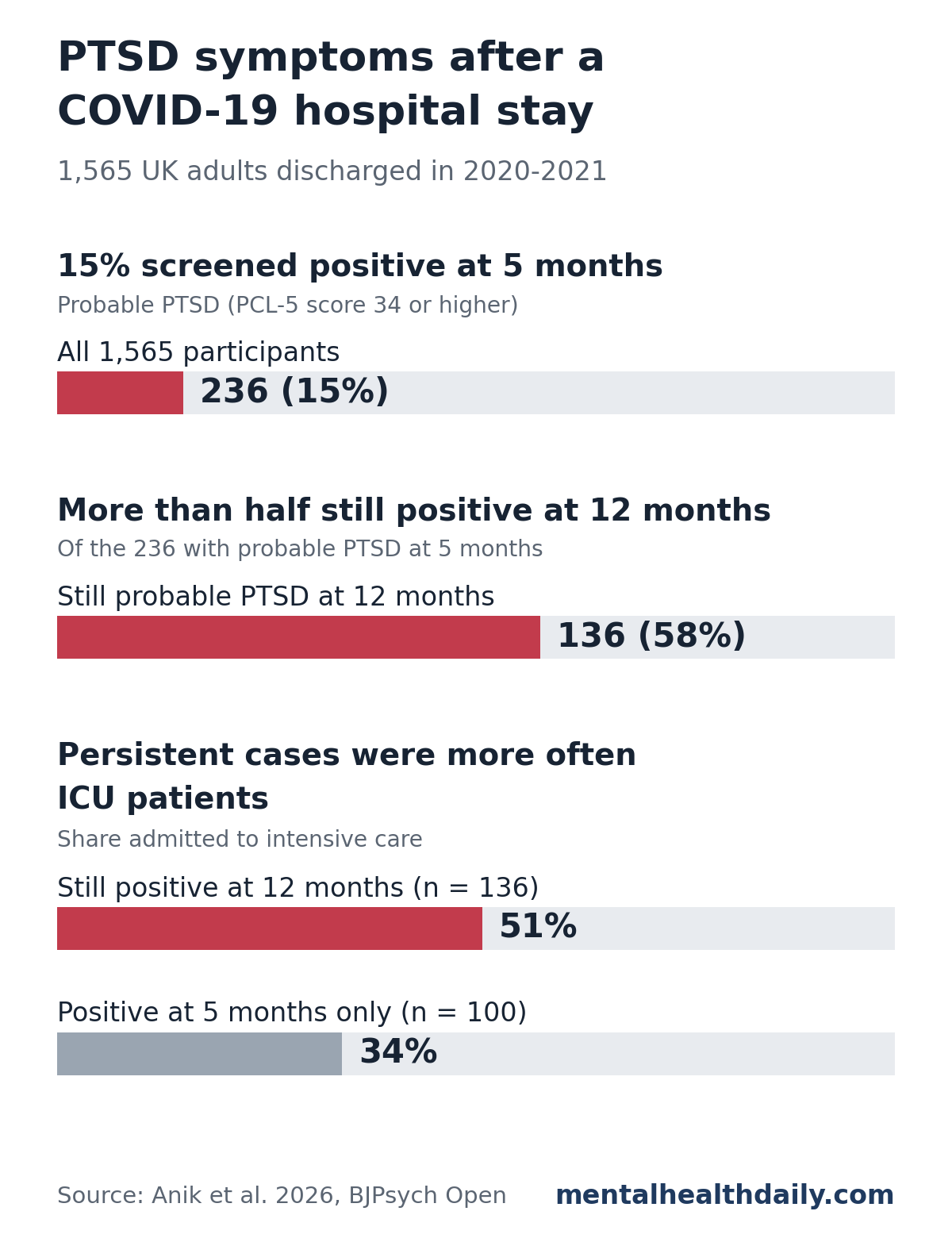
About 5 months after leaving the hospital with COVID-19, 15% of UK adults in a large follow-up study screened positive for probable post-traumatic stress disorder (PTSD). Of those 236 people, 136 (57.6%) still screened positive a year after discharge.1 The patients were admitted early in the pandemic, between 2020 and 2021, and the 2026 report shows that for many of them trauma symptoms lasted well beyond discharge.
Research Highlights
- 15% had probable PTSD at 5 months: 236 of 1,565 former COVID-19 inpatients scored 34 or higher on the PCL-5 PTSD questionnaire.1
- Over half still screened positive a year out: 136 of the 236 (57.6%) remained above the cutoff at the 12-month visit.1
- Younger, lower-income patients were at higher risk: adults aged 18 to 50 had 3 times the risk of those 65 and older, and people earning under £19,001 a year had about twice the risk of those earning over £35,000.1
- Intensive care was linked to lasting symptoms: among people with probable PTSD at 5 months, an ICU stay was linked to a higher risk of still screening positive at 12 months (risk ratio 1.3, 95% CI 1.1 to 1.6).1
- A screening result, not a diagnosis: no clinical interviews were done, so “probable PTSD” means a high questionnaire score.1
Who Was in the PHOSP-COVID Study
PHOSP-COVID (Post-Hospitalization COVID-19) followed adults discharged from 83 National Health Service hospitals across England, Scotland, Wales and Northern Ireland after an admission for confirmed or clinician-diagnosed COVID-19. This analysis, led by Evrim Anik and Max Henderson at the University of Leeds, included the 1,565 participants who completed a PTSD questionnaire at both research visits.1
- Admissions: discharged in 2020 and early 2021, with research visits between August 2020 and March 2022
- Timing: the first visit came a median 5.4 months after discharge and the second a median 12.7 months after
- Who they were: 61.3% men, 77.4% White, mean age 59.4, and 62% from more deprived neighborhoods
- How sick they were: one-third (33.5%) had been admitted to intensive care, and 21.1% stayed in the hospital 20 days or longer
PTSD symptoms were measured with the PCL-5 (PTSD Checklist for DSM-5), a 20-item self-report questionnaire covering each PTSD symptom, such as intrusive memories, avoidance, feeling on edge and trouble sleeping. Each item is scored 0 to 4, and a total of 34 or more marks probable PTSD.1
15% Screened Positive, and Over Half of Them Stayed Positive
At the 5-month visit, 236 of the 1,565 participants (15.1%) scored 34 or higher. The authors note that this is around double the PTSD prevalence reported in the general population of the US and UK. By the 12-month visit, 136 of those 236 (57.6%) were still above the cutoff. Another 68 people (4.3% of the sample) scored below 34 at 5 months but crossed the threshold at 12 months; the analysis did not follow them further.1
People who stayed above the cutoff had started out with heavier symptoms. Their average PCL-5 score at 5 months was 50.5, compared with 43.2 in those whose scores later fell below 34. They also had higher depression (PHQ-9) and anxiety (GAD-7) scores at both visits, and 73.5% said at 12 months that they had not recovered from COVID-19, compared with 63% of the group whose PTSD scores eased.1
Who Was Most Likely to Have Probable PTSD at 5 Months
The researchers used log-binomial regression, which estimates risk ratios (how many times more likely one group was to screen positive than a reference group), with each factor adjusted for the others. Five factors stood out:1
- Younger age: adults 18 to 50 had a risk ratio of 3.0 (95% CI 2.1 to 4.3) compared with those 65 and older.
- Lower income: earning under £19,001 a year carried a risk ratio of 2.1 (1.5 to 2.8) compared with earning over £35,000.
- Longer admission: a stay of 20 days or more had a risk ratio of 1.4 (1.2 to 1.7) compared with a shorter stay.
- Past depression or anxiety: 39.4% of people with probable PTSD reported this history, compared with 12.4% of those without.
- Psychiatric medication in the hospital: 40.3% vs. 12.3%.
For the last two, the paper shows the adjusted risk ratios only in a figure, so the raw percentages are given here. Both remained significant in the adjusted model.1
Women and non-White patients were more likely to screen positive in the unadjusted comparisons, but those differences did not hold up once the other factors were accounted for. Intensive care was more common among people who screened positive (43.6% vs. 31.8%) but did not remain in the final 5-month model.1
The income finding is one the authors emphasize. COVID-19 hit poorer communities harder in the UK, through crowded housing, public transport use and lower vaccine uptake, and low income stayed linked to probable PTSD even after accounting for illness severity. The authors argue that the strain of poverty itself may make people more vulnerable to trauma symptoms.1
Intensive Care Was Linked to Symptoms That Lasted
The picture changed when the researchers looked only at the 236 people with probable PTSD at 5 months and asked who was still above the cutoff at 12 months. Younger age, lower income and a long hospital stay no longer predicted persistence. Three other factors did:1
- ICU admission: risk ratio 1.3 (95% CI 1.1 to 1.6); 50.7% of the persistent group had been in intensive care, compared with 34.0% of those whose scores fell
- Anxiety at 5 months: a GAD-7 score of 10 or higher
- Heavier early PTSD symptoms: a PCL-5 score above 42 at 5 months
In the authors’ words, “How ill you were and how distressed you were predicted persistent PTSD symptoms.”1
The ICU link is consistent with research from before the pandemic. A 2015 meta-analysis of 36 cohorts (4,260 patients) found clinically important PTSD symptoms in about one-fifth of general ICU survivors at 1-year follow-up, with higher rates in people with prior mental health problems.2 And in a US Veterans Affairs cohort of 153,848 people who survived COVID-19, the risk of new stress and adjustment disorders was 38% higher than in uninfected controls, with the highest risks among those who had been hospitalized.3
Limitations
- Screening, not diagnosis. Probable PTSD came from a questionnaire cutoff, and no clinical interviews were done. Screening results and diagnostic interviews do not always agree.
- Selected sample. Of 7,935 people recruited to PHOSP-COVID, fewer than half agreed to both research visits, and this analysis kept only the 1,565 who completed the PCL-5 at both. Of 2,295 people with a 5-month score, 730 were excluded for missing the second questionnaire.
- No comparison group. The study did not include people hospitalized for other illnesses or people with COVID-19 who stayed home, so it cannot say how much of the risk is specific to COVID-19.
- Early-pandemic patients. Admissions were in 2020 and early 2021, with a mix of vaccinated and unvaccinated participants and different variants. The results describe that period and are not an estimate of PTSD risk from a COVID-19 infection today.
- Recall and timing. Pre-admission mental health history was mostly recalled after discharge, and visit timing varied from 2 to 7 months and 10 to 14 months after discharge.
- Observational design. The risk ratios show which groups were more affected, not what caused the symptoms.
What It Means for Hospital Aftercare
The authors argue that many of the risk factors, including age, income and past depression or anxiety, can be picked up by taking a good social and psychiatric history on admission, and that patients who needed intensive care or had high early symptom scores are the ones most likely to stay unwell. Their broader point applies well beyond COVID-19: after a frightening hospital stay, checking for trauma symptoms in the months after discharge can catch people who would otherwise go unnoticed.1
Anyone who still has intrusive memories, nightmares or strong avoidance months after a serious illness can ask a doctor about PTSD screening. PTSD is a treatable condition, and a high score on a checklist is a reason for a proper assessment.
References
- Anik E, Armour C, Guthrie E, et al.; PHOSP-COVID Study Collaborative Group. Probable post-traumatic stress disorder following discharge from hospital with COVID-19: prospective cohort study. BJPsych Open. 2026;12:e240. doi:10.1192/bjo.2026.12081
- Parker AM, Sricharoenchai T, Raparla S, et al. Posttraumatic stress disorder in critical illness survivors: a metaanalysis. Critical Care Medicine. 2015;43(5):1121–1129. doi:10.1097/CCM.0000000000000882
- Xie Y, Xu E, Al-Aly Z. Risks of mental health outcomes in people with covid-19: cohort study. BMJ. 2022;376:e068993. doi:10.1136/bmj-2021-068993