
People can learn when a threat is likely to strike just by watching someone else get hurt. In 2 lab experiments with 43 healthy adults, volunteers who only watched videos of another person in pain learned which warning signal predicted the pain and which trials had pain at random moments.1
Research Highlights
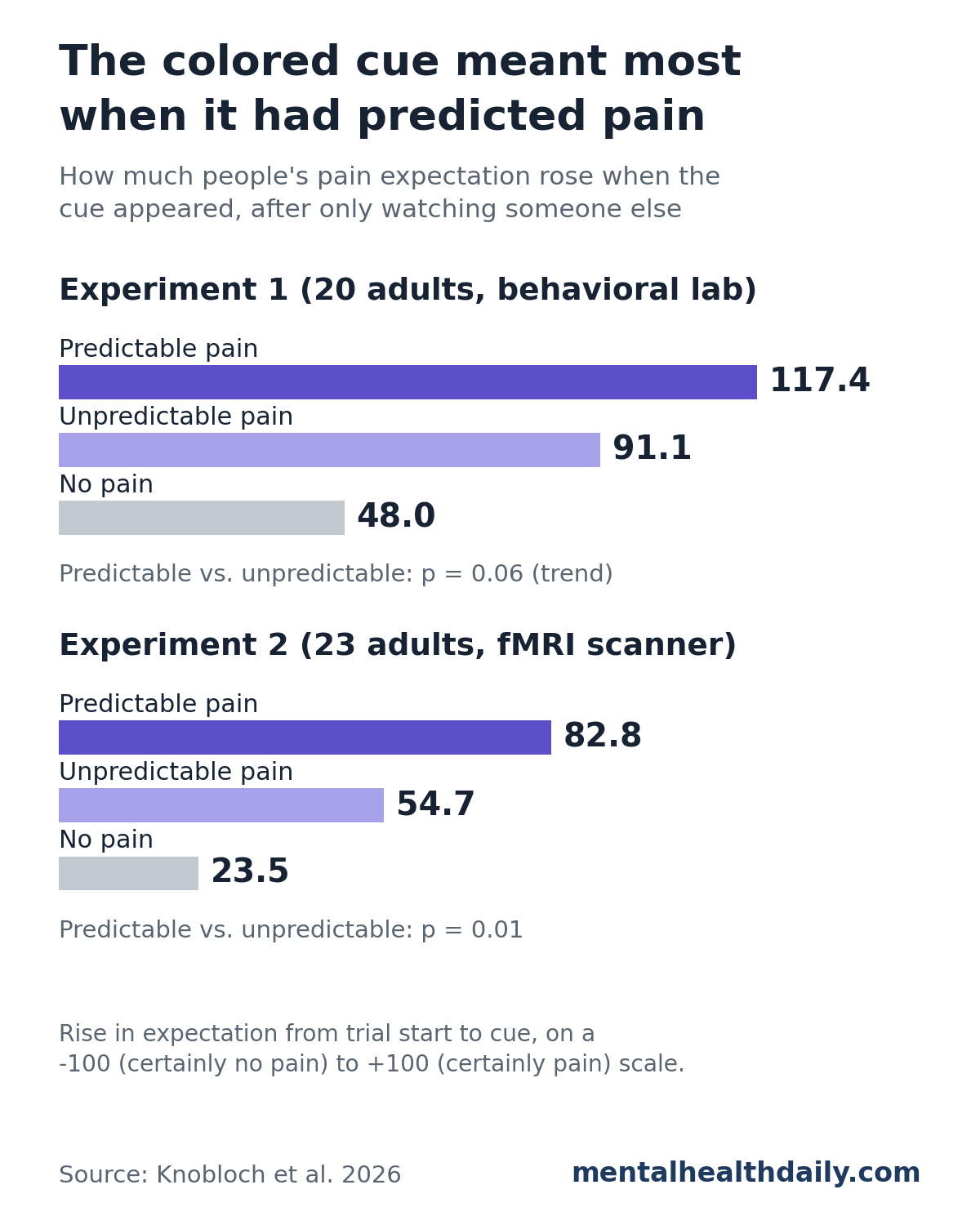
- People learned threat timing by watching: in the fMRI experiment (23 adults), expectation of pain rose 82.8 points when a warning cue appeared if it had predicted pain, vs. 54.7 points when pain had come at random (p = 0.01) and 23.5 points when no pain was shown.1
- Random timing raised expectation early: when a trial with unpredictable pain began, people already expected pain more than at the start of a predictable trial.1
- Anterior insula tracked the difference: this brain region’s response mirrored people’s ratings when they later faced the same screens themselves (corrected p = 0.009).1
- Amygdala stayed active under unpredictable threat: it faded across trials for reliable warning cues but stayed engaged while watching pain arrive at random times.1
- Early lab evidence: small healthy samples, a hippocampus result that fell just short of significance (p = 0.056), and no anxiety patients or treatment tested.1
Knobloch et al. at the University Medical Center Hamburg-Eppendorf published the 2 experiments in Translational Psychiatry in 2026. Experiment 1 enrolled 20 adults in a behavioral lab; Experiment 2 scanned 23 adults with functional MRI (fMRI, which tracks brain activity through changes in blood oxygen).1
Why Unpredictable Threat Matters for Anxiety
A threat you can see coming is easier to live with than one that might hit at any moment. With a clear warning, the body can relax between warnings and brace only when the signal appears.
Researchers split these reactions into 2 kinds:
- Fear: a short, sharp spike of alarm set off by a specific warning, which drops once the danger passes
- Anxiety: a slower, lasting state of alert that sets in when danger could arrive at any time and no signal says when
Lab studies separate the two with the NPU threat test (for No threat, Predictable threat, Unpredictable threat). In the predictable condition an unpleasant stimulus comes only during a cue; in the unpredictable condition it can come at any time.
Panic disorder is the clearest clinical example. In a 2008 NPU study of 24 people with panic disorder and 24 healthy controls, both groups startled equally to the predictable threat cue. Only the panic disorder group showed an elevated startle response during the unpredictable condition.2
That fits how panic disorder feels: attacks seem to come “out of the blue,” and the dread of the next one becomes a problem of its own. Grupe and Nitschke’s 2013 review argued that uncertainty about future threat is a core driver of anxiety disorders more broadly. The brain regions they highlighted include the amygdala and anterior insula.3
Almost all of this work used firsthand threats, such as mild shocks or loud noises delivered to the person being tested. In daily life, though, much of what people learn about danger comes from watching others.
How the Observational Threat Experiment Worked
Observational fear learning means picking up a fear from someone else’s experience rather than your own. A 2007 fMRI study found that the amygdala, a small almond-shaped region deep in the brain that flags threats, responded both when people watched someone else go through an unpleasant event signaled by a cue and when they later faced that cue themselves.4
That kind of study used predictable cues only. The Hamburg team built a task to test whether people could also learn unpredictable threat timing by observation.
Observation phase: volunteers watched 24-second videos of a man receiving painful heat on his forearm while he looked at a screen. On that screen, one of 3 sliders moved across a gray bar with a colored section, the cue. What the cue meant depended on the slider:
- Predictable: the man showed pain while the slider crossed the colored section
- Unpredictable: pain appeared at random slider positions, so the colored section told viewers nothing
- No pain: the man stayed at rest the whole time
Nobody explained these rules. Volunteers had to work them out from what they saw.
Expression phase: volunteers then watched the same slider screens themselves and rated how strongly they expected pain, on a scale from −100 (certainly no pain) through 0 (uncertain) to +100 (certainly pain). In Experiment 2 they wore the same kind of cuff as the man in the videos and were told it might deliver unpleasant stimulation. No pain was ever delivered to the volunteers.1
Volunteers Learned Predictable vs. Unpredictable Threat by Watching
The researchers’ main measure was cue prominence: how much a person’s pain expectation rose between the start of a trial and the moment the colored cue appeared. A high number means the cue carried real warning value for that person.
In both experiments, cue prominence was highest for the predictable condition and lowest for the no-pain condition, with the unpredictable condition in between:1
- Experiment 1 (20 adults): 117.4 points for predictable pain, 91.1 for unpredictable pain, and 48.0 for no pain. The predictable vs. unpredictable gap was a trend (p = 0.06).
- Experiment 2 (23 adults): 82.8, 54.7, and 23.5 points. Here the predictable vs. unpredictable difference was significant (p = 0.01) in a test the team preregistered before data analysis.
Before the observation phase, Experiment 2 volunteers rated all 3 conditions similarly, so the later differences reflect what they learned from watching.1
Unpredictable trials shifted worry to the start. In Experiment 2, expectation at the colored cue was about the same in the predictable and unpredictable conditions. The difference lay at the start of the trial: people expected pain more at the start of an unpredictable trial than at the start of a predictable one (p = 0.032).1
That is the observational version of the fear-vs.-anxiety split. A reliable signal concentrated expectation at the signal; random timing spread it across the whole trial.
Ratings were still below zero at the start of unpredictable trials, meaning people leaned toward “no pain” but were unsure. After the cue passed, Experiment 2 volunteers still expected more pain in both pain conditions than in the no-pain condition.1
Amygdala, Anterior Insula and Hippocampus Responses
The fMRI analysis focused on 3 regions known from firsthand threat studies:
- Amygdala: flags threats and drives defensive reactions
- Anterior insula: a fold of cortex that reads internal body states and is active when people anticipate uncertain threats
- Hippocampus: best known for memory and context, and linked to learning about unpredictable threats
Because an fMRI analysis tests thousands of brain locations, results were corrected for multiple comparisons; the corrected p-values below account for that.1
Anterior insula: when volunteers faced the screens themselves, the right insula showed the same pattern as their ratings: a bigger cue response in the predictable condition and a bigger start-of-trial response in the unpredictable one (p = 0.009). While watching, the left anterior insula responded at the start of unpredictable trials compared with no-pain trials (p = 0.007).1
Amygdala: while watching, the amygdala’s response to reliable warning cues faded across trials, as it does once firsthand threats have been learned. Under unpredictable threat, part of the amygdala stayed more active across the whole video than under predictable threat (p = 0.027 and 0.034 for 2 clusters).1
Hippocampus: the observation-phase contrast that directly matched the rating pattern landed in the left hippocampus but only approached significance (p = 0.056). In the expression phase, the left hippocampus stayed more active through unpredictable trials than predictable ones (p = 0.032).1
Watching pain itself: seeing the man in pain activated the left insula and amygdala compared with watching him at rest. The right hippocampus, along with the amygdala and insula, responded more to pain that came on cue than to pain at random times.1
The researchers noted that their data do not cleanly separate predictable and unpredictable threat into different brain regions. All 3 areas took part in both, with differences in timing and pattern.1
Limits of This Small Healthy-Volunteer Study
- Small samples: 20 and 23 volunteers. The team noted that 23 may be small for fMRI, where signals are noisy.
- Healthy people only: anyone with a current or past psychiatric disorder was excluded, so the study says nothing directly about how people with anxiety disorders learn from others.
- Not every result survived correction: the Experiment 1 predictable vs. unpredictable rating gap (p = 0.06) and the observation-phase hippocampus result (p = 0.056) were trends.
- No body-based confirmation: skin conductance (sweat response) was recorded but only 13 people had usable data, so the ratings lack a physiological check.
- Artificial setting: one man on video, a slider task, and no real consequences for the viewer. Real social threat learning is messier.
- Not a treatment study: nothing here tests a therapy for anxiety or trauma.
What Observational Threat Learning Could Mean for Anxiety
The study shows that the fear-vs.-anxiety split seen in firsthand threat research also appears when threats are learned secondhand. People who only watched still treated a reliable warning as a sharp signal and random threat as a reason to stay on guard.
That raises questions worth testing in clinical groups:
- Panic disorder: people with panic disorder react more strongly to unpredictable firsthand threat.2 Whether they also over-learn unpredictable threat from watching others is untested.
- Secondhand fears: news footage, a parent’s fear, or a friend’s bad experience can all teach threat, and this task offers a way to measure how that learning handles uncertain timing.
- Brain markers: the anterior insula and amygdala patterns could be compared between anxious and non-anxious people using this task.
For now, this is basic science in healthy adults. It adds a social piece to the picture of why unpredictable danger keeps people on edge, but it does not show how anxiety disorders develop or how to treat them.
References
- Knobloch S, Jansen T, Hille LC, et al. Resolving temporal threat uncertainty by observational learning involves the amygdala, hippocampus and anterior insula. Translational Psychiatry. 2026;16:488. doi:10.1038/s41398-026-04492-7
- Grillon C, Lissek S, Rabin S, et al. Increased anxiety during anticipation of unpredictable but not predictable aversive stimuli as a psychophysiologic marker of panic disorder. American Journal of Psychiatry. 2008;165(7):898–904. doi:10.1176/appi.ajp.2007.07101581
- Grupe DW, Nitschke JB. Uncertainty and anticipation in anxiety: an integrated neurobiological and psychological perspective. Nature Reviews Neuroscience. 2013;14(7):488–501. doi:10.1038/nrn3524
- Olsson A, Nearing KI, Phelps EA. Learning fears by observing others: the neural systems of social fear transmission. Social Cognitive and Affective Neuroscience. 2007;2(1):3–11. doi:10.1093/scan/nsm005