
In a 2020 survey of 491 actors, singers, voice actors, comedians and managers in South Korea, some beliefs about suicide were linked to a history of depression and past suicide attempts. Past depressive symptoms and having no one to turn to showed the strongest links.1
Research Highlights
- The study: a cross-sectional online survey of 491 adult entertainment industry workers, published in Psychiatry Investigation in September 2026.1
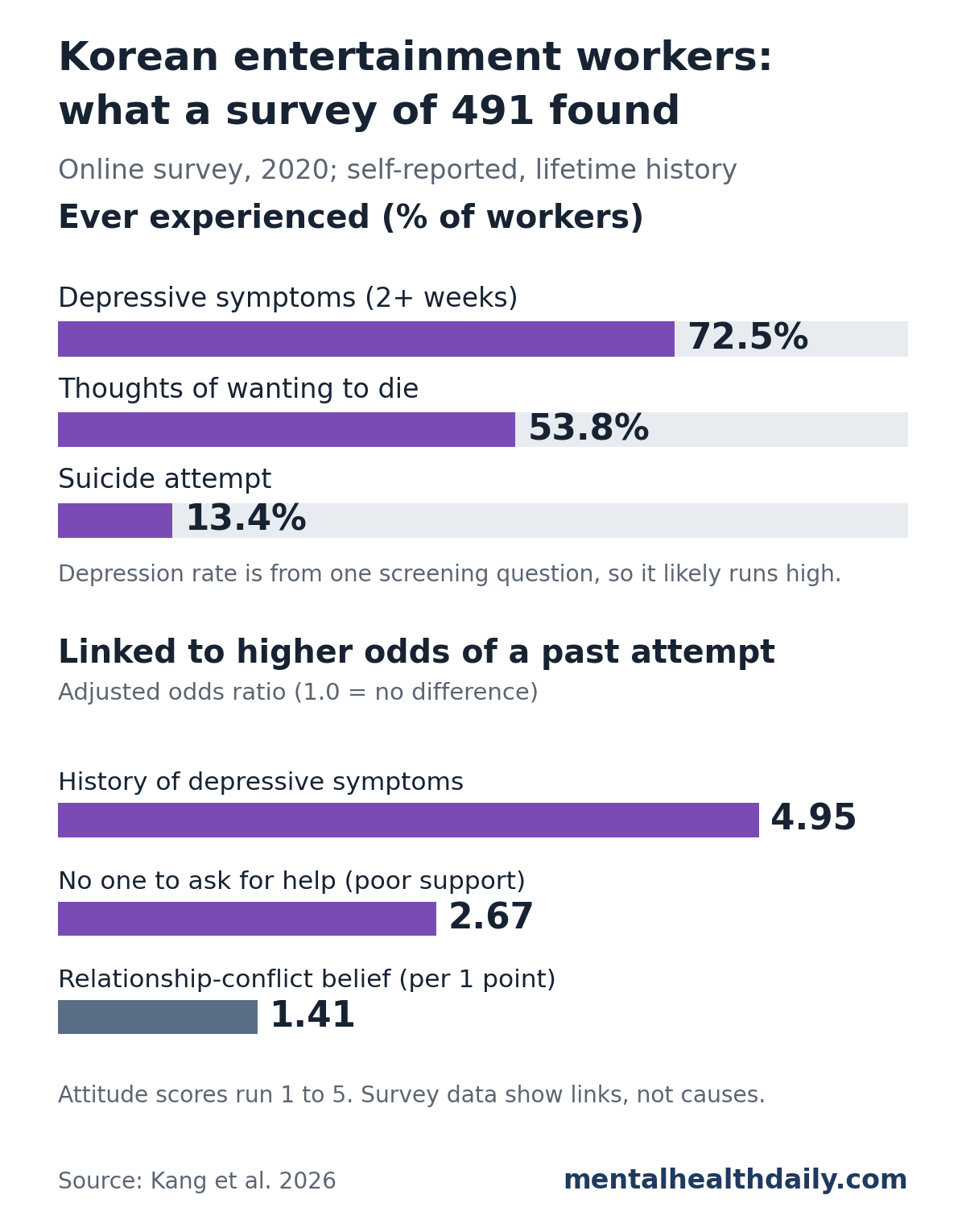
- High lifetime rates: 72.5% reported a past stretch of depressive symptoms, 53.8% had thought about wanting to die, and 13.4% reported a past suicide attempt.1
- Strongest links: a history of depressive symptoms (about 5 times the odds) and poor social support (about 2.7 times the odds) were linked to a past suicide attempt after adjustment.1
- Beliefs mattered too: seeing suicide as an acceptable personal choice, or as something that comes without warning, was linked to past depression. Seeing it as driven by relationship conflict was linked to past attempts.1
- Design limits: one-time, self-reported survey data, so the study shows links, not which came first.1
Why Researchers Surveyed Korean Entertainment Workers
Entertainment work comes with job insecurity, irregular hours and constant public scrutiny. In a 2022 survey of 1,302 Australian entertainment workers, stronger social support was linked to fewer suicidal thoughts among those in poorer mental health.2
The stakes reach beyond the industry. News coverage of celebrity suicides is followed by a short-term rise in suicides in the wider population, which is one reason reporting guidelines ask the media to avoid sensational coverage and method details.4 South Korea has seen this pattern after several well-known entertainers died by suicide.1
The research team, working with the Korea Foundation for Suicide Prevention and several industry unions and associations, sent an online survey to all members of 3 groups: the Korea Broadcasting Actors’ Union, the Korea Management Federation and the Korea Entertainment Management Association.1
Who Took Part and What They Were Asked
After removing duplicates, incomplete answers and people no longer working in the industry, 491 of 600 respondents remained. That is about 20% of the roughly 2,500 members of the participating groups.1
- Roles: 74.5% entertainers (actors, singers and trainees), 13.6% voice actors, 8.8% comedians and 3.1% managers
- Profile: 55.0% men; most were aged 30 to 49, and 64.2% had worked in the industry for 10 years or more
- Depressive symptoms: one screening question asking whether they had ever felt depressed nearly every day, or lost interest in things they used to enjoy, for more than 2 weeks
- Suicidal thoughts and attempts: one question each, adapted from South Korea’s national mental health survey
- Social support: whether they had someone to ask for help when emotionally distressed
Beliefs about suicide were measured with the Attitudes Toward Suicide Scale (ATTS-20), a 20-item questionnaire rated from 1 (strongly disagree) to 5 (strongly agree).1
Lifetime Rates of Depression, Suicidal Thoughts and Attempts
Most respondents reported at least one period of depressive symptoms in their lives, and more than half had thought about wanting to die at some point:1
- Depressive symptoms: 356 people (72.5%), including 191 (38.9%) in the past year
- Thoughts of wanting to die: 264 people (53.8%), including 92 (18.7%) in the past year
- Suicide attempt: 66 people (13.4%), including 6 (1.2%) in the past year
The authors compare these with lifetime figures for Korean adults in general of 7.7% for depression, 10.7% for suicidal thoughts and 1.7% for attempts.1 The depression comparison is uneven, though. A single screening question catches far more people than a full diagnostic interview, and the authors note that their depression figure likely overstates clinical depression.
Past Depression and Poor Support Showed the Strongest Links
About 1 in 4 respondents (24.8%) said they had no one to ask for help when distressed. In models adjusted for sex, age, marital status and workplace exposures, poor support was linked to all 3 outcomes:1
- Depressive symptoms: adjusted odds ratio (aOR) 2.16
- Suicidal thoughts: aOR 2.57
- Suicide attempts: aOR 2.67
An odds ratio of 2.67 means the odds of a past attempt were about 2.7 times higher in people without support. A history of depressive symptoms had the largest link of all: aOR 3.57 for suicidal thoughts and 4.95 for attempts, although the attempt estimate is imprecise (95% confidence interval 1.88 to 17.10).1
Several work-specific factors stood out at first but faded after adjustment. Exposure to hurtful online comments or media coverage, and seeing a colleague’s suicidal behavior, were not significantly linked to any outcome in the adjusted models. Seeing a colleague in serious distress was still linked to depressive symptoms (aOR 2.36) and suicidal thoughts (aOR 1.75).1
Which Beliefs About Suicide Were Linked to What
An earlier Korean version of the ATTS-20 did not fit this group’s answers, so the team regrouped 17 of the items into new clusters (a method called exploratory factor analysis). Five clusters were reliable enough to analyze.1 Three showed significant links after adjustment:
- Permissiveness (seeing suicide as an acceptable personal decision): linked to past depressive symptoms, aOR 1.67 per 1-point higher score. People with a past attempt scored higher than people with depressive symptoms alone (average 2.35 vs. 1.91).
- Unpredictability (seeing suicide as happening without warning signs): linked to past depressive symptoms, aOR 1.48. Scores rose from 3.46 in people with depressive symptoms alone to 3.73 in those with suicidal thoughts and 3.95 in those with a past attempt.
- Relation-caused (seeing suicide as driven mainly by conflict with other people): the only belief linked to past suicide attempts after adjustment, aOR 1.41.
Permissiveness and unpredictability were also linked to suicidal thoughts and attempts in the unadjusted analysis, but those links were no longer significant after adjustment.1
The permissiveness result is consistent with earlier Korean work. In a nationwide survey led by the same senior author, a permissive attitude was the only factor significantly linked to future suicidal intent after adjustment, and people with depression held more permissive views.3
What the Authors Suggest for Prevention
The authors argue that prevention for entertainment workers should go beyond screening for symptoms:1
- Build support: make sure workers have someone to turn to, given how strongly poor support tracked with every outcome.
- Screen for depression early, since it had the strongest link to suicidal thoughts and attempts.
- Correct the idea that suicide comes without warning, and offer gatekeeper training so colleagues and managers learn to notice warning signs and respond.
- Address permissive beliefs through education, because viewing suicide as an acceptable solution may make people less likely to seek help.
These suggestions follow from the authors’ reading of the data. The survey itself did not test any prevention program.
Limitations of the Survey
- One point in time. Attitudes were measured once, while outcomes covered a whole lifetime. A past attempt or a period of depression could shape someone’s beliefs, rather than the other way around.
- Single-question measures. Depressive symptoms, suicidal thoughts and attempts were each based on one self-reported question, not a clinical interview.
- Not representative. Respondents were association members who chose to answer, about a fifth of the membership. Influencers, YouTubers and non-members were not included.
- Modest belief links. The attitude clusters were built from this same sample, some had only 2 or 3 items with modest reliability, and the relationship-conflict result only just reached significance (95% confidence interval 1.01 to 2.00).
- Missing factors. Income, family history of mental illness, physical health and major life stressors were not measured.
- 2020 data. The survey ran in mid-2020 and was published in 2026.
The Bottom Line for Entertainment Workers
This is the first systematic look at depression and suicidal behavior in South Korean entertainment workers, and it points to a group carrying a heavy load. The clearest message is about support: workers without someone to turn to had higher odds of depression, suicidal thoughts and past attempts.1
Follow-up studies that track workers over time, with clinical interviews, are needed to show whether beliefs about suicide come before suicidal behavior or follow it.
If you or someone you know is struggling or in crisis, help is available. In the United States, call or text 988 to reach the 988 Suicide & Crisis Lifeline. In South Korea, call 109. Elsewhere, contact local emergency services or a local crisis line.
References
- Kang C, Jang J, Myung W, et al. Attitudes toward suicide are associated with lifetime history of depressive symptoms and suicide attempts among entertainment industry workers in South Korea. Psychiatry Investigation. Published online September 22, 2026. doi:10.30773/pi.2025.0451
- Zarate D, Sonn C, Fisher A, Stavropoulos V. Suicidal behaviors in the entertainment industry: a preliminary exploration of the interplay between work scheduling, social support, and wellbeing in Australia. BMC Psychiatry. 2022;22:754. doi:10.1186/s12888-022-04376-2
- Jeon HJ, Park JH, Shim EJ. Permissive attitude toward suicide and future intent in individuals with and without depression: results from a nationwide survey in Korea. Journal of Nervous and Mental Disease. 2013;201(4):286–291. doi:10.1097/NMD.0b013e318288d2c7
- Niederkrotenthaler T, Braun M, Pirkis J, et al. Association between suicide reporting in the media and suicide: systematic review and meta-analysis. BMJ. 2020;368:m575. doi:10.1136/bmj.m575