
Healthy hospital workers in Munich reported more stress in late 2021 than healthy German adults in a 2005 reference study that used the same questionnaire, and workers with chronic health conditions reported more still.1
Research Highlights
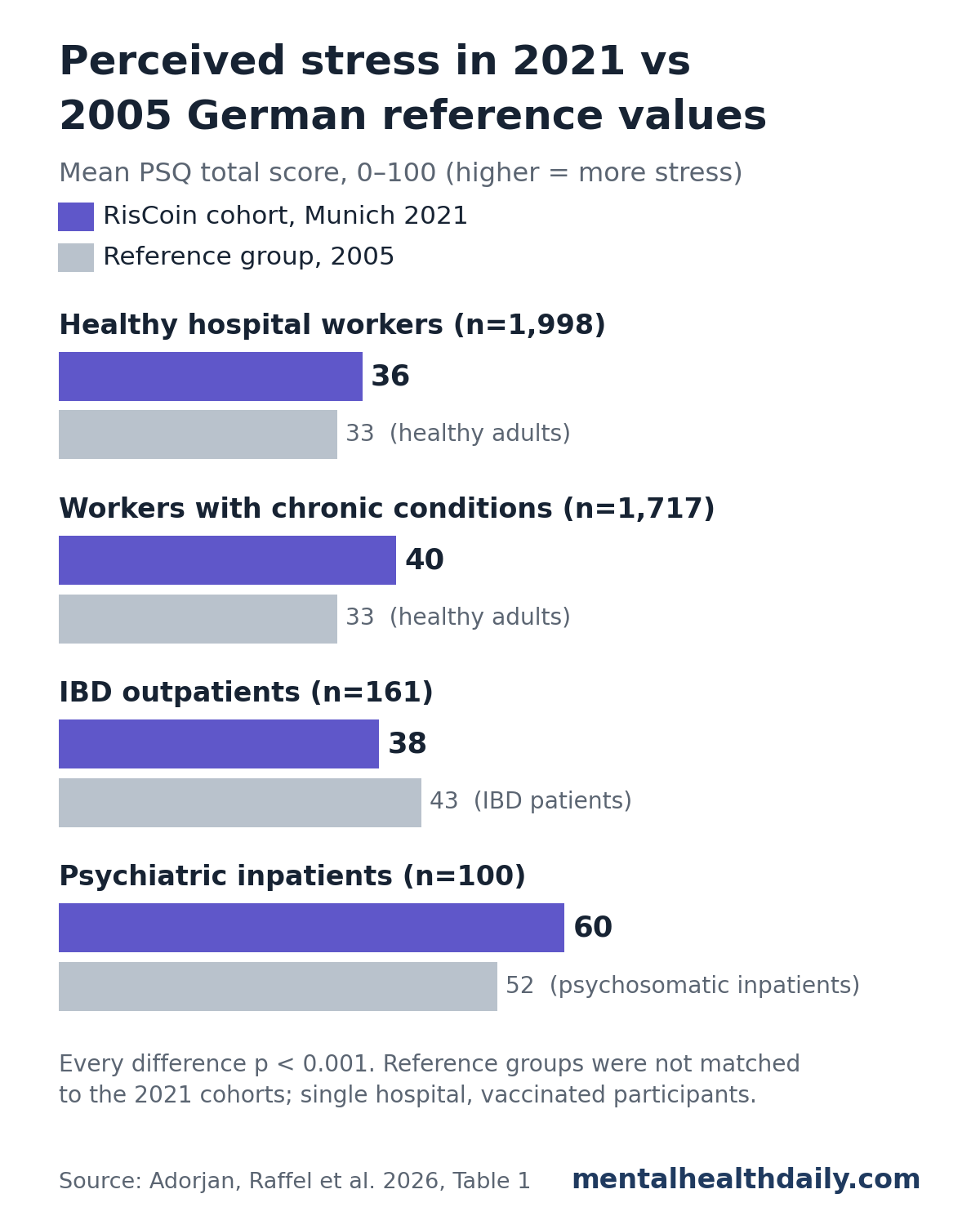
- Healthy workers scored higher than the old norm: 1,998 healthy hospital employees averaged 36 on the 0–100 Perceived Stress Questionnaire (PSQ), vs 33 in the 2005 healthy reference group (p < 0.001).1
- Chronic conditions added stress: 1,717 employees with a chronic condition or regular medication averaged 40.1
- Demands rose the most: the “demands” score (time pressure, overload) was 46 in healthy workers vs 36 in 2005, the largest difference of the four PSQ domains.1
- Psychiatric inpatients scored highest: 60, vs 52 in psychosomatic inpatients from 2005. Patients with inflammatory bowel disease (IBD) went the other way: 38 now vs 43 then.1
- Not a population trend: the 2021 groups came from one university hospital and were not matched to the 2005 groups.1
What the RisCoin Study Measured
RisCoin is a cohort study at LMU University Hospital Munich that was set up to find out why some people respond poorly to COVID-19 vaccines.2 Between October and December 2021, it enrolled 4,115 adults who had received at least 2 vaccine doses, and each filled out a long questionnaire that included stress.1
The new analysis, published in European Archives of Psychiatry and Clinical Neuroscience, covers 3,976 participants in 4 groups:1
- Healthy hospital workers (n = 1,998; average age 38; 67% women): no underlying disease and no regular medication.
- Hospital workers with chronic conditions (n = 1,717; average age 43; 83% women): any chronic illness, such as heart, lung, thyroid or neurological disease, or regular medication.
- IBD outpatients (n = 161): adults with Crohn’s disease or ulcerative colitis.
- Psychiatric inpatients (n = 100): recruited mostly from wards for depression (57%) and substance use disorders (27%).
“Hospital workers” here means everyone on staff, not just doctors and nurses. Administrative, technical, service, cleaning and research staff were included too.1
How the Perceived Stress Questionnaire Works
The PSQ asks how often, over the past 4 weeks, people have felt things like worry, tension or lack of time. The German version has 20 items grouped into 4 domains:3
- Worries: anxious concern about the future, frustration.
- Tension: restlessness, exhaustion, trouble relaxing.
- Joy: energy, security and positive challenge (higher is better).
- Demands: time pressure, overload and outside demands.
Scores run from 0 to 100, with joy reversed in the total so that a higher total always means more stress.1 The German reference values came from a 2005 validation study of 1,808 people, in which healthy adults averaged 33.3
Healthy Hospital Workers Scored 36, Up From a 2005 Norm of 33
The healthy workers’ average of 36 (standard deviation 18) sat 3 points above the 2005 healthy-adult average of 33 (standard deviation 17).1 That is a modest shift on a 100-point scale, but with nearly 2,000 people it was statistically clear (p < 0.001).
Demands moved the most. Healthy workers scored 46 on demands vs 36 in 2005. Tension (38 vs 34) and worries (27 vs 26) rose less.1 The authors point to heavier workloads and time pressure as a likely contributor.
Joy was slightly higher, too. Healthy workers scored 66 on joy vs 62 in 2005, so the higher total came from more pressure rather than less enjoyment.1
Chronic Conditions, Age and Gender
Workers with chronic conditions averaged 40, higher than both the healthy workers and the 2005 norm, and higher across every domain except joy compared with 2005.1 Their scores stayed fairly flat from age 18 to 60 and dropped after 60.
Younger healthy workers reported more stress. Those aged 18–30 averaged 38, compared with 33 at ages 51–60 and 29 over age 60.1
Women scored higher than men among healthy workers (38 vs 34). The gap was sharpest in younger staff: at ages 18–30, 20% of women crossed the study’s high-stress line vs 12% of men.1 Among workers with chronic conditions, women and men scored about the same.
What Was Linked to High Stress in Hospital Workers
The researchers defined “high stress” as a score more than 1 standard deviation above each group’s average. That meant above 54 for healthy workers (17% of them) and above 59 for workers with chronic conditions (18%).1
After adjusting for age, gender and job, these factors were linked to higher odds of high stress in healthy workers:1
- No moderate or heavy exercise: 84% higher odds than exercising more than once a week (odds ratio 1.84; 95% CI 1.33 to 2.56).
- Living with children: odds ratio 1.69 (1.29 to 2.20).
- Eating ready-made meals regularly: odds ratio 1.66 (1.10 to 2.50).
- Being a woman: odds ratio 1.40 (1.05 to 1.86).
- Job: administrative staff had about twice the odds of nurses (2.29; 1.55 to 3.38), and so did clinical scientists who did not work with patients (2.06; 1.26 to 3.35). Physicians did not differ significantly from nurses.
In workers with chronic conditions, no exercise stood out even more (odds ratio 2.57; 1.85 to 3.57), along with ready-made meals and living with children.1 These are one-time associations, so they cannot show whether exercise lowers stress or stressed people exercise less.
Psychiatric Inpatients Scored Highest; IBD Patients Scored Lower Than in 2005
Psychiatric inpatients averaged 60, with high worries (63) and tension (63) and low joy (33).1 That is above the 52 reported for psychosomatic inpatients in 2005, but the authors note that the 2 groups differed in symptom severity and treatment, so the comparison is loose.
Among psychiatric inpatients, being physically inactive and having a food allergy were linked to high stress; the ward and medications were not.1
IBD patients averaged 38, well below the 43 reported for IBD patients in 2005, with lower worries and tension and more joy.1 Half were on anti-TNF biologic drugs. The authors link the drop to better IBD treatments and care over the past 2 decades, though this study did not measure disease activity.
COVID-19 Exposure Was Mostly Unrelated to Stress in Late 2021
Stress scores generally did not differ by COVID-19 infection, antibody results, testing frequency or contact with infected people, and staff with direct patient contact were no more stressed than other staff. The exception was contact with infected people in an IBD subgroup of just 5 patients (p = 0.012).1
The authors point to timing. The survey came after Germany’s last national lockdown, after 2 vaccine doses and before the Omicron wave. A national German cohort surveyed between May and November 2020, before vaccines were available, found a slight rise in depression and anxiety symptoms compared with pre-pandemic levels, driven partly by job and money strain.4
Limitations
The authors offer these scores as updated reference values, “assuming representativeness.” That assumption is the weak point.1
- Unmatched comparison groups: the 2021 and 2005 samples were different people, recruited differently. The data cannot prove that stress rose in Germany over 20 years.
- Selected sample: one Munich university hospital, all vaccinated, with many young, female and university-educated staff. The authors say the large share of young and female staff could explain part of the higher scores.
- Single time point: the lifestyle findings are associations measured once.
- Small patient groups: 161 IBD and 100 psychiatric patients, with no disease-severity data and no disclosed psychiatric diagnoses.
The questionnaire itself held up well. Internal consistency (Cronbach’s α, a measure of how well the items hang together) was 0.92 to 0.94 for the total score in every group, similar to or higher than in 2005.1
What It Means
For researchers using the German PSQ, these numbers are a more recent yardstick, especially for hospital staff. The authors advise choosing a comparison group that matches the age and gender of the people being studied.1
For hospital workers, the clearest pattern is that work demands, younger age, being a woman, living with children and inactivity went along with higher stress scores. Administrative staff, not frontline clinicians, had the highest odds of high stress.1
References
- Adorjan K, Raffel J, Zhelyazkova A, et al. Results of the validated German Perceived Stress Questionnaire (PSQ) from a large German cohort of healthy adults and different disease groups compared to historical reference values. European Archives of Psychiatry and Clinical Neuroscience. 2026. doi:10.1007/s00406-026-02379-8
- Koletzko S, Le Thi TG, Zhelyazkova A, et al. A prospective longitudinal cohort study on risk factors for COVID-19 vaccination failure (RisCoin): methods, procedures and characterization of the cohort. Clinical and Experimental Medicine. 2023;23(8):4901–4917. doi:10.1007/s10238-023-01170-6
- Fliege H, Rose M, Arck P, et al. The Perceived Stress Questionnaire (PSQ) reconsidered: validation and reference values from different clinical and healthy adult samples. Psychosomatic Medicine. 2005;67(1):78–88. doi:10.1097/01.psy.0000151491.80178.78
- Dragano N, Reuter M, Peters A, et al. Increase in mental disorders during the COVID-19 pandemic—the role of occupational and financial strains: an analysis of the German National Cohort (NAKO) Study. Deutsches Ärzteblatt International. 2022;119:179–187. doi:10.3238/arztebl.m2022.0133