
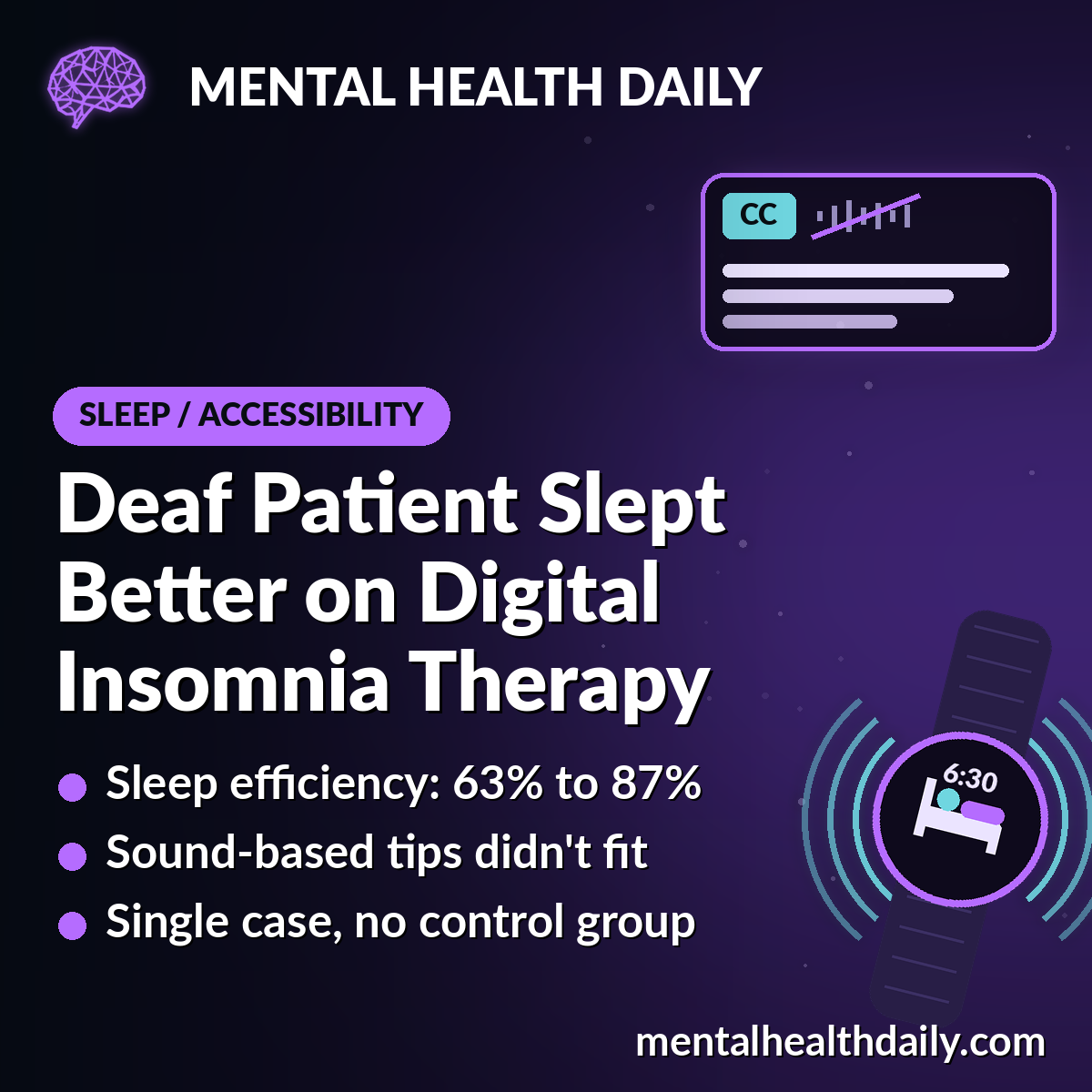
A 2026 case report followed one deaf man through a 6-week digital course of cognitive behavioral therapy for insomnia (CBT-I). He finished every session and every sleep diary, and his sleep efficiency rose from 63% to 87%.1 He also ran into advice he could not use, such as setting a sound alarm or listening to music until bedtime, and he relied on his own transcription app because he never learned the program had captions.
It is a single case with no comparison group, so it cannot tell us how well digital CBT-I works for deaf people in general. What it does well is show, in concrete detail, where a standard program helped and where it left a deaf user to find his own workarounds.
Research Highlights
- Full adherence: the patient completed all 6 sessions without missing a weekly appointment or a daily sleep diary entry.1
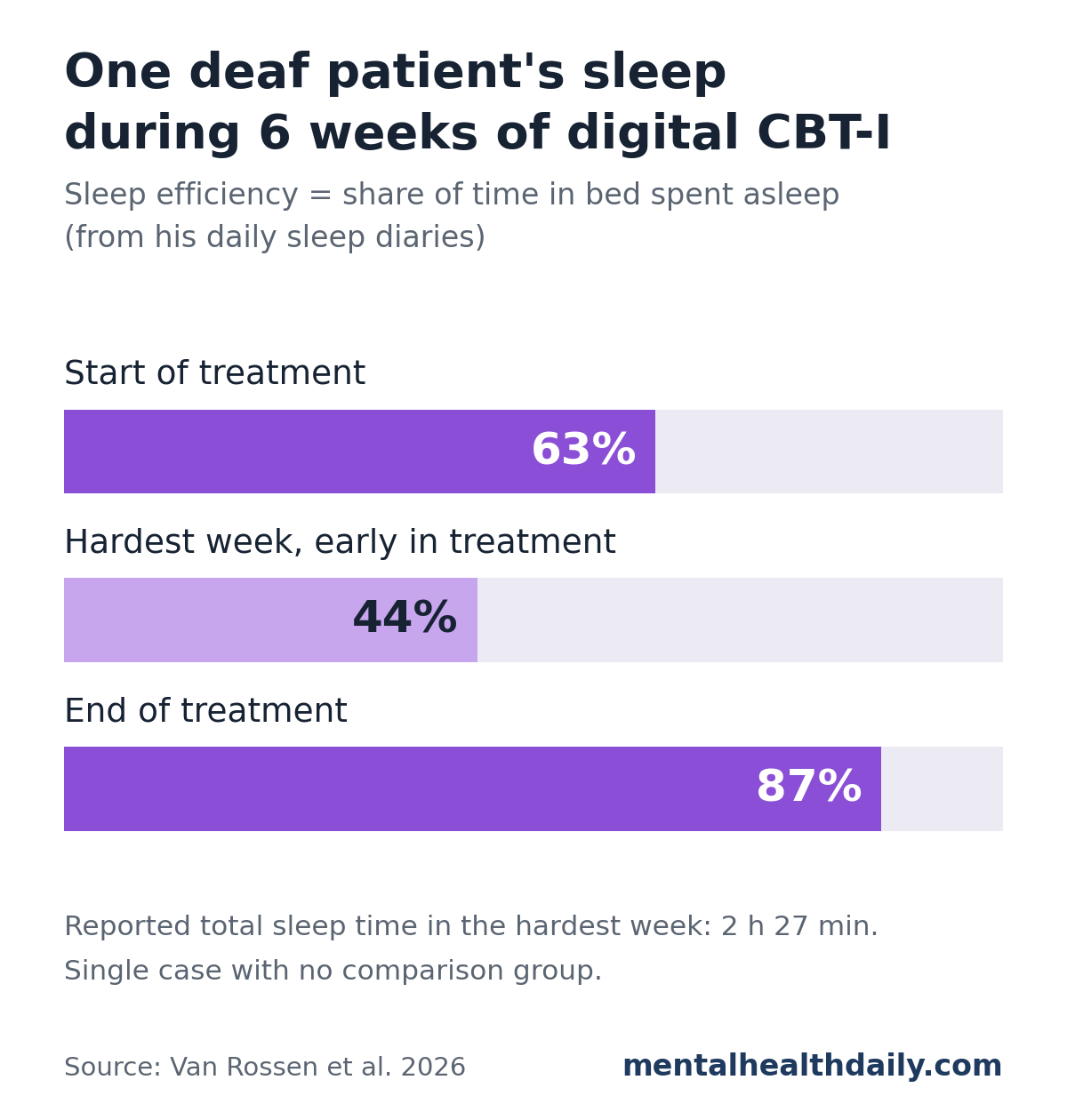
- Better sleep on his diaries: sleep efficiency (the share of time in bed spent asleep) rose from 63% at the start to 87% by the end of treatment.1
- Access gaps: sound-based alarms and music suggestions were unusable for him, and he did not know the program had closed captions, so he used a live-transcription app instead.1
- Human backup mattered: a video call with a nurse coach during his hardest week “brought comfort” and kept him going.1
- Evidence strength: one patient chosen for a case study, self-reported sleep data, and no control group.
Why Insomnia Care Is Harder to Reach for Deaf Adults
CBT-I is the first-line treatment for chronic insomnia. It is a structured program that retrains sleep habits and the thoughts that keep people awake, and one of its core tools is sleep restriction: limiting time in bed to roughly the amount of time a person actually sleeps, then widening that window as sleep consolidates.
Fully automated digital versions spread this treatment beyond the small number of trained therapists. In a randomized trial of 1,711 adults, an online CBT-I program produced small gains in overall health and well-being and a large improvement in sleep-related quality of life compared with sleep hygiene education, and those gains were largely explained by better insomnia scores.2 That trial’s participants were 91% white and had to be able to read and understand English, which is typical of the evidence base and says little about deaf users whose first language is American Sign Language (ASL).
The need is real. In a small study of 20 deaf adults fluent in ASL, 70% had clinically meaningful insomnia, and insomnia severity was strongly linked to depression scores.3
The Patient and the Program
The patient was a Hispanic man in middle to late adulthood with low income who had been deaf since age 10, after an untreated fever. His insomnia was moderate to severe (a score of 19 on the Insomnia Severity Index), with trouble both falling and staying asleep. He had tried a long list of sleep medications, including trazodone, zolpidem (Ambien), eszopiclone (Lunesta), temazepam, mirtazapine, lorazepam (Ativan), and gabapentin, and none had worked. Transportation, cost, and the shortage of ASL interpreters made in-person care hard, and he wanted a behavioral treatment he could do at his own pace.1
He was one participant in a larger two-arm randomized trial at Henry Ford Health in Detroit (ClinicalTrials.gov NCT05182372). He was assigned to the arm that received the digital program plus nurse coaching:1
- Digital CBT-I: 6 sessions with daily sleep diaries, sleep restriction, and sleep hygiene education
- Nurse coaching: supplementary sessions, held for him over video call
- Follow-up interview: a semi-structured conversation about what helped and what got in the way, transcribed and sorted into themes
His Sleep Efficiency Rose From 63% to 87%
His daily diaries tracked how much of his time in bed he actually spent asleep. Early in treatment it dropped to 44%, with a reported total sleep time of 2 hours and 27 minutes that week. That is the week he asked for a coaching session to sort out his sleep diaries. From there it climbed, reaching 87% by the end of treatment.1
The authors describe his end-of-treatment level as a sign of good sleep quality, and he still keeps sleep diaries after finishing the program.1
What Helped Him Stay With It
- Clear, easy-to-follow app. He singled out the program’s ease of use and step-by-step guidance.
- His own captioning tool. The program offered closed captions, but he did not know about them. He used Nagish, an app that turns calls into live transcripts and typed text into a spoken voice, and called it a “game changer” that reduced his reliance on relay services.
- A coach on video. Reaching a person when he got stuck “brought comfort and encouraged continuation of the treatment process.”
- A contrast with past care. In person, he had felt disregarded and was offered mainly medication.
Asked whether a version tailored for deaf users would help, he said he preferred the full standard program: if it had been customized to what he “thought” his needs were, he “might have missed some important information along the way.” He wanted the same content everyone else got, delivered in a way he could use.1
Where the Program Fell Short
Sleep restriction is hard for most patients, and several of the program’s tips for getting through it were unusable or a poor fit for him:1
- Sound-based alarms (which he could not hear) to hold a fixed wake-up time
- Listening to music to pass the time until the scheduled bedtime
- Light exposure, which was harder for him because of sensory sensitivity
Other techniques translated well. “Cognitive shuffling,” described in the report as repeating a simple word such as “the” to quiet the mind, worked when he swapped in a silently repeated string of numbers. He described his mind as “always thinking 200 miles an hour” when he closed his eyes, and he felt that heightened sensitivity to small changes in light and vibration made it harder to stay asleep. The authors treat that last point as a preliminary observation from one person.1
He also pointed to features the program lacked: clearly synchronized, complete captions and a real-time chat for questions. And he suggested community forums built for ASL, where storytelling is a central way of sharing experience and learning from others.1
Practical Design Lessons for Digital Sleep Programs
Drawing on what this patient ran into, several changes look straightforward to make:
- Make captions obvious. A caption feature that a deaf user never discovers does not help him. Turn it on by default or ask about it at sign-up, and make sure it is complete and in sync.
- Offer non-auditory versions of every tip. Vibrating alarms, silent wind-down activities, and quiet mental exercises like his number string can stand in for sound-based advice.
- Keep the full program. This patient wanted access to the same treatment, not a trimmed version.
- Keep a human reachable. Video coaching and text-based chat give a way through the hardest weeks without needing an interpreter.
Limitations
- One patient. He was chosen for case analysis from the coached arm of a larger trial and was highly engaged, so his experience may not reflect other deaf or hard-of-hearing users.
- No comparison. Without a control, the improvement cannot be credited to the program rather than to coaching, time, or natural ups and downs in sleep.
- Self-reported sleep. Sleep efficiency came from his diaries, and the report gives no end-of-treatment insomnia severity score.
- Small inconsistency. The text places his 44% low in the third week, while the figure plots it at the second session.
- Industry tie. One co-author works for Big Health, the company that makes the Sleepio digital CBT-I program.
The authors call their findings preliminary and say they need confirmation in larger, controlled studies. As a guide to what a deaf user runs into inside a standard digital sleep program, though, the case is specific and useful.1
References
- Van Rossen V, Kapoor I, Treger M, Miller C, Cheng P. Is digital cognitive behavioral therapy for insomnia accessible for the deaf community? Nature and Science of Sleep. 2026;18:601462. doi:10.2147/NSS.S601462
- Espie CA, Emsley R, Kyle SD, et al. Effect of digital cognitive behavioral therapy for insomnia on health, psychological well-being, and sleep-related quality of life: a randomized clinical trial. JAMA Psychiatry. 2019;76(1):21–30. doi:10.1001/jamapsychiatry.2018.2745
- Carr M, Yoo A, Guardino D, Hall WC, McIntosh S, Pigeon WR. Characterization of sleep among deaf individuals. Sleep Health. 2023;9(2):177–180. doi:10.1016/j.sleh.2022.10.011