
Sedating antidepressants and orexin-blocking sleep drugs are not interchangeable treatments for insomnia in major depression, a 2026 narrative review argues. Each class fits a different kind of sleep problem, and the evidence behind each is uneven.1
Research Highlights
- Trouble falling asleep: sedating antidepressants such as mirtazapine fit best when sleeplessness comes with worry, anxiety, agitation, or poor appetite and depression treatment is also needed.1
- Waking in the night: dual orexin receptor antagonists (DORAs) such as suvorexant, lemborexant, and daridorexant fit repeated or early waking, and their strongest evidence is for staying asleep.1
- Big evidence gap: most DORA trials enrolled people with insomnia alone, and no trials directly compare the two classes in active depression.1
- Safety comes first: current suicidal thoughts, recent self-harm, bipolar features, or rapidly worsening depression call for psychiatric stabilization before either approach.1
- Type of paper: a narrative review in Frontiers in Psychiatry, not a meta-analysis. The authors call their framework a starting point for research, not a validated prescribing guide.1
Insomnia in Depression Comes in Different Forms
About one third of adults have some insomnia symptoms, and an estimated 6% to 10% have chronic insomnia disorder with daytime problems. In major depressive disorder (MDD), poor sleep is both part of the illness and a separate problem that can linger after mood improves.1
Yiwei Zhang and colleagues at Peking University Shougang Hospital in Beijing describe several common patterns:
- Trouble falling asleep, often with racing thoughts, guilt, or worry at bedtime
- Repeated waking during the night, with long stretches of feeling alert
- Waking too early and not getting back to sleep
- Residual insomnia, when sleep problems persist after depression has partly lifted
The review organizes these patterns around hyperarousal, a state in which the brain and body stay too switched on to sleep well. That can mean mental arousal (rumination and worry), physical arousal (stress hormones and heart rate), or a strong drive to stay awake during the night.1
The authors stress one point repeatedly: when someone sleeps badly does not prove why. The same complaint can come from rumination, an activating antidepressant, a shifted body clock, pain, or physical arousal.1
Sedating Antidepressants: Mood and Sleep Together
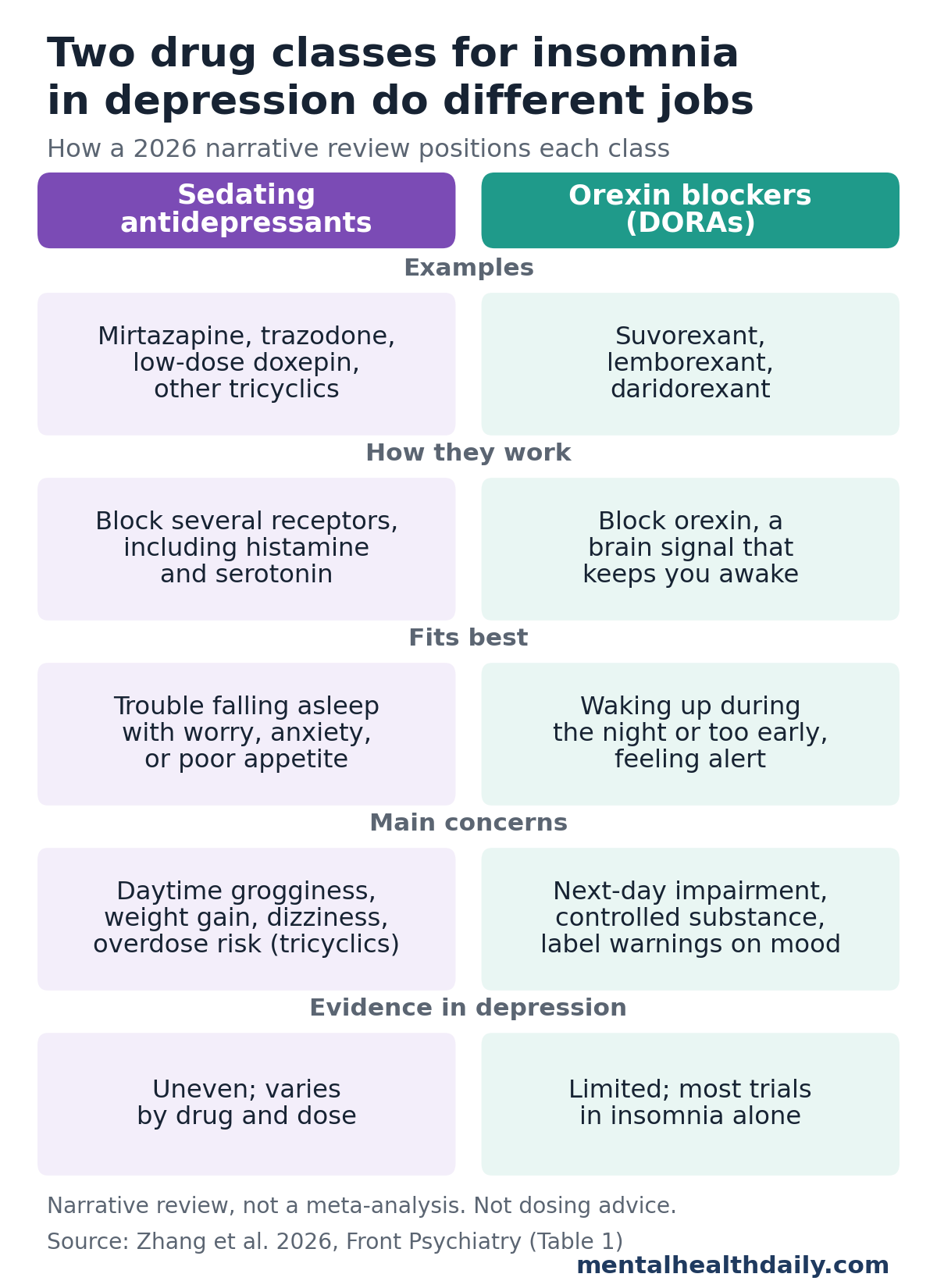
This group includes mirtazapine, trazodone, doxepin, and other tricyclic antidepressants such as amitriptyline. Their sleep effects come from a mix of receptor actions, especially blocking histamine H1 receptors (histamine helps keep the brain awake), plus serotonin and adrenergic effects.1
Their appeal is simple: one drug may treat depression and insomnia at once. The review argues they are not one interchangeable group, though, and that dose changes what the drug is for:
- Mirtazapine fits an acute episode where depression, anxiety, appetite loss, and trouble falling asleep all show up together. Its boost to appetite and weight can help someone who has stopped eating but is a drawback with obesity or diabetes.
- Low-dose trazodone is better described as a sleep aid added to other treatment than as an antidepressant. The American Academy of Sleep Medicine recommends against trazodone for chronic insomnia disorder, and most trazodone evidence comes from sleep studies rather than depression studies.
- Low-dose doxepin acts mainly on histamine at sleep doses and has a narrower role: guideline-supported treatment for trouble staying asleep.
- Higher-dose tricyclics carry broader side effects, including anticholinergic effects, heart rhythm concerns, and toxicity in overdose.
The trade-off is daytime function. Grogginess, slowed thinking, and fatigue overlap with depression itself, so a drug that lengthens sleep while worsening the next day may not help much overall.1 Sedation also does not guarantee normal sleep: some of these drugs change REM sleep and deep sleep.1
Orexin Blockers Target the Drive to Stay Awake
Orexin (also called hypocretin) is a brain signaling molecule that keeps wakefulness stable by activating other alertness systems. DORAs block both orexin receptors (OX1R and OX2R), turning down the wake signal instead of sedating the whole brain.1
In randomized trials of people with insomnia disorder, suvorexant, lemborexant, and daridorexant improved sleep compared with placebo. The most consistent gains were less time awake after first falling asleep, more total sleep, and better sleep efficiency. Studies of daridorexant and lemborexant also suggest they keep REM and deep sleep largely intact.1
The authors see a natural fit for a common depression complaint: being tired but not truly sleepy, falling asleep, then waking repeatedly and lying there alert. They see the clearest role in partial remission, when the antidepressant is otherwise working but night waking remains.1
DORAs Are Sleep Drugs, Not Antidepressants
The review is firm on this point. DORAs should not be treated as general sedatives or as a first-line add-on to antidepressants, and better sleep in insomnia trials says nothing directly about depression recovery, suicidal thinking, or relapse.1
Two systematic reviews cited by the authors show how thin the depression-specific evidence is:
- Insomnia with psychiatric conditions: a 2024 review of suvorexant and lemborexant found 21 reports, of which only 4 were completed or terminated randomized trials. DORAs may work about as well in these patients as in insomnia alone, but the evidence came from a few small studies.2
- Depression itself: a 2025 review of 5 randomized trials with 498 participants found mixed results. The orexin drug seltorexant lowered depression scores in some trials, while filorexant did not beat placebo.3
Safety Warnings for Each Drug Class
The review lists specific risks for both classes. For DORAs:
- Label warnings: US prescribing information for suvorexant and lemborexant warns about worsening depression and suicidal thoughts. Current data do not show that DORAs destabilize mood, but insomnia trials often underrepresent people at high suicide risk.
- Controlled substances: DORAs are Schedule IV drugs. A history of substance use calls for a careful look at misuse risk, alcohol, and other sedatives, not an automatic switch to a DORA.
- Next-day effects: next-day impairment and complex sleep behaviors are possible, which matters for driving and work.
Sedating antidepressants call for caution with daytime sleepiness, memory or thinking problems, fall risk, weight and metabolic concerns, heart disease, multiple medications, or overdose risk.1
For anyone with current suicidal thoughts, recent self-harm, signs of bipolar disorder, or quickly worsening depression, the authors say psychiatric stabilization and close monitoring come before any sleep medication. If you are in crisis in the US, call or text 988 to reach the Suicide and Crisis Lifeline.
Where CBT for Insomnia Fits
Cognitive behavioral therapy for insomnia (CBT-I), a structured program that retrains sleep habits and bedtime thinking, remains a core treatment in the framework. The authors say medication can be added based on the depression phase, how urgent the symptoms are, access to CBT-I, and safety, but it should not replace behavioral treatment without a reason.1
The review walks through 3 example situations:
- Active depression with anxiety, poor appetite, and trouble falling asleep: a sedating antidepressant may make sense if the same drug is appropriate for the depression, with monitoring for daytime sedation and weight.
- Partial remission with repeated night waking and little bedtime rumination: CBT-I, checking for other sleep disorders, or a DORA may match better, though DORA evidence here is mostly borrowed from insomnia trials.
- A mix of slow sleep onset, night waking, sleep worry, and irregular habits: medication alone is unlikely to be enough, and CBT-I, a steadier sleep schedule, and adjusting the antidepressant may need to be combined.
These are the authors’ reasoning examples, not instructions for individual patients. Medication choices, doses, and changes belong in a conversation with a prescriber.
Limitations of the Review
- Narrative, not systematic: the authors searched several databases and guidelines but did not pool data, and the main text reports no study counts or effect sizes (search details are in an online supplement).
- No head-to-head trials: no studies directly compare sedating antidepressants, low-dose doxepin, DORAs, CBT-I, and antidepressant adjustment in well-characterized active depression.
- Borrowed evidence: most DORA data come from people with insomnia disorder, not active depression.
- Mixed-up doses: studies often lump low sleep doses and full antidepressant doses together.
- Untested matching: the idea that sleep pattern predicts which drug works is a hypothesis; symptom timing does not identify the underlying mechanism.
The authors call for trials that sort patients by sleep pattern, rumination, anxiety, and treatment phase, and that track mood remission, relapse, suicidal thinking, and daytime function, not only nighttime sleep.1
References
- Zhang Y, Zhang H, Tang J, Wang Y, Wu L. Pharmacological modulation of hyperarousal in insomnia associated with major depressive disorder: a narrative review of sedating antidepressants and orexin receptor antagonists. Frontiers in Psychiatry. 2026;17:1928430. doi:10.3389/fpsyt.2026.1928430
- Kishi T, Koebis M, Sugawara M, Kawatsu Y, Taninaga T, Iwata N. Orexin receptor antagonists in the treatment of insomnia associated with psychiatric disorders: a systematic review. Translational Psychiatry. 2024;14:374. doi:10.1038/s41398-024-03087-4 (PubMed)
- Meshkat S, Kwan ATH, Le GH, et al. Efficacy of orexin antagonists for the management of major depressive disorder: a systematic review of randomized clinical trials. Journal of Affective Disorders. 2025;372:409–419. doi:10.1016/j.jad.2024.12.008