
A mental health app that let a machine-learning model choose which short exercise to send young people gave a small boost to how resilient they felt a few hours later, compared with exercises picked at random. In a 2026 German study of 49 youths aged 14 to 25, the model’s picks raised momentary resilience ratings by 0.147 points on a 1-to-7 scale (95% CI 0.01 to 0.29, p = 0.044), with no clear effect on positive or negative mood.1 The authors call it an initial signal that needs a larger trial.
Research Highlights
- Small resilience edge for the model’s picks: compared with random picks, exercises chosen by the model raised momentary resilience at the next check-in (B = 0.147, 95% CI 0.01 to 0.29, p = 0.044) in the 42 people analyzed.1
- No clear mood effect: positive affect (B = 0.012, p = 0.839) and negative affect (B = 0.093, p = 0.103) did not differ between the two ways of choosing exercises.1
- Many randomizations, few people: each person was randomized up to 210 times, but the study had 49 participants, below the 60 it planned for.1
- Feasible and no serious harms: 48 of 49 finished the post-assessment, participants used the app for almost 7 hours on average, and no serious adverse events were recorded.1
- Before-and-after gains are uncontrolled: resilience questionnaire scores rose (d = 0.55), but psychological distress barely moved, and with no comparison group these changes cannot be credited to the app.1
An App That Sends Exercises Into Daily Life
The study tested the AI4U training, a 40-day smartphone program built by researchers at the Central Institute of Mental Health in Mannheim, Germany. It is an ecological momentary intervention: instead of weekly sessions, it delivers brief exercises in the middle of ordinary life, right after a short mood check-in on the phone. The exercises drew on positive refocusing, mindfulness, and self-compassion techniques, and there were 8 to choose from.1
The question was not whether the app works overall. It was narrower: when the app has to choose which exercise to send, does a machine-learning model do better than a random draw?
- Check-ins: 6 prompts a day during the 30-day training phase, each rating 15 items such as mood, worry, stress, loneliness, energy, and resilience on a 1-to-7 scale
- The model: a recurrent neural network (a type of model built to learn patterns that unfold over time) trained separately for each person on their own check-in history and retrained from scratch every night
- How it chose: for each candidate exercise, the model forecast the next day of check-ins, scored how much each exercise was predicted to help, and then drew an exercise with the higher-scoring options more likely to come up
- What it did not use: no GPS, sleep, activity, or phone-use data, and no control over timing; exercises always followed a check-in
How a Micro-Randomized Trial Works
In a standard trial, each person is randomized once, to the app or to a comparison. A micro-randomized trial randomizes the same person many times. The design was developed for “just-in-time” apps that make repeated decisions about what to deliver and when, so researchers can test each decision rule directly.4
Here, every time the app was about to send an exercise (a “decision point”), a digital coin flip decided whether the model or a random draw would pick it. That could happen up to 7 times a day for 30 days, or up to 210 times per person. Each person served as their own comparison: the study asked whether their next check-in looked better after a model-chosen exercise than after a randomly chosen one.1
That next check-in is the proximal outcome, meaning the short-term effect measured soon after each decision. It came on average 3.1 hours later, and the gap was similar for both kinds of picks. The distal outcomes are the usual before-and-after questionnaires on distress, resilience, and emotion regulation at the end of the program.1
Up to 210 coin flips per person sounds like a lot of data, but the statistical weight still depends heavily on how many different people take part. The team calculated that 60 participants would give 87% power to detect a small effect. In the end, 49 entered randomization, and 42 were analyzed after 6 were lost to a server restart that broke the data log and 1 had too few check-ins.1
Resilience Improved; Mood Did Not Clearly Change
Momentary resilience was measured with one item: “I can handle all the difficulties that I may encounter.” After exercises picked by the model, that rating was 0.147 points higher at the next check-in than after random picks (95% CI 0.01 to 0.29, p = 0.044). The authors describe the effect as small.1
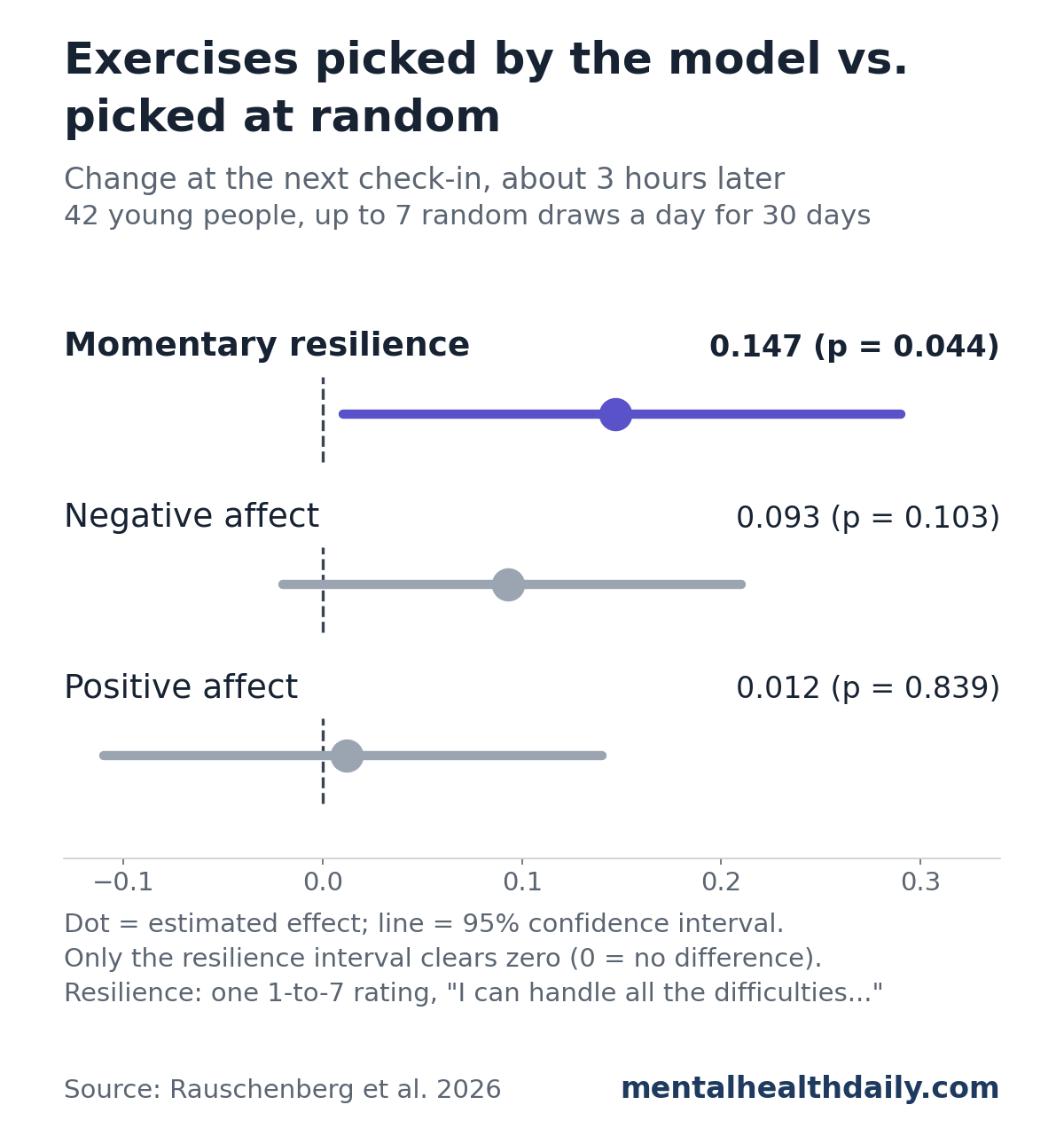
Positive affect (feeling good, relaxed, and satisfied) and negative affect (feeling scared, down, and sad) showed no evidence of benefit. The authors suggest two reasons. Moods shift quickly, so a check-in 3 hours later may miss a short lift, and resilience may be a steadier state that brief exercises can nudge more easily. They note that this second idea is tentative.1
One point matters for anyone reading “personalized AI” into the result. The study compared the model’s choices with random choices, so it cannot tell whether the model matched exercises to each person’s state or simply learned to favor exercises that tend to help most people. The authors also list chance and the particular sensitivity of the single resilience item as possible explanations.1
Feasibility, Safety, and the Before-and-After Numbers
Retention was high. Of the 49 participants, 48 completed the post-assessment, and average app time was almost 7 hours. Ratings were mostly favorable:
- Recommendation: 45 of 49 said they would recommend the app to several people, many people, or everyone
- Functionality: the overall functionality rating averaged 4.38 out of 5
- Willingness to pay: only 3 of 49 said they would buy it if it were not free, and 29 said no
No serious adverse events were recorded.1
Across 44 participants with complete before-and-after questionnaires, scores on the Connor-Davidson Resilience Scale rose from 57.4 to 62.1 (d = 0.55), and use of adaptive emotion regulation strategies also rose (d = 0.53). Psychological distress on the Kessler scale (K10) went from 23.8 to 23.0, a change that was not statistically significant (95% CI −2.25 to 0.70, d = −0.23).1 There was no control group for these outcomes, so they may reflect regression to the mean (unusually high scores drifting back toward normal), the effect of tracking one’s own mood, expectations, or the season. The authors state plainly that these changes should not be read as effects of the app.
How This Fits With Earlier Momentary Intervention Research
The same research group has tested this style of in-the-moment support before, in conventional randomized trials. In the SELFIE trial, 174 young people aged 12 to 26 with low self-esteem and a history of childhood adversity were randomized to a blended momentary intervention plus usual care or usual care alone. The intervention improved self-esteem at the end of treatment and at 6-month follow-up, with small to moderate effects on secondary outcomes such as general symptoms and quality of life.2
Short-term effects of individual exercises have been harder to pin down. A secondary analysis of the group’s EMIcompass trial in help-seeking young people looked at whether completing a compassion-focused exercise lowered negative affect and stress at the next check-in. With usable data from 37 participants, it found no clear proximal effects, with patterns that leaned in the expected direction.3 The new study’s null mood results are consistent with that, and its resilience result suggests that how exercises are chosen could matter.
Limitations
- Small participant sample. 42 people were analyzed, fewer than the 60 planned, and the many decision points per person do not make up for that.
- One borderline result among three. The resilience effect had p = 0.044, rested on a single item, and was one of three short-term outcomes; the paper does not report a correction for testing several outcomes.
- Personalization not shown. The design cannot separate tailored matching from the model simply favoring generally better exercises, and the forecasting model itself was not formally validated.
- Limited training data. Each person’s model learned from a few weeks of check-ins; its settings were tuned on a separate, earlier dataset, and the authors warn that sparse data can produce unstable forecasts.
- Who took part. Participants were mostly female (78%), and youth with a current mental health condition, current mental health care, or acute suicidal thoughts were excluded.
- Not a crisis tool. The model can only learn from states it has already seen, so it should not be expected to recognize a new crisis or a sharp decline. The authors frame it as mental health promotion, not treatment.
What the Study Shows About AI-Chosen Mental Health Exercises
This is an early test of a specific idea: that letting a model choose among short exercises works better than choosing at random. The answer from 42 young people is a small, outcome-specific yes for momentary resilience and no clear difference for mood. The app was well used and no serious adverse events were recorded, which supports running the larger trial the authors call for, ideally one with a person-level comparison group for the longer-term outcomes. For now, the study does not show that the app reduces distress or treats any mental health condition.
Young people who are struggling persistently, or who have thoughts of suicide, should reach out to a doctor, counselor, or crisis line; in the US, call or text 988.
References
- Rauschenberg C, Schirmbeck F, Fechtelpeter J, et al. A machine learning-based ecological momentary intervention for mental health promotion in youth: a micro-randomized trial. Translational Psychiatry. 2026;16:487. doi:10.1038/s41398-026-04475-8
- Reininghaus U, Daemen M, Postma MR, et al. Transdiagnostic ecological momentary intervention for improving self-esteem in youth exposed to childhood adversity: the SELFIE randomized clinical trial. JAMA Psychiatry. 2024;81(3):227–239. doi:10.1001/jamapsychiatry.2023.4590
- Gugel J, Rauschenberg C, Paetzold Jaehme I, et al. Proximal effects of a transdiagnostic, ecological momentary intervention for enhancing resilience in help-seeking young people (EMIcompass): findings from a secondary analysis of an exploratory randomized controlled trial. Journal of Medical Internet Research. 2026;28:e77150. doi:10.2196/77150
- Klasnja P, Hekler EB, Shiffman S, et al. Microrandomized trials: an experimental design for developing just-in-time adaptive interventions. Health Psychology. 2015;34(Suppl):1220–1228. doi:10.1037/hea0000305