
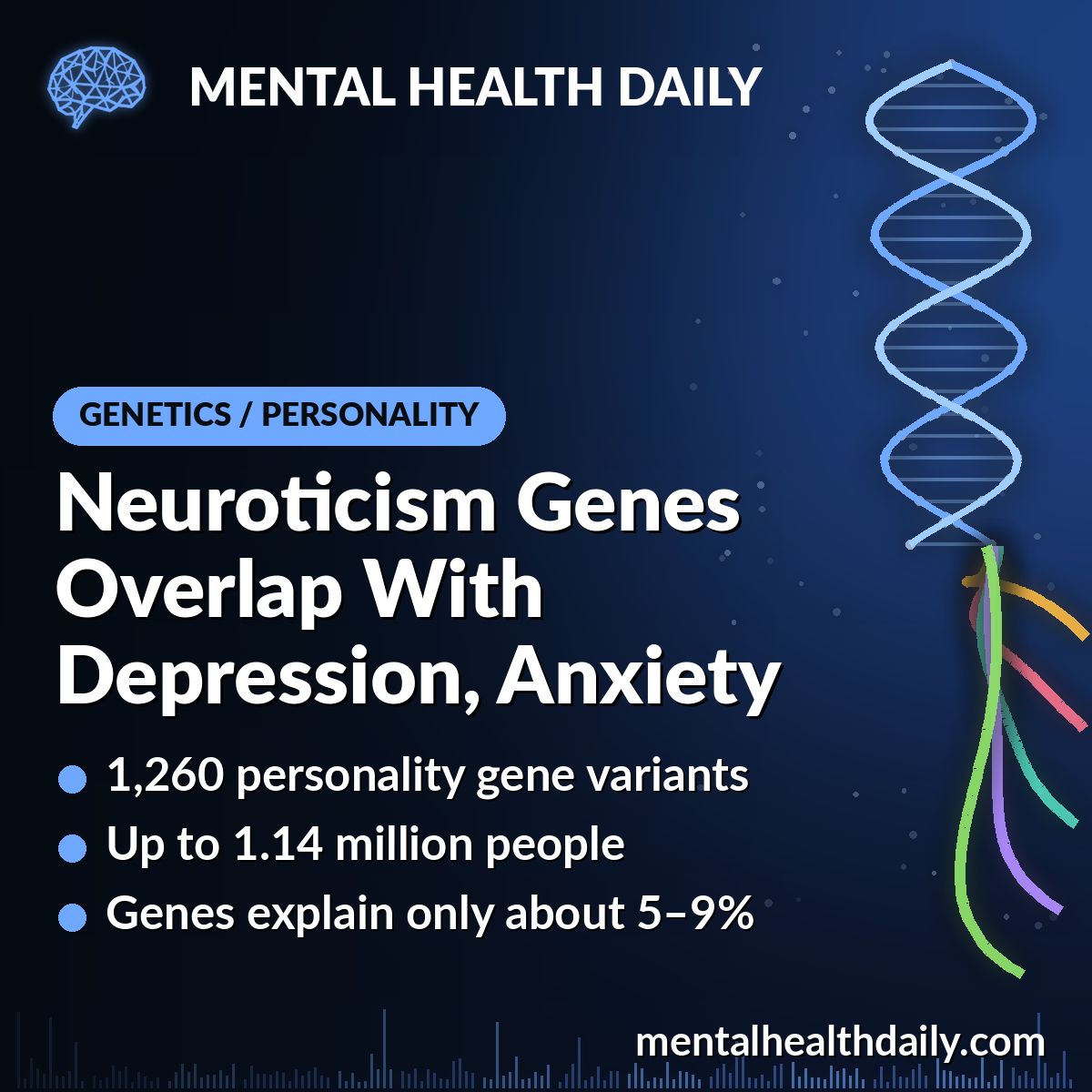
A 2026 genetic study involving up to 1.14 million people found 1,260 DNA variants linked to the Big Five personality traits. Genes linked to neuroticism overlapped heavily with genes linked to depression and anxiety.1
Research Highlights
- Many more personality variants: 1,260 independent variants reached genome-wide significance across the 5 traits, and 824 of them (65%) were in regions never before linked to that trait.1
- Common genes explain a modest share: common variants accounted for 4.8% (agreeableness) to 9.3% (extraversion) of the differences between people, far below the roughly 40% heritability estimated from twin and family studies.14
- Neuroticism and mental illness share genes: the genetic correlation between neuroticism and internalizing disorders such as depression and anxiety was 0.73; across all psychiatric disorders it averaged 0.43.1
- Little family confounding: within pairs of fraternal twins, genetic scores predicted personality almost as well as in the general population (96% as strongly).1
- No individual prediction: each variant has a tiny effect, and the researchers state that the genetic scores cannot predict any one person’s future behavior.1
What the Big Five Personality Genetics Study Measured
The Big Five is the standard model of personality in psychology. It sorts stable differences in how people think, feel and behave into 5 broad traits:
- Neuroticism: tendency toward anxiety, low mood and emotional volatility
- Extraversion: sociability, assertiveness and energy
- Agreeableness: compassion, respectfulness and trust
- Conscientiousness: organization, productiveness and responsibility
- Openness to experience: imagination, curiosity and appreciation of art and beauty
Schwaba et al. ran a genome-wide association study (GWAS), which scans millions of common DNA letter changes (single-nucleotide polymorphisms, or SNPs) across the genome and tests each one for a link with a trait. Their Revived Genomics of Personality Consortium pooled results from 46 cohorts and published them in Nature in 2026.1
- Sample: 611,037 people for agreeableness up to 1,136,711 for neuroticism
- Ancestry: about 95% of participants had European-like genomes; roughly 43,000 to 48,000 per trait had African-like genomes
- Family data: within-family analyses in up to 50,725 people, plus twin and parent–child samples
- Personality measures: validated multi-item questionnaires, mostly self-report
Genes Explain About 5% to 9% of Personality Differences
The lead-variant count jumped sharply over earlier work. Neuroticism went from 224 to 706 lead variants, extraversion from 17 to 258, conscientiousness from 3 to 131, openness from 8 to 126, and agreeableness from 4 to 39.1
Each variant does very little on its own. The median lead extraversion variant shifted a person by about 0.009 standard deviations, roughly the difference between the 50th and 50.35th percentile. The researchers estimated that about 16,180 common variants contribute to each trait on average.1
SNP heritability is the share of differences between people that common variants can account for. It ranged from 4.8% for agreeableness to 9.3% for extraversion, with neuroticism at 8.3%.1
- Better questionnaires, higher estimates: for a questionnaire of typical reliability, the estimates rose to 9.3%–13.3%, because random answering error cannot be genetic.
- Twin studies give much higher numbers: a 2015 meta-analysis of 134 behavior genetic studies put personality heritability at about 40%, with twin studies higher still.4 Common SNPs miss rare variants and gene interactions, which helps explain the gap.1
Most genetic signals were trait-specific: 82% of the genomic regions with a significant hit were linked to only 1 of the 5 traits.1
Neuroticism Genes Overlap Most With Depression and Anxiety
A genetic correlation (rg) measures how much the genetic influences on 2 traits overlap across the genome. It runs from −1 to 1; a value near 0.7 means much of the genetic signal behind one trait also shows up in the other.
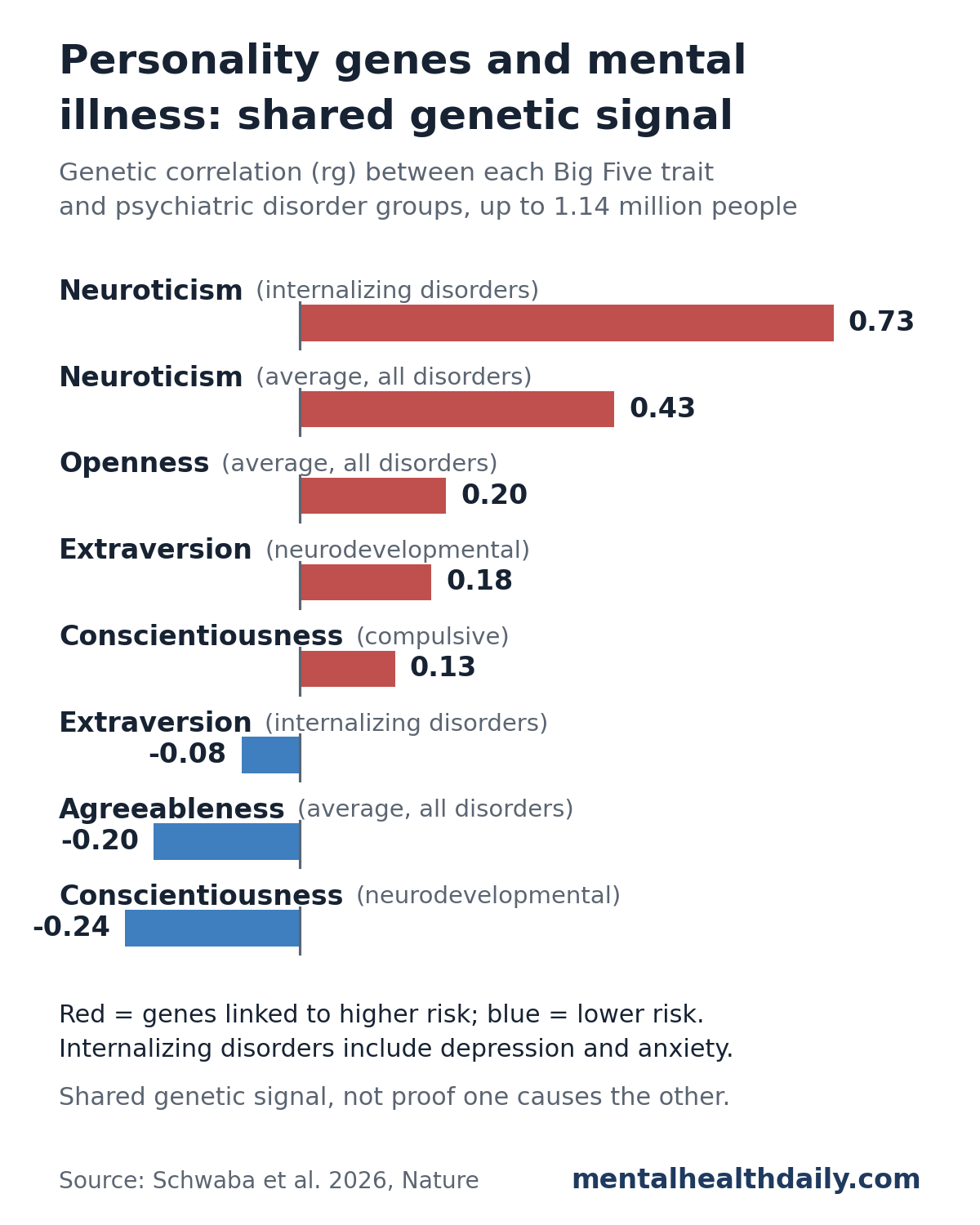
The researchers compared each personality trait with 10 psychiatric disorders and 4 broader disorder groups. Genetic profiles for higher neuroticism were associated with higher risk for every form of psychopathology they tested (average rg = 0.43), most strongly for the internalizing group, which covers conditions such as depression and anxiety (rg = 0.73).1
Among individual diagnoses, neuroticism’s largest genetic overlaps were with anxiety, depression and post-traumatic stress disorder (PTSD).1
The other traits showed more specific patterns:
- Agreeableness: linked to lower risk across disorders (average rg = −0.20)
- Openness: linked to higher risk across disorders (average rg = 0.20), a stronger link than questionnaire studies usually find
- Extraversion: slightly lower risk for internalizing disorders (rg = −0.08) but higher risk for neurodevelopmental disorders such as ADHD and autism (rg = 0.18)
- Conscientiousness: lower risk for neurodevelopmental disorders (rg = −0.24) but higher risk for compulsive disorders (rg = 0.13)
The result is consistent with decades of clinical research. A 2010 meta-analysis of 175 studies found that people with anxiety, depressive and substance use disorders scored much higher on neuroticism than comparison groups (mean Cohen’s d = 1.65) and lower on conscientiousness (mean d = −1.01).2
An earlier 2018 neuroticism GWAS, in 449,484 people, found 136 genetic regions and reported links between neuroticism and multiple psychiatric traits.3 The new study adds far more variants and puts all 5 traits side by side.
Survey responses carry a genetic signal too. In the UK Biobank, genetic variants linked to neuroticism were linked to answering fewer optional questionnaires (rg = −0.23) and giving more “I don’t know” or “prefer not to answer” responses (average rg = 0.32).1 The researchers note that this could quietly shape who ends up in survey-based research, including mental health surveys.
Family Background Did Not Explain the Personality Genetics
Population-level genetic studies can be inflated by family effects: parents pass on both genes and a home environment. For traits like educational attainment, genetic prediction shrinks to about 60% of its population strength when compared within families.1
Personality held up much better:
- Fraternal twins: differences in genetic scores between twins predicted their personality differences with an average effect of 0.159, vs 0.165 in the general population (96%).
- Parents and children: in 34,506 people from Icelandic parent–child data, genes passed directly from parent to child accounted for 96.2% of the prediction, vs 75.1% for educational attainment.
- Partner choice: parents were barely more genetically similar in personality than chance (genetic correlation 0.01–0.04), compared with 0.37 for educational attainment.
Confounding was small but not zero. For neuroticism, genetic effects from within-family and population analyses correlated at 0.75 rather than 1.1
What Mendelian Randomization Suggested About Neuroticism and Health
Mendelian randomization (MR) uses genetic variants as a natural experiment: because genes are shuffled at conception, they can help test whether a trait plausibly causes an outcome rather than merely travels with it.
Among 13 outcomes chosen to suit the method, the researchers found 33 plausibly causal links. Twenty-four ran from personality to outcomes, and 9 ran from outcomes to personality.1
- Neuroticism: linked to lower scores on a healthy aging and longevity factor, more smoking initiation and more hospital stays
- Conscientiousness: linked to lower body mass index (BMI), less smoking initiation and fewer hospital stays
- Reverse direction: more education was linked to lower neuroticism
Psychiatric disorders were not among the MR outcomes, so the study does not show that neuroticism causes depression. The researchers also say the MR results should be checked with other causal methods.1
Serotonin and Dopamine Theories of Personality Got Little Support
Genetic signals for 4 of the 5 traits (all but agreeableness) were enriched in genes active in the prefrontal cortex, the front part of the brain involved in planning and self-control.1
Long-standing theories tie neuroticism, agreeableness and conscientiousness to serotonin, and extraversion and openness to dopamine. In cell-type analyses using mouse and human brain data, neither serotonin nor dopamine neurons ranked among the most enriched cell types for any trait.1 The 2018 neuroticism GWAS had reported enrichment in serotonergic and dopaminergic cells, so this question is not settled.3
Limitations of This Personality GWAS
- Mostly European ancestry: about 95% of participants had European-like genomes. In people with African-like genomes, genetic scores significantly predicted only extraversion, neuroticism and openness, and more weakly.
- Common variants only: the 4.8%–9.3% figures leave out rare variants, so they understate total genetic influence.
- Shared genes are not causes: a genetic correlation with depression means overlapping genetic influence, not that one condition produces the other.
- Questionnaire quality: less reliable personality measures lowered the estimates, and agreeableness was less consistent across countries and questionnaires.
- Not preregistered: the analysis plan was not registered in advance.
What This Means for People With Depression or Anxiety
- Personality and mood problems share roots. High neuroticism and depression or anxiety draw partly on the same genes, which helps explain why they so often occur together.
- Genes are not destiny. The researchers stress that even direct genetic effects do not determine a person’s personality; they act probabilistically across large groups and interact with life experience.
- No personality gene test. Genetic scores built from these variants explain too little to say anything useful about one person’s personality or mental health risk.
- Experience shapes personality too. The MR finding that more education lowered neuroticism is consistent with the idea that life experience moves these traits.
References
- Schwaba T, Clapp Sullivan ML, Akingbuwa WA, et al. Robust inference and correlates from genetic associations with personality. Nature. 2026. doi:10.1038/s41586-026-10992-9
- Kotov R, Gamez W, Schmidt F, Watson D. Linking “big” personality traits to anxiety, depressive, and substance use disorders: a meta-analysis. Psychological Bulletin. 2010;136(5):768–821. doi:10.1037/a0020327
- Nagel M, Jansen PR, Stringer S, et al. Meta-analysis of genome-wide association studies for neuroticism in 449,484 individuals identifies novel genetic loci and pathways. Nature Genetics. 2018;50:920–927. doi:10.1038/s41588-018-0151-7
- Vukasović T, Bratko D. Heritability of personality: a meta-analysis of behavior genetic studies. Psychological Bulletin. 2015;141(4):769–785. doi:10.1037/bul0000017