
Two Massachusetts emergency departments built harm reduction programs, handing out naloxone, fentanyl test strips, and safer-use supplies to people who use drugs, and kept them running for years with no reported safety incidents.1
Research Highlights
- Two hospitals, two routes: Boston Medical Center wrote a formal policy before launch, while Baystate Medical Center in Springfield added supplies in stages as staff grew comfortable.1
- No safety problems reported: Boston’s incident system logged zero safety events involving the kits from May 2023 to December 2024, and Baystate reported no in-hospital overdoses or harm to patients or staff.1
- Open access drew the most naloxone: in Baystate’s fourth and fifth program years, 388 naloxone boxes went to ED patients and 1,083 were taken anonymously from the waiting room and staff lounges.1
- Low supply cost: about $15 per patient at Boston and $8 per starter kit at Baystate, under $3,000 a year for both sites combined; staff time cost more.1
- What it did not measure: the report did not track overdoses, infections, or deaths after discharge, or how many patients who use drugs were offered supplies.1
What Harm Reduction in the ER Means
Harm reduction means lowering the dangers of drug use for people who are still using, rather than requiring them to stop first. Examples include naloxone (the overdose-reversal drug, here given as a nasal spray), sterile supplies that cut the spread of HIV and hepatitis C, and fentanyl test strips that check drugs for fentanyl.1
The authors argue the emergency department is a good place for it. Alcohol or other substance-use disorders accounted for 9.4% of US adult ED visits in a 2014–2018 survey. In an Ontario, Canada cohort, 9% of people died within a year after an ED visit for a nonfatal opioid overdose, according to studies they cite.1
Many of these patients turn down addiction medication or plan to keep using. Community harm reduction programs often close in the evening, while the ER is open around the clock.1
How the Two Programs Were Built
Both programs offered take-home naloxone, fentanyl test strips, and safer-use equipment, paired with training on how to counsel patients. Staff were also encouraged to offer testing for sexually transmitted infections, HIV prevention medication, and addiction medication such as buprenorphine or methadone.1
Boston Medical Center (Site A), a safety-net hospital with about 130,000 ED visits a year, partnered with Project TRUST, a drop-in HIV prevention center staffed by people with lived experience.1
- Early attempts raised ethical and legal questions, so the team wrote a formal hospital policy, which went live in month 6.
- The program launched 8 months after it was first proposed, with supplies kept in a locked, badge-access room and handed out at discharge.
- Nurses were left out of the first policy over scope-of-practice concerns. The state Board of Nursing later ruled that harm reduction is within nursing practice, and nurses were added the following year.
Baystate Medical Center (Site B), with about 122,000 ED visits a year, serves Springfield, where the 2023 opioid death rate was twice the state average. It partnered with Tapestry, a local syringe service program, and expanded in phases:1
- Phase 1: wound care and basic sterile supplies, with information brochures.
- Phase 2 (year 2): syringes, sharps containers, and take-home naloxone after a state law change allowed it.
- Phase 3 (year 4): safer smoking and sniffing supplies, fentanyl and xylazine test strips, a colorful central supply cart, and free naloxone in the waiting room and staff lounges.
Baystate also gave the program a narwhal mascot, designed with an advisory group of people who use drugs who felt the playful tone made the topic less stigmatizing.1
Supply Counts and Safety Results
At Boston, kit orders surged in the first 4 months and then settled at about 10 kits a month. Safer smoking and sniffing kits and condoms were restocked most often, and take-home naloxone was ordered more often than supply kits.1
At Baystate, 10 to 20 kits went out each month in the first 3 years. In the 6 months after the supply cart arrived, 500 individual items went to more than 100 patients.1
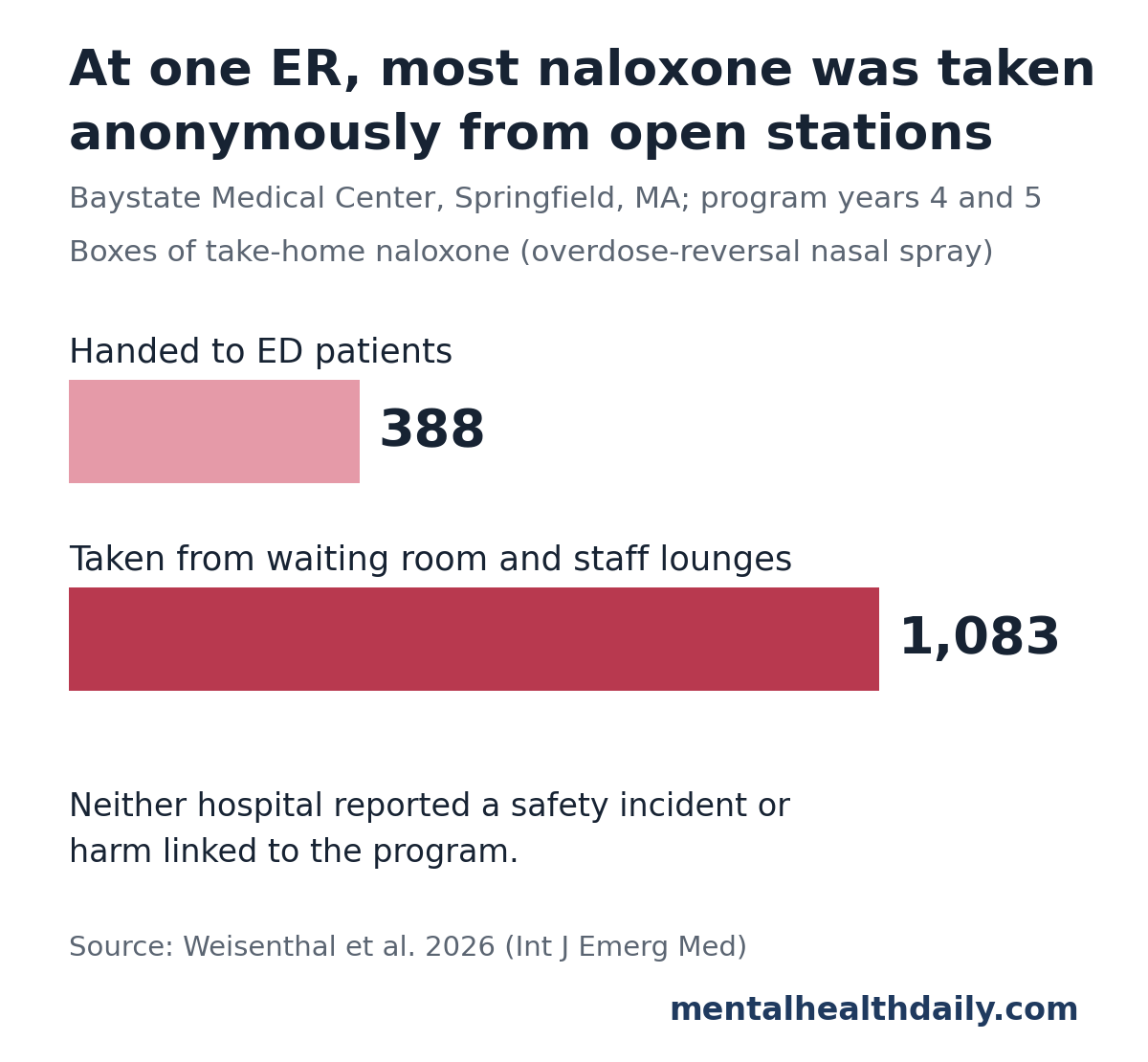
The naloxone numbers stand out. Open stations that anyone could use, including visitors, moved far more naloxone than staff handing it out at the bedside.1
Safety was a key concern at both hospitals. Boston searched its safety-incident reporting system from May 2023 to December 2024 and found zero events involving the kits. Baystate reported no in-hospital overdoses and no harm to patients or staff.1
What Staff Said
On a follow-up survey, an attending physician at Boston said patients expressed gratitude for the supplies, “particularly overnight.” A resident said the program made them feel they delivered more equitable care.1
These quotes fit a 2024 interview study at a California hospital. There, 20 patients and 20 staff described harm reduction services as building trust and reducing staff stigma, with staff unsure about regulations and short on substance use training.2
People who use drugs also told the Baystate team that they learn to hide their drug use from doctors. As one participant in the team’s earlier interview study put it: “Sometimes I tell them, ‘I’m never going to use drugs again!’ Because that’s what they want to hear.”1
What Made the Programs Work
The authors used an implementation science framework (CFIR, a checklist of factors that help or block new programs) to compare the two sites. Three factors stood out:1
- An ED physician champion who knew the department’s culture and led the effort.
- A local harm reduction partner that supplied materials, advice, and staff with lived experience.
- Staff education delivered alongside the launch, through lectures, short online talks, shift huddles, and regular emails sharing patient success stories.
Neither site made participation mandatory. The common barriers were legal uncertainty, cost, stigma, and busy staff being asked to take on one more task.1
Some staff worried that giving out supplies would encourage drug use. For naloxone specifically, a 2022 systematic review of 7 studies with 2,578 participants found no evidence that take-home naloxone led to more opioid or other drug use.3
Limitations
This is a descriptive report by the teams who built the programs, not a controlled study. It shows the programs could be set up and run without reported safety problems; it does not show they prevented overdoses or infections.
- No health outcomes: the authors could not report whether the supplies reduced illness or death.
- Unknown reach: neither site tracked how many patients who use drugs were offered supplies, or whether supplies were offered fairly.
- Thin feedback data: the staff survey is summarized with a few quotes, and the number of respondents is not reported.
- Two well-supported sites: both are large Massachusetts teaching hospitals with grants, community partners, and supportive state rules. Laws on syringes and pipes differ by state.
- Costs only partly counted: supplies were cheap, but the staff time to manage them and train colleagues was not measured.
The authors also flag funding pressure on hospitals and recent federal limits on harm reduction education as threats to programs like these.1
What It Means for ER Care
For emergency departments weighing a harm reduction program, this report is a practical playbook: find a champion, partner with a local program, train staff as you launch, and consider open naloxone stations.
If you or someone you know uses opioids or other drugs, carrying naloxone is a simple step, and many ERs and pharmacies can provide it. Asking an ER team about naloxone or treatment options is a reasonable request, even if you are not ready to stop using.
References
- Weisenthal K, Strokes N, Weinstein Z, et al. Meeting people where they are, whenever they are here: the implementation of harm reduction programs in two U.S. emergency departments. International Journal of Emergency Medicine. 2026;19:244. doi:10.1186/s12245-026-01380-1
- Fraimow-Wong L, Martín M, Thomas L, et al. Patient and staff perspectives on the impacts and challenges of hospital-based harm reduction. JAMA Network Open. 2024;7(2):e240229. doi:10.1001/jamanetworkopen.2024.0229
- Tse WC, Djordjevic F, Borja V, et al. Does naloxone provision lead to increased substance use? A systematic review to assess if there is evidence of a ‘moral hazard’ associated with naloxone supply. International Journal of Drug Policy. 2022;100:103513. doi:10.1016/j.drugpo.2021.103513